
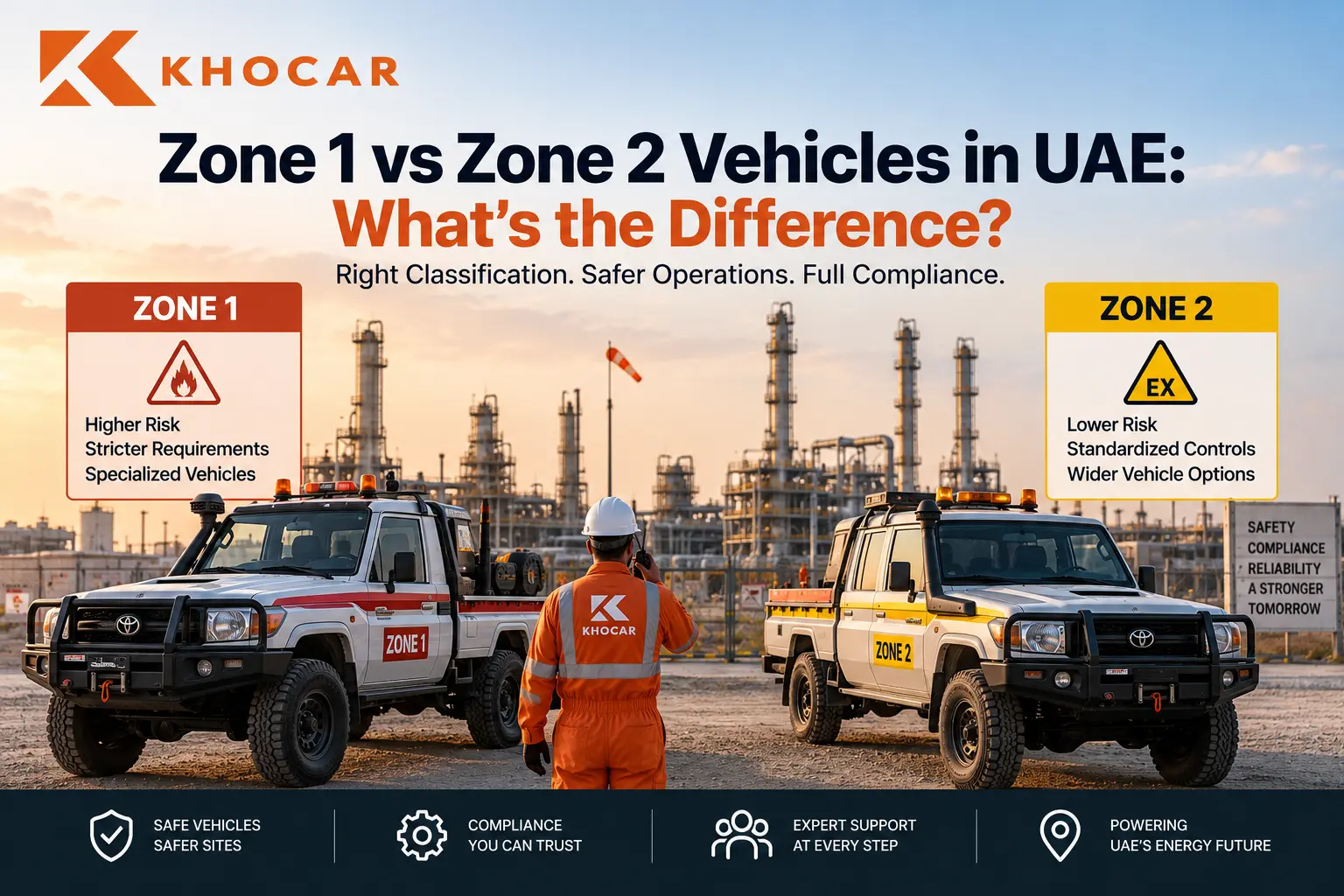
The difference between a Zone 1 and Zone 2 hazardous area is not just a label on a site drawing; it can change how a vehicle or mobile machine must be assessed before it enters the area. For contractors working in UAE oilfields, refineries, gas facilities, drilling locations, terminals, and other controlled industrial environments, the question is often phrased as “What is the Zone 1 vs Zone 2 vehicle requirement?”
The technically correct answer starts with the area classification, then moves to the vehicle’s ignition sources, operating method, equipment installed on the vehicle, and the project or site acceptance criteria. Zone 1 represents an area where an explosive gas atmosphere is likely to occur occasionally during normal operation. Zone 2 represents an area where such an atmosphere is not likely during normal operation but may exist briefly if it occurs.
That difference matters because vehicles contain multiple potential ignition sources: electrical circuits, batteries, alternators, hot exhaust components, mechanical parts, static electricity, and braking systems. This guide explains Zone 1 vs Zone 2 vehicle requirements in the UAE, what changes during hazardous-area vehicle conversion, why a standard pickup is not automatically suitable, and how contractors can prepare their fleets before mobilization rather than discovering a problem at the site gate.
Key Takeaways
- Zone 1 and Zone 2 describe the hazardous area, not two universal vehicle models or two simple conversion packages.
- Zone 1 has a higher likelihood of an explosive gas atmosphere during normal operation than Zone 2, so equipment selection and ignition-source controls can be more demanding.
- Zone 2 still requires serious ignition-source control; it does not mean a normal road vehicle is automatically safe.
- Vehicle suitability depends on the classified area, vehicle design, fuel/engine type, onboard equipment, operating method, duration, and project/site requirements.
- Common conversion considerations include exhaust spark control, engine shutdown, gas detection interfaces where required, electrical protection, battery isolation, anti-static measures, hot-surface control, labels, inspection, and documentation.
- Diesel is not automatically Zone 1- or Zone 2-approved, and petrol vehicles are not automatically acceptable simply because they operate normally on public roads.
- IEC 60079-10-1 defines the area-classification framework, while equipment and installation standards address how equipment is selected and protected; vehicle acceptance must still be assessed for the actual application.
- For ADNOC-related work, confirm the written site-access and HSE requirement before starting conversion and verify what documentation will be required at inspection.
Zone 1 vs Zone 2 Hazardous Area: What Is the Difference?
The most important distinction is the expected frequency and duration of an explosive gas atmosphere. The IEC 60079-10-1:2020 hazardous-area classification standard provides the international framework for classifying areas where flammable gas or vapour hazards may arise. The European Union’s ATEX workplace framework provides a concise description of the same zone concept: Zone 1 is where an explosive atmosphere is likely to occur occasionally in normal operation; Zone 2 is where it is not likely during normal operation but, if it occurs, it persists only for a short period. EUR-Lex’s ATEX zone definitions
| Classification | Explosive gas atmosphere | What it means for a vehicle |
| Zone 0 | Present continuously, for long periods, or frequently | Extremely restrictive environment; ordinary mobile vehicles should not be assumed suitable. Any vehicle/equipment use requires a project-specific hazardous-area assessment. |
| Zone 1 | Likely to occur occasionally during normal operation | Higher exposure potential than Zone 2; vehicle and mobile-equipment ignition sources require careful control and site-specific acceptance. |
| Zone 2 | Not likely during normal operation, but may occur briefly if it does | Still hazardous; vehicle ignition sources must be controlled, and the vehicle may require assessment, modification, documentation, and inspection before entry. |
The UK HSE similarly explains that hazardous-area zones are based on the likelihood and duration of an explosive atmosphere, and specifically warns that vehicles can contain multiple ignition sources. HSE guidance on hazardous-area classification and ignition sources This is an important point: the zone describes the environment, while the vehicle assessment addresses whether the equipment can introduce an ignition source into that environment.
Why Zone Classification Matters for Vehicles
A vehicle is a mobile collection of ignition sources. A standard pickup can contain a battery, alternator, starter motor, relays, fuses, switches, lights, wiring, an internal-combustion engine, exhaust components, brakes, rotating parts, and electrically operated accessories. A service truck may add compressors, inverters, work lights, power tools, chargers, auxiliary batteries, hydraulic equipment, and other systems.
- Electrical sparks or faults can occur in wiring, switches, relays, connectors, or battery circuits.
- Hot exhaust surfaces may reach temperatures relevant to flammable materials present in the environment.
- Internal-combustion engines introduce intake, combustion, exhaust, and shutdown considerations.
- Braking and mechanical systems can create heat or friction-related ignition risks.
- Static electricity can become relevant depending on the vehicle, environment, bonding arrangements, and task.
- Aftermarket modifications can add ignition sources that were not present in the original vehicle design.
- An engine that cannot be stopped quickly can continue operating after a hazardous-gas event, increasing the risk-control challenge.
HSE explicitly lists vehicles as potential ignition sources unless they are specially designed or modified, and recommends correct selection of vehicles and internal-combustion engines for zoned areas. HSE’s vehicle and ignition-source guidance
Zone 1 Vehicle Requirements UAE: What Should Be Evaluated?
Zone 1 should be treated as the higher-exposure case when comparing Zone 1 and Zone 2. The classification means an explosive gas atmosphere is likely to occur occasionally in normal operation. That does not translate into a single universal “Zone 1 vehicle conversion kit,” because the required controls depend on the vehicle, the area, the gas group and temperature considerations, the task, and the operator’s acceptance process.
A Zone 1 vehicle assessment should consider at least:
- The exact Zone 1 location and the source of release.
- How often and for how long the vehicle will operate in the area.
- Whether the engine runs continuously, intermittently, or only for entry/exit.
- Fuel type and engine configuration.
- Exhaust routing, temperature, and spark-control requirements.
- Engine emergency shutdown requirements and how shutdown is triggered.
- Gas detection requirements and whether detection should alarm, isolate power, or shut down the engine.
- Battery location, isolation, terminal protection, and wiring condition.
- Electrical accessories, lights, switches, radios, chargers, inverters, and auxiliary equipment.
- Non-electrical ignition sources such as hot surfaces, friction, mechanical equipment, and static discharge.
- Any mounted equipment that has its own hazardous-area certification or protection requirements.
- Inspection, certification, labelling, test, and handover documents required by the project or site.
IEC 60079-14:2024 sets requirements for the design, selection, installation, and initial inspection of electrical Ex equipment and explicitly covers fixed, transportable, portable, and personal electrical Ex equipment. It is useful background for understanding why electrical components on mobile equipment cannot simply be treated as ordinary accessories. However, it is not a stand-alone “vehicle approval” document; a complete vehicle still requires application-specific assessment.
Zone 2 Vehicle Requirements UAE: What Should Be Evaluated?
Zone 2 has a lower expected frequency of explosive atmosphere than Zone 1, but the word “lower” should never be interpreted as “safe for normal vehicles.” A Zone 2 atmosphere is not expected during normal operation, but if it occurs, it may persist for a short period. That is exactly why ignition-source control remains necessary.
Typical Zone 2 vehicle controls may include:
- Spark-arresting or otherwise suitable exhaust protection where required by the application.
- Engine air-intake shutdown or emergency engine-stop systems for applicable diesel equipment.
- Gas detection and automatic shutdown interfaces where specified by the project.
- Electrical system review, including battery isolation, wiring, switches, relays, lights, and added accessories.
- Anti-static bonding/grounding provisions where required.
- Hot-surface identification and control.
- Suitable warning indicators and vehicle labels.
- Inspection and maintenance records.
- Conversion or installation documentation and component evidence.
- Site-specific inspection and acceptance before access.
KhoCAR’s Zone 2 installation and certification service describes typical service elements such as power cut, automatic engine halt upon gas detection, ignition-source reduction, anti-static measures, suitable ATEX/IECEx-certified equipment, visual indicators, and inspection/audit documentation. The exact scope should be confirmed for the vehicle and project.
Zone 1 vs Zone 2 Vehicles: Side-by-Side Comparison
| Factor | Zone 1 | Zone 2 |
| Area condition | Explosive gas atmosphere likely occasionally in normal operation | Not likely in normal operation; if it occurs, expected only for a short period |
| Relative exposure | Higher | Lower than Zone 1, but still hazardous |
| Vehicle assumption | Ordinary road vehicle should not be assumed suitable | Ordinary road vehicle should not be assumed suitable |
| Ignition-source control | More demanding because exposure likelihood is higher | Required because abnormal release can still create an ignition hazard |
| Electrical equipment | Must be suitable for the application/zone where required | Must be suitable for the application/zone where required |
| Non-electrical systems | Mechanical ignition sources require assessment | Mechanical ignition sources require assessment |
| Engine/exhaust | Requires careful application-specific evaluation | Requires careful application-specific evaluation |
| Gas detection/shutdown | May be required depending on project and vehicle use | May be required depending on project and vehicle use |
| Documentation | Site/operator requirements can be extensive | Site/operator requirements can be extensive |
| Final acceptance | Depends on site, project, assessment and inspection | Depends on site, project, assessment and inspection |
The key lesson is that Zone 1 versus Zone 2 is a classification difference, not a simple statement that one vehicle is “safe” and the other is “less safe.” The IECEx area-classification material explains that hazardous areas are classified based on the frequency and duration of an explosive gas atmosphere.
Zone 1 Zone 2 Vehicle Conversion: What Actually Changes?
Vehicle conversion should begin with a hazard and application assessment, not with a shopping list of components. A conversion provider needs to understand the base vehicle, its existing systems, added equipment, intended work location, and site requirements. The resulting scope can then focus on controlling the ignition sources that matter for that particular vehicle.
| Conversion Area | Why It Matters | Possible Control |
| Engine shutdown | A running engine may remain an ignition source after gas detection | Emergency engine shutdown / automatic shutdown interface where required |
| Exhaust | Hot surfaces and exhaust sparks can be relevant ignition sources | Spark-control/exhaust protection appropriate to the application |
| Gas detection | Provides warning and may initiate defined shutdown actions | Suitable detector/interface where specified |
| Electrical system | Short circuits, exposed terminals, switches, relays and accessories can create sparks | Protected wiring, battery isolation, suitable components and installation |
| Static control | Static discharge can be an ignition source in some environments | Bonding/grounding or anti-static measures where required |
| Hot surfaces | Surface temperatures can ignite a flammable atmosphere | Assessment, shielding or other engineering controls where required |
| Accessories | Added lights, radios, inverters, chargers and tools may introduce new ignition sources | Review each modification rather than assuming OEM vehicle status covers it |
| Documentation | Site access may depend on evidence of the work performed | Inspection records, component evidence, labels and handover documents |
Why Ordinary Road Vehicles Are Not Automatically Zone 1 or Zone 2 Vehicles
A road-legal vehicle is designed to meet road-transport requirements, not automatically to operate in an explosive atmosphere. Roadworthiness and hazardous-area suitability answer different questions. A vehicle can be perfectly roadworthy and still be unsuitable for a classified area.
For example: A modern pickup may have excellent brakes, emissions performance, airbags, traction control, and electrical reliability. None of those features by themselves prove that its ignition sources are controlled for a Zone 1 or Zone 2 hazardous area. Similarly, adding one spark arrestor does not automatically make the complete vehicle compliant.
The ISO 80079-36 standard for non-electrical Ex equipment is useful background because it addresses non-electrical equipment with its own potential ignition sources intended for explosive atmospheres. The broader principle is important for vehicles: mechanical and thermal ignition sources deserve attention alongside electrical systems.
Diesel vs Petrol: Does Fuel Type Decide the Zone?
No. Fuel type is an important design factor, but it does not by itself determine whether a vehicle is suitable for Zone 1 or Zone 2. Diesel engines can still have hot exhausts, intake-air risks, mechanical ignition sources, electrical circuits, and potential runaway conditions. Petrol engines introduce spark-ignition systems and other characteristics that can require particularly careful assessment.
Diesel vehicles
- Can still create ignition risks through hot exhaust components and mechanical/electrical systems.
- May require engine runaway protection or air-intake shutdown for applicable applications.
- May require exhaust spark control depending on the vehicle and site requirement.
- Still need electrical, battery, static, and accessory review.
- Should not be described as automatically Zone 2 compliant merely because the engine is diesel.
KhoCAR’s diesel engine runaway and Chalwyn guidance explains why engine runaway protection can be an important part of hazardous-area diesel vehicle preparation.
Petrol vehicles
- Use spark-ignition engines, creating a different ignition-source profile from diesel engines.
- Require especially careful review of ignition systems, electrical systems, exhaust, and site requirements.
- Should never be assumed acceptable for a Zone 1 or Zone 2 area simply because the vehicle is modern or well maintained.
- May be prohibited by a particular site even if engineering controls could reduce ignition risk.
KhoCAR’s article on petrol vehicles in Zone 2 areas explains why fuel type alone cannot establish hazardous-area suitability and why project/site acceptance remains critical.
Which Vehicles Commonly Need Hazardous-Area Assessment in the UAE?
| Vehicle / Mobile Equipment | Typical Risk Drivers | What to Clarify |
| Pickup / 4×4 | Engine, exhaust, electrical circuits, battery, accessories | Where will it enter? Will it idle? What site requirement applies? |
| Service truck | Base vehicle plus tools, lights, batteries, inverters, compressors | List all modifications and powered equipment |
| Mobile workshop | Multiple electrical/mechanical ignition sources and long stationary periods | Provide full equipment inventory and work method |
| Generator / compressor | Engine, exhaust, alternator, hot surfaces, continuous operation | Operating zone, duration, load, shutdown and equipment suitability |
| Forklift / telehandler | Engine or battery systems, hydraulics, brakes, hot surfaces | Area classification and task-specific acceptance |
| Crane / crane truck | Engine, exhaust, electrical/hydraulic systems, extended work near facilities | Exact work location and lift plan/site requirements |
| Vacuum truck / tanker | Engine plus fluid handling and vapor-release exposure | Material handled, loading/unloading method and classified area |
| Light tower / pump | Engine/electrical systems and prolonged operation | Whether equipment is permitted in the classified area |
ADNOC-Related Projects: Why Site Requirements Matter
Contractors often search for a single “ADNOC Zone 1 vehicle requirement” or “ADNOC Zone 2 vehicle certificate,” but project acceptance is not necessarily reduced to one public checklist that applies identically to every vehicle and site. The practical requirement can depend on the operator, EPC contractor, site classification, vehicle type, intended task, and documents requested during inspection.
KhoCAR’s Zone 2 vehicle checklist for ADNOC site access recommends confirming the specific site requirement before conversion and collecting vehicle type, make/model, fuel type, engine details, previous modifications, photos, intended site, deadline, and written HSE/access instructions.
KhoCAR’s page on vehicles that may need Zone 2 conversion for ADNOC projects similarly emphasizes that the same vehicle model can face different requirements depending on where it operates, what it carries, whether it remains running, and what the project HSE team requires.
Documents to prepare early
- Vehicle identification and specification details.
- Conversion/installation scope and work records.
- Inspection or test evidence applicable to installed systems.
- Component certificates or technical documentation where required.
- Vehicle labels/identification evidence.
- Maintenance and inspection records.
- Site-specific forms, gate documents, or HSE checklists.
- Any written project instruction that defines hazardous-area vehicle acceptance.
How to Determine the Right Vehicle Requirement Before Mobilization
- Identify the exact work location and determine whether the area is Zone 0, Zone 1, Zone 2, or non-hazardous.
- Ask the project or site HSE team for the written vehicle-entry and inspection requirements.
- Record the vehicle make, model, year, fuel type, engine details, and current condition.
- List every modification and accessory, including lights, radios, inverters, chargers, auxiliary batteries, compressors, tools, and hydraulic equipment.
- Confirm whether the engine will run, idle, stop, or remain parked inside the classified area.
- Identify the substances that create the hazardous atmosphere and any relevant gas/vapour characteristics provided by the site.
- Have a competent hazardous-area vehicle provider assess the ignition-source risks and required controls.
- Complete the required installation/conversion work and testing.
- Prepare the inspection and documentation package before mobilization.
- Confirm final site acceptance rather than assuming that a previous project’s approval automatically transfers.
Zone 1 vs Zone 2 Vehicle Conversion: Practical Examples
Example 1: A supervisor’s 4×4 entering a Zone 2 plant area
The 4×4 is used for daily inspections and sometimes parks near operating equipment. The first step is not to order a generic conversion kit. The contractor should obtain the site’s vehicle-entry requirement, identify whether the engine must remain running, document accessories and electrical modifications, and then assess the vehicle’s ignition sources. If the site requires automatic shutdown, gas detection, exhaust protection, anti-static measures, or specific documentation, those controls should be included before inspection.
Example 2: A maintenance truck entering a Zone 1 process area
The vehicle carries an auxiliary battery, work lights, inverter, compressor, tools, and electrical test equipment. Because Zone 1 has a higher likelihood of explosive atmosphere during normal operation, the assessment should be particularly careful about the vehicle’s added systems and the conditions under which they are used. The site may require equipment with appropriate hazardous-area protection or may restrict the vehicle’s operation entirely depending on the task.
Example 3: A diesel service vehicle used near a Zone 2 wellsite
The vehicle has a diesel engine and a standard electrical system. Diesel does not automatically make it suitable. The assessment may consider engine runaway protection, exhaust spark control, gas detection/shutdown, battery isolation, electrical accessories, static control, and the specific site-access checklist.
Common Mistakes That Delay Zone 1 and Zone 2 Vehicle Approval
- Assuming Zone 2 is “safe enough” for any normal road vehicle.
- Treating Zone 1 and Zone 2 as vehicle models instead of hazardous-area classifications.
- Using the same conversion scope for every vehicle regardless of modifications and intended use.
- Assuming diesel automatically means Zone 2 compliant.
- Assuming a single component, such as a spark arrestor or gas detector, makes the entire vehicle compliant.
- Starting conversion without obtaining the project’s written HSE/site-access requirement.
- Failing to disclose aftermarket electrical modifications.
- Waiting until the mobilization date to begin inspection and documentation.
- Confusing ATEX/IECEx certification of individual components with approval of the complete vehicle for a specific site.
- Assuming approval on one project automatically transfers to another site or operator.
Zone 1 / Zone 2 Vehicle Pre-Mobilization Checklist
- Exact hazardous-area classification confirmed
- Site/operator vehicle-entry requirement received
- Vehicle make/model/year recorded
- Fuel type and engine configuration recorded
- Current modifications and accessories documented
- Intended work activity and operating duration defined
- Engine idle/run requirement inside the area confirmed
- Exhaust and hot-surface risks assessed
- Electrical and battery systems assessed
- Gas detection/shutdown requirement confirmed
- Engine emergency shutdown requirement confirmed
- Static/bonding requirements confirmed
- Suitable components selected for the actual application
- Installation/conversion completed and inspected
- Required test/inspection evidence prepared
- Labels and identification installed as required
- Documentation package reviewed
- Site inspection/acceptance booked before mobilization
How KhoCAR Supports Zone 2 Vehicle Conversion in Abu Dhabi
KhoCAR’s Zone 2 Installation & Certification service covers hazardous-area vehicle and equipment preparation in Abu Dhabi and describes controls such as engine shutdown, power isolation, ignition-source reduction, anti-static measures, suitable Ex-certified equipment, visual indicators, and inspection documentation.
KhoCAR’s Zone 2 vehicle conversion page explains that the conversion scope depends on the vehicle, its use, the hazardous area, and the project’s requirements. This is particularly relevant for pickups, service trucks, mobile workshops, generators, compressors, forklifts, cranes, vacuum trucks, and other field-support equipment.
KhoCAR’s Zone 2 conversion checklist can help contractors collect the information needed for a more accurate assessment before sending a vehicle to the workshop.
KhoCAR’s Zone 2 conversion cost guide notes that pricing is normally quotation-based because scope varies with vehicle type, hazardous-area requirements, components, inspection expectations, documentation, and mobilization urgency.
Need Zone 2 Vehicle Conversion in Abu Dhabi?
If your vehicle or mobile equipment needs to enter an ADNOC-related oilfield, gas facility, drilling site, plant, terminal, or other hazardous operating area, get the requirement assessed before mobilization. Send KhoCAR the vehicle make/model, fuel type, photos, current modifications, intended site, project deadline, and any written HSE or access instructions you have received. Explore KhoCAR’s Zone 2 Installation & Certification service for support with hazardous-area vehicle preparation in Abu Dhabi.
FAQs
What is the difference between Zone 1 and Zone 2 hazardous areas?
Zone 1 is an area where an explosive gas atmosphere is likely to occur occasionally during normal operation. Zone 2 is an area where an explosive gas atmosphere is not likely during normal operation but, if it occurs, will persist for a short period. Zone 1 therefore represents the higher expected frequency of explosive atmosphere.
Do Zone 1 and Zone 2 require different vehicles?
Not necessarily different vehicle models, but vehicle suitability and the required controls can differ significantly. The correct approach is to assess the vehicle, its ignition sources, the classified area, operating method, and the site’s written requirements. A vehicle prepared for Zone 2 should not automatically be assumed suitable for Zone 1.
Does a Zone 2 vehicle automatically work in Zone 1?
No. A Zone 2 preparation or acceptance should not be treated as automatic approval for a Zone 1 area. The zone, equipment protection requirements, task, vehicle design, and site acceptance criteria must be reviewed for the actual application.
Does a diesel vehicle need Zone 2 conversion in the UAE?
It may. Diesel fuel does not automatically make a vehicle suitable for a hazardous area. Diesel vehicles can have exhaust, hot-surface, mechanical, electrical, static, and engine-runaway risks. The site requirement and vehicle assessment determine the necessary controls.
Can petrol vehicles enter Zone 1 or Zone 2 areas in the UAE?
Not simply because they are road-legal. Petrol vehicles use spark-ignition engines and require careful hazardous-area assessment. Whether a particular petrol vehicle can enter a classified area depends on the site requirement, vehicle controls, conversion/engineering measures, and final acceptance.
What is included in Zone 2 vehicle conversion?
Depending on the vehicle and project, the scope can include engine shutdown, gas detection interfaces, exhaust spark control, electrical and battery protection, anti-static measures, hot-surface controls, warning indicators, suitable hazardous-area components, inspection, testing, and documentation.
Are Zone 1 and Zone 2 vehicle requirements the same across the UAE?
No. Requirements can vary by operator, site, project, EPC contractor, hazardous-area classification, vehicle type, work activity, and inspection process. Contractors should obtain the current written requirement for the specific project.
Are ATEX and IECEx certificates enough to approve a complete vehicle?
Not necessarily. ATEX and IECEx are important hazardous-area equipment frameworks, but certification of individual components does not automatically establish that an entire modified road vehicle is approved for a specific site. The complete vehicle, installation, application, documentation, and site acceptance process must be considered.
Why do oilfield sites inspect vehicle electrical systems?
Electrical circuits, batteries, switches, relays, lights, alternators, chargers, radios, inverters, and aftermarket accessories can introduce potential ignition sources. A hazardous-area assessment therefore considers the complete electrical configuration rather than only the vehicle’s engine.
What documents should I prepare for Zone 2 vehicle site access?
Requirements vary, but a project may request vehicle identification, conversion/installation records, inspection or test evidence, component documentation, labels, maintenance records, and site-specific forms. Obtain the exact list from the operator, EPC contractor, or HSE team before mobilization.
How early should I start Zone 2 vehicle conversion?
Start as soon as the vehicle’s intended hazardous-area work is known. Early planning allows time to confirm the site requirement, assess the vehicle, source suitable components, complete installation and testing, prepare documents, and address any inspection findings before the mobilization deadline.
Who provides Zone 2 vehicle conversion in Abu Dhabi?
KhoCAR provides Zone 2 installation and certification support in Abu Dhabi for vehicles and mobile equipment used in hazardous oil and gas environments. Contractors can provide vehicle and project details to determine the likely conversion and documentation scope.
Compliance note: Zone classification, hazardous-area equipment requirements, vehicle conversion scope, inspection, certification, and site-access rules can vary by operator, project, vehicle, work activity, and location. This article is educational and should not replace the current written requirement of the relevant site, operator, EPC contractor, competent hazardous-area specialist, or authority.