
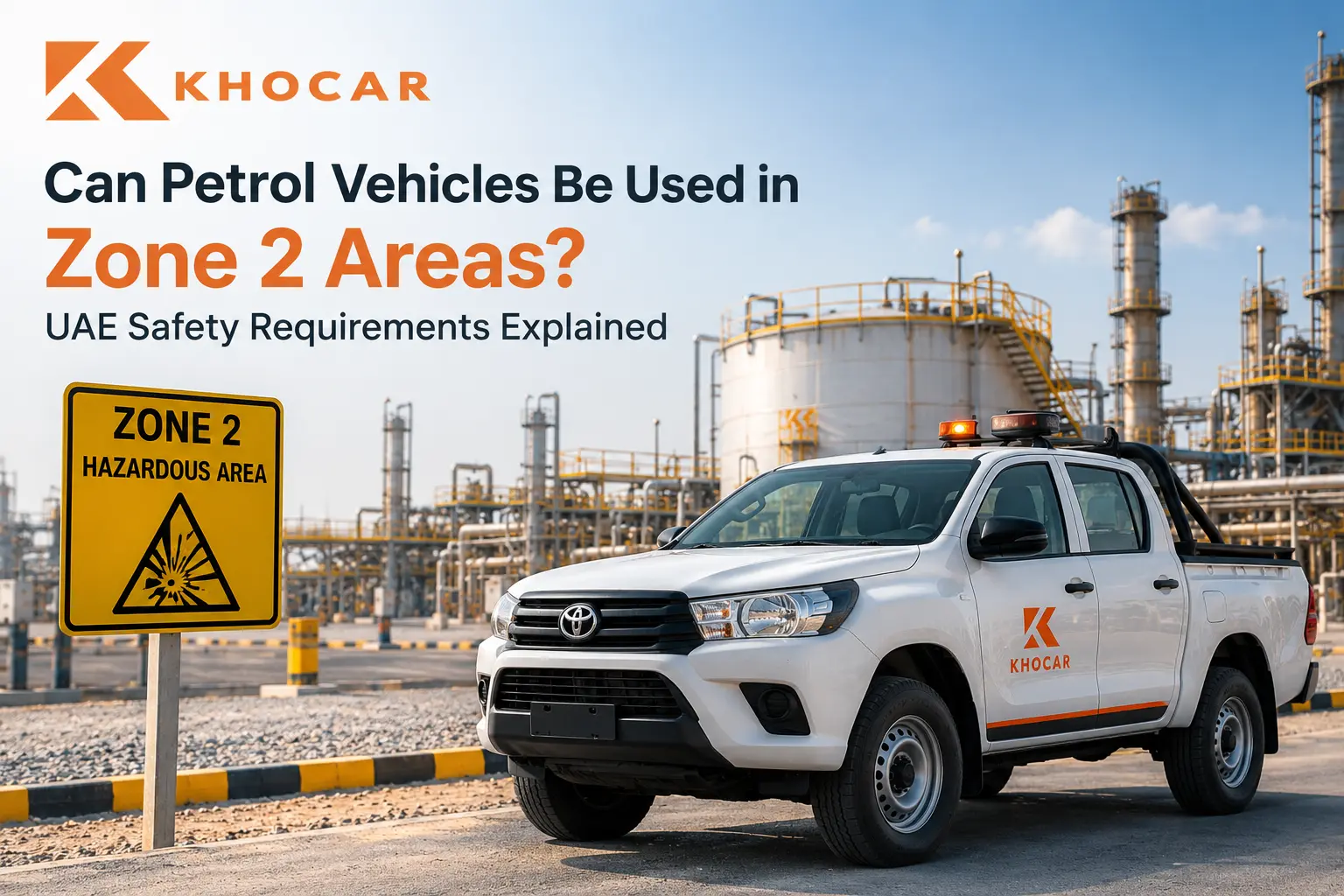
Can a petrol vehicle enter a Zone 2 oilfield area in the UAE? The safest answer is: not as an ordinary road vehicle, and never simply because it is mechanically sound. A petrol vehicle may be considered only when the vehicle, its ignition sources, its safety systems, its operating conditions and the site requirements have all been assessed and accepted. In many hazardous-area applications, petrol or gasoline engines are more difficult to make suitable than diesel or purpose-built alternatives because a spark-ignition engine contains an ignition system by design.
That distinction matters for contractors working around Abu Dhabi oilfields, gas facilities, process plants, drilling locations and other controlled environments. Zone 2 does not mean an explosive atmosphere is present continuously. It means an explosive gas, vapour or mist atmosphere is not expected during normal operation but could occur briefly under abnormal conditions. If that happens while an ordinary vehicle is operating nearby, hot surfaces, electrical equipment, exhaust components, static discharge or engine ignition components can become potential ignition sources.
So, can petrol vehicles be used in Zone 2 areas in the UAE? Sometimes, but only where the specific vehicle and site controls make the operation acceptable. The decision should come from the site’s hazardous-area requirements, risk assessment, applicable standards and competent technical review—not from the fuel label alone.
IECEx: What Is an Ex Area? provides the international hazardous-area context.
Key Takeaways
- An ordinary petrol or gasoline vehicle should not be assumed suitable for a Zone 2 hazardous area.
- Petrol engines present a particular challenge because spark-ignition systems can themselves be potential ignition sources. IEC 60079-45:2025 addresses certain spark-ignited engine ignition systems, but explicitly excludes road vehicles, so it is not a blanket certification route for ordinary petrol pickups.
- Zone 2 vehicle approval is application-specific. Site classification, vehicle use, duration, operating method, equipment carried and HSE requirements all matter.
- Diesel is not automatically safe either. Diesel vehicles still have hot exhausts, electrical circuits, batteries, static risks and other potential ignition sources.
- Gas detection with automatic engine shutdown can be an important risk-control measure where specified, but it does not by itself make an ordinary petrol vehicle intrinsically safe or automatically approved.
- Typical controls may include gas detection, automatic shutdown, exhaust spark prevention, electrical protection, emergency isolation, anti-static bonding, warning systems and inspection documentation.
- A vehicle accepted on one project should not automatically be assumed acceptable on another site.
- Before mobilization, provide the vehicle make/model, fuel type, engine details, intended site, zone classification, operating activity, existing modifications and written HSE requirements.
Can Petrol Vehicles Be Used in Zone 2 Areas? The Short Answer
Yes, a petrol vehicle can potentially be used in a Zone 2 area only if the specific application has been assessed and the vehicle is modified, protected and accepted in accordance with the applicable project and hazardous-area requirements. However, an unmodified standard petrol car, SUV or pickup should not be treated as a Zone 2 vehicle merely because it has passed normal road inspection.
The reason is fundamental: a petrol engine uses controlled ignition to burn its fuel. In a hazardous atmosphere, the question is not whether the ignition system is working correctly. The question is whether any part of the vehicle can provide enough energy or heat to ignite a flammable atmosphere if that atmosphere occurs.
UK HSE hazardous-area guidance identifies vehicles as potential ignition sources and notes their electrical, engine, exhaust, electrostatic, brake and mechanical risks.
Therefore, the correct procurement question is not simply “petrol or diesel?” It is “What vehicle configuration, protection measures, operating controls and site approval are required for this particular Zone 2 application?”
What Does Zone 2 Mean for a Vehicle?
Zone 2 is a hazardous-area classification for explosive gas atmospheres. Under the IEC zoning concept, Zone 2 is an area in which an explosive gas atmosphere is not likely during normal operation, but if it occurs, it will exist only for a short period.
IECEx area-classification guidance describes the three-zone concept and the Zone 2 definition.
For vehicle operators, the practical implication is important: Zone 2 is not a “safe zone” simply because an explosive atmosphere is unlikely. The classification exists because a release is credible enough that ignition sources must be controlled.
Area classification is based on release sources, ventilation and the characteristics of the hazardous substance. A vehicle then has to be evaluated in the context of that environment. This is why a vehicle may be allowed on a normal road but restricted from entering a process area, wellsite, tank farm or loading zone.
Why Petrol Vehicles Are More Challenging in Hazardous Areas
Petrol engines are spark-ignition engines. During normal operation, the engine uses an ignition system to initiate combustion. That is different from a conventional diesel engine, where fuel ignition occurs through compression rather than spark plugs.
This does not make every petrol vehicle automatically prohibited or every diesel vehicle automatically acceptable. It does mean the ignition system becomes an especially important part of the hazardous-area assessment.
IEC 60079-45:2025 provides requirements for electrical ignition systems used with certain spark-ignited reciprocating internal-combustion engines that can be potential ignition sources. Crucially for contractors, the IEC publication states that the standard does not apply to road vehicles. Therefore, it should not be presented as a certificate that an ordinary petrol pickup can be driven into a Zone 2 oilfield.
IEC 60079-45:2025 — Electrical ignition systems for internal combustion engines defines that scope and explicitly excludes road vehicles.
In practical terms, a petrol vehicle may require a project-specific engineering solution rather than a generic “Zone 2 kit.” The exact solution must be based on the vehicle and the site.
Petrol vs Diesel Vehicle Zone 2: What Is the Difference?
| Consideration | Petrol vehicle | Diesel vehicle | Practical implication |
| Engine ignition | Spark-ignition system is part of normal operation. | Compression ignition does not use spark plugs for normal fuel ignition. | Petrol vehicles need particularly careful ignition-system assessment. |
| Exhaust | Hot exhaust and catalyst components can be significant heat sources. | Hot exhaust, turbocharger and aftertreatment can also be significant. | Fuel type does not remove hot-surface risk. |
| Electrical system | Alternator, starter, wiring, relays and accessories can create electrical risks. | Same categories remain. | Both require electrical-risk assessment. |
| Static | Body, tyres and movement can contribute to electrostatic build-up. | Same fundamental issue. | Bonding/grounding controls may be required. |
| Gas detection | May be required by the site/application. | May be combined with shutdown and other controls. | Detection is one protection layer, not universal approval. |
| Engine runaway | Not the classic diesel runaway mechanism. | Diesel engines can potentially run on ingested hydrocarbon vapour/oil mist. | Diesel systems may need dedicated air-intake shutdown protection where specified. |
| Road-vehicle standards | IEC 60079-45:2025 excludes road vehicles. | Hazardous-area suitability still requires complete-vehicle assessment. | Do not infer approval from an engine-only standard. |
Zone 2 Vehicle Fuel Type Is Only One Part of the Assessment
When a contractor asks whether a particular fuel type is permitted, the better approach is to evaluate the entire vehicle as an ignition-source system. The assessment should consider where the vehicle goes, what it does there, how long it remains, whether it idles, what equipment it carries and what happens if a gas release occurs.
- Vehicle make, model and year.
- Petrol, diesel, hybrid, electric or other propulsion type.
- Engine and ignition configuration.
- Exhaust routing, catalytic converter, turbocharger and aftertreatment components.
- Battery, alternator, starter and auxiliary electrical systems.
- Lighting, radios, chargers, inverters and aftermarket accessories.
- Gas detection and automatic shutdown capability, if required.
- Emergency stop and electrical isolation arrangements.
- Anti-static/bonding arrangements.
- Vehicle-mounted hydraulic, pneumatic, generator, compressor or other auxiliary equipment.
- Intended operating area and zone classification.
- Site-specific HSE, permit-to-work and vehicle-access requirements.
Key Zone 2 Vehicle Safety Requirements in the UAE
Exact requirements vary by project and operator, but the following controls are commonly relevant when assessing mobile equipment or vehicles for hazardous-area work. They should be treated as engineering and site-approval topics—not as a DIY conversion checklist.
Gas Detection and Automatic Engine Shutdown
Gas detection can provide early warning when flammable gas or vapour reaches a defined threshold. A properly designed shutdown interface can then stop the engine or isolate specified systems when a dangerous condition is detected.
Automatic shutdown is not a magic certification switch. If the petrol ignition system, exhaust, electrical accessories or hot surfaces remain unacceptable, a gas detector does not eliminate those ignition sources. The complete vehicle and response logic must be assessed together.
Exhaust and Spark Protection
Vehicle exhaust systems contain hot surfaces and may be relevant to ignition-source control. Hazardous-area vehicle modifications may therefore include spark-arresting or exhaust-temperature control measures where the application and site require them.
Component selection, installation location, maintenance condition and inspection are critical. A poorly fitted device is not equivalent to a correctly engineered protection system.
Electrical and Battery Systems
Alternators, starters, relays, fuses, switches, lights, chargers, radios and aftermarket accessories can introduce electrical ignition risks. The assessment should identify which circuits are present, where they are located and how they are protected.
Do not assume that a factory vehicle’s electrical system is hazardous-area compliant simply because the vehicle is new or well maintained.
Anti-Static and Bonding Measures
Static electricity is a recognised ignition source in hazardous areas. Depending on the vehicle and operating environment, bonding, grounding or anti-static measures may be part of the site requirement.
Tyres, bodywork, loading operations, hoses and movement can influence electrostatic behaviour. Controls should be selected from the risk assessment rather than added generically.
Emergency Shutdown and Warning Systems
An emergency shutdown function can help stop the vehicle or isolate selected systems when a hazardous condition is detected. Warning lights, alarms and clearly marked controls can support rapid response.
The shutdown philosophy should be defined before installation, including engine operation, auxiliary equipment, electrical loads and restart behaviour.
Fuel System and Hot-Surface Controls
Petrol and diesel fuel systems must be maintained to prevent leaks, and hot surfaces must be assessed against the ignition characteristics of materials that could be present.
Maintenance condition matters. Damaged exhaust insulation, leaking fuel lines, oil contamination or modified wiring can undermine an otherwise well-designed safety system.
Inspection, Documentation and Site Approval
A Zone 2 vehicle is not only a physical machine. For controlled oilfield work, documentation is part of operational readiness. A site or project may request evidence that the vehicle has been assessed, modified, tested or inspected in accordance with applicable requirements.
- Vehicle identification and specification.
- Description of installed protection systems.
- Component details and technical documentation.
- Inspection or test records, as applicable.
- Gas detector calibration/verification records where applicable.
- Shutdown-system functional test results where applicable.
- Modification drawings or wiring information where required.
- Inspection/certification documentation requested by the site.
- Maintenance records for installed safety systems.
- Clear identification of the vehicle’s approved operating scope.
IECEx’s published standards framework includes IEC 60079-0 for general Ex equipment requirements, IEC 60079-10-1 for classification of explosive gas atmospheres, IEC 60079-14 for electrical installation design and selection, and IEC 60079-17 for inspection and maintenance. The applicable standard depends on the equipment and application; none should be treated as a blanket road-vehicle approval document.
IECEx standards overview lists these relevant standards.
Can a Standard Petrol SUV or Pickup Be Used in Zone 2?
As a general rule, do not send an unmodified standard petrol SUV or pickup into a Zone 2 area unless the site has explicitly assessed and accepted that vehicle for the intended operation. Normal roadworthiness does not equal hazardous-area suitability.
HSE guidance notes that normal vehicles contain a range of potential ignition sources and that site rules should control where ordinary road vehicles may be taken.
HSE: Hazardous Area Classification and Control of Ignition Sources explains the vehicle ignition-source issue.
When a Petrol Vehicle May Be Considered
A petrol vehicle may be considered when competent parties establish that it can be used safely for the specific task and the site’s requirements permit it. The key is documented suitability, not the fuel label.
- The hazardous-area classification is known and documented.
- The site owner/operator has defined vehicle-access requirements.
- A competent technical team has evaluated the complete vehicle.
- Ignition sources have been identified and controlled.
- Any required gas detection and shutdown system has been engineered and tested.
- Electrical and auxiliary equipment has been reviewed.
- Static and bonding controls have been addressed where required.
- Exhaust and hot-surface risks have been assessed.
- Inspection and documentation requirements have been met.
- The final approval is valid for the specific vehicle and intended operating scope.
When a Petrol Vehicle Should Not Be Taken Into Zone 2
- No site requirement or written authorization exists.
- The vehicle is a normal unmodified road vehicle and the area is a controlled hazardous zone.
- The petrol ignition system has not been evaluated.
- Aftermarket electrical accessories have been installed without hazardous-area assessment.
- The exhaust or hot surfaces have not been reviewed.
- Gas detection is being used as the sole justification for vehicle entry.
- The protection system is damaged, bypassed or overdue for inspection.
- The vehicle was approved for another project but current site requirements are unknown.
- Required documentation or inspection evidence is missing.
Example: Petrol Pickup vs Diesel Service Truck
Imagine a contractor needs one vehicle to enter a controlled oilfield work area. The petrol option is a standard pickup with spark ignition, factory electrical systems, a radio and aftermarket work lights. The diesel option is a service truck already fitted with a documented engine air-intake shutdown, gas detection, emergency isolation, exhaust protection and inspection records.
The diesel truck is not automatically approved simply because it is diesel. But it presents a more developed hazardous-area control package, making its technical assessment more straightforward. The petrol pickup would need its own assessment, and its spark-ignition system could be a significant design challenge. The procurement team should therefore compare the complete risk-control package—not the fuel type alone.
How Site Operators Decide Whether a Vehicle Is Acceptable
A site operator has to consider both the hazardous-area classification and the work activity. A vehicle that merely passes through an area under controlled conditions may have a different exposure profile from a service truck that parks beside process equipment, keeps its engine running, operates auxiliary equipment and remains there for several hours.
| Question | Why it matters | Example |
| Where will the vehicle operate? | Zone classification determines the hazardous-atmosphere scenario. | Wellsite, process unit, loading area, maintenance zone. |
| How long will it remain? | Exposure duration affects risk and operating controls. | Brief transit vs several-hour service work. |
| Will the engine idle? | Running engine means ignition and hot-surface sources remain active. | Queueing or powering auxiliary systems. |
| What equipment is onboard? | Added electrical/hydraulic systems introduce additional hazards. | Lights, compressors, radios, inverters, pumps. |
| What happens on gas detection? | Response must be defined and reliable. | Alarm, engine shutdown, electrical isolation. |
| Who approved the vehicle? | Site access is controlled by the responsible operator/project. | HSE, permit authority, fleet or inspection team. |
Checklist Before Sending a Vehicle for Zone 2 Assessment
- Vehicle make, model and year.
- Fuel type and engine type.
- Engine and ignition-system details.
- Vehicle registration/identification information.
- Photos of the vehicle, engine bay, exhaust, battery and dashboard.
- List of all aftermarket electrical accessories.
- Existing gas detection or shutdown equipment.
- Existing exhaust or spark-protection equipment.
- Anti-static or grounding arrangements already installed.
- Intended oilfield site, facility or project.
- Known Zone 2 classification or site-access instruction.
- Expected operating activity and whether the engine will idle.
- Expected duration/frequency of site entry.
- Required date for mobilization.
- Any HSE checklist, client specification or written vehicle-access requirement.
- Previous inspection or modification records.
Common Mistakes Contractors Make
Assuming diesel is automatically compliant. Diesel avoids spark-ignition architecture but still has hot surfaces, electrical ignition sources, static risks and other hazards.
Assuming petrol is always prohibited everywhere. The correct decision depends on the vehicle, application and site requirement; do not invent a universal rule where a documented engineering solution exists.
Using a gas detector as the only protection. Detection and shutdown can be valuable controls, but they do not remove every ignition source.
Treating a roadworthiness inspection as a Zone 2 inspection. Normal vehicle inspection addresses road safety, not necessarily explosive-atmosphere ignition risks.
Copying another vehicle’s conversion. Different engines, electrical systems, accessories and layouts require their own assessment.
Ignoring aftermarket accessories. Lights, chargers, radios, inverters, cameras and other additions can change the ignition-source profile.
Skipping documentation until mobilization. Missing certificates, test records or inspection evidence can delay site access even when hardware is installed.
Failing to define the shutdown response. Operators should know what the system does when gas is detected and how restart is controlled.
Assuming one site approval works everywhere. Requirements can differ by operator, project, facility and risk assessment.
Waiting until the vehicle reaches the gate. Zone 2 preparation should begin when the project requirement is identified.
How to Prepare a Petrol Vehicle for Hazardous-Area Assessment
If a project specifically asks whether a petrol vehicle can be considered, do not start by purchasing generic accessories. Start with a technical assessment.
- Obtain the site’s written Zone 2 vehicle requirement.
- Document the exact vehicle and engine configuration.
- Identify every potential ignition source, including the spark-ignition system, exhaust, electrical system and accessories.
- Define the vehicle’s operating profile and exposure.
- Determine whether gas detection and automatic shutdown are required.
- Evaluate whether the vehicle can be modified without creating new hazards.
- Select components and controls appropriate to the application and required standards.
- Install and test approved systems.
- Prepare inspection and technical documentation.
- Submit the vehicle through the project’s required inspection/approval route before mobilization.
Why You Should Not Rely on a Previous Project Approval
Zone 2 approval is not a permanent personality trait of a vehicle. It is an assessment of a vehicle in a particular operational context. The same pickup can be used on a non-hazardous road, restricted from a process area, or accepted under specific controls at another site.
Changes can also affect suitability. Installing a new light bar, inverter, radio, charger, auxiliary generator or other electrical equipment can change the vehicle’s ignition-source profile. Likewise, a damaged exhaust component, bypassed shutdown switch or failed gas detector can undermine the protection that previously existed.
Need to Know If Your Petrol Vehicle Can Enter a Zone 2 Area?
Do not guess based on fuel type. Send KhoCAR the vehicle make/model, petrol engine details, photos, intended site, Zone 2 requirement, planned work activity, mobilization date and any HSE or client specification you have received. The team can review the vehicle and help determine the appropriate Zone 2 installation, protection and documentation scope for the project.
Contact KhoCAR for Zone 2 installation and certification support in Abu Dhabi.
FAQs
Can petrol vehicles be used in Zone 2 areas in the UAE?
Potentially, but not as ordinary unmodified road vehicles. A petrol vehicle should only be used where the specific site permits it and the complete vehicle has been assessed for ignition risks, protection systems, operating conditions and documentation requirements.
Are petrol vehicles allowed in ADNOC Zone 2 areas?
There is no safe universal answer based on fuel type alone. The specific project, site, vehicle category, zone classification, modification scope and inspection requirements determine whether the vehicle can be accepted. Confirm the requirement with the responsible site/HSE authority before mobilization.
Why are petrol vehicles difficult to use in Zone 2?
Petrol engines use spark ignition, so the ignition system is an inherent part of normal engine operation. In an explosive atmosphere, that creates an additional ignition-source challenge compared with compression-ignition systems. Other vehicle systems also require assessment.
Is diesel better than petrol for Zone 2 vehicles?
Diesel can be easier to adapt for some hazardous-area applications because it does not rely on spark plugs for normal fuel ignition, but diesel is not automatically Zone 2 compliant. Diesel vehicles still have hot exhausts, electrical systems, static risks and potential runaway risks.
Does a gas detector make a petrol vehicle safe for Zone 2?
No. Gas detection and automatic shutdown can be important protective measures, but they do not automatically eliminate ignition sources such as the petrol ignition system, hot surfaces or unsuitable electrical equipment.
What is a Zone 2 vehicle?
A Zone 2 vehicle is a vehicle or mobile equipment unit assessed and prepared for operation in a defined Zone 2 hazardous environment under applicable project and safety requirements. It is not a universal vehicle category independent of site and application.
What Zone 2 vehicle safety requirements are commonly checked?
Depending on the application, checks may include gas detection, automatic engine shutdown, exhaust and spark protection, electrical and battery systems, emergency isolation, anti-static measures, hot-surface controls, warning systems, component suitability and inspection documentation.
Can a petrol pickup be converted for Zone 2 use?
It may be technically possible in a specific application, but petrol road vehicles require careful engineering because of their spark-ignition systems. The project requirement and competent technical assessment should determine whether conversion is feasible and acceptable.
Do Zone 2 requirements apply only to diesel vehicles?
No. The hazardous-area risk applies to ignition sources regardless of fuel type. Petrol, diesel, hybrid, electric and other vehicles can all require assessment when they enter a hazardous area.
What documents are needed for Zone 2 vehicle approval?
Requirements vary by site and project. They may include vehicle identification, modification details, component documentation, inspection/test records, gas-detector calibration or verification records, shutdown functional tests and other certification or HSE documents requested by the operator.
Can I use a vehicle approved on another UAE oilfield project?
Do not assume so. The new site’s hazardous-area classification, operator requirements, vehicle-access rules and inspection process may be different. Confirm acceptance for the current project.
What information should I provide before requesting Zone 2 conversion?
Provide the vehicle make/model/year, fuel and engine type, photos, existing modifications, intended site, zone classification, work activity, whether the engine will idle, mobilization deadline and any written HSE or client requirements.
Where can I get Zone 2 vehicle installation support in Abu Dhabi?
KhoCAR provides Zone 2 installation and certification support in Abu Dhabi for vehicles and equipment used in hazardous oil and gas environments. The appropriate scope should be determined from the vehicle and project requirements.
Related KhoCAR Resources
Zone 2 Installation & Certification Abu Dhabi — Main Zone 2 installation and certification service.
Zone 2 Vehicle Conversion Checklist for ADNOC Site Access — Preparation checklist before assessment.
Which Vehicles Need Zone 2 Conversion for ADNOC Projects? — Explains common vehicle types and why conversion scope varies.
Zone 2 Vehicle Conversion Cost in Abu Dhabi — Explains cost, scope and timeline factors.
Diesel Engine Runaway in UAE Oilfields — Explains diesel-specific runaway risks.