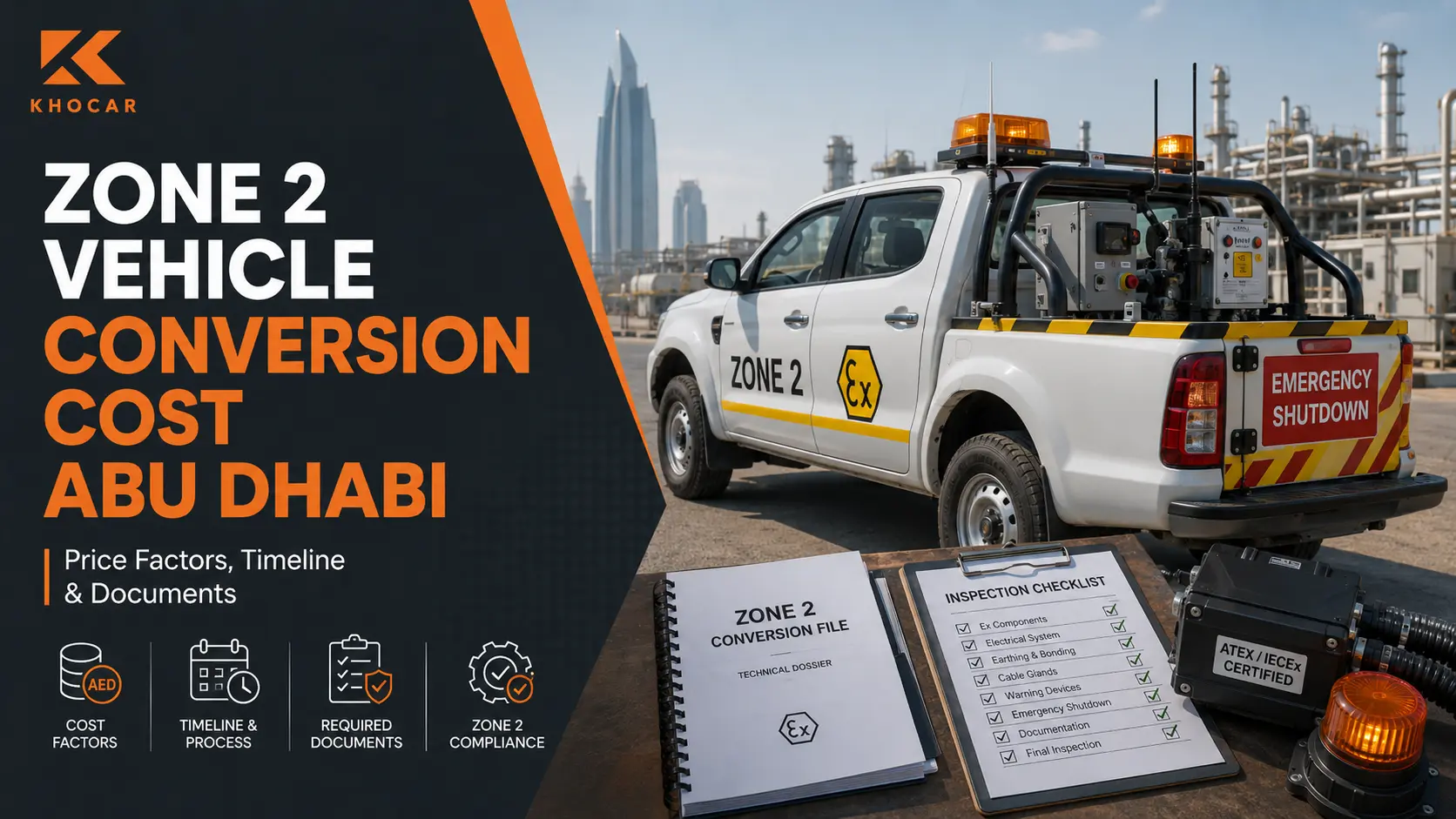
If you are searching for zone 2 vehicle conversion cost Abu Dhabi, you are probably not looking for a generic safety article. You need to know what the conversion may involve, why one vehicle costs more than another, how long the work can take, and what documents your project or HSE team may ask for before the vehicle is allowed near an ADNOC-related oilfield, gas facility, drilling site, or hazardous operating area.
At KhoCAR, the goal is to help contractors make that process clearer before the vehicle reaches the workshop. The difficult part is that Zone 2 conversion is rarely priced like a simple accessory installation. A pickup, service truck, generator unit, compressor, wireline support vehicle, or mobile workshop can each require a different scope because the ignition risks, electrical systems, exhaust setup, site rules, and documentation expectations are different.
This guide explains the practical price factors, timeline, and documents involved so contractors, fleet managers, procurement teams, and maintenance supervisors can request a quote with fewer delays and fewer surprises.
Key Takeaways
Zone 2 vehicle conversion cost in Abu Dhabi is usually quotation-based, not fixed, because the final scope depends on the vehicle type, operating location, hazardous-area requirement, component standard, inspection expectations, and documentation requested by the project or site safety team.
For ADNOC-related work, the biggest cost drivers are usually gas detection and automatic shutdown requirements, exhaust spark prevention, electrical and wiring safety, anti-static measures, certified or suitable components, labels and warning indicators, documentation, testing, and how urgently the vehicle must be mobilized.
A faster and more accurate Zone 2 quote usually starts with complete information: vehicle make and model, fuel type, engine details, site requirement, project deadline, photos, current condition, previous modifications, and any written HSE or ADNOC site-access instructions.
The cheapest Zone 2 conversion is not always the safest or fastest option. In hazardous-area work, missing documents, unsuitable components, undocumented wiring, or incomplete inspection preparation can cost more through delays, rework, rejected site access, and downtime.
What Is Zone 2 Vehicle Conversion?
Zone 2 vehicle conversion is the process of preparing a vehicle, machine, or mobile equipment unit for use in a hazardous area where an explosive gas, vapor, or mist atmosphere is not expected during normal operation but could occur briefly under abnormal conditions. The UK Health and Safety Executive describes Zone 2 as a place where an explosive atmosphere is not likely in normal operation but, if it occurs, will persist for a short period only. That definition is important because Zone 2 is not treated as “no risk.” It is treated as a controlled-risk environment where ignition sources must be managed carefully.
In Abu Dhabi oil and gas work, Zone 2 preparation often becomes relevant when a contractor needs a vehicle to enter a controlled facility, drilling area, gas plant, workshop area, wellsite, service yard, or other hazardous operating location. The exact scope depends on the site requirement. A vehicle may need spark prevention, engine shutdown on gas detection, anti-static protection, suitable wiring practices, warning signs, emergency isolation, and documentation that supports inspection or site access review.
KhoCAR’s Zone 2 installation service in Abu Dhabi focuses on preparing vehicles and equipment for hazardous-zone operation in line with ADNOC-related expectations and international safety concepts such as ATEX and IECEx component suitability. The practical goal is not just to install parts. The goal is to reduce ignition risk, keep the vehicle operational for the intended site, and prepare the supporting paperwork so the contractor can move through project review with fewer delays.
Also see: Zone 2 Installation & Certification Abu Dhabi
So, how much does a Zone 2 Vehicle Conversion Cost in Abu Dhabi?
The most accurate answer is this: Zone 2 vehicle conversion cost in Abu Dhabi depends on the required scope, so it should be quoted after a vehicle and requirement review. A fixed online price can be misleading because two vehicles that look similar from the outside may need different gas detection, shutdown, exhaust, electrical, anti-static, documentation, or inspection-preparation work.
For example, a newer pickup with clean wiring and a clear written site requirement may be easier to assess than an older field vehicle with previous accessories, undocumented electrical work, exposed wiring, or a rushed mobilization deadline. A mobile service truck with power tools, auxiliary systems, storage compartments, lighting, compressors, or workshop equipment may require a deeper review than a basic transport vehicle. The vehicle’s current condition affects both labor and risk.
That is why contractors should think about ADNOC Zone 2 certification cost as a scope-based compliance cost rather than a single product price. The quote may include component supply, installation labor, fabrication or mounting work, wiring and testing, labels, documentation, inspection support, and scheduling requirements. The best way to control cost is to provide complete information early, confirm the site requirements, and avoid last-minute changes after installation has started.
| Cost question | Practical answer |
| Is there one fixed Zone 2 conversion price? | Usually no. Pricing depends on vehicle type, required systems, condition, documents, and site expectations. |
| Can the lowest quote create risk? | Yes. If the quote excludes required parts, testing, documentation, or inspection preparation, the vehicle may face rework or access delays. |
| What makes a quote faster? | Clear site requirements, vehicle photos, make/model/year, fuel type, deadline, and details of existing modifications. |
| What should a good quote clarify? | Scope of work, including components, installation steps, documentation, expected timeline, and assumptions or exclusions. |
Main Price Factors for Zone 2 Installation in Abu Dhabi
A useful Zone 2 conversion estimate should explain what is included, what is assumed, and what might change after inspection. The following factors are the areas that most often affect pricing, timeline, and documentation.
1. Vehicle Type, Use Case, and Site Requirement
A pickup used for supervised site visits is not the same as a service vehicle carrying tools, fuel containers, compressors, electrical accessories, or specialized oilfield equipment. The intended use matters because the conversion provider needs to understand what the vehicle will do in the hazardous area. Will it drive through the zone only? Will it idle near equipment? Will technicians operate tools from the vehicle? Will auxiliary equipment remain powered? Each situation can change the risk review.
Site instructions also matter. Some projects only provide a short note saying “Zone 2 required,” while others provide a detailed HSE or mobilization requirement. The clearer the requirement, the easier it is to scope the conversion correctly. If the requirement is unclear, the provider may need to ask follow-up questions before pricing the work.
2. Gas Detection and Automatic Shutdown Requirements
Gas detection and shutdown systems are often among the most important cost drivers because they directly affect vehicle safety in a hazardous atmosphere. Depending on the requirement, the vehicle may need a detector, alarms, engine shutdown logic, isolation features, wiring, mounting, calibration-related documentation, and testing. The purpose is to reduce the chance that the vehicle continues operating when flammable gas or other hazardous atmosphere indicators are detected.
This is one area where incomplete scoping can cause real delays. If a project expects automatic shutdown and the quote only includes basic visual warning equipment, the vehicle may not be ready for site review. Contractors should ask whether the quoted scope includes detection, alarm, shutdown, testing, and paperwork, or whether some of these items are excluded.
3. Spark Arrestor and Exhaust Safety Work
Exhaust systems can become ignition sources because of hot surfaces, sparks, or unsuitable routing. Many Zone 2 conversions include exhaust spark prevention or spark arrestor installation where required by the site. The cost can vary based on vehicle model, exhaust layout, mounting requirements, part availability, and whether fabrication or adjustment is needed for a secure and practical installation.
For a simple vehicle with accessible exhaust routing, installation may be more straightforward. For a vehicle with custom modifications, tight space, corrosion, previous repairs, or heavy-duty equipment mounted nearby, the work may take longer. This is why photos from different angles can help before the vehicle is brought in.
4. Anti-Static Measures and Earthing Considerations
Static discharge can become an ignition risk in some hazardous-area situations. Zone 2 preparation may include anti-static straps, bonding or earthing-related measures, and checks to reduce static buildup. The exact requirement depends on the vehicle, the operating environment, and what the project or inspection process expects.
Anti-static work is usually not the largest part of the conversion, but it is easy to overlook. A quote that appears low may simply not include the full set of static-control measures expected by the project. This is another reason a checklist-based quote request is better than a quick verbal estimate.
5. Electrical Accessories, Wiring, and Ignition-Source Control
Electrical condition is one of the most common reasons a Zone 2 vehicle requires extra work. Field vehicles often have added lights, chargers, beacons, radios, GPS units, tool power points, dash cameras, external switches, inverters, compressor wiring, and older accessories installed at different times by different workshops. Every accessory can create a review question if wiring is exposed, undocumented, poorly routed, damaged, or unsuitable for the hazardous-area expectation.
The cost can increase when technicians need to trace old wiring, remove unsafe accessories, reroute cables, protect circuits, improve isolation, or document changes. This does not mean every accessory must automatically be removed. It means the vehicle should be assessed as a complete system, not just as an engine with a spark arrestor.
6. Certified or Suitable Components
Zone 2 work often refers to ATEX or IECEx concepts because these frameworks help identify equipment suitable for explosive atmospheres. KhoCAR’s service page notes the use of ATEX- and IECEx-certified equipment suitable for Zone 2 hazardous applications where required. In practice, component selection affects cost because suitable parts, reliable mounting hardware, documentation, and availability are not the same as those of generic automotive accessories.
When comparing quotes, procurement teams should ask whether the quote identifies the relevant components, whether documentation is included, and whether the items are suitable for the intended application. A cheaper part that cannot support inspection or documentation can become expensive if it delays mobilization.
7. Documentation, Labels, and Inspection Readiness
Documentation is not an afterthought in Zone 2 vehicle conversion. In many site-access situations, the vehicle needs proof of what was installed, how the work was completed, what components were used, and whether the setup is ready for inspection or review. Labels, signs, visible indicators, serial details, completion records, photos, and test notes may all become part of the submission package.
The cost may include more than installation labor because the provider may need to prepare records, organize photos, produce completion documents, and support the contractor during review. A quote that excludes documents may look cheaper, but it may not solve the actual business problem: getting the vehicle ready for the project.
8. Urgency, Parts Availability, and Fleet Size
Urgent work often costs more operationally because the provider may need to rearrange schedules, source parts quickly, or prioritize a vehicle needed for mobilization. Fleet work can sometimes be planned more efficiently, especially when several similar vehicles need the same or similar scope. However, a mixed fleet of pickups, service trucks, and specialized units may still require separate assessments.
If you have multiple vehicles, send a list early. Group vehicles by type, model, usage, and deadline. This helps the provider identify whether the same scope applies across the fleet or whether each vehicle needs different work.
| Price factor | How it affects cost | What to prepare |
| Vehicle type and use | Different vehicles have different ignition risks and installation needs. | Make, model, year, fuel type, photos, intended site use. |
| Gas detection/shutdown | Detection, alarm, isolation, wiring, testing, and documentation can change scope. | Written site requirement and whether automatic shutdown is requested. |
| Spark arrestor/exhaust | Part type, mounting, access, fabrication, and condition affect labor. | Photos of the exhaust route and current vehicle condition. |
| Electrical accessories | Old or undocumented wiring can require correction before conversion is complete. | Accessory list, photos of dashboards, batteries, tool systems, and control panels. |
| Anti-static measures | Static-control needs vary by site and vehicle application. | Operating area and any HSE instructions. |
| Documentation | Inspection-ready paperwork takes time and should be included in the scope. | Vehicle registration details, project details, prior certificates, and deadline. |
Typical Zone 2 Vehicle Conversion Timeline in Abu Dhabi
The Zone 2 conversion timeline depends on vehicle condition, parts availability, site requirement clarity, and inspection/documentation needs. A simple vehicle with clear requirements can move faster than a vehicle with unknown wiring, missing details, or last-minute changes. Instead of treating the timeline as a fixed number of days, contractors should understand the workflow.
| Step | What happens | Why it matters |
| 1. Requirement review | The provider reviews site instructions, ADNOC-related expectations, vehicle details, deadline, and photos. | Prevents quoting the wrong scope. |
| 2. Vehicle assessment | Technicians check condition, exhaust layout, electrical accessories, mounting points, and existing modifications. | Finds issues before parts are installed. |
| 3. Scope confirmation | The quote confirms systems, parts, labor, documentation, assumptions, and exclusions. | Helps procurement approve the right work. |
| 4. Installation | Spark prevention, gas detection/shutdown, anti-static measures, wiring, signs, and other required systems are installed. | Reduces ignition-source risk for the intended use. |
| 5. Testing and review | Installed systems are checked for function, placement, labeling, and documentation consistency. | Supports inspection readiness. |
| 6. Document handover | Completion records, photos, component details, and other relevant documents are prepared as required. | Helps project and site teams review the vehicle. |
A realistic timeline should include time for questions. If the project team changes the requirement after work begins, or if the vehicle arrives with unexpected wiring and accessories, the schedule can shift. The fastest route is to provide the written requirement and vehicle details before the vehicle arrives at the workshop.
Documents and Information Needed Before Requesting a Zone 2 Quote
A strong quote request saves time. Instead of asking only “What is the ADNOC Zone 2 certification cost?”, send the details that allow the provider to assess the vehicle and expected scope. The more complete the request, the fewer assumptions the quote must make.
- Vehicle make, model, year, plate number if available, and registration details.
- Fuel type, engine type, and whether the vehicle has auxiliary systems or mounted equipment.
- Clear photos of the full vehicle, dashboard, engine bay, exhaust route, battery area, accessories, tool compartments, and any previous modifications.
- Project name, operating site, intended work area, and whether the vehicle is for ADNOC-related site access.
- Written site-access, HSE, or mobilization instructions that mention Zone 2, spark arrestor, gas detection, shutdown, anti-static systems, or documentation.
- Required mobilization date and whether inspection or submission deadlines are already scheduled.
- Existing certificates, previous Zone 2 documents, inspection reports, or records of earlier modifications.
- Contact person for technical clarification, especially if procurement is separate from the site or maintenance team.
If you do not have a written requirement, explain what you know. For example: “The project told us the pickup needs Zone 2 preparation for an ADNOC site in Abu Dhabi, and we need it ready before mobilization next week.” That information is still more useful than asking for a price without context.
Practical Cost Examples: Why Similar Vehicles Can Need Different Scopes
The following examples are not price quotes. They show why Zone 2 installation in Abu Dhabi is usually scoped after assessment rather than priced as one fixed package.
Example 1: Pickup for Site Visits
A contractor needs a pickup to enter a controlled oilfield area for supervised site visits. The vehicle is relatively new, has limited accessories, and the project requirement is clear. The scope may focus on required spark prevention, gas detection or shutdown if specified, anti-static measures, warning labels, and supporting documents. Because the vehicle is clean and the requirement is clear, the assessment and quote can usually be completed faster.
Example 2: Mobile Service Truck With Added Electrical Accessories
A maintenance team needs a service truck for field repairs. It has added work lights, storage compartments, power points, tool chargers, and previous wiring. Even if the final Zone 2 requirement is similar, technicians may need extra time to review and correct accessories that could create ignition risks or documentation issues. This vehicle may cost more than a basic pickup because the system is more complex.
Example 3: Older Field Vehicle With Unknown Modifications
An older vehicle has been used on several projects and modified by different workshops. Some wiring is undocumented. The exhaust system has been repaired before. Photos are missing, and the deadline is urgent. This is the kind of vehicle where the cost can increase because the provider needs to investigate the existing condition before safe installation can be completed. The delay is not the Zone 2 label itself; it is the hidden work needed to make the vehicle inspection-ready.
How to Reduce Zone 2 Conversion Cost Without Cutting Safety Corners
The goal is not to make the conversion cheap at the expense of compliance. The goal is to avoid unnecessary rework, waiting, and confusion. Most avoidable costs come from missing information, unclear requirements, poor timing, and incomplete documents.
- Confirm the site requirement before asking for a final quote. A one-line request may not be enough if the project expects specific shutdown, gas detection, or documentation standards.
- Send photos before the vehicle arrives. Good photos can reveal exhaust layout, accessory issues, mounting constraints, and possible wiring concerns.
- Do not hide previous modifications. Old accessories, extra lights, inverters, tool systems, or aftermarket wiring can affect the scope.
- Avoid last-minute mobilization. Urgent scheduling can make parts sourcing and workshop planning harder.
- Ask what documents are included. A conversion that does not support site review may not solve the access problem.
- Group fleet vehicles by type. Similar vehicles can often be assessed more efficiently than mixed, undocumented units.
Common Mistakes That Make ADNOC Zone 2 Certification Cost Higher
Many contractors only think about the installation price. In practice, the higher cost can come from delayed mobilization, rejected documentation, repeated workshop visits, or idle crews waiting for site access. These mistakes are common and usually preventable.
| Mistake | Why does it create cost or delay | Better approach |
| Asking for a price without vehicle details | The provider must guess the scope, which can lead to changes later. | Send vehicle data, photos, use case, and site requirements. |
| Assuming one Zone 2 scope fits all vehicles | Different vehicles have different risks and accessories. | Assess each vehicle or group of similar vehicles carefully. |
| Ignoring old wiring and accessories | Unsafe or undocumented wiring can delay inspection readiness. | Disclose accessories and allow time for electrical review. |
| Treating documents as optional | Site teams may need proof, photos, component details, and completion records. | Confirm document expectations before installation. |
| Waiting until the mobilization deadline | Urgency reduces scheduling flexibility and can increase downtime. | Start the requirement review as soon as the project mentions Zone 2. |
Why This Topic Matters More in Abu Dhabi Right Now
Zone 2 vehicle conversion demand is closely tied to oilfield activity, project mobilization, and contractor readiness. ADNOC announced on May 3, 2026, that it plans AED 200 billion, or about $55 billion, in new project awards for 2026-2028. ADNOC said the awards will support a new phase of world-scale project execution across its value chain and reinforce its approved five-year CAPEX plan. For contractors, that kind of project pipeline increases the importance of having vehicles, equipment, documents, and suppliers ready before mobilization windows become tight.
This does not mean every vehicle automatically needs Zone 2 conversion. It means contractors working around Abu Dhabi oil and gas projects should treat hazardous-area access requirements as an early planning item. If the project requires Zone 2 preparation, waiting until the week of mobilization can create avoidable pressure on procurement, maintenance, HSE, and operations teams.
Zone 2 Cost Guide vs. Zone 2 Checklist: How to Use Both
KhoCAR already has a practical Zone 2 vehicle checklist for ADNOC site access in Abu Dhabi. That checklist is useful when you want to prepare the information and vehicle details before starting the process. This cost guide serves a different purpose: it helps you understand why quotes vary, which factors affect budget, and what to ask before approving the work.
Recommended next read: Zone 2 Vehicle Conversion Checklist for ADNOC Site Access in Abu Dhabi
What a Good Zone 2 Installation Quote Should Include
A professional quote should make the scope understandable for both technical and procurement teams. It should not leave the client guessing whether major safety systems, documents, or testing steps are included. Before approving a quote, look for these items:
- Vehicle or equipment description being quoted.
- Clear scope of Zone 2 installation work.
- List or category of major components to be supplied and installed.
- Whether gas detection, shutdown, spark prevention, anti-static work, labels, or electrical corrections are included.
- Expected timeline and assumptions about parts availability.
- Documentation is included after completion.
- Items excluded or dependent on vehicle inspection.
- Support available if the project team requests clarification.
If a quote is vague, ask for clarification before work begins. This helps prevent disputes later and gives your HSE or operations team a clearer picture of what will be delivered.
Need Zone 2 Vehicle Conversion Support in Abu Dhabi?
If you need Zone 2 installation in Abu Dhabi for ADNOC-related site access, KhoCAR can help you review the requirement, assess the vehicle, identify likely cost factors, and prepare the conversion scope with the right documents for your project timeline. Whether you are preparing one pickup or a group of oilfield support vehicles, the best first step is to share the vehicle details, photos, site requirements, and mobilization deadline so the scope can be reviewed properly.
Visit KhoCAR’s service page for more details: Zone 2 Installation & Certification Abu Dhabi.
For project inquiries, contact KhoCAR here: Contact KhoCAR Services in Abu Dhabi.
FAQs
How much does a Zone 2 vehicle conversion cost in Abu Dhabi?
Zone 2 vehicle conversion cost in Abu Dhabi is usually quotation-based because the price depends on vehicle type, condition, gas detection or shutdown requirements, spark prevention, anti-static measures, electrical work, documentation, and project timeline. A provider should review the vehicle and site requirements before giving a final quote.
What affects ADNOC Zone 2 certification cost the most?
The biggest factors are the required safety systems, vehicle condition, certified or suitable components, documentation, inspection preparation, urgency, and whether the vehicle has previous accessories or undocumented wiring. A clear written site requirement helps reduce uncertainty and improves quote accuracy.
Does every vehicle need the same Zone 2 installation in Abu Dhabi?
No. A pickup, service truck, generator unit, compressor, or mobile workshop may each need a different Zone 2 scope. The operating area, site rules, fuel type, electrical accessories, exhaust setup, and intended use all affect the conversion requirements.
How long does Zone 2 vehicle conversion take?
The timeline depends on the scope, parts availability, vehicle condition, documentation needs, and how clearly the requirement is provided. The process usually includes requirement review, vehicle assessment, scope confirmation, installation, testing, and document handover.
What documents are needed for Zone 2 vehicle conversion?
Useful documents include vehicle registration details, make and model, photos, fuel and engine details, written HSE or site-access instructions, project name, mobilization deadline, previous certificates, and records of earlier modifications. These details help the provider quote and schedule the work faster.
Is a spark arrestor enough for Zone 2 compliance?
Not always. A spark arrestor may be one required part, but Zone 2 preparation can also involve gas detection, automatic shutdown, anti-static measures, electrical safety, labels, testing, and documentation. The correct scope depends on the site requirement and vehicle use.
Can I get a Zone 2 quote without bringing the vehicle to the workshop?
You may be able to get an initial estimate if you provide photos, vehicle details, and written requirements. However, the final quote may still depend on physical inspection, especially if the vehicle has older modifications, added electrical accessories, or an unclear condition.
Why should I avoid the cheapest Zone 2 conversion quote?
A low quote may exclude important systems, documents, testing, or inspection preparation. In oilfield work, the real cost of an incomplete conversion can be downtime, rework, rejected site access, or missed mobilization. Compare scope, not just price.
What is Zone 2 in oil and gas vehicle safety?
Zone 2 is a hazardous area where an explosive gas, vapor, or mist atmosphere is not expected during normal operation but could occur for a short period. Vehicles entering these areas may need preparation to reduce ignition risks from exhaust, electrical systems, static discharge, or uncontrolled engine operation.
Who provides Zone 2 installation in Abu Dhabi?
KhoCAR provides Zone 2 installation and certification support in Abu Dhabi for vehicles and equipment used in hazardous areas, with services aligned around ADNOC-related expectations, ATEX/IECEx safety concepts, installation, documentation, and inspection readiness.