ADNOC Zone 2 vehicles are a serious planning issue for contractors, fleet managers, and oilfield support teams working around Abu Dhabi’s oil and gas facilities. The question is rarely as simple as “Does this vehicle need a sticker?” A pickup truck used only for office errands is very different from a diesel service truck entering a hazardous operating area with tools, lighting, batteries, fuel, welding support, or electrical equipment on board.
When a vehicle is expected to enter or operate near a Zone 2 hazardous area, the project team may require a proper assessment, modification, documentation, and inspection support before access is granted. This matters even more as ADNOC confirmed AED 200 billion, about $55 billion, in planned project awards for 2026-2028, creating more mobilization activity across upstream and downstream work in Abu Dhabi.
For contractors, the best approach is to identify which vehicles may need Zone 2 vehicle conversion in Abu Dhabi early, before the vehicle is due at the gate, yard, rig, plant, terminal, or field location.
Key Takeaways
Vehicles most likely to need Zone 2 conversion or assessment are those that enter, work inside, stop inside, or power equipment inside a hazardous area where explosive gas, vapor, mist, or hydrocarbon release could occur briefly under abnormal conditions.
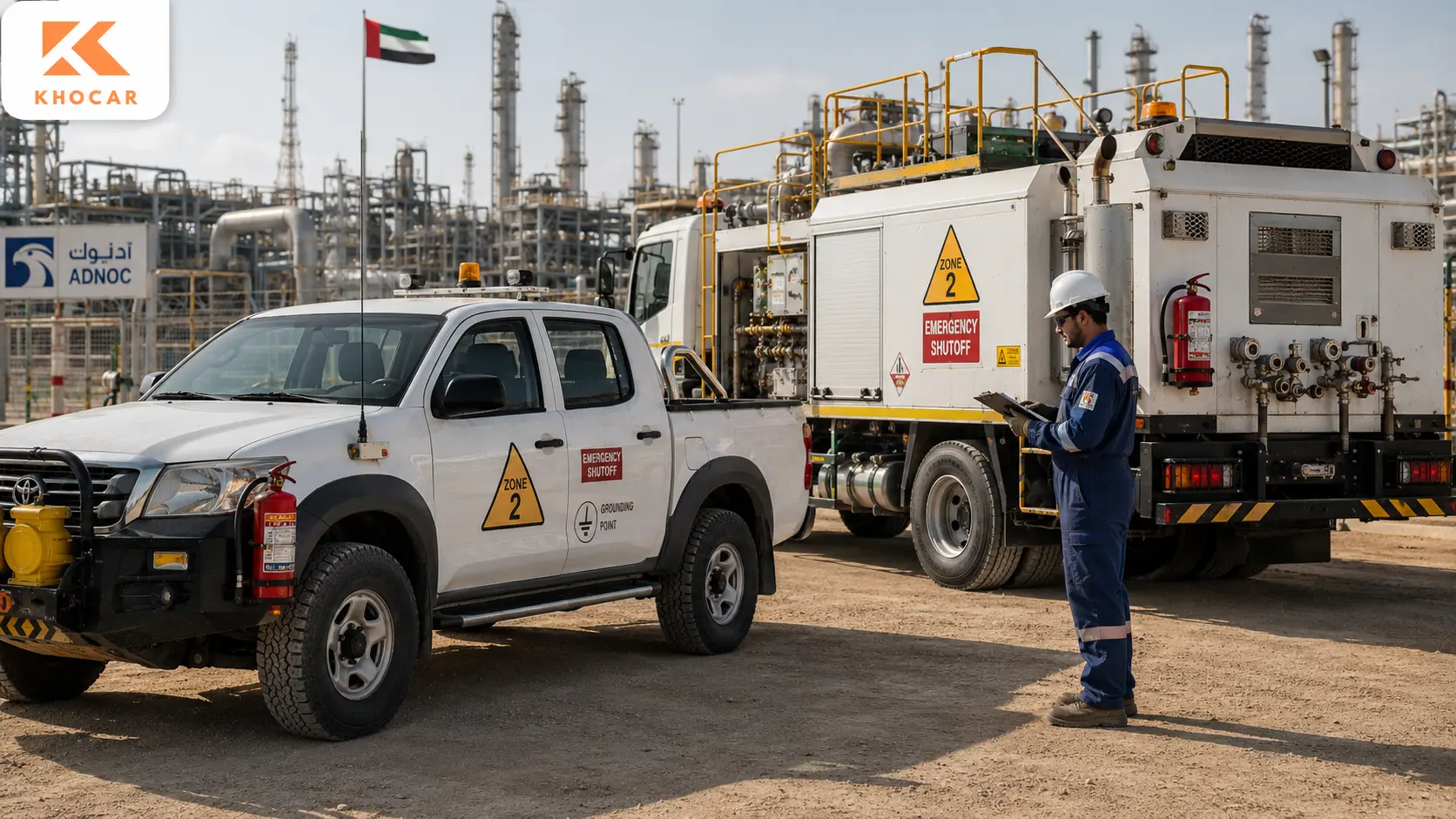
Common ADNOC Zone 2 vehicles include pickups, 4x4s, crew vehicles, service trucks, maintenance vans, mobile workshops, generators, compressors, forklifts, cranes, vacuum trucks, tankers, welding support vehicles, and other mobile equipment used near oilfield process areas.
The conversion scope is not identical for every vehicle. A basic pickup may require a different review than a mobile workshop with auxiliary power, battery banks, compressors, lighting, hydraulic systems, and stored tools.
Zone 2 conversion is usually about ignition-source control, not cosmetic modification. Typical review areas include exhaust spark prevention, engine shutdown, gas detection interface, electrical protection, battery isolation, anti-static bonding, labeling, and documentation.
The safest answer is always project-specific: confirm the site requirement, vehicle use, operating zone, documentation expectation, and inspection process before starting work. KhoCAR can assess the vehicle and help prepare Zone 2 installation and certification support for Abu Dhabi oil and gas projects.
What Does Zone 2 Mean for Vehicles in Abu Dhabi Oil and Gas Work?
Zone 2 is a hazardous area classification used where an explosive gas, vapor, or mist atmosphere is not expected during normal operation, but could occur for a short time if something abnormal happens, such as a leak, venting event, equipment failure, or operational upset. In practical field language, Zone 2 means the area is not continuously explosive, but it is still not a normal public-road environment. A vehicle entering that area can become an ignition source if its electrical, exhaust, mechanical, or static-control systems are not suitable for the risk.
For Abu Dhabi oil and gas contractors, this matters because ADNOC-related work often involves controlled sites where vehicle access is linked to HSE review, site permits, project instructions, and inspection documents. The European Commission explains that a potentially explosive atmosphere can exist when air combines with gases, vapors, mists, or dusts in a way that can ignite under certain operating conditions. The UK Health and Safety Executive also explains that hazardous areas are classified into zones based on the likelihood and persistence of explosive atmospheres, and equipment selection should match the zone.
That is why “ADNOC Zone 2 vehicles” should be treated as a risk category, not simply a vehicle category. The same model pickup may be treated differently depending on where it goes, how long it stays, what equipment it carries, whether the engine remains running, and what the site HSE team requires.
What are ADNOC Zone 2 Vehicles?
ADNOC Zone 2 vehicles are vehicles or mobile equipment that may enter or operate in a Zone 2 hazardous area on Abu Dhabi oil and gas projects. The vehicles most likely to need Zone 2 conversion or formal assessment include pickups, 4x4s, crew vehicles, maintenance vans, service trucks, mobile workshops, generators, compressors, forklifts, telehandlers, cranes, vacuum trucks, tankers, pumps, light towers, and any mobile equipment with ignition-source risks.
The requirement depends on where the vehicle will operate, whether it will run inside the hazardous area, what equipment it carries, and what the project HSE or site-access team requires. Zone 2 vehicle conversion in Abu Dhabi usually focuses on controlling ignition sources through exhaust protection, engine shutdown, electrical safety, battery isolation, gas-detection interface, anti-static measures, labeling, and documentation.
Why Ordinary Vehicles Can Be a Problem in a Hazardous Area
A standard road vehicle is designed for transport, not for operation around possible hydrocarbon gas, H2S, flammable vapors, or oilfield process hazards. Even a well-maintained vehicle can create multiple ignition risks if it enters the wrong area without suitable controls. Hot exhaust surfaces, alternators, exposed wiring faults, battery terminals, relays, switches, lighting circuits, static discharge, friction sparks, or uncontrolled engine operation can all become relevant depending on the vehicle and the environment.
The issue is not that every vehicle will cause a fire. The issue is that hazardous-area planning assumes a possible abnormal release and then asks: if that release happens, could this vehicle ignite it? Zone 2 vehicle conversion aims to reduce that possibility by controlling ignition sources and preparing the vehicle for site review. For example, a diesel pickup used to transport supervisors may need different treatment than a maintenance truck that parks near equipment, powers tools, and opens storage compartments throughout the shift.
This is why project teams often ask for details before giving a final answer: vehicle make and model, fuel type, purpose, work location, onboard equipment, auxiliary power, electrical modifications, expected operating time, and required certification documents. Without that information, a contractor may under-scope the conversion and face delays later.
Which Vehicles Usually Need Zone 2 Conversion?
Vehicles usually need Zone 2 conversion, or at least a formal Zone 2 assessment, when they are expected to enter, operate, idle, park, load, unload, inspect, repair, lift, tow, power, or perform support work inside a Zone 2 hazardous area. The more the vehicle interacts with the work area, the more likely it is to need review. A vehicle passing near an administrative area may have a lower requirement than a service truck working beside a production unit, wellsite, rig, storage area, loading area, or maintenance shutdown zone.
In ADNOC-style project environments, the most common vehicles and mobile equipment that may need review include pickups and 4x4s, crew buses, maintenance vans, mobile workshops, mechanic trucks, electrical service trucks, crane trucks, forklifts, telehandlers, generators, compressors, welding support vehicles, vacuum trucks, tankers, lowbed support vehicles, light towers, air compressors, and any machine with electrical or diesel systems that may operate close to a hazardous release source.
The key phrase is “may need” because final requirements depend on site classification, work method, and HSE instructions. A contractor should never assume that a vehicle is exempt because another project accepted it previously. Site-access rules can differ by operator, project, zone, vehicle type, and inspection authority.
Vehicle Types That Commonly Need Zone 2 Assessment or Conversion
The table below gives practical guidance for content readers. It should not be treated as a final approval matrix because the actual decision depends on the written project requirement and site review.
| Vehicle or Equipment Type | Why It May Need Zone 2 Review | Example Use Case | CTA/Service Relevance |
| Pickup trucks and 4×4 vehicles | They may enter field locations, wellsites, plants, yards, or production-support areas where hazardous gases may occur. | A site supervisor pickup travelling to a wellsite or shutdown area. | KhoCAR can assess vehicle use and the required Zone 2 installation scope. |
| Maintenance vans and service trucks | They often carry batteries, tools, lighting, compressors, auxiliary systems, and modified wiring. | A mobile mechanic truck used for field repairs inside an oilfield facility. | A deeper conversion review may be needed because of onboard systems. |
| Mobile workshops | They combine storage, electrical circuits, power tools, welding support, and long parking time near work fronts. | A workshop truck parked during maintenance or shutdown support. | KhoCAR can review ignition-source risks and documentation needs. |
| Generators and compressors | They run engines continuously and may create hot surfaces, exhaust risks, or electrical ignition sources. | A portable generator powering site tools or temporary lighting. | Zone 2 equipment preparation may be required before deployment. |
| Forklifts and telehandlers | They move materials inside yards, plants, loading areas, or field zones where flammable vapors may be present. | A forklift is handling materials near process or storage areas. | Review may include exhaust, electrical, and static-control risks. |
| Cranes, crane trucks, and lifting equipment | They may operate close to live facilities, shutdown work, or construction areas within controlled zones. | A crane truck supporting equipment installation near oil and gas infrastructure. | Site HSE may require Zone 2 suitability evidence. |
| Vacuum trucks, tankers, and fluid-handling vehicles | They may handle liquids, residues, or waste connected to hydrocarbon operations. | A vacuum truck supporting cleaning, maintenance, or spill-response work. | Conversion scope may depend on cargo, process risk, and work area. |
| Welding support and hot-work vehicles | They carry high-risk equipment and are usually subject to strict permit and ignition-source controls. | A welding support truck mobilized during repair work. | Needs careful review because hot work and hazardous zones are a sensitive combination. |
| Light towers, pumps, and temporary support equipment | They may be left running or energized for long periods in field locations. | Temporary lighting during night work or shutdown activities. | Assessment should confirm whether the equipment is suitable for the area. |
Pickups and 4x4s: Not Always Simple, Not Always Exempt
Many contractors first ask about pickups because they are the most common project vehicles in Abu Dhabi. A pickup may look ordinary, but its use can change the requirement. If it only moves staff between an office and a non-hazardous parking area, the review may be limited. If it enters a plant, wellsite, drilling area, production location, shutdown zone, or field-support area, the HSE team may require Zone 2 preparation before access.
A realistic example: a supervisor has a 4×4 used for daily site rounds. The vehicle drives into controlled areas, stops near work fronts, and sometimes remains parked while the engine or electrical systems are active. That vehicle is more likely to need assessment than a staff car that never enters the controlled area. The conversion decision may consider exhaust control, battery isolation, electrical circuits, gas detection or shutdown interfaces, warning labels, inspection records, and the site’s specific access procedure.
The practical advice for contractors is simple: do not wait until gate access is rejected. Send the vehicle details, intended site, and use case to a Zone 2 conversion provider early so the likely scope can be checked before mobilization.
Service Trucks, Maintenance Vans, and Mobile Workshops
Service vehicles are often higher-risk than basic transport vehicles because they are modified for work. A maintenance van may have added lighting, chargers, inverters, storage drawers, jump-start equipment, electrical reels, compressors, hydraulic tools, testing instruments, or auxiliary batteries. A mobile workshop may also carry lubricants, spares, welding equipment, grinders, power tools, or field-repair kits. Each added system can introduce another ignition-source question.
For Zone 2 vehicle conversion in Abu Dhabi, these vehicles often need a more detailed assessment because the provider must understand not only the original vehicle but also the modifications added after purchase. If wiring has been changed, accessories installed, or equipment mounted by different vendors, the review may need photos, electrical details, and condition checks. A service truck with poorly protected wiring or improvised battery connections can create HSE concerns even if the base truck is new.
A proper Zone 2 conversion provider does not just install parts; it reviews how the vehicle is actually used in the field and prepares the documentation needed for inspection support.
Generators, Compressors, Pumps, and Light Towers
Mobile equipment such as generators, compressors, pumps, and light towers can be easy to overlook because they are not “vehicles” in the everyday sense. However, they are still mobile equipment with engines, electrical systems, hot surfaces, fuel, batteries, cables, alternators, and control panels. If they will operate inside or near a Zone 2 hazardous area, they may need an assessment or suitable certified alternatives.
A generator powering temporary equipment during night work is a good example. It may run for hours, create heat, produce exhaust, and energize circuits while located close to field activity. A compressor used for maintenance support may also create heat, vibration, and electrical-control risks. The review should consider where the equipment will sit, whether the engine runs continuously, how the exhaust is handled, whether the control panel is suitable, and whether the equipment documentation matches the site requirement.
Forklifts, Telehandlers, Cranes, and Material-Handling Equipment
Material-handling equipment can fall into the Zone 2 discussion when it operates near storage areas, production support areas, loading points, fabrication zones, shutdown work fronts, or oilfield logistics areas. Forklifts, telehandlers, cranes, and crane trucks may use diesel engines, electrical systems, hydraulic systems, lighting, horns, alarms, sensors, and control panels. Any of these may be reviewed if the machine enters a hazardous area.
A forklift used only in a general warehouse may not face the same requirements as a forklift working near a controlled oil and gas facility. A crane supporting installation work near a live plant may face more detailed access rules than a crane used in an open construction yard. The difference is not the equipment name alone; it is the combination of classified area, activity, duration, and ignition-source risk.
For contractors, the best practice is to classify the intended job location first. If the lifting or handling equipment will enter a Zone 2 location, obtain the site instruction and share it with the conversion provider before dispatching the equipment.
Tankers, Vacuum Trucks, and Fluid-Handling Vehicles
Tankers, vacuum trucks, and fluid-handling vehicles deserve special attention because they can be connected to hydrocarbon operations, waste handling, cleaning, spill response, maintenance, or fluid transfer. These vehicles may be reviewed not only because of their engines and electronics, but also because of the substance handled, the loading or unloading process, and the possibility of vapor release.
A vacuum truck working around oilfield waste or a tanker supporting site operations may operate close to potential vapor sources. The site may require a stricter assessment of exhaust spark prevention, grounding or bonding practices, shutdown systems, equipment labeling, and operating procedures. In some cases, the work permit and vehicle acceptance process may be as important as the conversion itself.
Fluid-handling vehicles should never rely on generic assumptions. Contractors should confirm the fluid type, work location, operating procedure, and required documents before mobilization.
Vehicles That May Not Need Full Zone 2 Conversion but Still Need Review
Not every vehicle connected to an ADNOC project automatically needs full Zone 2 conversion. Some vehicles may only operate on public roads, general parking areas, non-classified logistics zones, administrative locations, or off-site workshops. Others may only deliver materials to a handover point without entering the hazardous area. However, “not full conversion” does not always mean “no review.” A project may still require a vehicle pass, safety inspection, documentation, driver training, insurance, site induction, or basic vehicle condition checks.
Examples may include office staff cars, vendor delivery vehicles stopping outside controlled zones, courier vehicles, passenger transport that does not enter classified locations, or third-party transport vehicles that hand over cargo before the hazardous area boundary. The contractor should still confirm the boundary between classified and non-classified areas. A vehicle that starts as a delivery vehicle can become a Zone 2 vehicle if the route changes and the driver is asked to enter a controlled zone.
The practical rule is this: if the vehicle will not enter the hazardous area, full Zone 2 conversion may not be required. If there is any chance it will enter, park, idle, load, unload, or perform support work inside a classified zone, get a formal answer before the project deadline.
What Is Usually Reviewed During Zone 2 Vehicle Conversion?
The exact scope depends on the vehicle and project requirements, but most Zone 2 vehicle conversion discussions focus on reducing ignition-source risk and preparing evidence for site review. Common review areas include the following:
- Exhaust and spark control, including spark arrestor suitability where required.
- Engine shutdown or emergency shutdown systems are designed to stop the engine during unsafe conditions.
- Gas detection interface or gas-triggered shutdown where required by the site or project.
- Electrical wiring, relays, alternator areas, lighting, switches, accessories, and exposed electrical risks.
- Battery isolation, battery terminal protection, and safe routing of cables.
- Anti-static bonding, grounding, or static discharge control where relevant to the vehicle and task.
- Protection of hot surfaces and assessment of possible heat-related ignition sources.
- Warning labels, identification plates, inspection records, certification documents, and handover paperwork.
- Condition of existing modifications, especially for service trucks, mobile workshops, and older equipment.
Zone 2 conversion is not one universal kit. It is a controlled preparation process that should match the vehicle’s risk profile and the site’s expected evidence.
How to Decide If Your Vehicle Needs Zone 2 Conversion Before Mobilization
Use this pre-assessment framework before sending a vehicle to an ADNOC-related project in Abu Dhabi.
| Questions to Ask | Why It Matters | Practical Action |
| Will the vehicle enter a classified or controlled hazardous area? | Entry into the zone is the main trigger for review. | Ask the site or EPC team for the written vehicle/access requirement. |
| Will the engine remain running inside the area? | Running engines create exhaust, heat, electrical, and shutdown-control concerns. | Share the expected operating time with the Zone 2 provider. |
| Does the vehicle carry powered tools or added electrical systems? | Accessories can create ignition risks not present in the original vehicle. | Provide photos and details of all modifications. |
| Is it a diesel engine, generator, compressor, or powered machine? | Continuous operation can create hot surfaces and an exhaust risk. | Confirm spark, shutdown, and equipment suitability requirements. |
| Will the vehicle handle liquids, waste, fuel, or hydrocarbons? | Fluid and vapor risks can change the required controls. | Provide work method and material details before mobilization. |
| What documents will the site ask for? | Access can fail if paperwork is incomplete, even after physical conversion. | Prepare inspection, certificate, component, and handover records early. |
Common Mistakes That Delay ADNOC Site Access
Assuming every vehicle has the same requirement
Zone 2 requirements can vary between a pickup, service truck, generator, forklift, and mobile workshop. Treating all vehicles the same can lead to under-scoped work or unnecessary cost.
Starting conversion without the written site requirement
A provider can assess the vehicle better when the contractor shares the actual instructions from the project, EPC, operator, or HSE team. Verbal assumptions often create rework.
Ignoring previous modifications
Added lights, batteries, inverters, chargers, compressors, storage systems, or wiring can change the risk profile. These details should be disclosed before the quote and inspection.
Waiting until the mobilization deadline
Zone 2 conversion may include assessment, parts, installation, testing, labeling, documentation, and review. Last-minute work increases the risk of access delays.
Thinking a low quote is always better.
A quote that excludes documentation, inspection support, suitable components, or project-specific requirements can become more expensive if the vehicle fails review.
Need Zone 2 Vehicle Conversion Support in Abu Dhabi?
If your vehicle, service truck, generator, compressor, forklift, crane, or mobile equipment needs to enter an ADNOC-related hazardous area, do not wait until the gate-access stage to discover the requirement. Send KhoCAR your vehicle make, model, photos, fuel type, intended site, deadline, and any written HSE or site-access instructions you received.
KhoCAR provides Zone 2 installation and certification services in Abu Dhabi for vehicles and equipment used in hazardous oil and gas environments. The team can assess the likely conversion scope, install suitable safety systems, prepare documentation, and help your fleet become better prepared for ADNOC-style site review.
To start, contact KhoCAR in Abu Dhabi with your vehicle details and project requirements.
FAQs
What vehicles need Zone 2 conversion for ADNOC projects?
Vehicles that may enter, park, idle, operate, load, unload, repair, lift, power, or support work inside a Zone 2 hazardous area may need Zone 2 conversion or assessment. Common examples include pickups, 4x4s, service trucks, mobile workshops, generators, compressors, forklifts, cranes, vacuum trucks, tankers, and field-support equipment.
Do all ADNOC project vehicles need Zone 2 certification?
No. Not every project vehicle automatically needs full Zone 2 conversion. Vehicles operating only in non-classified areas may have lower requirements. However, any vehicle expected to enter a classified hazardous area should be checked against the site-specific HSE and access requirements before mobilization.
Does a pickup truck needa Zone 2 conversion in Abu Dhabi?
A pickup truck may need Zone 2 conversion if it will enter or operate in a hazardous oil and gas area. A pickup used only outside the classified area may not need the same scope. The decision depends on the vehicle’s route, work location, engine use, onboard equipment, and written project requirements.
Do generators and compressors need Zone 2 certification?
Generators and compressors may need Zone 2 assessment or certified suitability if they will run inside or near a Zone 2 hazardous area. These machines can create hot surfaces, exhaust risk, electrical ignition sources, and continuous operating hazards, so the site requirement should be confirmed before deployment.
What is checked during Zone 2 vehicle conversion?
A Zone 2 vehicle conversion review may check exhaust spark prevention, engine shutdown, gas detection interface, electrical wiring, battery isolation, anti-static bonding, hot surfaces, warning labels, certification documents, and inspection readiness. The exact scope depends on the vehicle type and site requirements.
Can a vehicle be approved automatically after Zone 2 conversion?
No provider should promise automatic approval without knowing the site process. Zone 2 conversion helps prepare a vehicle for hazardous-area access, but final acceptance may depend on inspection, documentation, project rules, site HSE review, and the operator or EPC requirement.
What information should I send before asking for Zone 2 conversion?
Send the vehicle type, make, model, year, fuel type, engine details, photos, intended site, project deadline, current modifications, onboard equipment list, and any written HSE or access requirements. This helps the provider assess the vehicle faster and reduce rework.
What is the difference between Zone 1 and Zone 2 vehicle requirements?
Zone 1 generally indicates a higher likelihood of an explosive atmosphere than Zone 2. Zone 2 means the explosive atmosphere is not expected during normal operation but could occur briefly under abnormal conditions. Equipment and vehicle suitability should match the classified zone and project requirements.
Are ATEX and IECEx relevant for UAE hazardous area vehicles?
Yes, ATEX and IECEx concepts are commonly referenced in hazardous-area equipment discussions. ATEX relates to equipment and protective systems for potentially explosive atmospheres in the EU framework, while IECEx is an international certification system for equipment used in explosive atmospheres. UAE projects may reference these concepts alongside local and operator requirements.
Who provides Zone 2 vehicle conversion in Abu Dhabi?
KhoCAR provides Zone 2 installation and certification support in Abu Dhabi for vehicles and equipment used in hazardous oil and gas environments. Contractors can share vehicle details and project requirements with KhoCAR to understand the likely conversion scope and documentation needs.