
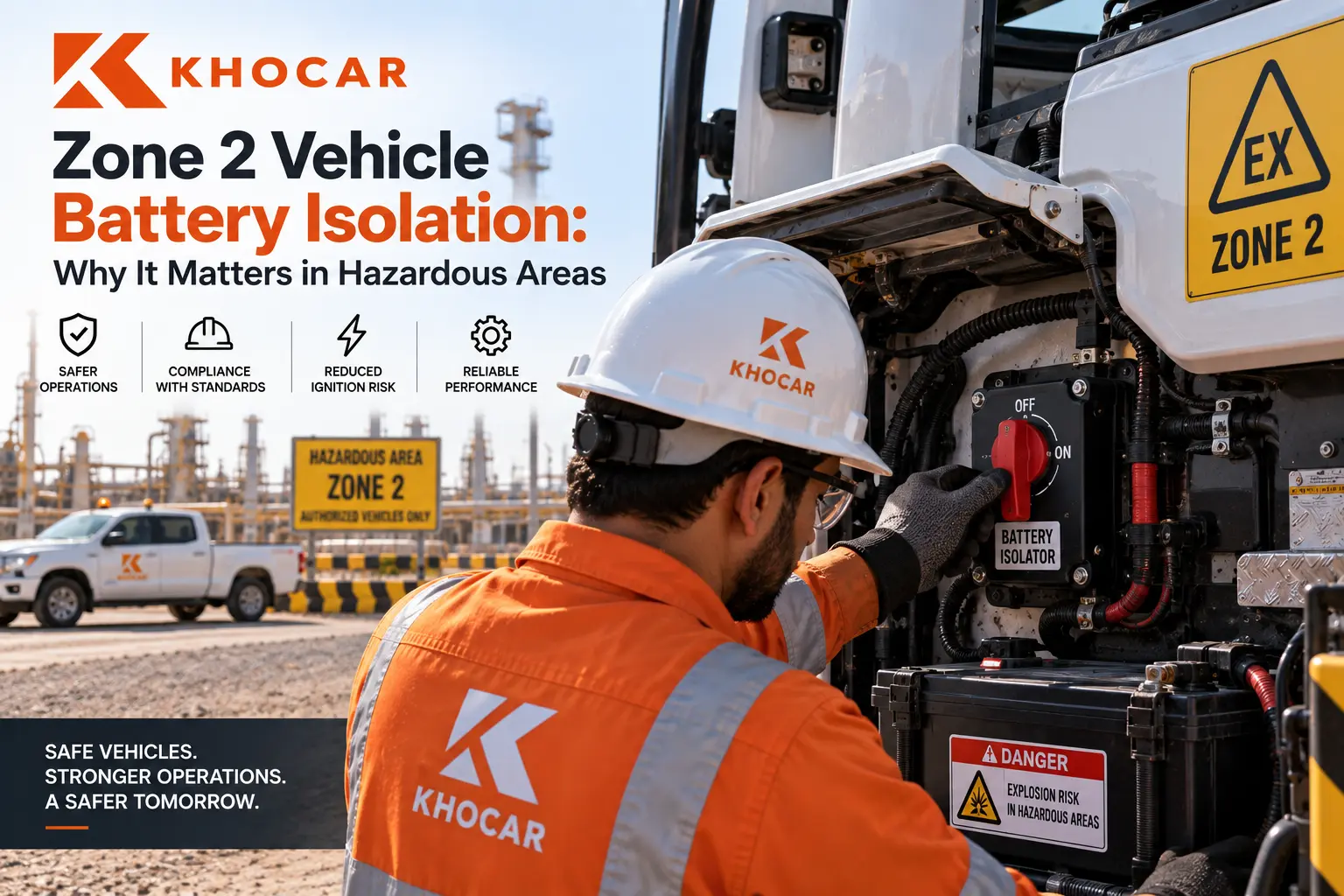
A vehicle entering a Zone 2 hazardous area can carry far more potential ignition sources than the engine alone. The battery powers starter circuits, charging equipment, control modules, lighting, communications, sensors and other electrical loads. That is why Zone 2 vehicle battery isolation deserves attention when a vehicle is being prepared for oilfield or other hazardous-area work.
A correctly engineered battery isolation system can help reduce the amount of energized electrical equipment present when isolation is required, but it is not, by itself, a certificate of Zone 2 compliance. The switch, its location, wiring, connected circuits, protection method and operating procedure all have to be considered as part of the vehicle’s overall ignition-risk controls.
This guide explains what battery isolation does, what it does not do, how it differs from an ordinary battery disconnect, how it fits into a wider Zone 2 vehicle conversion, and what operators should check before a vehicle enters a hazardous area.
Key Takeaways
- A battery isolator is one control measure within a hazardous-area vehicle system; it does not automatically make an ordinary vehicle suitable for Zone 2.
- Zone 2 is an area classification based on the likelihood and duration of an explosive gas atmosphere; the site’s classification determines the applicable controls.
- Opening a battery circuit can reduce electrical energy available to some circuits, but the isolation device itself can create an arc unless its design and installation are suitable.
- A complete vehicle assessment should consider the battery, starter, alternator, wiring, fuses, relays, lighting, radios, gas detection, exhaust, hot surfaces, static electricity and aftermarket accessories.
- IEC 60079-14:2024 addresses design, selection, installation and initial inspection of electrical Ex equipment and applies to fixed, transportable, portable and personal equipment.
- Emergency isolation and routine shutdown are not necessarily the same function; the approved operating sequence should be defined.
- For UAE oilfield work, project and client requirements may add conditions beyond general technical principles. Site acceptance should be checked for the actual vehicle and location.
- Inspection, testing and maintenance matter because loose connections, corrosion, damaged cables, unauthorized modifications or bypasses can undermine the isolation strategy.
What Does Zone 2 Mean for a Vehicle?
Zone 2 is a hazardous-area classification used where an explosive gas atmosphere is not expected to be present continuously or for long periods, but could occur for a short time under abnormal conditions. The exact classification and boundaries come from the site’s area-classification study; a vehicle does not define the zone simply by entering a location.
IEC 60079-10-1:2020 is the relevant international standard for classification of areas where explosive gas atmospheres may arise.
For a vehicle operator, the practical implication is that once a vehicle is permitted to operate in a classified area, its potential ignition sources need to be identified and controlled. That includes electrical sources, hot surfaces, exhaust-related sources, mechanical sparks and other hazards.
The HSE guidance on hazardous-area classification and ignition sources identifies vehicles as potential ignition sources unless specially designed or modified for the hazardous-area application.
Why Is the Vehicle Battery an Ignition-Control Concern?
A vehicle battery is an energy source rather than an automatic ignition source, but its terminals, conductors, switching devices and powered circuits can form part of an ignition-risk assessment. Short circuits can produce heat and arcing; poor connections can create localized heating; and switching devices can generate an arc when current is interrupted.
HSE explains that electricity can generate hot surfaces or sparks capable of igniting an explosive atmosphere.
The battery can feed the starter, alternator, engine-control electronics, lighting, HVAC controls, communications, GPS or telematics, cameras, auxiliary pumps and aftermarket accessories. Battery isolation therefore has to be based on the vehicle’s actual electrical architecture.
What Is Zone 2 Vehicle Battery Isolation?
Zone 2 vehicle battery isolation is the controlled disconnection of a vehicle’s battery supply so that specified electrical circuits are de-energized when isolation is required. The purpose may include reducing electrical ignition risk, providing a defined emergency or maintenance isolation point, and preventing unwanted energization when the vehicle must be electrically isolated.
The word “specified” matters. An isolation switch does not necessarily remove power from every electrical component. Some systems can be wired separately, some may have backup power, and some electronic components may retain charge briefly. The design must identify what is disconnected and what remains energized.
Battery Isolator vs. Ordinary Battery Disconnect Switch
A generic automotive battery disconnect may be useful for maintenance or storage while still being unsuitable for a hazardous-area application. The important issue is the device’s actual electrical duty, switching characteristics, installation location, environmental protection and application—not the label on the product.
| Question | Ordinary Disconnect | Hazardous-Area Application |
| Purpose | Maintenance, storage or theft prevention | Defined ignition-risk or isolation function |
| Switching | Normal vehicle environment | Electrical duty and arc behavior must be assessed |
| Installation | Convenience-oriented | Part of an engineered vehicle design |
| Documentation | Often limited | Inspection, test and configuration records may be required |
| Compliance | Normal automotive use | Assessed against hazardous-area and site requirements |
Do not buy a generic battery switch and describe the vehicle as Zone 2 compliant. The isolation device should be selected as part of the complete hazardous-area vehicle design.
How Battery Isolation Fits Into a Complete Zone 2 Vehicle Conversion
A hazardous-area vehicle conversion is a system-level engineering task. Battery isolation can address part of the electrical ignition risk, but it does not control the vehicle’s other ignition sources.
KhoCAR’s Zone 2 vehicle conversion service describes the broader approach to preparing vehicles for hazardous-area project requirements.
| Vehicle Area | Potential Concern | Engineering Question |
| Battery/cables | Short circuit, arcing, overheating | How is power isolated and are cables protected? |
| Starter | High-current switching | Is the starter energized when isolation is required? |
| Alternator | Electrical generation | How is charging controlled? |
| Fuses/relays | Energized circuits | Which circuits remain live? |
| Lighting | Electrical switching/hot parts | Are lights suitable and required? |
| Radio/communications | Electrical equipment | Does equipment have required protection/approval? |
| Gas detection | Safety-critical power | What happens to detection during isolation? |
| Exhaust/engine | Hot surfaces/exhaust | What additional engine controls are required? |
| Static | Electrostatic discharge | Are bonding and operating controls adequate? |
| Accessories | Uncontrolled ignition sources | Have all added circuits been assessed? |
This is why a battery isolator should never be presented as a standalone Zone 2 conversion.
What Circuits May Remain Energized After Battery Isolation?
This is a critical inspection question. Depending on the vehicle design, isolation may leave certain circuits energized or intentionally keep selected systems powered.
- Emergency or monitoring equipment supplied through a separate circuit.
- Gas detection or alarm systems designed to remain active.
- Tracking or communications equipment with a separately engineered supply.
- Memory/control systems that require maintained power.
- Electronic components that retain charge briefly after isolation.
- Incorrectly installed aftermarket accessories that bypass the isolator.
There is no universal list of circuits that must remain live or must be disconnected. The answer depends on the vehicle and its approved operating philosophy. If a safety-critical device needs power while the vehicle is isolated, that power architecture should be documented.
Emergency Isolation vs. Routine Shutdown
A battery isolator can serve an emergency function, maintenance function, site-entry function, or more than one. These functions should not be confused.
| Function | Objective | Planning Question |
| Emergency isolation | Rapidly remove defined power | Can it be reached and operated safely? |
| Maintenance isolation | Prevent unintended energization | Is the isolation point clearly identified? |
| Site-entry isolation | Meet a hazardous-area procedure | Does the approved procedure define when/how to isolate? |
| Storage isolation | Reduce battery drain | Is the switch suitable for the intended current? |
An emergency switch may need rapid access, while a maintenance isolation point may be positioned differently. The approved design should balance accessibility, protection from accidental operation and site requirements.
How to Choose a Vehicle Battery Isolator for a Hazardous-Area Application
1. Start With the Electrical Load
Determine system voltage, continuous current, starting/cranking current, alternator output, inductive loads and connected accessories. Starter circuits can involve much higher current than ordinary accessories, so voltage alone is not enough.
- System voltage
- Continuous current
- Starting/cranking current
- Alternator output
- Inductive loads
- Connected accessories
- Ambient temperature and enclosure conditions
2. Consider the Switching Event
A switch can carry a specified current continuously and still have limitations on the current it can safely interrupt. Interrupting high-current or inductive circuits can create an arc. Review the manufacturer’s switching duty and application ratings.
3. Confirm Hazardous-Area Suitability
If the isolator is located in a classified area, its suitability for that environment must be addressed. A heavy-duty automotive, marine or racing switch is not automatically hazardous-area equipment.
IEC 60079-14:2024 covers design, selection, installation and initial inspection of electrical Ex equipment and applies to electrical Ex equipment that can be fixed, transportable, portable or personal.
4. Check Environmental Protection
UAE vehicles can face heat, dust, moisture, vibration, road spray and industrial corrosion. The switch and connections should be protected for the actual environment.
5. Protect and Route the Cables
The isolator does not compensate for poor cable installation. High-current conductors should be protected from abrasion, crushing and excessive heat, with secure connections and appropriate mechanical protection.
6. Make the Isolation State Obvious
Operators should know whether the vehicle is isolated and what that state means. Identify the switch and document the required position for entry, shutdown, maintenance and emergency conditions.
Standards and Hazardous-Area Principles
Battery isolation sits inside the wider hazardous-area framework. Area classification determines where explosive gas atmospheres may arise; equipment selection and installation then address ignition risks within those areas.
IEC’s current IEC 60079-14:2024 publication addresses electrical installation design, equipment selection and installation, initial inspection, documentation and personnel competency.
The IEC 60079-10-1:2020 area-classification standard supports classification where flammable gas or vapour hazards may arise.
For non-electrical ignition hazards, ISO 80079-36:2016 provides basic methods and requirements for non-electrical Ex equipment and potential ignition sources.
These standards are not a shortcut to a vehicle certificate. The vehicle, components, installation, area classification, site rules and project acceptance requirements all need to be considered.
IECEx educational material shows the relationship between Zone 2 and EPL Gc while higher EPL equipment can also be used where the applicable installation rules permit it.
Zone 2 Vehicle Electrical Safety: What Should Be Checked?
| Inspection Area | Questions to Ask |
| Battery | Secure, protected, undamaged terminals and conductors? |
| Isolator | Suitable for electrical duty and application? |
| Cabling | Protected from abrasion, heat and crushing? |
| Connections | Tight, protected and free from corrosion/overheating? |
| Starter/alternator | Addressed in the isolation design? |
| Fuses/relays | Any circuits bypassing the isolator? |
| Aftermarket equipment | Radios, beacons, trackers, cameras reviewed? |
| Gas detection | Power arrangement consistent with approved safety system? |
| Bonding/static | Applicable controls addressed? |
| Documentation | Drawings, component records and inspection results available? |
Why a Battery Isolator Alone Does Not Make a Vehicle Zone 2 Compliant
This distinction is critical. The isolator reduces only part of the ignition-risk picture.
- Starter motors can contain switching/arcing points.
- Alternators remain part of the electrical system depending on wiring.
- Hot engine and exhaust surfaces can present ignition risks independently of the battery.
- Static electricity can create an ignition source even when electrical power is isolated.
- Radios, lights, trackers, cameras and accessories can introduce additional electrical sources.
- Poorly protected cables can short to chassis and create heat or arcing.
- An unsuitable switch location or enclosure can itself create an ignition concern.
- Engine, exhaust and other non-electrical ignition controls may still be required.
HSE’s explosive-atmosphere guidance emphasizes control of electrical and other potential ignition sources as part of an overall hazardous-area risk-control system.
Example: Diesel Pickup Entering a Zone 2 Oilfield Area
Consider a diesel pickup used by a maintenance team at an oilfield facility. It has a standard battery, starter, alternator, radio, GPS tracker, LED work lights and an aftermarket inverter. The site requires the vehicle to be approved for controlled operation in a Zone 2 area.
A sensible assessment would map:
- Battery-fed circuits and which pass through the isolator.
- Radio, tracker, lights and inverter power after isolation.
- Whether the isolator is suitable for starter/charging duty or only an emergency isolation function.
- Switch location and environmental/hazardous-area suitability.
- Non-electrical ignition sources and any required controls.
- Inspection and acceptance documentation.
If an installer simply fits a generic battery switch beside the battery, uncontrolled ignition sources may remain. The correct outcome is a documented conversion and inspection against the actual project requirements.
Example: Service Vehicle With Gas Detection and Communications
Suppose a service vehicle carries technicians into a hazardous area and has fixed gas detection, a two-way radio and an emergency beacon. If the site expects gas detection to remain available, a simple ‘everything off’ isolation philosophy may conflict with the safety function.
The engineering team should define which systems remain powered, how those systems are protected, what happens during emergency isolation and how the operator knows the isolation state. The objective is controlled ignition risk, not simply disconnecting the largest possible number of wires.
Common Mistakes With Zone 2 Battery Isolation
| Mistake | Why It Creates a Problem |
| Assuming any battery switch is suitable | It may not suit the electrical duty, environment or hazardous-area application. |
| Treating the isolator as the whole conversion | Other electrical and non-electrical ignition sources remain. |
| Ignoring switching arc | High-current interruption can create an arc. |
| Failing to map bypass circuits | Aftermarket equipment may remain energized. |
| Forgetting the alternator | Charging behavior must be considered with isolation. |
| No documentation | Operators and inspectors cannot verify what is isolated. |
| Poor cable condition | Isolation cannot compensate for damaged or badly routed conductors. |
| Ignoring heat/vibration | Vehicle components face harsh operating conditions. |
| Assuming site acceptance is automatic | Projects can have different technical and documentation requirements. |
| Bypassing for convenience | Configuration changes can undermine the approved design. |
Inspection, Testing and Maintenance
A battery isolation system is useful only if it works when required. Maintenance should verify both physical condition and the intended isolation function.
Routine Inspection Points
- Inspect isolator housing, mounting and identification.
- Check terminals for looseness, corrosion, heat discoloration or damage.
- Check high-current cables for abrasion, cracking or insecure routing.
- Confirm no unauthorized accessory has been added around the isolator.
- Verify smooth operation and defined switch positions.
- Confirm the isolation function matches the documented electrical diagram.
- Inspect protective enclosures/glands for damage.
- Review records for repeated faults.
Functional Testing
Testing should follow the approved vehicle procedure and establish which circuits de-energize and how safety systems behave. Do not improvise live switching tests in a hazardous area simply to see whether a switch sparks; use a controlled procedure and competent personnel.
Documentation to Keep With the Vehicle
- Electrical schematic showing the isolation arrangement
- Isolator manufacturer/model and technical data
- Electrical ratings and installation records
- Inspection and functional-test results
- Maintenance records
- Records of aftermarket electrical changes
- Applicable hazardous-area certification or project acceptance documents
- Operator instructions for normal/emergency isolation
- Client/site-specific acceptance checklist
Zone 2 Vehicle Battery Isolation in the UAE
For UAE oilfield work, the technical design should be paired with the requirements of the actual client, facility and project. A vehicle accepted for one site should not automatically be assumed to satisfy every other site’s requirements.
KhoCAR’s Zone 2 vehicle checklist for ADNOC site access provides a practical starting point for reviewing vehicle equipment and documentation.
Its Zone 2 installation and certification guidance discusses hazardous-area installation work in the context of UAE oil and gas projects.
A sound procurement approach is to provide vehicle details, intended operating area, client/site requirements and existing conversion documentation before modifying the electrical system. This lets the isolation arrangement be designed as part of the complete vehicle conversion.
Pre-Entry Zone 2 Vehicle Battery Isolation Checklist
| Check | Status |
| Vehicle model/configuration recorded | ☐ |
| Hazardous-area classification confirmed | ☐ |
| Battery/electrical architecture reviewed | ☐ |
| Isolator model and ratings documented | ☐ |
| Switching duty assessed | ☐ |
| Isolator location assessed | ☐ |
| Battery cables inspected/protected | ☐ |
| Bypass and auxiliary circuits identified | ☐ |
| Starter/alternator circuits addressed | ☐ |
| Gas detection/safety power arrangement verified | ☐ |
| Aftermarket electrical equipment reviewed | ☐ |
| Other ignition sources assessed | ☐ |
| Isolation function tested | ☐ |
| Operator knows isolation procedure | ☐ |
| Conversion/inspection documents available | ☐ |
| Client/site acceptance requirements confirmed | ☐ |
Need Zone 2 Vehicle Conversion or Electrical Safety Support?
If a vehicle is being prepared for hazardous-area work in the UAE, battery isolation should be treated as one part of a complete Zone 2 vehicle engineering and inspection process. KhoCAR supports hazardous-area vehicle work, including Zone 2 conversion and related installation requirements for oilfield and industrial applications.
See KhoCAR’s Zone 2 Vehicle Conversion Service to discuss vehicle configuration, hazardous-area requirements and project-specific needs.
You can also review the Zone 2 vehicle conversion cost guide for factors that can affect the scope and cost of a UAE vehicle conversion.
FAQs
What is Zone 2 vehicle battery isolation?
It is a controlled method of disconnecting a vehicle’s battery supply from specified electrical circuits when isolation is required for hazardous-area operation, maintenance or emergency conditions. The exact circuits depend on the engineered electrical arrangement.
Why is a battery isolator important on a Zone 2 vehicle?
It can reduce energized electrical equipment when isolation is required and provide a defined way to disconnect specified circuits. It is only one ignition-risk control and does not by itself make a vehicle Zone 2 compliant.
Does a battery isolator make a vehicle Zone 2 compliant?
No. Other electrical and non-electrical ignition sources, installation requirements, documentation and site acceptance criteria also have to be addressed.
Can I use a normal automotive battery disconnect switch in a Zone 2 area?
Do not assume so. Electrical ratings, switching duty, construction, location, environmental protection and hazardous-area suitability must be assessed.
Can a battery isolator create a spark?
Yes. Opening a circuit under load can produce an arc, especially with high-current or inductive circuits. The device’s switching duty and installation therefore matter.
Where should a Zone 2 vehicle battery isolator be installed?
The location depends on the vehicle design and intended function. It should be accessible for its purpose while installed and protected appropriately for the environment and hazardous-area requirements.
Should the starter motor be connected through the battery isolator?
That depends on the approved electrical design and isolation purpose. Starter and high-current circuits must be specifically considered.
What happens to the alternator when the battery is isolated?
It depends on the electrical architecture and isolation arrangement. Charging, regulation and isolation should be considered together.
Can a Zone 2 vehicle keep its gas detector powered after battery isolation?
It can be possible when the safety system has been specifically engineered for that operating philosophy. The power supply, equipment protection and isolation behavior should be documented and accepted.
What other ignition sources should be checked besides the battery?
Electrical equipment, starter/charging systems, hot engine and exhaust surfaces, mechanical sparks, static electricity, lighting, communications equipment and aftermarket accessories can all require assessment.
Is Zone 2 the same as Zone 1 for vehicle requirements?
No. They are different hazardous-area classifications based on expected occurrence and duration of explosive gas atmospheres. Controls must match the actual classification.
What standards are relevant to Zone 2 vehicle electrical systems?
IEC 60079-10-1 addresses area classification for explosive gas atmospheres, while IEC 60079-14:2024 addresses design, selection, installation and initial inspection of electrical Ex equipment and installations. Other standards can apply depending on equipment and hazards.
How often should a vehicle battery isolator be inspected?
Follow the vehicle maintenance plan, conversion documentation and client/site requirements, with additional checks after electrical modifications, damage, corrosion or abnormal heating.
What should be checked before a Zone 2 vehicle enters an oilfield site?
Confirm area classification and site requirements, inspect isolation and wiring, verify conversion/inspection documentation, check safety equipment and accessories, and ensure the operator understands the procedure.
Can an aftermarket accessory bypass the battery isolator?
Yes, if it is wired directly to the battery or another live supply. All aftermarket electrical equipment should therefore be identified during conversion and inspection.
Is a Zone 2 battery isolator the same as an emergency stop?
Not necessarily. An isolator disconnects defined electrical circuits, while an emergency-stop function may stop specific vehicle or safety functions. Their intended behavior should be defined by the engineering design.
How much does Zone 2 vehicle battery isolation cost in the UAE?
There is no single price. Cost depends on vehicle architecture, isolator type, wiring changes, protection, inspection, documentation and the wider Zone 2 conversion scope.