
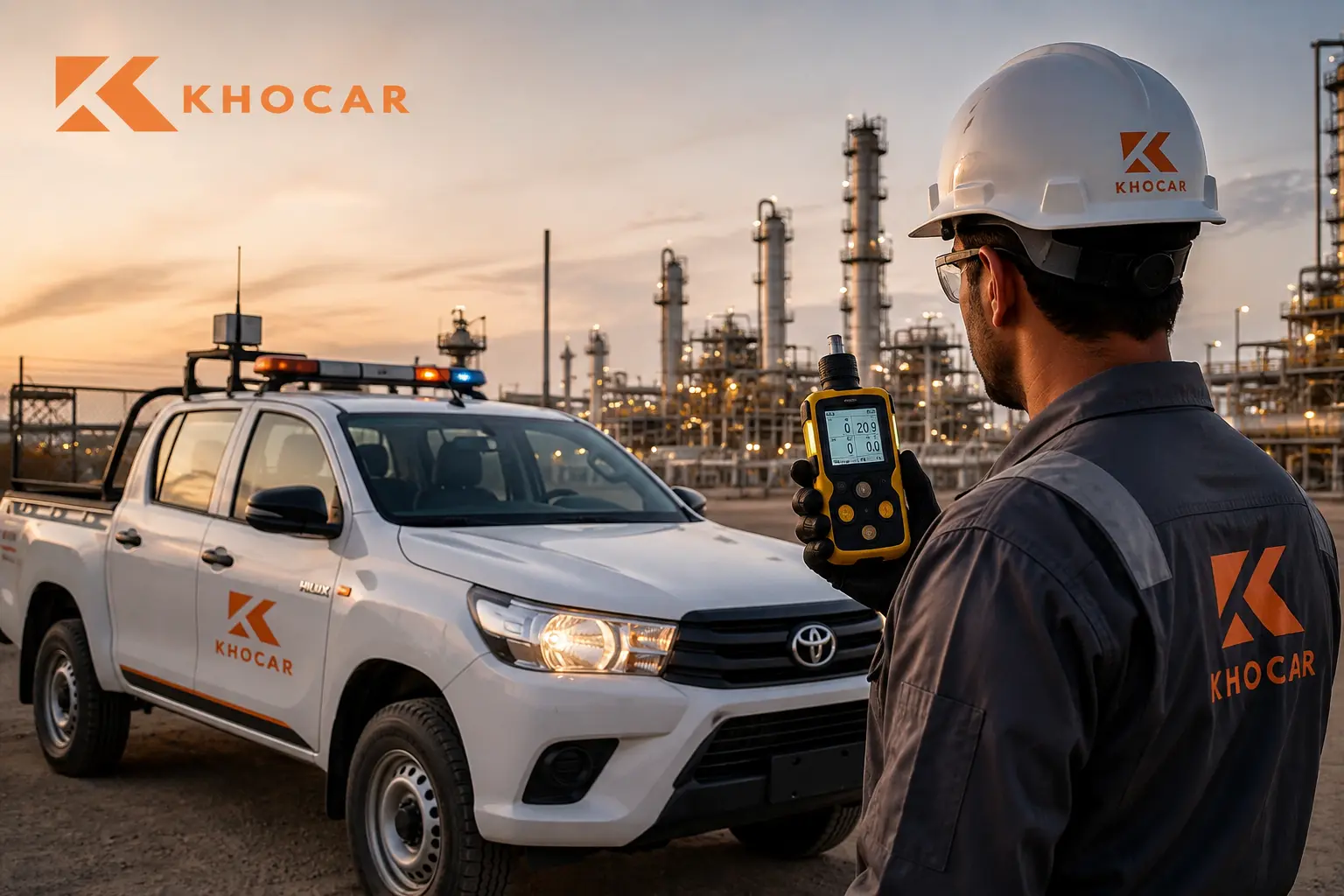
A vehicle can be mechanically perfect and still be a serious concern inside a hazardous oilfield area. In a Zone 2 environment, the risk is not that flammable gas is present continuously; the risk is that an abnormal release can create an explosive atmosphere for a short period while a running engine, hot exhaust, electrical circuit, or other ignition source is nearby. That is where a Zone 2 gas detection system UAE contractors use for vehicles becomes more than another piece of safety equipment; it becomes part of the vehicle’s ignition-risk control strategy.
A properly engineered system can detect a hazardous gas concentration, provide an audible or visual warning, and, where the project design requires it, initiate a controlled shutdown or isolation response. The exact arrangement depends on the vehicle, the gases expected, the classified area, the site HSE requirements, and the certification or equipment-protection requirements that apply. ADNOC’s published engineering guidance classifies Zone 2 as an area where an explosive gas-air mixture is not likely during normal operation but, if it occurs, exists only for a short time.
ADNOC’s hazardous-area classification guidanceand the current IEC 60079-10-1 framework provide the technical background for that classification.
Key Takeaways
- A Zone 2 vehicle gas detection system is designed to detect specified hazardous gases and trigger alarms and, where required by the system design, an automatic shutdown or isolation response.
- Zone 2 does not mean ‘no gas risk.’ It describes an area where an explosive atmosphere is not expected during normal operation but may occur briefly under abnormal conditions.
- A gas detector alone does not automatically make a vehicle Zone 2 compliant. Sensor type, Ex protection, wiring, controller, shutdown logic, installation, testing and documentation all matter.
- Vehicle gas detection commonly works as part of a wider conversion package that can include engine air-intake shutdown, exhaust spark prevention, anti-static measures, emergency isolation, warning indicators and inspection documentation.
- Sensor placement must be based on the vehicle layout, expected gas, release sources and airflow—not simply on a convenient mounting point.
- Project requirements should be confirmed before conversion. A previous approval for one site or vehicle should not be treated as universal approval for another project.
What Is a Zone 2 Gas Detection System for Vehicles?
A Zone 2 gas detection system for a vehicle is an integrated safety arrangement that monitors for specified hazardous gases around a vehicle operating in or near a classified hazardous area. Depending on the design, it may include one or more gas sensors, a controller, alarm indicators, relays or outputs, an emergency shutdown interface and supporting wiring and protection. The system is intended to give the operator a timely warning and, where the engineered cause-and-effect requires it, initiate actions that reduce the vehicle’s contribution to ignition risk.
The important distinction is between detection and compliance. Detection tells the system that a gas concentration has reached a programmed or configured threshold. Zone 2 suitability is broader: equipment used in the classified area must be appropriate for the hazardous-area classification and environmental conditions, and the complete installation must be designed, installed, inspected and maintained correctly.
IECEx guidance explains that equipment selection in classified areas is linked to the applicable Equipment Protection Level, while the IEC 60079 series provides the wider framework for explosive atmospheres.
Why Gas Detection Matters in UAE Oilfields
Oilfield vehicles operate in environments where hydrocarbons, process gases and other hazardous substances can be present around wells, separators, pipelines, storage systems, loading areas, drilling operations and production equipment. A normal road vehicle is not automatically designed around those hazards. A hot exhaust component, electrical fault or running engine can become an ignition concern if a flammable atmosphere develops.
The timing of the issue also matters. ADNOC confirmed in May 2026 that it was targeting AED 200 billion (about US$55 billion) in project awards for 2026–2028 across its value chain. That scale of planned project activity does not mean every vehicle needs the same conversion, but it reinforces the importance of contractor readiness: fleets may be mobilized quickly, and hazardous-area requirements should be identified before the vehicle reaches the gate.
ADNOC’s May 2026 project-awards announcement describes the planned 2026–2028 awards and the broader project-delivery pipeline.
For contractors, gas detection is therefore best viewed as one layer in a larger hierarchy of controls. The objective is not simply to install a sensor and hope it solves the hazardous-area problem. The objective is to understand the classified area, identify credible release and ignition scenarios, select suitable equipment, define the response and verify that the vehicle remains fit for its intended operating conditions.
How a Zone 2 Vehicle Gas Detector Works
At a basic level, the process is straightforward: a sensor samples the surrounding atmosphere, the detector converts the gas concentration into an electrical signal, a controller evaluates that signal against configured alarm conditions, and the system activates the appropriate response. The engineering challenge is making every part of that chain dependable in a moving vehicle and suitable for the hazardous area.
1. Gas enters the sensing environment.
A leak or release creates a concentration of the target gas near the vehicle. Sensor location and airflow determine how quickly the gas reaches the sensing element.
2. The sensor detects the target gas.
The sensing technology may be selected for the gas and operating environment. Combustible-gas detection may use technologies such as catalytic or infrared sensing, while toxic gases such as H₂S may require a different sensor technology.
3. The controller interprets the signal.
The control unit checks the sensor reading, fault status and configured thresholds. A robust design also distinguishes a genuine gas alarm from sensor or wiring faults.
4. The system warns the operator.
Visual indicators, audible alarms or other approved annunciation can tell the driver that a hazardous condition has been detected.
5. The defined shutdown response occurs.
Where automatic shutdown is part of the engineered system, the controller can send a signal to the appropriate shutdown device. The exact response depends on the vehicle and project cause-and-effect design.
6. The vehicle is inspected and reset according to procedure.
After an alarm or shutdown, the operator should follow the site’s emergency and reset procedure rather than simply bypassing the system and continuing to work.
Key Components of a Vehicle Gas Detection and Shutdown System
| Component | Purpose |
| Gas sensors | Detect the specific gas or gas class selected for the application. Sensor technology and certification must match the intended service. |
| Control unit | Processes sensor signals, handles alarms and faults, and provides outputs to the vehicle’s shutdown or warning functions. |
| Audible/visual alarm | Provides a clear indication to the operator. The location should allow the driver to recognize an alarm without relying on a hidden or inaccessible indicator. |
| Shutdown interface | Provides the control signal to the relevant engine or electrical isolation device when automatic shutdown is required. |
| Engine air-intake shutdown device | On diesel vehicles, an engine air-intake shutdown device such as a certified or approved air shutoff arrangement may be used where the design calls for rapid engine stopping. |
| Wiring and protection | Connections, cable routing, glands, enclosures and protection must be selected and installed for the hazardous-area and environmental conditions. |
| Power supply and isolation | The system needs a dependable power source and a controlled way to isolate or service it without creating additional hazards. |
| Test/calibration provisions | The installation should support the manufacturer’s and site’s required testing, calibration, inspection and maintenance activities. |
What Happens When Gas Is Detected?
The correct response is determined by the system’s cause-and-effect design and the site’s operating procedure. A common sequence is: detect → alarm → operator response → automatic shutdown or isolation if configured → emergency/site procedure → inspection and controlled reset.
It is important not to assume that every detector should immediately kill the engine at the first measurable trace of gas. Alarm and shutdown thresholds, time delays, voting logic, sensor faults and reset conditions should be engineered for the application. A system that shuts down too easily can create operational problems; a system that shuts down too late can fail its safety purpose. The correct balance is a project-specific engineering decision.
Gas Detection vs. Automatic Engine Shutdown: What Is the Difference?
Gas detection and automatic shutdown are related but different functions. A detector identifies the hazardous condition. A shutdown system changes the vehicle’s operating state in response to that condition. For a vehicle entering a hazardous area, the shutdown function can be especially important because stopping the engine may remove or reduce an ignition source.
| Function | What it does | Why it matters |
| Detection | Measures a target gas concentration. | Creates early awareness of a hazardous atmosphere. |
| Alarm | Alerts the operator. | Allows the driver to stop, move away or follow the site emergency procedure. |
| Automatic shutdown | Initiates a predefined shutdown/isolation action. | Can reduce ignition risk when continued operation is unsafe. |
| Fault monitoring | Identifies sensor, power or circuit faults. | Prevents a false sense of security when the system itself is impaired. |
Where Should Gas Sensors Be Installed on a Vehicle?
There is no universal ‘best spot’ for a vehicle gas detector. Sensor placement should be based on the gas’s physical characteristics, likely release points, vehicle geometry, ventilation, heat sources, shielding and the way the vehicle is expected to operate.
- Near credible release points identified by the vehicle and site risk assessment.
- Where airflow is likely to carry the target gas to the sensor rather than away from it.
- At a height appropriate to the gas being detected. Gas density matters, but real vehicle airflow and turbulence also matter.
- Away from exhaust heat, direct water impact and contamination sources that could damage or distort sensor performance.
- In locations that can be inspected, tested and maintained without unsafe access.
- Where cable routing and the enclosure arrangement remain appropriate for the classified environment.
For example, a detector intended for combustible hydrocarbon gas should not automatically be mounted at the lowest point of a pickup just because someone assumes ‘gas is heavy.’ The correct location depends on the target gas, possible release sources and actual airflow around the vehicle. H₂S also requires particular attention because it is both toxic and flammable under the right conditions, while its behavior around a vehicle depends on release and ventilation conditions.
What Gases Can Vehicle Systems Detect?
The answer depends on the site hazard assessment and the intended sensor technology. In UAE oilfield environments, contractors may encounter combustible hydrocarbon gases and toxic gases such as hydrogen sulfide. A system should be specified for the gases that are credible for the operating area rather than selected solely because a particular detector is commonly used.
| Gas / hazard | Typical detection objective | Important consideration |
| Combustible hydrocarbon gas | Detect a developing flammable atmosphere, often expressed relative to LEL. | Sensor technology and alarm thresholds must match the gas and application. |
| Methane / natural gas | Detect combustible gas releases where methane is a credible hazard. | Placement and sensor technology should account for the gas’s behavior and vehicle airflow. |
| Hydrogen sulfide (H₂S) | Detect toxic exposure risk and, where relevant, flammability risk. | Requires the appropriate toxic-gas sensor technology and site-specific alarm strategy. |
| Other process gases | Detect other gases identified by the site risk assessment. | Do not assume a generic hydrocarbon detector covers every process gas. |
Zone 2, ATEX, IECEx and Ex Equipment: What Contractors Should Know
One of the most common misunderstandings is treating ‘gas detector,’ ‘Zone 2 detector,’ ‘ATEX detector’ and ‘IECEx detector’ as interchangeable terms. They are not. A gas detector is a functional device. ATEX is a European regulatory framework for equipment and protective systems intended for potentially explosive atmospheres. IECEx is an international certification system supporting equipment and service-facility conformity to relevant IEC standards.
The IECEx system’s published material explains how equipment selection in hazardous zones is connected to the applicable Equipment Protection Level. The current IEC 60079 series provides the broader technical framework for explosive-atmosphere equipment and installations.
For a vehicle, the practical question is therefore not simply ‘Does the detector have an ATEX label?’ The questions are: Is the equipment certification appropriate for the classified area? Is the equipment suitable for the gas and temperature range? Is the complete installation correct? Are the wiring and accessories appropriate? Has the system been inspected and documented? And does the installation satisfy the project’s specific requirements?
IEC 60079-10-1:2020 addresses classification of areas where flammable gas or vapour hazards may arise and provides the basis for selecting equipment and controls appropriate to hazardous areas.
Typical Zone 2 Gas Detection Requirements for UAE Oilfield Vehicles
There is no single public checklist that should be treated as a universal approval matrix for every UAE oilfield vehicle. Requirements can vary by operator, project, site classification, vehicle function, work method and inspection process. However, a contractor preparing a vehicle should be ready to address the following areas:
- Confirmed hazardous-area classification and intended operating location.
- Target gases identified by the project or site risk assessment.
- Suitable gas detector technology and hazardous-area protection/certification.
- Sensor locations justified by the release scenario and vehicle airflow.
- Audible and visual alarm arrangements visible/audible to the driver.
- Automatic shutdown or isolation where required by the project cause-and-effect design.
- Engine shutdown equipment appropriate to the vehicle and fuel/engine type.
- Electrical and wiring modifications that do not introduce new ignition hazards.
- Appropriate cable routing, glands, enclosures and mechanical protection.
- Anti-static measures and bonding/grounding where required.
- Testing, calibration and functional verification records.
- Inspection-ready documentation and labels/identification where required.
How Gas Detection Fits Into the Wider Zone 2 Vehicle Conversion
Gas detection should not be treated as a standalone accessory. KhoCAR’s existing Zone 2 guidance describes a broader conversion process that may include gas detection and shutdown, exhaust spark prevention, anti-static measures, electrical safety, warning indicators and documentation.
KhoCAR’s Zone 2 vehicle conversion checklist provides a practical pre-conversion framework for contractors preparing vehicles for ADNOC-related site access.
- Gas detection: identifies hazardous gas conditions.
- Automatic shutdown: reduces the vehicle’s operating ignition potential when the defined alarm condition occurs.
- Spark arrestor/exhaust controls: address potential ignition sources associated with exhaust systems.
- Engine air-intake shutdown: can stop a diesel engine when the engineered system requires it.
- Anti-static controls: reduce the likelihood of electrostatic discharge becoming an ignition source.
- Electrical protection: addresses wiring, accessories and components that could produce sparks or hot surfaces.
- Documentation: gives the project and inspection team evidence of what was installed, tested and verified.
Example: Service Pickup Entering a Zone 2 Wellsite
Imagine a contractor sending a diesel pickup to a wellsite for a maintenance job. The vehicle carries tools, a battery-powered test kit and additional electrical equipment. The driver may need to park near production equipment and remain on site for several hours.
The project team identifies the work area as Zone 2 and specifies combustible-gas detection with an automatic shutdown response. The vehicle is assessed before mobilization. The assessment identifies the expected gas hazard, confirms the detector technology and mounting locations, checks the electrical installation, verifies the shutdown interface and reviews other ignition-source controls.
During operation, the detector registers an elevated combustible-gas concentration. The alarm activates. If the reading reaches the configured shutdown condition, the shutdown circuit initiates the predefined engine response. The driver then follows the site’s emergency procedure rather than treating the shutdown as a nuisance fault.
The important lesson is that the detector is only one part of the safety chain. The value comes from the combination of detection, a defined response, suitable equipment and correct installation.
Example: Mobile Workshop With Auxiliary Equipment
Now consider a mobile workshop with an engine, auxiliary generator, battery banks, lighting, welding equipment and additional electrical accessories. Compared with a simple pickup, it has more potential ignition sources and a more complicated electrical architecture.
A gas detection system may need multiple sensors and a more deliberate cause-and-effect strategy. The conversion assessment should consider what happens to the auxiliary systems when gas is detected: Does the generator stop? Are non-essential circuits isolated? Does the main engine shut down? Which functions must remain available for emergency response? Those decisions should come from the project risk assessment and approved design, not from a generic ‘one-size-fits-all’ kit.
This is why vehicle complexity can change both the conversion scope and the time needed for testing and documentation.
Inspection, Testing and Maintenance
Installing a detector is not the finish line. Gas detection systems require ongoing inspection and maintenance because sensors can drift, become contaminated, suffer physical damage or reach the end of their service life. Vehicle vibration, dust, water, heat and frequent engine-bay maintenance can also affect installation integrity.
- Functional-test the detection and alarm chain according to the manufacturer’s and site’s requirements.
- Verify the shutdown response where automatic shutdown is part of the approved system.
- Inspect sensor condition, mounting and cable entries.
- Check alarm indicators and operator visibility/audibility.
- Maintain calibration or bump-test records as required by the sensor technology and site procedure.
- Investigate repeated alarms instead of repeatedly bypassing or resetting the system.
- Reassess the installation after major vehicle modifications, electrical additions or changes in operating location.
IECEx material on hazardous-area equipment and installations emphasizes that equipment selection, installation, inspection and maintenance are part of controlling explosion hazards.
Common Mistakes That Cause Zone 2 Vehicle Delays
Buying a generic detector first: A detector selected without knowing the gas, zone, certification and vehicle design may not meet the project requirement.
Assuming detection equals compliance: A sensor does not address every ignition source on a vehicle.
Poor sensor placement: A convenient location can be a poor location if airflow or gas behavior prevents timely detection.
Ignoring auxiliary electrical systems: Generators, lighting, inverters, battery banks and added accessories can change the ignition-risk profile.
Skipping documentation until the end: Missing certificates, test records or installation details can delay inspection and site access.
Treating an old conversion as permanently valid: Vehicle modifications, site rules and project requirements can change.
Bypassing nuisance alarms: Repeated alarms can indicate sensor placement, calibration, contamination or a real process hazard; bypassing the system defeats its purpose.
Waiting until mobilization week: Late discovery of the required scope leaves less time for parts, installation, testing and rework.
How to Prepare a Vehicle Before Zone 2 Gas Detection Installation
A contractor can make the assessment faster by providing complete information at the start. KhoCAR’s published Zone 2 checklist recommends collecting vehicle details, site requirements, photos, previous modification history and project deadlines before requesting conversion support.
- Vehicle make, model and year.
- Fuel type and engine details.
- Clear photographs of the engine bay, exhaust, dashboard, battery area and any auxiliary equipment.
- A list of electrical accessories and aftermarket modifications.
- The intended site, work area and project/operator.
- Any written HSE, site-access or Zone 2 instruction received from the client.
- Required mobilization date.
- Previous Zone 2 certificates, inspection records or modification documents, if available.
- Details of generators, compressors, welding systems, lighting, inverters or other auxiliary equipment carried by the vehicle.
KhoCAR’s Zone 2 conversion cost guide also explains why vehicle type, gas detection/shutdown, electrical work, exhaust controls, documentation and project urgency can affect the final conversion scope.
Why Zone 2 Gas Detection Is Becoming More Important for UAE Contractors
The UAE’s oil and gas project environment continues to demand faster contractor mobilization while maintaining strict safety controls. ADNOC’s 2026 project-awards announcement points to substantial activity across its upstream and downstream value chain, while its Industrial Resilience Program emphasizes stronger supply-chain capability and local project delivery.
ADNOC’s Industrial Resilience Program announcement highlights the company’s focus on supply-chain resilience and project execution.
For fleet managers, the practical takeaway is simple: hazardous-area vehicle readiness should be planned alongside procurement and mobilization, not after the vehicle has already been assigned to a site. A well-scoped gas detection and shutdown system can help reduce ignition risk, but only when it is engineered as part of the complete vehicle conversion and supported by testing, maintenance, and documentation.
Related KhoCAR Resources
Zone 2 Installation & Certification in Abu Dhabi — For contractors needing Zone 2 installation and certification support for vehicles and equipment.
Zone 2 Vehicle Conversion Checklist for ADNOC Site Access — A practical pre-conversion checklist covering vehicle details, ignition-source controls, gas detection, anti-static measures and documentation.
Which Vehicles Need Zone 2 Conversion for ADNOC Projects in the UAE? — Useful when deciding which fleet vehicles should be assessed before project mobilization.
Zone 2 Vehicle Conversion Cost in Abu Dhabi — Explains the factors that can change conversion scope, cost and timeline.
Oilfield Services & Industrial Supplies in the UAE — For broader oilfield equipment, industrial supplies and maintenance support.
Need a Zone 2 Gas Detection System for Your Vehicle in Abu Dhabi?
If your vehicle or mobile equipment is being prepared for an ADNOC-related oilfield, gas facility, wellsite, drilling area or other hazardous operating environment, the right time to review gas detection requirements is before mobilization. KhoCAR can assess the vehicle and help identify the appropriate Zone 2 installation scope, including gas detection and shutdown requirements, ignition-source controls and inspection documentation.
Request Zone 2 Installation & Certification from KhoCAR and provide the vehicle make/model, photos, intended site, fuel type, project deadline and any written HSE requirement you have received.
FAQs
What is a Zone 2 gas detection system UAE contractors use for vehicles?
It is a vehicle-mounted gas monitoring arrangement designed to detect specified hazardous gases around a vehicle operating in or near a Zone 2 hazardous area. Depending on the approved design, it can provide alarms and initiate automatic shutdown or isolation when configured thresholds are reached.
Does every Zone 2 vehicle need a gas detector?
Not necessarily. Requirements depend on the classified area, vehicle type, intended work, credible gas hazards and project/site HSE requirements. A vehicle should be assessed against the actual site requirement rather than assuming that every Zone 2 vehicle needs an identical detector package.
What is a Zone 2 vehicle gas detector?
A Zone 2 vehicle gas detector is a gas-sensing device selected and installed for use in a hazardous-area vehicle application. The detector itself must be appropriate for the gas, environmental conditions and hazardous-area protection requirements; simply detecting gas does not make a device suitable for Zone 2.
What gases can a Zone 2 vehicle gas detection system detect?
The system can be configured for the gases identified by the site’s risk assessment. Common oilfield hazards include combustible hydrocarbon gases and toxic gases such as hydrogen sulfide. Different gases can require different sensor technologies, alarm strategies and placement considerations.
How does automatic gas shutdown work on a vehicle in the UAE?
A sensor sends its measurement to a controller. If the reading reaches a defined alarm or shutdown condition, the controller can activate the approved shutdown interface. Depending on the vehicle, this may stop the engine, isolate selected systems or initiate another predefined response. The exact cause-and-effect should be engineered for the application.
Is a gas detector enough for ADNOC Zone 2 vehicle approval?
No. Gas detection is only one potential part of a wider Zone 2 conversion. The vehicle may also require controls for exhaust sparks, engine shutdown, electrical systems, static discharge, warning indicators, documentation and inspection. Final acceptance depends on the applicable project and site requirements.
Where should a gas detector be installed on an oilfield vehicle?
Sensor location should be selected based on the target gas, likely release points, vehicle geometry, airflow, environmental exposure and maintenance access. There is no universal mounting location that is correct for every vehicle.
Are ATEX and IECEx certificates important for Zone 2 vehicle gas detection?
They can be important because hazardous-area equipment must have suitable protection and certification for its intended application. The exact certification required should be confirmed against the project, zone, equipment protection concept and applicable standards. A certificate should be checked for the actual equipment and intended use, not treated as a generic label.
How often should a Zone 2 vehicle gas detector be tested?
The required testing, bump testing, calibration and maintenance interval depends on the sensor manufacturer, technology, site procedure and project requirements. The system should be maintained according to the applicable instructions and any site-specific inspection regime.
Can a Zone 2 gas detection system be installed on an existing pickup truck?
In many cases, an existing vehicle can be assessed and modified, but the scope depends on the vehicle’s engine, electrical system, accessories, exhaust, operating location and project requirements. The vehicle should be evaluated before parts are selected so the conversion is engineered as a complete system.
What information should I send a Zone 2 conversion company before requesting a quote?
Provide the vehicle make/model/year, fuel type, engine details, clear photos, electrical accessories, intended site, work area, project/operator, deadline and any written HSE or site-access instructions. Previous certificates and modification records are also useful.
Who provides Zone 2 vehicle gas detection and conversion support in Abu Dhabi?
KhoCAR provides Zone 2 installation and certification support in Abu Dhabi for vehicles and equipment used in hazardous oil and gas environments. Contractors can contact the team with vehicle and project details to determine the likely conversion scope.