
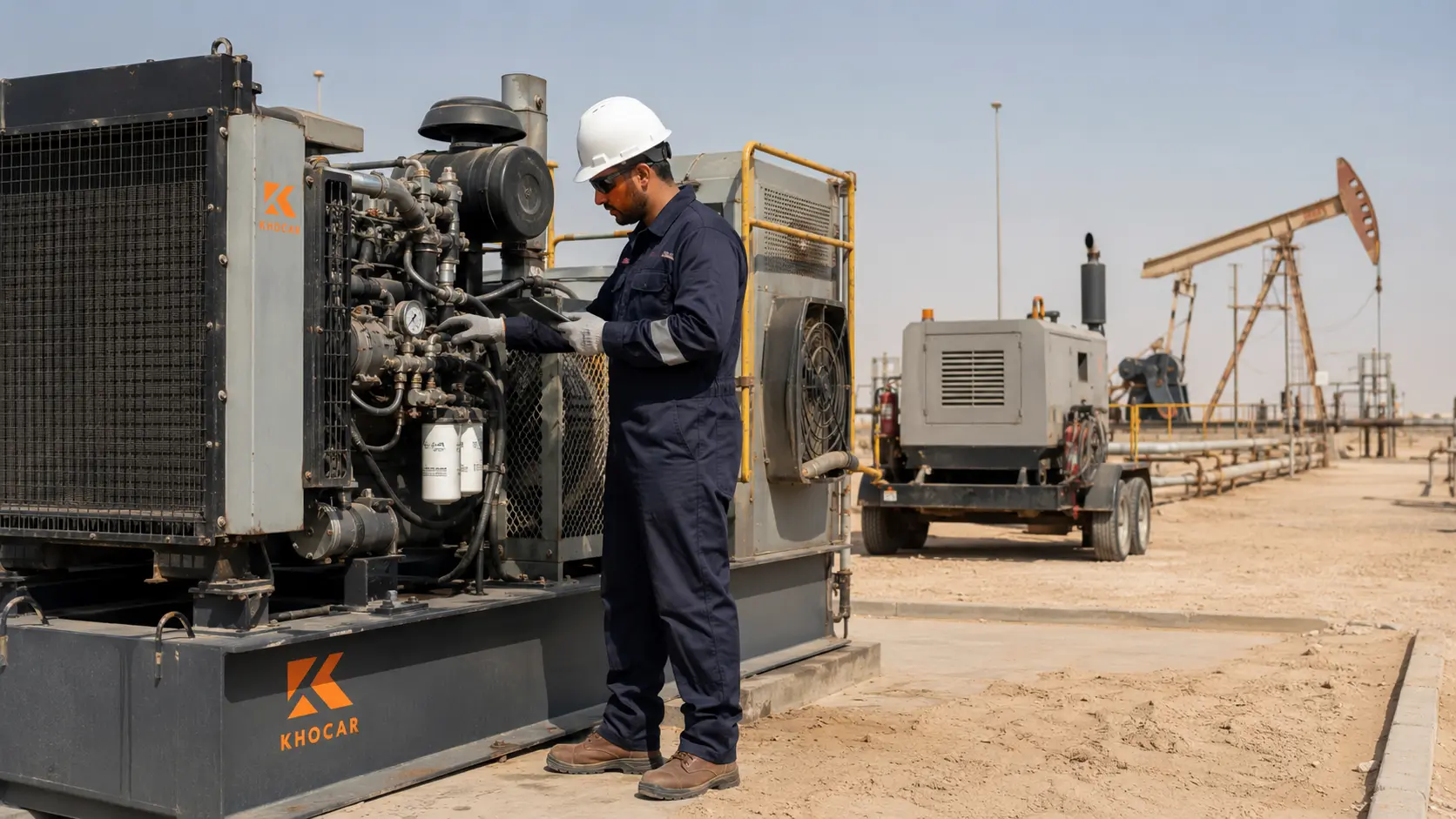
A maintenance checklist becomes valuable only when it changes what the crew does before equipment fails. That point is especially important in UAE oilfield operations, where heat, airborne dust, long duty cycles, remote mobilization, and high-consequence pressure systems can turn a small leak, loose terminal, or blocked cooler into downtime, or a serious safety event.
The urgency is current: IOGP’s June 2026 review of member-company data reported 52 fatalities in 2025, a 75% increase in the fatal accident rate from 2024. Maintenance was among the most frequent activities associated with fatal incidents, and 85% of those incidents involved a breach of at least one IOGP Life-Saving Rule. An effective oilfield equipment maintenance checklist therefore needs more than boxes marked “OK.”
It should identify the asset, define the correct inspection frequency, compare readings with limits or baselines, assign defects, verify isolation, record the repair and prove the equipment was safely returned to service.
This guide provides a practical structure for engines, generators, pumps, compressors, hydraulic systems, wireline units, pressure-control equipment and mobile support assets across Abu Dhabi and the wider UAE.
Key Takeaways
- A checklist is a control system, not a memory aid: every failed item needs an owner, priority, deadline, work order and close-out verification.
- Use the OEM manual, current project requirement, equipment history and risk assessment to set intervals; the sample frequencies in this guide are planning prompts, not universal legal or ADNOC requirements.
- Separate pre-use inspection from scheduled preventive maintenance, condition-based monitoring, statutory or third-party inspection, and corrective repair.
- UAE severity factors—high ambient heat, dust, long idling, remote operation, coastal humidity and salt exposure—can justify shorter inspection or service intervals.
- Safety-critical systems such as pressure containment, emergency shutdown, gas detection, hazardous-area electrical protection, lifting devices and guards require competent inspection and traceable proof testing.
- The most useful maintenance records capture readings, defects, photographs, parts, technician identity, calibration status and the final functional test—not only a signature.
Quick answer: A practical oilfield equipment maintenance checklist covers equipment identity, safety isolation, visual condition, fluids and lubrication, mechanical integrity, hydraulics, electrical and control systems, pressure containment, guards and emergency devices, operating readings, defect escalation and return-to-service verification. The exact tasks and intervals must be customized to the asset, duty, environment, OEM instructions and the current UAE project or operator requirement.
Why Preventive Maintenance Matters in UAE Oilfield Operations
Oilfield equipment rarely fails in isolation. A blocked radiator increases temperature; heat degrades oil and seals; leakage attracts dust; contamination accelerates wear; the operator compensates by working the machine harder; and a manageable maintenance issue becomes a hydraulic, engine or production problem. The purpose of preventive maintenance is to interrupt that chain while the equipment is still controllable.
The safety case is equally important. The UK Health and Safety Executive’s major-hazard maintenance guidance identifies failure of safety-critical equipment, human error, poor communication, incorrect spares, inadequate isolation and faulty recommissioning as contributors to major accidents. Although HSE guidance is not UAE law, the failure mechanisms are directly relevant to oil and gas work everywhere. [HSE maintenance procedures]
The checklist must control three outcomes
- Safety: prevent uncontrolled energy, loss of containment, fire, explosion, dropped objects and unexpected movement.
- Availability: detect degradation early enough to plan labor, parts, tools, transport and a suitable maintenance window.
- Evidence: create an auditable record showing what was checked, what was found, what was repaired and who accepted the return to service.
This is why “inspect equipment regularly” is not an adequate task. A useful task states what to inspect, the method, the acceptable condition, the frequency or trigger, who is competent to do it, what reading to record and what action follows a failed result.
Inspection, Preventive Maintenance, Predictive Maintenance and Repair Are Different
| Maintenance type | Trigger | Primary purpose | Typical evidence |
| Pre-use inspection | Before a shift, use or mobilization | Find visible or functional defects before exposure begins | Operator checklist, photos, meter readings |
| Preventive maintenance | Calendar, hours, cycles or mileage | Replace, clean, adjust, lubricate and test before expected deterioration | Planned work order and service record |
| Condition-based maintenance | When trends or thresholds change | Intervene based on measured condition | Vibration, oil analysis, thermography, pressure or temperature trend |
| Corrective maintenance | After a defect is found | Restore required function and integrity | Repair record, parts traceability and verification |
| Breakdown maintenance | After functional failure | Recover failed equipment | Emergency work order and root-cause review |
| Statutory / project inspection | At a defined legal, certification or client interval | Demonstrate conformity to the governing scope | Certificate, inspection report or test record |
A single form should not blur these activities. An operator may be competent to record a leak, noise or gauge reading but not to dismantle a pressure-control device, alter a hazardous-area enclosure or certify lifting equipment. The checklist should route the finding to the right level of competence.
How to Build an Oilfield Equipment Maintenance Checklist
Begin with the asset register, not with a generic template downloaded from the internet. ISO 14224 is specifically concerned with collecting and exchanging reliability and maintenance data for equipment in petroleum, petrochemical and natural-gas industries. ISO 55000 provides the broader asset-management principles. Together, they support a disciplined approach: identify the asset, define its function and criticality, capture failure information consistently and use the history to improve decisions. [ISO 14224] [ISO 55000]
Step 1: Identify the asset and its duty
- Unique asset number, serial number, make, model and equipment family.
- Location, project, operating area and whether the asset enters a hazardous area.
- Engine hours, running hours, cycles, mileage or other usage counter.
- Primary function, process fluid, pressure, temperature, load and duty cycle.
- OEM manual revision, drawings, parts list and applicable certificates.
- Known failure modes, safety function, environmental exposure and maintenance history.
Step 2: Rank criticality before assigning frequency
Criticality is not the purchase price. Ask what happens if the item fails: Could it release pressure or hydrocarbons? Defeat a shutdown? Drop a load? Immobilize the only service unit at a remote site? Damage an expensive cable or well tool? Delay a short intervention window? A low-cost seal, sensor or relay can be more operationally critical than a large non-essential component.
| Class | Failure consequence | Maintenance implication |
| A — Safety / production critical | Failure could cause serious harm, loss of containment, failed protection or immediate operational stop. | Defined inspection and proof-test regime; strict overdue control; approved spares. |
| B — Operationally important | Failure reduces capacity, quality or schedule but redundancy or recovery exists. | Planned PM plus condition trends and controlled backlog. |
| C — Support / low consequence | Failure has limited immediate consequence and can be isolated safely. | Economical PM or run-to-failure where formally justified. |
Step 3: Use four kinds of trigger
- Time based: each shift, weekly, monthly, quarterly or annually.
- Usage based: engine hours, pump hours, winch cycles, starts, kilometres or lifts.
- Condition based: vibration, temperature, pressure, oil cleanliness, leakage, wear or electrical test results.
- Event based: after overload, shutdown trip, hose burst, impact, transport, repair, prolonged storage, abnormal alarm or change of site.
Interval rule: Never copy a calendar interval without checking the OEM manual, certificate schedule, governing inspection requirement, actual duty and failure history. Shorten an interval when the evidence shows faster deterioration; extend it only through an approved, documented review.
Master Oilfield Equipment Preventive Maintenance Checklist
The checklist below is intentionally system-based so it can be adapted to a generator, pump skid, compressor, hydraulic power unit, wireline truck or mobile workshop. “Pass” should mean the defined acceptance condition is met—not merely that someone looked at the item.
| System | Minimum verification | Escalate when |
| Identification and records | Asset ID, meter reading, location, operator, last/next service and open defects match the current record. | Wrong asset, unreadable plate, overdue task or missing certificate. |
| Work area and isolation | Permit, JSA, energy sources, depressurization, draining, blocking and lockout points are identified. | Stored pressure, unexpected movement, live electrical energy or hydrocarbon exposure. |
| General condition | No loose, missing, cracked, bent, corroded or improvised parts; covers and access panels secure. | Structural damage, unauthorized modification or missing fasteners. |
| Leaks and containment | No fuel, oil, coolant, hydraulic, air, gas or process-fluid leakage beyond the defined limit. | Active leak, staining that indicates progression or failed secondary containment. |
| Fluids and lubrication | Correct grade, level, condition, sampling point and change status; no cross-contamination. | Low level, water, foam, burnt odor, metal debris or wrong lubricant. |
| Cooling and filtration | Radiators, coolers, fans, breathers, filters and restriction indicators are clean and functional. | Blocked fins, bypass indication, damaged fan, high differential pressure. |
| Mechanical drive | Belts, couplings, bearings, shafts, mounts and guards are secure, aligned and within condition limits. | Abnormal play, heat, vibration, noise, cracking or missing guard. |
| Hydraulic and pneumatic | Hoses, tubes, fittings, cylinders, accumulators, valves and gauges show correct condition and response. | Abrasion, bulge, exposed reinforcement, drift, pressure instability or damaged restraint. |
| Electrical and controls | Cables, batteries, terminals, earthing, enclosures, sensors, alarms and emergency stops are intact and tested. | Loose terminal, damaged gland, bypassed interlock, fault code or failed shutdown. |
| Pressure integrity | Pressure boundaries, flanges, valves, gauges, relief devices and supports match the approved configuration. | Leakage, corrosion, damage, missing seal, overdue test or out-of-range indication. |
| Lifting and load handling | Wire rope, drum, sheaves, hook, latch, brake, limit device, structure and certification are acceptable. | Broken wires, crushing, distortion, brake slip, limit failure or expired inspection. |
| Functional test | Startup, no-load and operating checks show stable pressure, temperature, vibration, speed and control response. | Reading outside limit, unstable trend, alarm, excessive smoke, noise or heat. |
| Close-out | Defects are classified, tagged, assigned and closed; tools removed; guards restored; return-to-service approved. | Unsigned repair, open critical defect, missing test evidence or uncontrolled configuration change. |
Suggested Frequency Structure for UAE Operations
The following cadence is a planning framework. It deliberately avoids pretending that every pump, compressor or pressure device has the same interval. Replace the examples with the exact OEM, site, certificate and reliability requirements for each asset.
| Frequency / trigger | Typical scope | Typical owner |
| Before each shift / use | Leaks, damage, fluid levels, guards, hoses, cables, alarms, emergency stops, gauges, tires/supports and open-defect status. | Operator |
| During operation | Noise, vibration, temperature, pressure, flow, smoke, leakage, filter restriction and alarm trends. | Operator / field technician |
| End of shift | New defects, cleanliness, consumables, meter reading, abnormal events and handover notes. | Operator |
| Weekly | Fasteners, mounts, cooler cleaning, battery terminals, belt/drive condition, hose routing, corrosion and functional safety checks. | Maintenance technician |
| Monthly | Lubrication tasks, filters by condition, calibration status, electrical terminations, shutdown tests and backlog review. | Competent maintenance team |
| Quarterly / scheduled hours | Oil sampling, vibration route, thermal survey, alignment indicators, wear measurements and critical-spares review. | Specialist as required |
| Annual / certificate interval | Major service, pressure or load testing, hazardous-area inspection, lifting inspection and protection-system proof testing. | Authorized / competent person |
| Event triggered | Inspection after overload, trip, impact, repair, transport, storage, hose failure, contamination or site change. | Defined by event and system |
IOGP’s Start Work Checks provide a useful human-performance principle: the safeguards should be verified at the job location immediately before the activity begins, with a second set of eyes where the check requires a verifier. If a safeguard cannot be confirmed, the work should pause and the crew should seek help. This complements—not replaces—the technical PM schedule. [IOGP Start Work Checks]
Equipment-Specific Preventive Maintenance Checks
Diesel engines and generators
- Record hours and compare the next service with the OEM schedule; do not reset the counter without closing the work order.
- Check engine oil, coolant, fuel-water separator, air-filter restriction and visible fuel or exhaust leakage.
- Inspect radiator and charge-air-cooler faces for dust, oil film and blocked airflow; verify fan, shroud and belt condition.
- Check battery state, terminals, cables, mounting and charging behavior; investigate slow cranking rather than repeatedly boosting.
- Run under a representative load where the procedure requires it and trend oil pressure, coolant temperature, voltage, frequency and smoke.
- For hazardous-area use, separately verify the approved ignition-control and shutdown configuration; ordinary engine PM does not prove Zone 2 suitability.
Hydraulic power units, winches and mobile machinery
- Check reservoir level using the specified machine position and temperature condition; inspect oil for foam, water, discoloration or burnt odor.
- Inspect every hose along its full length for abrasion, cracking, bulges, exposed reinforcement, leakage and unsafe routing near heat or sharp edges.
- Confirm cylinders hold position without abnormal drift and rods are clean, straight and free from scoring or corrosion.
- Review filter restriction indicators, breather condition, cooler cleanliness, fan performance and operating-temperature trend.
- Listen for cavitation-like noise and compare hot versus cold performance; falling force after warm-up can indicate internal leakage or viscosity problems.
- Use safe hydraulic practices: depressurize stored energy, support raised components and never search for a pinhole leak with a hand.
For more detail on heat-related hydraulic failure modes, see KhoCAR’s guide to hydraulic system overheating in UAE summer.
Pumps and rotating equipment
- Inspect seals, packing, flanges, drains and baseplate for leakage or movement; define what leakage rate is acceptable for the specific design.
- Trend suction and discharge pressure, differential pressure, flow, bearing temperature, vibration and motor current under comparable operating conditions.
- Verify lubrication level and condition, coupling guard, alignment indicators, anchor bolts, pipe supports and evidence of soft foot or strain.
- Investigate cavitation symptoms—crackling noise, unstable flow, vibration or damage—by checking suction conditions, blockage, fluid temperature and operating point.
- After seal or coupling work, confirm correct rotation, prime or vent as required, inspect for leaks and compare readings with the pre-repair baseline.
Compressors and pneumatic systems
- Check lubricant, separator condition, intake filtration, cooling path, condensate drains and abnormal oil carryover.
- Trend suction/discharge pressure and temperature, vibration, noise and loading/unloading behavior.
- Inspect hoses, receivers, fittings, guards and pressure-relief devices; isolate and depressurize before opening any part of the system.
- Verify shutdowns, alarms and automatic controls by the approved test method; a screen indication alone may not prove the final element moved.
- Review any surge, high-temperature trip or repeated unload event before restart instead of clearing the alarm and continuing.
Wireline and slickline units
- Inspect drum, level-wind, bearings, guards, brakes, controls and emergency stop; confirm smooth operation without binding or abnormal noise.
- Examine cable or line condition using the approved inspection method and rejection criteria; record damage location and relevant service history.
- Check depth, tension, pressure and other measurement systems for calibration status, connector condition and stable response.
- Inspect hydraulic drives, hoses, cylinders, coolers and reservoir condition under the unit’s real operating cycle.
- Verify vehicle/skid structure, mounts, stabilizers, earthing and the full hazardous-area configuration where applicable.
KhoCAR provides dedicated wireline logging unit repair and preventive maintenance in Abu Dhabi, including mechanical, electrical and hydraulic support.
Pressure-control equipment and high-pressure accessories
Pressure-control equipment must be maintained to the manufacturer’s procedure, approved pressure rating, material specification and governing test scope. Check identification, pressure rating, connection condition, sealing surfaces, elastomers, valves, gauges, restraints, corrosion, storage protection and test status. Do not improvise pressure tests or treat a visual inspection as proof of pressure integrity.
Review KhoCAR’s slickline and pressure-control equipment resources when planning compatible tools and accessories.
Hazardous-area electrical equipment and safety systems
IEC 60079-17:2023 covers inspection and maintenance factors directly related to electrical installations designed for hazardous areas. For relevant oilfield equipment, inspect markings, enclosure integrity, fasteners, glands, seals, bonding, earthing, visible damage and unauthorized modification according to the required inspection grade and competent-person procedure. Gas detectors, emergency stops, overspeed devices and shutdown circuits also need calibration or functional proof testing under their own approved regimes. [IEC 60079-17:2023]
Adjust the Checklist for UAE Heat, Dust and Corrosion
| UAE severity factor | Maintenance effect | Checklist adjustment |
| High ambient heat | Reduced cooling margin; faster lubricant and seal stress; battery and electronics temperature. | Trend temperature under comparable load; clean coolers; confirm oil grade, fan performance and duty-cycle limits. |
| Airborne dust and sand | Blocked filters/coolers, contaminated fluids, abrasive wear and damaged seals. | Increase visual checks; protect filling points; cap hoses/fittings; use restriction indicators and cleanliness controls. |
| Coastal humidity and salt | Electrical connection corrosion, coating breakdown, seized fasteners and structural corrosion. | Inspect glands, terminals, earth points, coatings and hidden moisture traps; preserve stored equipment. |
| Long idling / light loading | Soot, incomplete warm-up, battery undercharge and aftertreatment issues. | Review operating practice; include representative-load checks where approved; trend faults and regeneration history. |
| Remote sites | Long parts lead time, delayed specialist response and limited recovery options. | Hold critical spares, test kits and recovery plans; close defects before mobilization. |
| Frequent transport | Vibration, loose mounts, shifted guards, hose chafe and connector damage. | Add post-transport inspection and event-triggered functional testing. |
Avoid a blanket statement such as “service twice as often in summer.” The correct adjustment depends on the asset and evidence. If filter restriction, oil condition, temperature, leakage or failure history worsens during hot months, shorten the relevant task interval and record why. That produces a defensible maintenance plan instead of a seasonal guess.
Use Condition Monitoring to Find Deterioration Earlier
Preventive maintenance based only on the calendar can replace good parts too early and still miss failures that develop randomly. Condition monitoring adds measured evidence. The U.S. Department of Energy’s O&M Best Practices Guide describes techniques such as vibration analysis, infrared thermography, lubricant and wear-particle analysis, ultrasonic testing and electrical monitoring, while repeatedly deferring to manufacturer recommendations and trained personnel. It is a general facilities guide—not a UAE oilfield standard—but the monitoring principles are transferable. [U.S. DOE O&M Best Practices Guide]
| Technique | Useful applications | Good practice |
| Vibration | Bearings, shafts, couplings, pumps, compressors, motors | Trend change from a stable baseline; diagnose frequency content rather than using feel alone. |
| Oil analysis | Engines, gearboxes, hydraulics, compressors | Viscosity, contamination, water, oxidation and wear metals interpreted for the oil and machine. |
| Thermography | Electrical panels, bearings, couplings, coolers | Compare like-for-like load and ambient conditions; investigate abnormal temperature patterns. |
| Ultrasound | Air/gas leaks, bearings, steam or valve leakage | Use a repeatable route and baseline; confirm the source before repair. |
| Performance trending | Pumps, compressors, generators, hydraulics | Pressure, flow, temperature, current, speed and fuel/energy use under comparable duty. |
| Visual / dimensional | Ropes, hooks, hoses, seals, corrosion, wear parts | Use defined rejection criteria, measurement tools and photographs where appropriate. |
Trend, do not merely collect: A temperature or vibration reading without asset ID, location, load, speed, ambient condition, instrument and prior baseline may be difficult to interpret. Record context so a future technician can compare like with like.
Turn Checklist Findings into Controlled Work
The inspection is incomplete until the result reaches a decision. A green tick closes an acceptable check. Anything else needs a defined route: monitor, plan repair, restrict use, isolate immediately or refer to engineering. The decision should be based on the acceptance criterion and consequence—not on how busy the schedule is.
| Priority | Meaning | Required response |
| Red — Stop / isolate | Immediate safety, containment or catastrophic-damage potential; failed critical safeguard. | Stop safely, isolate and escalate under the emergency/permit process. |
| Amber — Restrict / urgent repair | Degradation outside normal condition but controlled operation may be possible under written limits. | Engineering or competent-person review; defined restriction, owner and deadline. |
| Yellow — Plan and monitor | Non-critical defect with acceptable short-term condition and measurable progression. | Create work order; set monitoring method and due date. |
| Green — Accept | Condition meets the specified criterion. | Record result and continue the normal interval. |
A seven-step defect-to-close workflow
- Identify the defect against a specific asset and checklist point; describe facts, not assumptions.
- Make the equipment safe and apply the required operational restriction, tag or isolation.
- Assign risk priority, owner and due date; create the work order and attach readings or photographs.
- Plan the repair with the correct procedure, competent people, tools, permits and traceable parts.
- Execute the work under controlled isolation and record measurements, parts, torque/settings and any change from the approved configuration.
- Recommission: restore guards, remove tools and isolations through the approved process, inspect for leaks and conduct the defined functional test.
- Close only after an authorized person verifies the result and updates the equipment history, interval and spare usage.
Safe Maintenance Execution and Recommissioning
A checklist must never encourage a technician to open energized, pressurized or moving equipment casually. OSHA’s lockout/tagout standard describes controls for hazardous energy during servicing, while HSE guidance stresses isolation, draining, flushing, gas testing, risk assessment, permits and communication before maintenance. These are international references, not substitutes for UAE law or the site’s permit-to-work system. [OSHA lockout/tagout] [HSE maintenance guidance]
Before maintenance
- Confirm the work scope, equipment identity, current drawings/manuals and change status.
- Identify every energy source: electrical, hydraulic, pneumatic, pressure, gravity, spring, thermal, chemical and stored mechanical energy.
- Obtain the required permit, JSA or method statement and confirm gas testing or hazardous-area controls where applicable.
- Shut down, isolate, lock/tag, block, drain, vent, cool and verify zero-energy state using the approved procedure.
- Confirm parts and consumables match the specification, shelf-life and certificate requirements.
Before return to service
- Verify assembly, fasteners, alignment, fluid grade/level, hose routing, wiring and all safety devices.
- Remove foreign material, temporary blanks, jumpers and tools; restore guards, covers and barriers.
- Complete pressure, insulation, calibration, no-load or functional tests required by the procedure.
- Check for leakage, abnormal noise, vibration, temperature and control response under a suitable operating condition.
- Update drawings, configuration records, certificates, work orders and the next-due date; brief operations on limitations or monitoring needs.
No silent resets: If an alarm, trip or emergency stop operates, do not simply reset it and return the unit to service. Record the event, identify the cause, verify the protective function and obtain the required authorization.
Maintenance Records That Support Audits and Reliability
A paper form can work, and a CMMS can improve scheduling and traceability, but neither guarantees quality. The record should connect inspection, defect, repair and verification. Consistent equipment taxonomy and failure coding—an objective of ISO 14224—make it possible to compare assets instead of searching through free-text notes.
- Asset ID, location, date/time, running hours/cycles and operating condition.
- Checklist revision, task method and acceptance limit.
- Technician/operator identity and competence where relevant.
- Actual readings, instrument ID and calibration status.
- Defect description, priority, photographs and immediate controls.
- Work-order number, parts and serial/batch details, settings and measurements.
- Functional-test result, verifier, return-to-service approval and next due date.
Useful maintenance KPIs
| KPI | Simple definition | How to use it |
| PM compliance | Completed scheduled PM tasks ÷ due PM tasks | Shows schedule control, but should not reward superficial completion. |
| Critical overdue count | Open overdue tasks on safety/production-critical assets | Highlights exposure hidden by an overall compliance percentage. |
| Planned-work percentage | Planned maintenance hours ÷ total maintenance hours | Tracks the shift away from emergency work. |
| Repeat defect rate | Defects recurring within a defined period after repair | Reveals weak diagnosis, workmanship, parts or commissioning. |
| MTBF trend | Operating time ÷ number of functional failures | Useful within comparable assets and consistent failure definitions. |
| Mean time to repair | Total corrective repair time ÷ repair events | Shows maintainability and response; interpret with job complexity. |
| Backlog age by risk | Open work grouped by criticality and age | Prevents low-value jobs from hiding old high-risk work. |
Do not chase a KPI at the expense of safe work. Closing tasks to improve PM compliance, deferring defects without approval or combining several inspections under one vague work order can make the dashboard look better while the equipment condition gets worse.
Practical Example: A Wireline Unit Before Abu Dhabi Mobilization
Consider a truck-mounted wireline unit scheduled to mobilize from a Musaffah yard to an Abu Dhabi field location. Its monthly PM is marked complete, but the pre-mobilization review finds three details: the hydraulic oil temperature has risen across the last two jobs, a hose near the winch has fresh abrasion, and the depth-measurement calibration expires during the planned campaign.
A weak checklist records “hydraulics OK,” replaces the visibly damaged hose and sends the unit. A strong process treats the findings as connected evidence. The team identifies why the temperature trend changed, checks cooler airflow, filter restriction and internal leakage, replaces the hose with a correctly specified assembly, corrects the routing or support that caused abrasion, and completes calibration before mobilization. It then performs a functional test under a representative duty cycle and links the readings, parts and certificate to the asset record.
The difference is not paperwork volume. It is that the second approach controls recurrence, avoids an expired certificate on site and creates a baseline for the next inspection.
Common Preventive-Maintenance Mistakes to Avoid
| Mistake | Why it creates risk or rework |
| Using one generic checklist for every asset | Critical functions and failure modes disappear inside vague wording. |
| Treating a tick as evidence | No readings, limits, photo or defect route exist to prove the condition. |
| Servicing only by calendar | High-hour equipment is under-maintained while lightly used equipment may be over-maintained. |
| Ignoring UAE severity | Dust, heat, humidity, salt and transport vibration accelerate different failure modes. |
| Changing parts without diagnosing cause | The new hose, seal, bearing or fuse fails again for the same reason. |
| Using unverified spares | Wrong material, pressure rating, seal compound or electrical protection can create a larger hazard. |
| Closing work before functional test | Assembly errors, leaks, wrong rotation or bypassed safeguards remain hidden. |
| Allowing critical backlog to age | Production pressure normalizes a defect until the margin is gone. |
For procurement readiness without duplicating the maintenance program, use KhoCAR’s oilfield MRO supplies checklist for Abu Dhabi and its pre-mobilization spare-parts checklist.
Need Oilfield Equipment Maintenance Support in the UAE?
A generic checklist can start the conversation, but reliable maintenance depends on the actual equipment, failure history, operating environment and project scope. KhoCAR supports UAE operators and contractors with oilfield equipment repair, preventive maintenance, industrial supplies, hydraulic and mechanical support, wireline-unit servicing and access to pressure-control equipment resources.
Learn more about KhoCAR’s oilfield services and industrial supplies across the UAE.
FAQs
What should be included in an oilfield equipment maintenance checklist?
Include asset identity, usage reading, safety isolation, leaks, fluids, cooling, mechanical drives, hydraulics, electrical controls, pressure integrity, guards, safety devices, operating readings, defects, corrective actions and return-to-service verification. Add equipment-specific tasks and acceptance limits.
How often should oilfield equipment receive preventive maintenance?
Use the OEM schedule plus actual hours, cycles, duty, environment, criticality, failure history and project requirements. Pre-use checks may occur each shift, while specialist testing follows its own interval. There is no responsible universal schedule for every asset.
What is checked during a daily oilfield equipment inspection?
Typical pre-use checks cover leaks, visible damage, fluid levels, hoses, guards, cables, gauges, alarms, emergency stops, tires or supports, unusual noise and open defects. The operator should also record the usage meter and any abnormal event.
What is the difference between inspection and preventive maintenance?
Inspection identifies condition; preventive maintenance performs planned actions such as cleaning, lubrication, adjustment, replacement and testing. A failed inspection should trigger a work order rather than being treated as a completed repair.
How do UAE heat and dust affect maintenance intervals?
Heat reduces cooling margin and stresses oils, seals, batteries and electronics. Dust blocks filters and coolers and contaminates fluids. Use condition trends and failure history to shorten the affected tasks instead of applying an arbitrary seasonal multiplier.
Which oilfield equipment should receive the highest maintenance priority?
Prioritize equipment whose failure could cause loss of containment, defeat a safety function, drop a load, create ignition or stop a critical operation. Criticality depends on consequence and redundancy, not merely equipment price.
What should be checked on oilfield hydraulic equipment?
Check oil level and condition, filters, breathers, coolers, fans, hoses, fittings, cylinders, accumulators, pumps, valves, pressure, temperature, noise, leakage and drift. Depressurize stored energy and use the approved procedure before maintenance.
Is a CMMS required for preventive maintenance?
Not always, but it helps schedule tasks, control revisions, link defects to work orders and preserve history. A well-managed paper system can work; a poorly configured CMMS can still produce overdue tasks and weak evidence.
What maintenance records should UAE oilfield contractors retain?
Retain the checklist revision, asset data, readings, defects, photos, work orders, parts traceability, certificates, calibration details, test results, technician and verifier identities, restrictions and return-to-service approval required by the governing project and company system.
What is condition-based maintenance for oilfield equipment?
It schedules action from measured condition rather than time alone. Examples include vibration trends, oil analysis, thermography, pressure/flow performance, filter differential pressure and wear measurements interpreted against a baseline or limit.
What should happen when a checklist item fails?
Make the equipment safe, classify the risk, apply any restriction or isolation, create a work order, assign an owner and deadline, complete the repair and verify the functional result before closing the defect.
Does a generic checklist prove ADNOC or UAE compliance?
No. Acceptance depends on the latest operator, asset, project, legal, OEM, certification and inspection requirements. Use a generic checklist as a planning framework, then have competent personnel adapt and approve it for the actual equipment and work scope.