
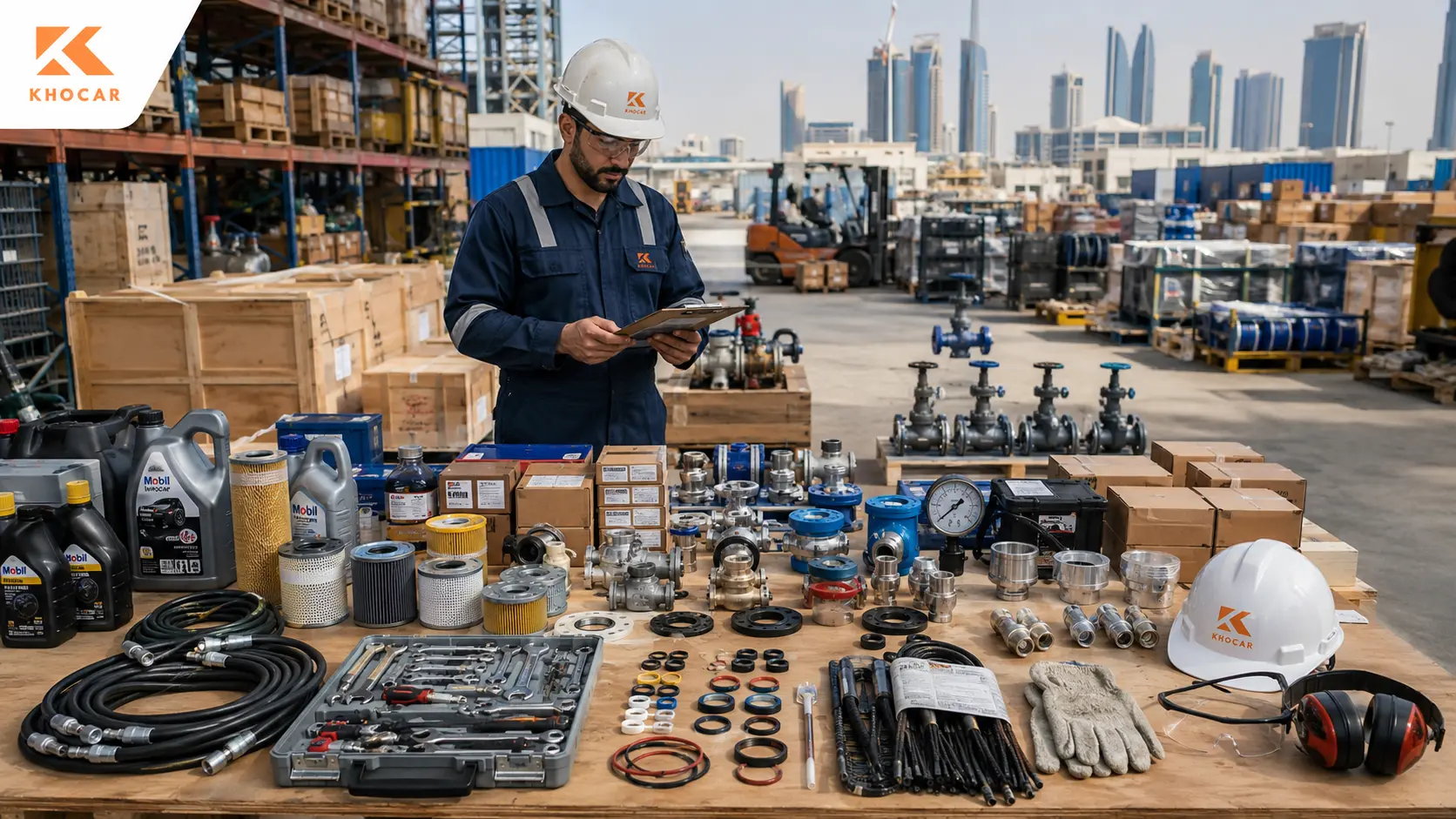
Before an ADNOC project mobilization, most contractors focus on people, permits, vehicles, and site access. Those are important, but one missing seal, wrong hydraulic fitting, expired lubricant, damaged gauge, undocumented pressure-control accessory, or unavailable consumable can still delay the first shift. That is why choosing dependable oilfield equipment suppliers UAE teams can reach quickly is not just a procurement task; it is a mobilization risk-control step.
In Abu Dhabi, oil and gas work, spare parts are not only about repair. They protect uptime, safety, inspection readiness, and crew confidence when equipment is moved from the workshop to a live field environment.
This guide explains the oilfield spare parts and industrial supplies contractors should prepare before ADNOC-related project mobilization, including seals and O-rings, lubricants and greases, hydraulic components, pressure-control accessories, safety consumables, wireline support items, tools, labels, and documentation.
It also shows how to decide what should be stocked in advance and what can be sourced on demand through a local oilfield industrial supplies Abu Dhabi partner.
Key Takeaways
| For ADNOC project mobilization, contractors should prepare a practical critical-spares kit before equipment leaves the yard. The highest-priority items are seals and O-rings, lubricants and greases, hydraulic hoses and fittings, pressure-control accessories, wireline support spares, safety consumables, fasteners, gauges, electrical protection items, inspection tags, and basic maintenance tools. The goal is not to overstock every possible part. The goal is to identify items that are low-cost, high-failure, hard to substitute, safety-related, or likely to stop work if missing. A local UAE oilfield industrial supplies partner can help contractors stage spares, check documentation, reduce urgent sourcing, and keep mobilization moving. |
Why Spare Parts Planning Matters Before ADNOC Project Mobilization
ADNOC-related projects move on strict timelines. A contractor may be preparing vehicles, equipment, crews, training, site passes, safety files, and method statements at the same time. In that environment, spare parts can look like a small detail until a simple component stops an expensive crew from starting work. A cracked O-ring, incorrect grease, missing hydraulic adapter, damaged pressure gauge, or incompatible fitting can turn into a site delay when the equipment is already at the gate or on location.
The current project environment makes this even more important. ADNOC announced AED 200 billion in project awards for 2026-2028, aimed at accelerating growth, local manufacturing, and delivery across its strategy. More project activity means more mobilizations, more equipment movement, more subcontractor coordination, and higher pressure on local supply chains. Contractors who wait until the day of mobilization to check spares often discover problems when there is the least time to solve them.
ADNOC also presents itself as a high-scale energy group with 4.85 million barrels per day of oil production capacity and 11.5 billion cubic feet per day of natural gas capacity. In that operating context, the service culture is built around reliability, HSE discipline, and documentation, not informal last-minute improvisation. For contractors, the practical lesson is simple: spare-parts readiness should be treated as part of mobilization, not a workshop afterthought.
International maintenance standards support the same idea. ISO 14224, used in petroleum, petrochemical, and natural gas industries, focuses on reliability and maintenance data, including equipment data, failure data, maintenance actions, resources used, maintenance consequences, and downtime. That matters because the best spare-parts plan is not random stockpiling. It is based on how equipment fails, what parts are needed to restore service, and which missing parts can increase downtime or safety risk.
What Counts as a Mobilization-Ready Spare-Parts Kit?
A mobilization-ready spare-parts kit is a controlled set of parts, consumables, tools, labels, and documentation prepared for a specific project, site, equipment type, and work scope. It is not a warehouse full of unused stock. It is a practical field-support package that helps a contractor handle predictable maintenance issues during early mobilization and initial operations.
For example, a wireline support team mobilizing to an Abu Dhabi field may need different spares from a construction-support contractor moving pumps, compressors, and hydraulic equipment. A pressure-control crew may need certified accessories, gauges, seals, and replacement fittings. A heavy-equipment team may focus more on hydraulic hoses, clamps, filters, grease, fasteners, and tools. The right kit depends on equipment history, site requirements, OEM guidance, inspection notes, operating conditions, and lead time.
- Critical spares: parts that can stop work, affect safety, or require long lead times if missing.
- Routine consumables: items used during inspection, lubrication, minor service, cleaning, and daily maintenance.
- Emergency repair items: low-cost parts that often solve common field failures quickly.
- Compliance support items: labels, certificates, material data sheets, calibration records, inspection tags, and traceability paperwork.
- Project-specific items: parts tied to the actual equipment and the site requirement, not generic warehouse assumptions.
The Core Oilfield Spare Parts Contractors Should Prepare
The following categories are the most useful starting point for contractors preparing ADNOC project mobilization supplies. Not every contractor needs every item, but every contractor should review these categories before sending equipment to the site.
1. Seals and O-Rings
Seals and O-rings are small parts with large consequences. They are used across pumps, valves, cylinders, pressure-control equipment, hydraulic systems, engines, compressors, fittings, and fluid-handling assemblies. In field conditions, they can fail because of heat, pressure, chemical exposure, wrong material selection, poor installation, age, contamination, or surface damage.
For Abu Dhabi oilfield mobilization, contractors should not treat seals as generic rubber parts. Material compatibility matters. NBR, Viton/FKM, EPDM, PTFE, and other compounds perform differently depending on temperature, hydrocarbons, chemicals, pressure, and application. A seal that looks correct by size may still be wrong by material.
- Common O-ring sizes used in the equipment being mobilized.
- Backup rings where extrusion risk exists.
- Gasket sets for pumps, valves, flanges, and inspection covers.
- Hydraulic cylinder seal kits for frequently used equipment.
- Material documentation where the application is safety-critical or inspection-sensitive.
Practical example: A contractor mobilizes a hydraulic power pack for field support. During pre-start checks, a small oil leak appears at a fitting. If the correct seal size and compound are already in the kit, the issue can often be fixed before dispatch. If not, the team may lose hours trying to identify the part, find a supplier, confirm compatibility, and arrange delivery.
2. Lubricants, Greases, and Fluids
Lubricants and greases are not only maintenance consumables. They are protection systems for bearings, gears, moving joints, engines, wireline equipment, pumps, compressors, and heavy machinery. The UAE environment adds heat, dust, long idle time, and heavy-duty operating cycles, which make incorrect lubrication a common source of accelerated wear.
Before mobilization, contractors should confirm lubricant grade, OEM recommendation, shelf life, storage conditions, and compatibility. Mixing incompatible greases can reduce performance. Using a lubricant that is not suited to temperature, load, water exposure, or pressure can create avoidable failure risk.
- Engine oil, hydraulic oil, gear oil, compressor oil, and approved top-up fluids.
- High-temperature grease for bearings, pins, joints, and heavy-duty equipment.
- Thread compounds, anti-seize products, and corrosion protection where applicable.
- Grease guns, clean dispensing containers, drip trays, absorbent pads, and labeling.
- Safety data sheets and storage guidance for oils, chemicals, and greases.
This category is also strongly connected to procurement timing. Lubricants may be easy to find in general, but the exact approved grade, brand-equivalent, packaging size, and documentation may not be available immediately when the project is already moving. That is why contractors should stage lubricants before mobilization rather than relying only on emergency purchases.
3. Hydraulic Hoses, Fittings, Adaptors, and Couplings
Hydraulic problems are among the fastest ways to stop field equipment. A hose failure, damaged coupling, wrong adapter, leaking fitting, or missing cap can sideline cranes, loaders, skids, power packs, pressure units, workshop trucks, and auxiliary equipment. In oilfield mobilization, hydraulic readiness should include both parts and cleanliness controls.
- Common hose sizes and pressure ratings used by the equipment.
- Hydraulic fittings, elbows, tees, adapters, couplings, caps, and plugs.
- Spare clamps, guards, sleeves, and abrasion protection for exposed lines.
- Hydraulic filters and breathers where maintenance is due before mobilization.
- Clean caps, plugs, lint-free wipes, and containers to reduce contamination.
A common mistake is to stock only the hose and forget the fitting standard. Thread type, pressure rating, sealing method, hose size, end connection, and material all matter. A near match is not enough when pressure, safety, and downtime are involved. Contractors should list hydraulic connection types before mobilization and share those details with the supplier if urgent support is needed.
4. Pressure-Control Equipment Accessories
Pressure-control accessories require extra care because they can affect both safety and operational acceptance. Accessories may include gauges, valves, fittings, test plugs, seals, hoses, clamps, lubricants, pressure-rated components, and support items tied to well intervention, slickline, wireline, pressure testing, or fluid-handling work.
Contractors should identify which parts are consumable, which are pressure-rated, which need certificates, and which require calibration or inspection evidence. A pressure gauge without a valid calibration record may become a documentation problem even if the gauge physically works. A fitting without traceability may be rejected in a controlled environment. This is where procurement and QA/QC must work together before mobilization.
- Pressure gauges with valid calibration records.
- Rated fittings, valves, hoses, and adapters suitable for the application.
- Spare seals and packing elements are recommended by the OEM or equipment owner.
- Inspection tags, pressure-test records, and certificates where required.
- Protective caps, covers, storage boxes, and handling controls to prevent damage.
5. Wireline and Slickline Support Spares
Wireline and slickline work depend on accurate, well-maintained equipment. Even when the main unit is ready, small supporting parts can become the bottleneck. Contractors involved in wireline logging, unit repair, field support, or well-intervention activity should review spares that support cables, connectors, pressure-control interface items, logging-unit maintenance, and field troubleshooting.
- Connectors, protective covers, clamps, basic electrical protection items, and approved consumables.
- Cleaning materials suitable for sensitive equipment.
- Spare fuses, lamps, indicators, terminals, and labeled cable-management items where applicable.
- Selected seals, fittings, and consumables for supporting pressure-control equipment.
- Documentation for repairs, inspection, and maintenance history.
The aim is not to rebuild a wireline unit on site. The aim is to prevent small predictable issues from becoming major delays. KhoCAR already provides wireline logging unit repair and maintenance support, so this blog can naturally connect readers who need deeper support to the relevant service page.
6. Filters, Breathers, Belts, Fasteners, and Routine Maintenance Parts
Routine maintenance parts are often ignored because they do not look project-critical. In reality, filters, belts, fasteners, clamps, and breathers are exactly the items that can create annoying delays during commissioning, inspection, pre-start checks, or first-week field operations. They are usually low-cost compared with the cost of downtime.
- Fuel, oil, air, hydraulic, and compressor filters where equipment service is due.
- Breathers, strainers, and filter elements for hydraulic and lubrication systems.
- Drive belts, clamps, clips, pins, washers, bolts, nuts, and retaining hardware.
- Battery terminals, cable ties, heat-shrink, insulating tape, and protective sleeves.
- Basic spares for lighting, warning devices, switches, and field communication support.
For example, a contractor may complete all major mobilization approvals but fail a pre-use check because a warning light is not working, a clamp is missing, or a filter service is overdue. These issues rarely require advanced engineering. They require planning, stock, and a team that knows the equipment.
7. Safety Consumables and Spill-Control Items
Oilfield spare parts planning should not stop at mechanical items. Safety consumables help crews respond to minor leaks, housekeeping issues, temporary isolation, and routine maintenance without creating additional risk. These items also support a professional site impression during inspection and handover.
- Absorbent pads, spill kits, drip trays, waste bags, and disposal labels.
- Lockout/tagout supplies where maintenance isolation may be needed.
- Barricade tape, warning tags, inspection tags, and equipment-status labels.
- Gloves, eye protection, face shields, and task-specific PPE consumables.
- Fire-resistant covers, protective mats, and housekeeping items where relevant.
ADNOC emphasizes HSE and supplier expectations in its public-facing materials, and contractors should reflect that mindset in their mobilization supplies. A project team that has spare mechanical parts but no spill-control items, tags, or basic safety consumables is not fully ready for field work.
8. Tools, Test Equipment, Labels, and Documentation
The correct part is only useful if the team can install, test, document, and release the equipment properly. Before mobilization, contractors should check that the tool kit is not just present but suitable for the actual equipment. That includes torque tools where needed, calibrated instruments, special spanners, lifting accessories, test leads, labels, and basic cleaning tools.
- Torque wrench and tool calibration records where required.
- Pressure-test accessories and calibrated gauges where applicable.
- Equipment manuals, data sheets, parts lists, and maintenance records.
- Material certificates, safety data sheets, calibration certificates, and inspection reports.
- Labels for equipment status, quarantine, accepted items, rejected items, and service due dates.
Documentation is especially important for oilfield industrial supplies that Abu Dhabi contractors use in controlled sites. A part may be physically correct, but if the inspection team requires a certificate, calibration record, or maintenance record and it is missing, the item can still delay work.
Mobilization Spare Parts Checklist by Category
Use this checklist as a starting point. Contractors should adapt it to the exact project, equipment list, OEM recommendations, contract requirements, and site instructions.
| Category | Examples to Keep Ready | Why It Matters Before Mobilization |
| Seals and O-rings | O-rings, gaskets, backup rings, cylinder seal kits, packing elements | Small sealing failures can cause leaks, pressure loss, contamination, and failed pre-start checks. |
| Lubricants and greases | Hydraulic oil, engine oil, gear oil, compressor oil, high-temperature grease, thread compounds | Correct fluids reduce wear and help equipment survive heat, dust, and heavy-duty cycles. |
| Hydraulic parts | Hoses, fittings, adapters, caps, plugs, filters, clamps, sleeves | Hydraulic leaks and wrong fittings can stop cranes, power packs, loaders, pumps, and support equipment. |
| Pressure-control accessories | Gauges, valves, rated hoses, test plugs, fittings, seals, calibration records | Pressure-related components may affect safety, inspection, testing, and acceptance. |
| Wireline and slickline support | Connectors, covers, small electrical spares, cleaning items, interface consumables | Small support items can delay logging, intervention, or field-support work. |
| Routine maintenance parts | Filters, belts, fasteners, clamps, breathers, terminals, warning-light parts | Low-cost maintenance items often prevent avoidable first-week downtime. |
| Safety and spill control | Spill kits, absorbents, drip trays, tags, lockout items, PPE consumables | Supports housekeeping, HSE readiness, and professional site control. |
| Tools and documentation | Torque tools, calibrated gauges, manuals, certificates, SDS, inspection records | Parts must be installable, testable, traceable, and acceptable to the project team. |
How to Decide What to Stock Before Mobilization
The best spare-parts plan balances cost, risk, lead time, and operational impact. Overstocking creates waste. Understocking creates delays. Contractors should classify spare parts before mobilization using a simple decision framework.
Stock It Before Mobilization If:
- The part is low-cost but can stop work if missing.
- The part is used frequently during normal maintenance.
- The part has a known failure history on your equipment.
- The part has a long procurement lead time or limited local availability.
- The part requires certificates, calibration, or material verification.
- The part is difficult to substitute because of size, pressure rating, material, or OEM requirement.
- The project location makes same-day sourcing difficult.
Source It On Demand If:
- The part is high-cost and rarely fails.
- The supplier can guarantee quick availability in Abu Dhabi.
- The component requires case-by-case inspection before ordering.
- The project scope is short, and the risk is low.
- The part is bulky, difficult to store, or has strict shelf-life controls.
A good local supplier can help make this decision. For example, seals, O-rings, filters, grease, fasteners, tags, and fittings may be worth staging in advance. Larger assemblies, special hydraulic components, or complex repair parts may be better handled through an agreed urgent-supply process.
A Simple Critical-Spare Ranking System
Contractors can use a simple scoring model before mobilization. Rate each item from 1 to 5 for downtime impact, safety impact, lead time, failure likelihood, and substitution difficulty. Items with high scores should be staged before mobilization or covered by a supplier availability plan.
| Question | Low Risk | High Risk |
| What happens if this part fails? | Minor inconvenience | Work stops, equipment is rejected, or safety risk increases |
| Can the part be sourced locally today? | Available from multiple UAE suppliers | Special order, import, or hard-to-identify item |
| Can another part safely replace it? | Standard substitute is acceptable. | No substitute due to material, pressure, size, or certification |
| Does it need paperwork? | No special documentation | Certificate, calibration, SDS, inspection, or traceability required |
| Has it failed before? | No recent history | Known weak point or frequent replacement item |
This type of ranking supports AEO and AI visibility because it gives a direct answer to a common contractor question: which oilfield spare parts should be stocked first? The answer is: stock items that are likely to fail, difficult to substitute, quick to consume, safety-related, or capable of stopping work if absent.
Common Mobilization Mistakes Contractors Should Avoid
Many mobilization delays are not caused by rare technical failures. They come from predictable planning gaps. The following mistakes are common when teams rush toward a start date.
Mistake 1: Preparing Equipment but Not the Spares
A contractor may service a machine in the workshop, clean it, inspect it, and send it to the site without the small parts needed for first-week support. Once equipment is in the field, even a basic leak, filter issue, or missing fitting becomes harder to solve.
Mistake 2: Buying Generic Parts Without Checking Compatibility
Generic parts may fit visually but fail under heat, pressure, vibration, or chemical exposure. This is especially risky with seals, O-rings, hydraulic fittings, hoses, and lubricants. Compatibility should be checked before purchase, not after a failure.
Mistake 3: Forgetting Calibration and Certificates
Pressure gauges, torque tools, test equipment, lifting accessories, pressure-control accessories, and some materials may require documentation. A missing certificate can delay acceptance even when the physical item is available.
Mistake 4: Waiting Until the Purchase Request Is Urgent
Urgent procurement is expensive and stressful. It also increases the chance of buying the wrong part. Contractors should build the spare-parts list during planning, then confirm local availability before mobilization.
Mistake 5: Not Matching the Kit to the Actual Scope
A generic warehouse kit is not enough. A cementing job, wireline support job, pressure-testing job, heavy equipment support job, and maintenance support job each need different spares. The spare-parts kit should match the project work method and equipment list.
Practical Examples: What Different Contractors May Need
Example 1: Wireline Support Mobilization
A wireline support contractor preparing for field work may need logging-unit service items, connectors, small electrical protection parts, pressure-control interface consumables, cleaning supplies, spare seals, labeling, inspection records, and basic tools. If the unit has a known issue with a connector, sensor, seal, or power-related part, that item should be staged before mobilization.
Example 2: Hydraulic Equipment and Power Pack Mobilization
A contractor using hydraulic skids, pumps, or power packs should prepare hoses, fittings, adapters, hydraulic oil, filters, breathers, caps, plugs, clamps, absorbents, and leak-response items. The team should also record hose sizes, pressure ratings, thread types, and connection standards so replacement parts can be sourced quickly.
Example 3: Pressure-Control Accessory Mobilization
A pressure-control team should focus on rated accessories, gauges, calibration records, valves, seals, fittings, test plugs, certificates, and protective storage. If the equipment is inspected before use, paperwork is as important as physical inspection.
Example 4: Heavy Machinery Support for an Oilfield Project
Heavy equipment support may require filters, belts, hydraulic parts, grease, fasteners, warning-light parts, battery terminals, clamps, spill kits, and basic service tools. A simple missing clamp or leak can delay a machine that is otherwise ready for work.
How UAE Oilfield Equipment Suppliers Help Before Mobilization
The right supplier does more than sell parts. For ADNOC project mobilization, oilfield equipment suppliers and UAE contractors rely on should help identify part categories, confirm compatibility, organize stock, respond quickly, and support the documentation side of procurement where needed. This is especially useful for contractors working under time pressure or managing equipment from multiple brands.
A UAE-based supplier can also help reduce uncertainty. Local teams understand Abu Dhabi climate, field conditions, common oilfield equipment, delivery routes, urgent requests, and the difference between general industrial parts and oilfield-grade supplies. This is why local support is valuable before mobilization, not only after a breakdown.
- Review the equipment list and recommend common spares by category.
- Help identify seal, hose, fitting, lubricant, and pressure accessory requirements.
- Support sourcing of oilfield consumables and industrial supplies across the UAE.
- Assist with repair and maintenance coordination where parts alone are not enough.
- Provide faster response for Abu Dhabi, Mussafah, and wider UAE project needs.
Prepare Your ADNOC Mobilization Spares With KhoCAR
| Getting ready for an ADNOC-related project in Abu Dhabi or elsewhere in the UAE? Do not wait until equipment is already on site to discover a missing seal, hydraulic fitting, lubricant, pressure accessory, or maintenance consumable. KhoCAR supports contractors with oilfield services, industrial supplies, seals and O-rings, lubricants and greases, hydraulic parts, pressure-control accessories, machinery repair, Zone 2 support, and customized supply solutions. Share your equipment list, work scope, and mobilization timeline with KhoCAR, and our team can help you prepare the right spare-parts plan before project delays begin. |
FAQs
What spare parts should contractors keep ready before ADNOC project mobilization?
Contractors should usually prepare seals and O-rings, lubricants and greases, hydraulic hoses and fittings, filters, fasteners, pressure-control accessories, calibrated gauges, safety consumables, spill-control items, tools, and documentation. The exact list depends on the equipment, work scope, site requirements, and OEM recommendations.
Why are spare parts important before ADNOC project mobilization?
Spare parts are important because a small missing component can delay equipment acceptance, pre-start checks, maintenance, or first-shift operations. In oilfield work, spares also support safety, uptime, documentation, and faster troubleshooting when equipment is already on site.
How do I choose between stocking spares and sourcing them on demand?
Low-cost stock parts, commonly used, likely to fail, hard to substitute, safety-related, or capable of stopping work. Source on demand when the part is expensive, rarely used, bulky, or reliably available through a local UAE oilfield supplier.
What are the most common oilfield consumables for Abu Dhabi contractors?
Common consumables include O-rings, seals, gaskets, grease, hydraulic oil, engine oil, filters, caps, plugs, clamps, fasteners, absorbent pads, spill kits, warning tags, cleaning materials, and PPE consumables. Contractors should match these items to their equipment and site activity.
Do pressure-control accessories need certificates or calibration records?
Some pressure-control accessories, gauges, test equipment, and rated components may require certificates, inspection records, calibration records, or traceability depending on the project and site requirements. Contractors should confirm documentation before mobilization rather than after equipment arrives on site.
Can a local UAE oilfield supplier help with urgent mobilization?
Yes. A local supplier can help identify parts, confirm compatibility, arrange urgent sourcing, support documentation, and provide repair or maintenance help when parts alone are not enough. Local Abu Dhabi support is especially useful when mobilization timelines are tight.
What is the difference between oilfield spare parts and general industrial supplies?
Oilfield spare parts are selected for demanding field conditions, pressure, heat, fluids, safety requirements, and documentation needs. General industrial supplies may be suitable for some tasks, but critical oilfield applications often require stronger compatibility checks and better traceability.
Should contractors prepare lubricants before mobilization?
Yes. Contractors should confirm approved lubricant grades, grease types, quantities, shelf life, storage conditions, and safety data sheets before mobilization. Using the wrong lubricant or mixing incompatible greases can create wear, overheating, and avoidable maintenance problems.
What documents should be included with mobilization supplies?
Useful documents include equipment manuals, maintenance records, material certificates, safety data sheets, calibration certificates, inspection reports, pressure-test records, and item traceability where required. Documentation can be as important as the physical part in controlled oilfield environments.
Who supplies oilfield industrial supplies in Abu Dhabi?
KhoCAR provides oilfield services and industrial supplies in the UAE, including seals and O-rings, lubricants and greases, hydraulic parts, pressure-control equipment accessories, industrial supplies, machinery repair, Zone 2 support, and wireline-related field support.