
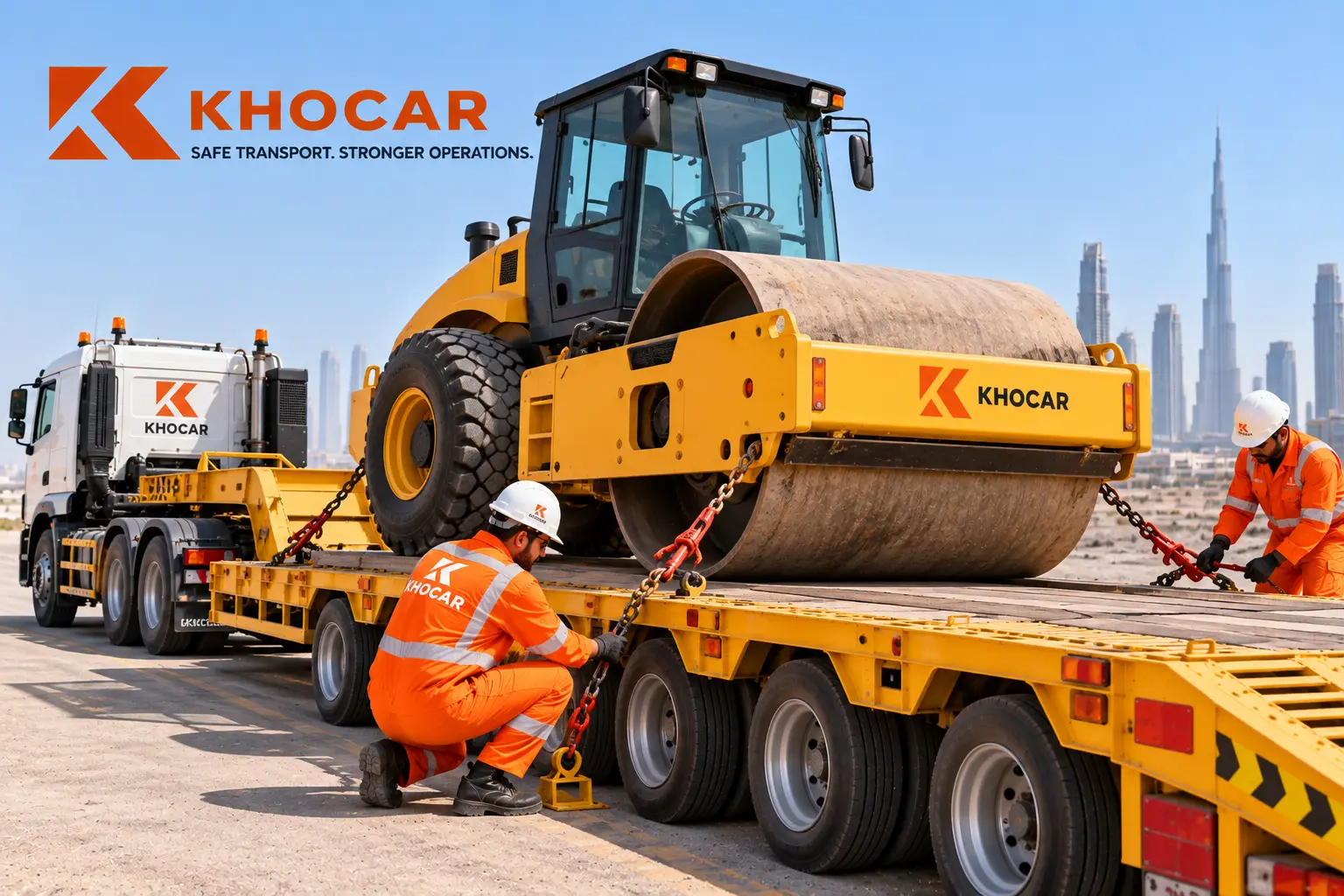
Road roller transport UAE projects often look straightforward until the machine reaches the loading area. A roller may be compact compared with an excavator or crane, but its operating weight, steel drum, articulated frame, limited ground clearance, and transport dimensions can make moving it more complicated than arranging an ordinary truck. Choose the wrong trailer or underestimate the loading angle, and the result may be a delayed handover, equipment damage, unsafe loading, or a route that cannot accommodate the loaded combination.
For contractors, road builders, asphalt teams, plant-hire companies, and project coordinators, the objective is not simply to move a compactor from point A to point B. The machine must be loaded without damaging the drum, tyres, scrapers, articulation joint, or hydraulic components; restrained against movement; transported on a suitable route; and unloaded at a location that is ready to receive it. UAE road restrictions, site access conditions, and the need to verify permit requirements also matter, particularly when moving between Abu Dhabi, Dubai, Sharjah, industrial areas, and active construction sites.
This guide explains how to plan road roller transportation in the UAE, choose a suitable lowbed trailer, prepare the machine, manage loading and securing, and reduce avoidable delays. The exact setup depends on the roller model, verified dimensions and weight, trailer specifications, route, and applicable authority requirements.
Key Takeaways
- Choose the trailer based on the roller’s verified transport weight, dimensions, ground clearance, loading method, and route, not on the machine category alone.
- A tandem drum roller, pneumatic tyre roller, and single-drum soil compactor may have very different loading and restraint needs.
- Confirm the machine’s transport configuration. ROPS or cab height, folding canopy, scraper bars, articulation, tyres, and attachments can change the loaded envelope.
- Inspect the trailer deck, ramps, tyres, brakes, tie-down points, and approach angle before loading.
- Use the manufacturer’s designated lifting, lashing, and transport points. Do not attach chains to hydraulic lines, handrails, scraper assemblies, or other unsuitable components.
- Calculate the loaded combination’s total height, width, length, gross weight, and axle loading before dispatch.
- Check current federal and emirate-level rules, route restrictions, and whether a special transport permit or route approval is required.
- Secure the roller against forward, rearward, and lateral movement, then recheck restraint after the initial part of the journey when it is safe to stop.
- Confirm that the receiving site has adequate space, ground conditions, access clearance, and a safe unloading area.
- Send the transport provider the make and model, operating weight, dimensions, pickup and delivery pins, machine condition, loading method, photos, and requested movement time.
Why Road Roller Transport Needs Equipment-Specific Planning
Road rollers are built to compact soil, aggregate, asphalt, or other surfaces. Their design priorities are compaction force, drum contact, traction, manoeuvrability, and operator visibility. Those same features affect transport. A steel drum is durable in normal operation, but it can be damaged by poor handling or unsuitable contact points. Articulated rollers can pivot at the centre, while some models have a high cab or canopy that determines the overall loaded height. Pneumatic tyre rollers have a different contact surface and restraint profile from steel-drum machines.
The word “roller” also covers a broad range of equipment. A small walk-behind roller may be moved using a different transport arrangement from a heavy tandem asphalt roller or a single-drum soil compactor. Weight alone does not settle the decision: width, height, length, track or tyre configuration, loading angle, and the ability to drive safely onto the trailer all matter.
A suitable lowbed trailer can help reduce transport height, but “lowbed” is not one universal specification. Deck height, usable deck length, width, ramp design, axle configuration, payload capacity, and tie-down arrangement must match the actual machine and route. For a broader explanation of trailer dimensions and capacity, review KhoCAR’s guide to lowbed trailer specifications, dimensions, capacity and legal limits.
What counts as a road roller or compactor?
Common equipment that may be described as a road roller or compactor includes:
- Tandem drum asphalt rollers used for asphalt compaction.
- Single-drum vibratory soil compactors used for earthworks and road foundations.
- Pneumatic tyre rollers used for finishing and compaction applications.
- Small articulated or combination rollers used on roads, parking areas, and confined sites.
- Walk-behind rollers and compactors used on smaller paving or repair jobs.
Do not assume that two machines in the same category share the same transport dimensions. Make and model information is more reliable than a general description.
Why the machine’s transport configuration matters
The dimensions listed in a brochure may describe the machine in its normal operating position. Transport height can change if a canopy folds, an exhaust component is removed according to manufacturer instructions, or a transport lock is engaged. Conversely, a raised attachment, loose scraper, protruding mirror, or unsecured accessory may increase the overall envelope or create a snag hazard.
Before requesting a trailer, record the actual configuration in which the roller will travel. If anything needs to be folded, removed, locked, or repositioned, follow the manufacturer’s procedure and ensure the work is completed by competent personnel.
How to Choose a Lowbed Trailer for Road Roller Transport in the UAE
The best trailer is the one that can carry the actual roller safely, within its rated limits, and along the intended route. It is not necessarily the trailer with the lowest deck or the highest advertised capacity. Compatibility includes payload, deck dimensions, axle loading, ramp geometry, restraint points, tractor-trailer configuration, and site access.
1. Confirm operating weight and transport weight
Start with the manufacturer’s operating weight for the exact model and configuration. Check whether the stated weight includes the cab or canopy, ballast, water or fuel, optional equipment, and attachments. If a machine has been modified, use the current configuration rather than relying on an old brochure.
Transport planning must account for the roller plus any equipment being carried with it. Do not add loose tools, spare drums, buckets, ramps, or other cargo without confirming that the trailer and the load arrangement can accommodate them safely. The trailer’s payload rating is not the same as the permitted gross weight of the complete road vehicle combination.
If the exact weight is uncertain, tell the provider that it is an estimate and share the model plate or manufacturer specification. Avoid presenting a guess as a confirmed figure.
2. Measure length, width, and height
Measure the machine in its planned transport configuration. Include protruding mirrors, scraper assemblies, handrails, exhausts, lights, and any other component that affects the overall envelope. If the machine will be positioned at an angle or an attachment will be removed, document the final arrangement clearly.
At minimum, provide:
- Overall length in transport position.
- Overall width at the widest point.
- Overall height in transport position.
- Operating or transport weight and the source of that figure.
- Ground clearance and any low-hanging components.
- Any removable or foldable parts and the manufacturer-approved transport position.
The relevant road dimension is the loaded combination, not the machine by itself. The trailer deck height and the roller’s position on that deck contribute to the total transport height. A low deck can help, but it does not automatically make a load compliant.
3. Check payload and axle distribution
The trailer must be suitable for the roller’s weight, and the weight must be distributed correctly across the trailer axles and the tractor unit. A trailer that appears large enough may still be unsuitable if the roller’s centre of gravity places too much load on one axle group or if the machine cannot be positioned within the permitted deck area.
The UAE’s Federal Decree-Law No. 12 of 2023 regulating heavy-vehicle weights and dimensions places obligations on heavy-vehicle operators to remain within applicable gross and axle-weight and dimensional limits and to ensure the load is properly distributed and fixed. The applicable limits and any special-permit conditions must be checked for the actual vehicle, road, and movement.
4. Assess deck height, ramps, and approach angle
A roller with low ground clearance or a short wheelbase may be sensitive to the transition between the ground, ramp, and deck. A steep approach can cause a frame, scraper, drum edge, or other low point to contact the ramp. The loading plan should consider ramp length, deck height, ground slope, and the machine’s approach and departure angles.
Do not improvise with loose timber or unapproved packing to overcome a poor ramp angle. If the loading surface is uneven or the machine risks grounding, stop and revise the method. The trailer operator and site team should agree on the loading arrangement before the machine moves.
5. Verify restraint points and equipment condition
Confirm that the trailer has suitable rated lashing points and that the machine has manufacturer-designated transport or tie-down points. The number and arrangement of restraints should be determined by a competent person based on the load, equipment guidance, applicable rules, and the restraint system’s ratings.
A restraint plan should not rely on friction alone. Chains, straps, binders, and other devices must be appropriate for the application and in serviceable condition. Do not attach restraints to hydraulic pipes, control levers, mirrors, handrails, scraper brackets, or other components not designed to take transport loads.
Quick trailer selection comparison
| Planning factor | What to verify | Why it matters |
| Payload | Roller weight plus any permitted carried items | Avoids overloading the trailer or combination |
| Deck dimensions | Usable length and width | Ensures the machine fits in the planned position |
| Loaded height | Deck height plus machine height | Helps assess clearance and permit needs |
| Ramps | Length, strength, surface, and approach angle | Reduces grounding and uncontrolled movement risk |
| Axle configuration | Rated capacity and weight distribution | Supports compliant load distribution |
| Tie-down points | Location, rating, and compatibility | Allows a proper restraint plan |
| Site access | Turning space, slope, ground strength, gate clearance | Helps avoid failed pickup or delivery |
Preparing a Road Roller Before Collection
Good preparation reduces loading time and lowers the chance of damage. The equipment owner or site supervisor should identify who is responsible for cleaning, inspecting, positioning, and releasing the machine for transport. If the roller is hired, confirm any handover requirements with the rental company.
Clean the roller and inspect for loose material
Remove loose soil, aggregate, asphalt build-up, and debris that could fall during transit or interfere with loading. Cleaning also helps reveal leaks, loose parts, damage, and obstructions. Do not direct cleaning methods at sensitive electrical or hydraulic components in a way that could damage them.
Check the drums or tyres, scraper bars, steps, handrails, mirrors, lights, access panels, articulation area, and visible hydraulic hoses. Record existing damage with photographs before loading. If a component is loose, repair or secure it according to the manufacturer’s instructions before transport.
Secure the machine in its transport configuration
Follow the manufacturer’s instructions for parking, shutting down, isolating, locking, and preparing the roller for movement. Apply the parking brake where specified, remove the key or secure the controls as appropriate, and engage articulation locks or transport locks if the model requires them. Lower or secure equipment in the prescribed position.
Do not assume that every roller uses the same lockout or transport procedure. If the manual is unavailable, ask the equipment owner or authorized service provider to confirm the correct process. Never place personnel between an articulated machine’s sections unless the equipment is safely secured in accordance with the manufacturer’s procedure.
Check fluids, batteries, and accessories
Look for obvious fluid leaks and loose accessories. Confirm whether the machine’s fuel level, battery isolation, or other preparation steps are specified by the manufacturer or transport plan. Remove or secure items that could move, fall, or be damaged during transit. Any fuel or hazardous-material issue should be handled under the applicable rules and the machine manufacturer’s guidance.
If the roller is non-operational, disclose this before dispatch. A machine that cannot drive onto the trailer may require a different loading plan, winch, crane, or other equipment. Never assume a standard ramp loading method will work for a disabled roller.
Loading and Unloading Compactors Safely
Loading is one of the highest-risk stages of road roller transport. The roller may be heavy, visibility can be restricted, the ramp may be steep, and the machine’s centre of gravity can shift as it climbs. The loading area should be controlled, with one designated person directing movement and a clear stop signal understood by everyone involved.
Prepare the loading area
Before the trailer arrives, confirm that the ground is firm, level enough for the planned operation, and free from obstructions. Keep unnecessary people and vehicles outside the loading zone. Check overhead clearance, nearby edges, drains, trenches, soft shoulders, traffic movement, and space for the tractor-trailer to align with the loading area.
The driver and site supervisor should agree on the approach route, stopping points, communication method, and the person authorized to direct the roller. If visibility is poor, use a trained banksman or spotter positioned where they can be seen by the operator and remain outside crush zones.
Align the trailer and inspect the ramps
Park and secure the trailer according to the operator’s procedure. Ensure ramps are fully deployed, correctly seated, rated for the load, and free from mud, oil, loose aggregate, or other slippery material. Confirm that the ramp surface and slope are suitable for the roller’s drum or tyre configuration.
If the ramp shifts, the trailer moves, the machine begins to slip, or any component contacts the ramp unexpectedly, stop the operation. Do not try to correct a dangerous position while the roller is moving. Reassess the setup and use a safer method.
Drive or winch the roller onto the deck
Use the loading method approved for the machine and trailer. If the roller is self-propelled and the manufacturer permits it to drive onto the trailer, move slowly and steadily under the direction of the designated signaler. Avoid sudden steering, acceleration, or braking. Keep personnel clear of the front, rear, sides, ramps, and articulation area.
If the roller is not operational or cannot safely climb the ramps, the transport plan should specify a suitable alternative, such as a properly engineered winching or lifting arrangement. Lifting must use designated lifting points and equipment with adequate capacity. Do not lift by the drum, scraper, axle, handrail, or other component unless the manufacturer specifically identifies it as a lifting point.
Position the roller and apply transport locks
Position the roller according to the approved load plan. The machine should be stable, aligned as intended, and within the trailer’s usable deck area. Engage the parking brake and any required transport or articulation locks, shut down the engine, and follow the manufacturer’s isolation instructions before personnel approach restraint points.
The load should not obstruct required vehicle lights, registration plates, or other mandatory equipment. If any part of the machine projects beyond the trailer, check applicable marking, permit, and movement requirements rather than assuming that a warning flag alone is sufficient.
Unloading requires the same discipline
Confirm the receiving area is ready before releasing the restraints. Position the trailer on suitable ground, establish an exclusion zone, deploy ramps correctly, and ensure the route off the trailer is clear. Remove restraints only when the roller is stable and the unloading procedure allows it. The operator and signaler should agree on commands before movement begins.
Never stand downhill from a roller on a slope or enter a crush zone to guide a machine by hand. If the trailer or ground is unstable, stop and reposition. A safe unloading operation is planned before dispatch, not improvised after arrival.
How to Secure a Road Roller on a Lowbed Trailer
The roller must be restrained against movement during braking, acceleration, cornering, uneven road surfaces, and other foreseeable transport forces. Restraint requirements depend on the equipment’s mass, geometry, centre of gravity, designated tie-down points, and the restraint devices used.
Use designated tie-down points
Consult the machine’s operator manual or transport instructions for approved tie-down points. Use rated chains or straps and compatible tensioning devices in good condition. Protect the equipment and restraint system from sharp edges where necessary, but do not introduce padding that allows a restraint to slip or loosen.
The correct restraint layout is not determined by a generic number of chains. A competent person should decide the arrangement and capacity based on the machine and the actual transport configuration. Ensure the restraint system does not damage hydraulic lines, wiring, tyres, drums, scraper assemblies, or other components.
Prevent rolling, sliding, and articulation movement
A roller’s drum or tyres can create specific restraint challenges. The plan must prevent forward, rearward, and sideways movement, while the machine’s parking brake and any approved transport locks are applied as required. Do not rely on the parking brake as the only restraint. Do not use an improvised block, loose timber, or an unverified chock as a substitute for a complete restraint system.
Articulated rollers may need the articulation joint locked for transport. Confirm the model’s instructions and make sure the lock is properly engaged before loading or securing. Never assume the steering system alone will prevent the two sections from moving relative to each other.
Inspect restraints before departure and during the trip
Before moving off, check that all restraints are correctly attached, tensioned, and secured; that no chain or strap is twisted or damaged; and that no restraint can contact a moving component or sharp edge. Verify that ramps and loose loading equipment are stowed and secured.
Plan a safe place to stop for a restraint recheck when appropriate. If any device loosens, shifts, or shows damage, stop in a safe location and correct the issue before continuing. Do not continue merely because the destination is close.
UAE Route Planning, Permits, and Heavy-Vehicle Restrictions
A roller that fits on a lowbed trailer in the yard may not be ready for road movement. The transport provider must assess the loaded dimensions and weight, the tractor-trailer combination, the route, and any applicable permit or movement restrictions. Requirements can differ by road, emirate, site, and the nature of the load.
Check federal heavy-vehicle requirements
The UAE’s federal framework regulates heavy-vehicle weights and dimensions. Under Cabinet Resolution No. 138 of 2023, the rules include maximum weights and dimensions and provisions for special permits for certain loads that cannot readily be divided. The Ministry of Energy and Infrastructure also published an explanation of the maximum weights and dimensions of heavy vehicles on federal roads.
These references are a starting point, not a substitute for checking the specific movement. Do not assume that a roller is exempt because it is a single machine or because the trailer is a lowbed. The combined vehicle, axle loads, actual dimensions, road category, and permit conditions all matter.
Consider Abu Dhabi movement restrictions
For trips involving Abu Dhabi City, check the current heavy-vehicle movement rules and any applicable time restrictions before booking the movement window. The Department of Municipalities and Transport’s Administrative Decision No. 5 of 2025 concerning heavy-vehicle movement on Abu Dhabi City roads sets out specified restrictions by day and time. Rules may change or may apply differently depending on the road and vehicle category, so verify the current official requirements for the planned route.
A pickup or delivery inside an industrial zone may also involve site-specific gate procedures, security approvals, internal traffic rules, or access restrictions. Confirm these with the receiving site in advance.
Check the full route, not only the distance
Route planning should consider:
- Bridges, underpasses, overhead signs, cables, and other height constraints.
- Road width, tight turns, roundabouts, and the turning radius of the tractor-trailer.
- Construction diversions, roadworks, temporary barriers, and restricted roads.
- Site gates, security checkpoints, loading bays, and internal roads.
- The permitted movement time and any route-specific approval conditions.
- Ground conditions and space for safe unloading.
The shortest route may not be the safest or permitted route. If the load is close to a dimensional limit, obtain reliable measurements and have the transport provider confirm the route before dispatch.
Understand when a special transport permit may be needed
A special permit or route approval may be required when a load exceeds applicable limits or falls within a controlled movement category. The decision depends on the actual loaded combination, the route, and the relevant authority’s rules. Do not treat a permit as a formality to be arranged after the trailer is already loaded.
For a practical overview of planning this stage, see KhoCAR’s guide to heavy equipment transport permits in the UAE. Share accurate dimensions, weight, pickup and delivery locations, and preferred timing early enough for the transport team to assess the job.
Common Road Roller Transport Problems and How to Prevent Them
The roller does not fit the planned trailer
This usually happens when the transport request uses an approximate machine category instead of verified measurements. A cab, canopy, scraper, or accessory may increase the overall dimensions, or the deck may be too short for the chosen positioning.
Prevention: Send the exact make and model, manufacturer data, actual measurements, and current photographs. Ask the provider to confirm the usable deck area and loaded height before dispatch.
The machine grounds out on the ramp
Low ground clearance, a steep ramp, an uneven loading surface, or a poor approach angle can cause the roller to contact the ramp or deck. Continuing to drive may damage the machine or destabilize the loading operation.
Prevention: Check the loading geometry in advance. Use a suitable trailer and approved loading arrangement. Stop immediately if contact or instability occurs, then revise the setup rather than improvising.
The roller moves or the restraints loosen
Poorly chosen tie-down points, damaged restraint equipment, insufficient tension, or a restraint layout that does not control movement in all directions can create a serious risk.
Prevention: Use designated tie-down points and rated devices, follow a competent restraint plan, inspect the system before departure, and recheck it at a safe stopping point when appropriate.
The route or permit is not ready
A movement can be delayed when dimensions, route restrictions, site access, or permit needs are checked too late. A lowbed trailer may arrive at the pickup point but be unable to proceed on the intended route or during the requested time.
Prevention: Provide the complete load details and route early. Confirm current requirements with the relevant authority or qualified transport provider before fixing the dispatch time.
The receiving site cannot accept the delivery
The site may have a narrow entrance, soft ground, insufficient turning room, overhead restrictions, active traffic, or no safe area to unload. The transport vehicle may then need to wait or return later.
Prevention: Ask the receiving contact to confirm access, ground conditions, unloading equipment, working hours, and the location where the roller should be placed. Share photos or a site pin if access is difficult.
Example: Moving an Asphalt Roller Between UAE Construction Sites
Imagine a contractor needs to move a tandem asphalt roller from a yard in Abu Dhabi to a roadwork project outside the city. The first request simply says, “Send a lowbed for one road roller.” That description is not enough to select the equipment or confirm the movement.
The transport coordinator asks for the make and model, operating weight, overall length, width and height, photos, whether the roller is operational, and whether its canopy or other components can be placed in a manufacturer-approved transport position. The coordinator also asks for exact pickup and delivery pins, the preferred delivery window, site contact details, and whether the receiving site has a firm loading area and enough space to unload.
The measurements are then compared with the trailer’s usable deck dimensions and deck height. The team checks payload and axle distribution, confirms the planned restraint points, and considers the ramp angle. The loaded height and other dimensions are assessed against applicable limits. Because the route involves Abu Dhabi roads, current movement restrictions and any permit or route requirements are verified before dispatch.
At pickup, the site clears the loading zone and assigns a trained signaler. The roller is inspected, placed in its approved transport configuration, loaded slowly, positioned, locked as specified by the manufacturer, and secured with suitable rated restraints. The driver completes the pre-departure checks and carries the required vehicle and movement documents. The receiving site confirms that the unloading area is ready.
The lesson is simple: a few minutes spent collecting accurate information can prevent a much longer delay caused by the wrong trailer, unsafe ramp geometry, incomplete route planning, or an unprepared delivery site.
Road Roller Transport Checklist for Contractors
Use this checklist before confirming a road roller transportation UAE booking.
Equipment details
☐ Confirm make, model, serial or fleet reference if needed.
☐ Verify operating weight and note the source.
☐ Measure transport length, width, and height.
☐ Record ground clearance and any low-hanging components.
☐ Identify attachments, removable items, canopy position, and articulation-lock requirements.
☐ Confirm whether the roller is operational and can drive onto the trailer.
☐ Take clear front, rear, side, and nameplate photographs.
Trailer and loading plan
☐ Confirm trailer payload, usable deck length and width, and deck height.
☐ Verify ramp capacity, length, surface, and loading angle.
☐ Confirm suitable rated tie-down points and restraint devices.
☐ Decide who will direct loading and unloading.
☐ Confirm whether a winch, crane, or other loading equipment is needed.
☐ Agree on the transport configuration and manufacturer-required locks.
Route and documentation
☐ Confirm pickup and delivery addresses or map pins.
☐ Check loaded height, width, length, gross weight, and axle loading.
☐ Verify current permit and route approval requirements.
☐ Check applicable movement time restrictions.
☐ Confirm gate passes, driver details, site induction, and delivery windows.
☐ Ensure required vehicle, load, and permit documents are ready.
Delivery and handover
☐ Confirm firm ground and enough space for the trailer to manoeuvre.
☐ Check overhead clearance and access width at the destination.
☐ Ensure the unloading area is free of people and obstructions.
☐ Photograph the machine before loading and after unloading.
☐ Report any damage or transport issue promptly.
What Information Should You Send When Booking Road Roller Transport?
A complete request allows a transport provider to assess the job more accurately. Instead of sending only “road roller, Abu Dhabi to Dubai,” include the equipment details and the practical conditions that affect the move.
| Information | Example of useful detail |
| Equipment | Tandem asphalt roller, make and model |
| Weight | Manufacturer-listed operating weight, marked as confirmed or estimated |
| Dimensions | Transport length, width, height, and ground clearance |
| Condition | Operational, non-operational, or requires loading assistance |
| Pickup | Exact address or map pin, site contact, access hours |
| Delivery | Exact address or map pin, receiving contact, unloading window |
| Loading | Can drive onto trailer, ramp required, or alternative method needed |
| Timing | Preferred date and delivery window |
| Photos | All sides, nameplate, loading area, and access route |
| Special requirements | Gate pass, route restrictions, permit status, site induction |
For a broader booking checklist covering other machinery types, read what details you need to book a lowbed trailer in the UAE. Providing these details in one message helps the transport team ask fewer follow-up questions and identify issues before dispatch.
How KhoCAR Supports Construction Equipment Transport in Abu Dhabi and Across the UAE
Road roller moves require coordination between the equipment owner, site team, transport provider, and receiving location. KhoCAR’s lowbed trailer service in the UAE supports heavy equipment movements across Abu Dhabi, Dubai, Sharjah, and other Emirates. The appropriate arrangement depends on the roller’s dimensions and weight, the loading method, route conditions, timing, and any applicable permit requirements.
For a smoother booking, share the equipment type and model, verified or clearly estimated weight, transport dimensions, photographs, pickup and delivery pins, machine condition, and preferred movement time. If the roller is non-operational, unusually wide or tall, or must reach a restricted project site, mention that at the beginning. Early information helps the transport team assess trailer suitability and identify route or access questions before dispatch.
Need to Arrange Road Roller Transport in the UAE?
If you need to move an asphalt roller, soil compactor, or other construction machine between project sites, contact KhoCAR to discuss the transport requirement. The team can review the equipment details, pickup and delivery locations, timing, and lowbed trailer needs to help plan the movement.
Visit KhoCAR’s lowbed trailer service page or use the lowbed booking details checklist to prepare the information needed for a quote. Share accurate dimensions and photos early, and confirm current route and permit requirements before the transport date.
FAQs
What type of trailer is used for road roller transport in the UAE?
A lowbed trailer is often considered for transporting road rollers because its lower deck can help reduce overall loaded height. The correct trailer depends on the roller’s verified weight and dimensions, deck requirements, ramp geometry, axle distribution, restraint points, and route. Not every roller needs the same trailer setup.
Can an asphalt roller be transported on a standard flatbed?
It depends on the machine’s size, weight, height, ground clearance, and the flatbed’s rated capacity and dimensions. A standard flatbed should not be selected simply because the roller appears compact. Compare the complete loaded dimensions and restraint requirements, then have the transport provider confirm whether the configuration is suitable and compliant.
How do I choose a lowbed trailer for a road compactor?
Confirm the exact make and model, operating weight, transport length, width and height, ground clearance, loading method, and tie-down requirements. Then compare those details with the trailer’s payload, usable deck, deck height, ramps, axle configuration, and rated restraint points. Route restrictions and permits must also be checked where applicable.
Do I need a permit to transport a road roller in the UAE?
A permit may be required depending on the loaded dimensions and weight, vehicle combination, route, and applicable federal or emirate-level rules. Do not assume every road roller movement requires a special permit or that none does. Confirm the current requirements for the specific load and journey before dispatch.
How should a road roller be secured on a lowbed trailer?
Use a restraint plan appropriate to the machine and transport conditions, with rated devices attached to manufacturer-designated tie-down points. The plan must control movement forward, backward, and sideways. Apply parking and transport locks as instructed by the manufacturer, and do not rely on the parking brake or friction alone.
Can a non-operational roller be transported?
Yes, but a non-operational roller may need a different loading method, such as a suitable winch or lifting arrangement. Tell the transport provider before booking so the trailer and loading plan can be assessed. Lifting should use approved lifting points and suitably rated equipment.
What details should I provide to get a road roller transport quote?
Provide the make and model, weight, dimensions, photos, machine condition, pickup and delivery locations, preferred date and time, loading method, site access details, and any known permit or gate-pass requirements. If some measurements are estimates, label them clearly so they can be verified before dispatch.
How can I avoid damage to the roller during loading?
Use a suitable trailer with appropriate ramps and a safe approach angle. Prepare a firm loading area, follow the manufacturer’s transport instructions, use a designated signaler, and keep people clear of crush zones. Stop if the machine grounds out, slips, or the trailer shifts. Do not improvise with unapproved packing or lifting points.
Are there specific road roller transport restrictions in Abu Dhabi?
Heavy-vehicle movement restrictions and permit conditions may apply on particular Abu Dhabi roads and at particular times. Check the current official rules for the planned route and date, including any relevant DMT decision, site-access requirements, and special movement approvals. Do not rely on an old schedule or a general assumption.
How far in advance should I book road roller transportation?
Book as early as practical, especially if the move involves a restricted route, a tight delivery window, unusual dimensions, a non-operational machine, or a site with gate-pass requirements. Early booking gives the transport provider time to confirm trailer suitability, coordinate loading, and check any route or permit needs. Urgent availability depends on equipment, location, and project conditions.