
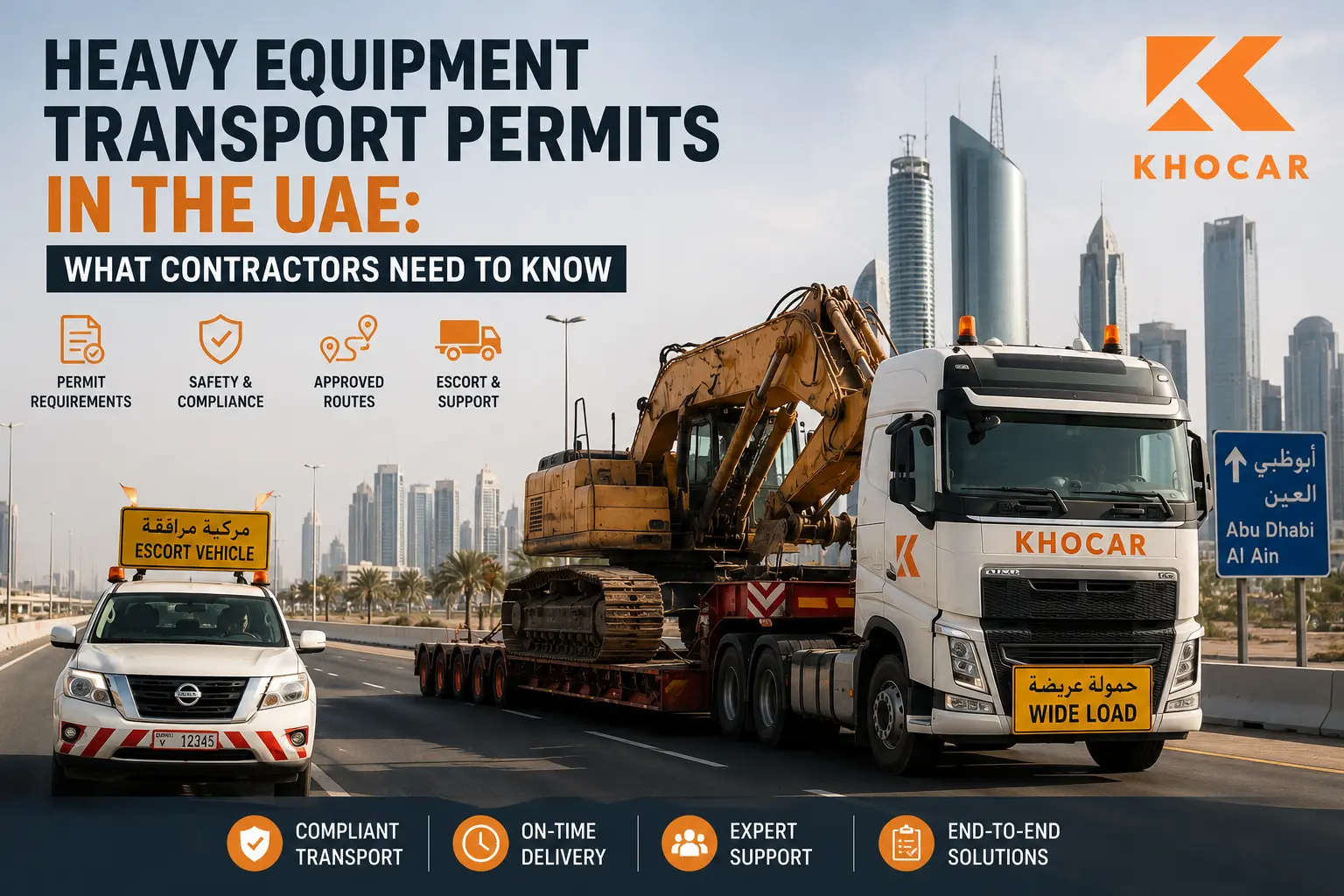
Moving an excavator, crane, generator, transformer, drilling component, or other oversized machine across the UAE is not simply a matter of booking a trailer and choosing a delivery date. Once the vehicle-and-load combination exceeds ordinary road limits, or the vehicle needs to travel on a restricted route or during a restricted period, the movement can require additional approvals, route planning, documentation, and operational controls. That is why understanding Heavy Equipment Transport Permits in the UAE should be part of project planning, not an afterthought on dispatch day.
The most important point is that there is no single permit that covers every heavy-equipment move everywhere in the country. Requirements can vary by emirate, road authority, vehicle category, load dimensions, total weight, route, movement time and project location. Dubai’s Roads and Transport Authority (RTA), for example, has a dedicated mobility permit for over-weight and over-dimension vehicles, while Abu Dhabi regulates freight transport through its Asateel system and applies separate heavy-vehicle movement restrictions. Dubai RTA’s official over-weight/over-dimension permit service and Abu Dhabi Mobility’s commercial transport portal are therefore essential references when planning a move.
This guide explains how contractors can prepare for an oversized or heavy equipment movement, what information permit authorities and transport companies typically need, how route restrictions affect scheduling, why lowbed selection matters, and where the responsibilities of the equipment owner, transporter and project team overlap. The goal is simple: fewer rejected applications, fewer gate delays, safer transport and a much lower risk of discovering a compliance problem after the trailer is already loaded.
Key Takeaways
- Heavy equipment transport permits in the UAE are not one universal document. Requirements depend on the emirate, route, vehicle, dimensions, weight, timing and nature of the move.
- If the vehicle/load is overweight or over-dimension, special approval may be required. Dubai RTA explicitly provides a Mobility Permit for Over-Weight and Over-Dimension Vehicles.
- Abu Dhabi has its own freight-transport regulatory framework through Asateel, covering operator, vehicle and driver permits and related compliance requirements.
- The UAE federal government states that heavy vehicles with a total weight exceeding 65 tonnes are banned from using roads from 2024 under the applicable weights-and-dimensions framework; this should not be interpreted as a blanket ‘permit up to 65 tonnes’ rule.
- Route restrictions can matter even when a load is not oversized. Abu Dhabi and Dubai both regulate heavy-vehicle movement on certain roads and at certain times.
- Accurate load dimensions and weight are critical. Under-declaring the loaded height, width, length or weight can invalidate planning and create delays at inspection points or site gates.
- A proper heavy-haul plan should consider trailer configuration, axle distribution, route, bridge/clearance risks, loading method, escorts, permits, timing and destination access—not just the transport distance.
- For contractors, the safest approach is to engage the transport provider early and provide the equipment specifications, pickup/drop-off points, project timing and site access requirements before dispatch.
What Are Heavy Equipment Transport Permits in the UAE?
In practical terms, a heavy equipment transport permit is an authorization or approval that allows a specific heavy vehicle, load or movement to operate under conditions that differ from ordinary road traffic rules. Depending on the authority and situation, the approval may address excess weight, excess dimensions, restricted routes, restricted hours, heavy construction vehicles or other controlled movements.
It is important to separate three related concepts:
| Concept | What It Controls | Example |
| Vehicle/operator authorization | Whether a company, vehicle and/or driver is authorized to perform regulated freight transport. | Abu Dhabi freight operator, vehicle and driver permits through Asateel. |
| Overweight/over-dimension movement permit | Whether a particular heavy or oversized vehicle/load can use specified roads under approved conditions. | Dubai RTA mobility permit for over-weight and over-dimension vehicles. |
| Route/time restriction approval | Whether a heavy vehicle can use a restricted road or travel during a restricted period. | Dubai permit for heavy vehicles on banned roads/times; Abu Dhabi heavy-vehicle movement restrictions. |
These approvals can interact. A transporter may have the correct commercial freight authorization but still need a separate approval for a particular oversized movement. Conversely, an oversized load may be technically transportable but cannot simply travel whenever the driver chooses because the route has heavy-vehicle restrictions.
When Does Heavy Equipment Require Special Approval?
The safest way to answer this question is: whenever the proposed movement falls outside the normal operating limits or restrictions of the applicable authority, assume that additional approval may be required until the route and load have been checked.
Typical triggers include:
- Excessive total weight or axle loading.
- Excessive width, height or length.
- A load that extends beyond normal vehicle dimensions.
- A heavy construction vehicle such as a crane that needs to travel on public roads.
- Movement on a road where heavy vehicles are restricted.
- Movement during prohibited or peak traffic periods.
- A project route requiring specific access or coordination.
- A transport configuration requiring special route clearance.
- Movement involving ports, industrial zones, critical infrastructure or controlled facilities where additional access approvals apply.
Do not rely on a generic online ‘oversize threshold’ without checking the authority for the actual route. The same load can face different movement conditions in Dubai and Abu Dhabi, and a route can have restrictions that are independent of the cargo’s dimensions.
UAE-Wide Rules vs Emirate-Specific Permits
One of the biggest sources of confusion is treating the UAE as if one road authority issues every transport permit. The federal framework establishes important baseline requirements, while local authorities regulate roads, movement and transport activities within their jurisdictions.
The UAE government’s road-safety guidance states that heavy vehicles with a total weight exceeding 65 tonnes are banned from plying on UAE roads from 2024 under the applicable heavy-vehicle weights and dimensions regulations. The same guidance explains that smart electronic gate systems are being used to measure and monitor heavy-vehicle weights and dimensions.
This 65-tonne figure is especially important for contractors because it is easy to misread it as an ‘oversize permit limit.’ It is not. A load can be below 65 tonnes and still be over-dimensional, subject to route restrictions, or otherwise require special approval. Conversely, an extremely heavy combination cannot simply be made legal by obtaining an ordinary oversized-load permit if it conflicts with the applicable maximum-weight rules.
The UAE government’s official platform also directs users to the federal legislation system for current laws and regulations. Because transport rules can change, contractors should verify the current rule set rather than rely on an old permit checklist. UAE legislation guidance is a useful starting point.
Abu Dhabi Heavy Equipment Transport: What Contractors Need to Know
Abu Dhabi deserves special attention for contractors because of its extensive industrial, oil and gas, construction and infrastructure activity. Abu Dhabi Mobility’s freight-transport framework regulates transport operators, vehicles and drivers through the Asateel platform.
Abu Dhabi Mobility’s commercial transport portal states that registered companies can access services for freight transport operation permits, freight transport vehicle permits and driver permits through Asateel.
The underlying freight-transport regulation is broader than a single oversize permit. Abu Dhabi Mobility explains that the regulation applies to vehicles transporting heavy and light freight within the emirate and sets requirements for operating entities, drivers, vehicles, safety conditions, permits and enforcement. It also says that companies and entities are prohibited from conducting freight transport activities without the required prior permit. Official Abu Dhabi freight-transport regulation summary is the best source to verify the current framework.
For a contractor moving a large machine into or out of Abu Dhabi, this means the permit conversation should start before the trailer is dispatched. Confirm that the transporter is properly authorized, the vehicle is permitted, the driver is authorized, the equipment/load is correctly described, and the route and movement window are acceptable.
Abu Dhabi Heavy-Vehicle Movement Restrictions
Oversized-load planning can fail even when the load itself is technically permitted because heavy vehicles may be restricted from specific roads or time periods.
For example, Abu Dhabi Mobility announced updated heavy-vehicle movement restrictions in January 2025, including weekday morning and evening restrictions on Abu Dhabi city roads and a Friday restriction period. The announcement specifically covers freight vehicles, trucks, tankers and heavy equipment. Abu Dhabi Mobility’s movement-restriction announcement Contractors should therefore confirm the current restrictions for the planned route and date rather than assume a previous schedule still applies.
Restrictions can also be route-specific. In November 2025, Abu Dhabi Mobility announced bans affecting Sheikh Maktoum bin Rashid Road (E11) and Al Raha Beach Road (E10), with alternative routes designated for heavy vehicles, and introduced peak-hour restrictions on part of Al Rawdah Road in Musaffah. Official Abu Dhabi route-restriction announcement This is a useful example of why a route survey and current authority check matter.
Dubai Oversized-Load Permits: RTA Requirements
Dubai has a clearly defined RTA service for overweight and over-dimension vehicles. The official RTA service states that circulation of overweight or over-dimension vehicles at any time and on roads not intended for that purpose constitutes a traffic violation, and that a Mobility Permit should be obtained from the Right-of-Way Department when such vehicles need to operate.
RTA’s current service page identifies its ‘large-sized load’ and ‘special load’ categories. It describes large-sized loads as vehicles with width below 3.5 metres and height below 4 metres, while its special-load category includes weight above 60 tonnes, width above 3.5 metres, height above 4 metres or length above 20 metres. These are Dubai RTA service classifications—not a universal UAE definition of oversized cargo. Dubai RTA’s official permit details should be checked for the current application.
The RTA service currently lists a service time of three working days and requires items such as load pictures and, where applicable, a vehicle registration certificate or company NOC. That means contractors should not plan an oversized movement as if a permit can always be obtained at the last minute.
RTA also operates a separate Mobility Permit for heavy vehicles in banned times and roads. The current service page identifies this as a permit for limited cases involving banned routes, banned times and banned areas. It lists a service time of three working days and a current fee of AED 70 per vehicle per month for that specific service. RTA heavy-vehicle restricted-time permit details Fees and requirements can change, so treat these figures as a current reference point rather than a permanent tariff.
For heavy construction vehicles such as cranes, RTA also provides a separate mobility-permit service. RTA heavy construction vehicle permit service The correct permit category should be confirmed from the actual vehicle and movement scenario.
What Documents Are Commonly Needed?
The exact document list depends on the authority and permit type, but contractors should be ready to provide a clear technical and commercial package. A strong application begins with accurate information rather than a large volume of paperwork.
| Information / Document | Why It Matters |
| Vehicle registration details | Identifies the towing vehicle and trailer configuration. |
| Load photos | Helps authorities and transport planners understand the actual cargo. |
| Equipment make/model | Supports technical identification and trailer selection. |
| Cargo weight | Determines total weight and axle-loading considerations. |
| Length × width × height | Determines over-dimension exposure and route-clearance risks. |
| Combined loaded dimensions | The relevant measurement is the vehicle/load combination as it will travel. |
| Pickup and delivery addresses | Defines the route and authorities involved. |
| Route or route-survey information | Helps identify clearance, turning and road restrictions. |
| Project contract / work details where required | May support restricted heavy-vehicle permit applications. |
| NOC where applicable | May be needed where the applicant is not the vehicle owner or another party controls access. |
| Driver / operator authorization | Confirms the transport operation is properly authorized. |
| Insurance and safety documents | Supports legal and risk requirements for commercial transport. |
| Site access / gate documents | Prevents a legally permitted load from being rejected at the destination. |
For Abu Dhabi freight operators, the Ministry of Energy and Infrastructure also provides a national transportation vehicle permit service covering land transport activity between emirates and internationally. The official service lists ownership/registration information, required safety measures and valid UAE-wide insurance among its requirements. MOEI national transportation vehicle permit service This is another reason to distinguish operator-level licensing from route-specific oversized-load approvals.
Why Accurate Load Dimensions Matter
The permit is only as useful as the data behind it. If the actual loaded configuration is wider, taller, longer or heavier than the declared configuration, the approved route and movement conditions may no longer match the real vehicle.
Measure the equipment in transport position. If an excavator’s boom is removed, record the configuration that will actually travel. If attachments remain installed, include them. If a machine sits on timber, ramps or other supports that change its height, include the final transport height.
- Length: measure the complete loaded combination as relevant to the permit application.
- Width: include the widest point of the equipment and any load overhang.
- Height: measure from road surface to the highest point after loading.
- Weight: use the actual equipment weight where possible, then add trailer and relevant vehicle weights for the total combination.
- Axle loads: do not assume that acceptable gross weight means every axle is within its permissible loading.
- Attachments: account for booms, counterweights, buckets, blades, outriggers and removable components.
KhoCAR’s own lowbed booking guide recommends preparing equipment type, weight, dimensions, pickup and drop-off locations, loading/unloading arrangements and site-access information before requesting a lowbed. This is not merely a quoting convenience; it is the same information that helps determine whether the planned transport configuration is operationally realistic.
Weight, Axle Loads and the UAE’s 65-Tonne Threshold
Weight is one of the most important—and most misunderstood—parts of heavy equipment transport. Contractors should distinguish gross combination weight from the weight carried by individual axles and from the rated capacity of the trailer.
The federal UAE road-safety guidance states that heavy vehicles with a total weight exceeding 65 tonnes are banned from using roads from 2024 under the applicable weights-and-dimensions regulations. Official UAE heavy-vehicle weights and dimensions guidance This is a significant national constraint, but it does not replace local permit checks.
Abu Dhabi’s published heavy-vehicle annual test manual provides additional technical context for standard vehicle dimensions. It states, for example, that the total height of a heavy vehicle must not exceed 4.2 metres and that a heavy vehicle’s total width must not exceed 2.6 metres under the standard inspection framework, with specified length limits for different vehicle combinations. It also notes that vehicles exceeding those dimensions should not be tested without proof of an exemption from police. Abu Dhabi Heavy Vehicle Annual Test Manual These figures are useful for understanding the baseline inspection framework, but contractors should not use them as a substitute for the specific permit requirements of the planned move.
Escort Vehicles, Police Coordination and Movement Windows
An oversized movement can require more than a permit. Depending on the route and dimensions, authorities or the transport plan may require escort vehicles, warning arrangements, specific movement hours or coordination with police and road authorities.
Dubai’s RTA has historically coordinated its heavy-truck permit systems with Dubai Police, allowing police systems to recognize permitted heavy vehicles and enforce permit conditions. RTA has also described special timing for trucks carrying oversized cargo under approved permits. RTA’s heavy-truck permit coordination information Current route and timing conditions should always be checked at the time of application.
For contractors, the practical takeaway is that ‘permit approved’ does not automatically mean ‘depart at any time.’ The approved movement may have a specific route, date, time window, vehicle plate, load description or escort condition.
- Confirm the permit validity period.
- Confirm the approved route, not merely the destination.
- Confirm whether escort vehicles are required.
- Confirm whether police or authority coordination is required.
- Confirm the permitted movement window.
- Confirm whether a printed permit, electronic permit or linked plate record must be available.
- Make sure the actual trailer and towing unit match the approved vehicle details.
Lowbed Trailer Selection and Why It Affects Compliance
A lowbed trailer is often the preferred solution for moving tall and heavy construction or industrial equipment because its low deck can reduce the overall transport height. But ‘lowbed’ is not a single specification. Trailer deck height, length, axle configuration, capacity and ramp arrangement all affect the final loaded dimensions and weight distribution.
KhoCAR’s Lowbed Trailers UAE service offers lowbed trailer rental with experienced drivers for excavators, bulldozers, loaders, cranes, generators and industrial machinery, with route planning and transport coordination as part of the service.
| Load Type | Typical Transport Concern | Planning Focus |
| Excavator | Height, width, boom position, operating weight | Low deck, secure attachment, route clearance |
| Bulldozer / loader | Weight and width | Axle distribution, ramps, load restraint |
| Crane | Extreme length/weight and configuration | Special permit, route survey, movement window |
| Generator | Weight, lifting points, center of gravity | Loading method, restraint, trailer capacity |
| Transformer | High value, weight, dimensions | Specialized transport planning and route engineering |
| Oilfield module | Large footprint and project-specific access | Route, permits, escorts and site coordination |
A useful rule is to select the trailer after understanding the load, not before. A cheap trailer that cannot legally or safely carry the actual configuration is not a cost saving.
Permit Application Workflow: Step by Step
- Define the exact load. Record make/model, weight, length, width, height, attachments and operating condition.
- Define the transport combination. Identify the towing vehicle, trailer type, axle configuration and expected loaded dimensions.
- Identify the route. Use exact pickup and delivery points and determine the emirates and road authorities involved.
- Check whether the move is over-weight, over-dimension, restricted by time/road, or otherwise subject to special approval.
- Verify operator and vehicle authorization. In Abu Dhabi, confirm the relevant Asateel requirements; in Dubai, confirm the RTA requirements for the specific movement.
- Prepare supporting documents. Keep registration, load photos, project details, NOCs, insurance and technical information ready where required.
- Conduct a route assessment. Check bridges, clearances, turning radii, road restrictions, industrial gates, construction zones and access roads.
- Submit the appropriate permit application. Do not submit a generic heavy-vehicle request when the actual move requires an over-dimension or special-load category.
- Review the approval conditions. Check route, timing, vehicle plate, load details, escort conditions and validity.
- Prepare the load and dispatch only when the actual configuration matches the approved information.
- Carry or make available the required permit and documents during movement.
- Complete delivery and record any changes or incidents for future route planning.
Common Mistakes That Cause Permit Delays or Rejection
1. Underestimating the Loaded Height
A machine’s catalog height is not necessarily its transport height. The final height includes the trailer deck and any support or loading arrangement. Clearance is especially important near bridges, signs, gantries and industrial entrances.
2. Giving Only the Machine Weight
The transport authority and trailer planner may need to understand the total vehicle/load combination and axle distribution, not simply the net equipment weight.
3. Using Old Route Information
Road restrictions change. Abu Dhabi’s 2025 heavy-vehicle restrictions are a good example. A route that was acceptable under an older schedule may now require a different movement window or alternative road.
4. Treating Dubai Rules as UAE-Wide Rules
Dubai RTA’s service classifications are specific to Dubai. Abu Dhabi operates its own freight-transport system. Always identify the authority responsible for the route.
5. Applying Too Late
RTA’s current over-weight/over-dimension service lists three working days as the service time. That is not a promise that every complex move will be ready in three days, especially if route coordination or corrections are needed. Build contingency time into the project schedule.
6. Ignoring Destination Access
A permit can authorize road travel but does not automatically guarantee that a construction site, oilfield gate, warehouse, port or industrial facility will accept the vehicle. Site access and gate documentation must be planned separately.
7. Declaring the Wrong Vehicle
If the permit is tied to vehicle details, the actual towing unit/trailer combination must match the approved application. Changing equipment at the last minute can create a compliance problem.
8. Forgetting Loading and Unloading
The transport plan must cover how the equipment gets onto and off the trailer. Non-running machinery may require a crane, winch or additional equipment.
Real-World UAE Transport Examples
Example 1: 22-Tonne Excavator from Musaffah to a Construction Site
A contractor needs to move a 22-tonne excavator from Musaffah to a project site. The machine is within the standard width range but is too tall for a conventional flatbed once loaded. A lowbed is selected.
The planning team records the machine dimensions, trailer dimensions, exact pickup/drop-off points, gate requirements and movement date. The transporter checks the route and confirms whether any local heavy-vehicle timing restrictions affect the move.
The key lesson is that a 22-tonne machine is not automatically a ‘simple move.’ Height, route and timing can still require careful planning.
Example 2: 55-Tonne Generator in Abu Dhabi
A 55-tonne generator is below the federal 65-tonne gross threshold mentioned in the UAE road-safety guidance, but the final combination and dimensions still need to be checked. If the loaded width or height exceeds normal limits, special approval may be necessary.
The contractor should not say, ‘It is under 65 tonnes, so no permit is needed.’ Weight is only one variable. The route, dimensions, vehicle configuration and local restrictions still matter.
Example 3: 70-Tonne Industrial Module
A 70-tonne module presents a fundamentally different problem. The federal guidance states that heavy vehicles with total weight exceeding 65 tonnes are banned from UAE roads from 2024 under the applicable framework. The contractor therefore cannot treat this as a normal oversize-load permit request.
The correct approach is to engage the competent transport and regulatory authorities early to determine whether a lawful specialized transport solution, exemption or alternative handling method exists for the specific project. Do not assume that paying a permit fee makes a movement above a stated legal limit permissible.
Example 4: Crane Movement in Dubai
A mobile crane needs to travel from one site to another. Even if the crane is not carrying a separate oversized cargo, its own dimensions and heavy-vehicle status can trigger special movement requirements.
Dubai RTA has a specific Mobility Permit service for heavy construction vehicles such as cranes. The contractor should therefore identify the vehicle category before planning the movement window. RTA’s heavy construction vehicle permit service is the appropriate official starting point for Dubai.
How Much Do Heavy Equipment Transport Permits Cost in the UAE?
There is no single UAE-wide permit price for every heavy equipment movement. Cost depends on the emirate, permit type, vehicle, duration, route, load category and any supporting services.
For example, Dubai RTA currently lists AED 20 per vehicle for one of its large-sized load permit options and AED 220 per vehicle for a specified special-load permit category after listed knowledge/innovation charges. Its separate heavy-vehicle restricted-time/road permit is currently listed at AED 70 per vehicle per month. RTA’s current service details and restricted-movement permit details show why quoting a single ‘oversize permit cost’ without knowing the actual movement can be misleading.
The bigger cost drivers for contractors are often indirect: route surveys, escort vehicles, special trailer configuration, waiting time, additional mobilization, police/authority coordination, off-hours movement, cranes for loading, and delays caused by incorrect documentation.
KhoCAR’s lowbed trailer rental cost guide similarly explains that heavy transport pricing depends on equipment weight, dimensions, route, trailer type, permits, loading conditions, urgency and waiting time. A permit is therefore one component of the transport budget, not the entire cost.
Contractor Checklist Before Dispatch
| Check | Complete? |
| Equipment make/model confirmed | ☐ |
| Actual or verified equipment weight | ☐ |
| Transport dimensions: L × W × H | ☐ |
| Attachments and removable components identified | ☐ |
| Trailer type and axle configuration confirmed | ☐ |
| Towing vehicle registration details confirmed | ☐ |
| Pickup and delivery pins confirmed | ☐ |
| Site gate/access requirements confirmed | ☐ |
| Applicable emirate authority identified | ☐ |
| Operator/vehicle/driver authorization checked | ☐ |
| Oversize/overweight permit requirement checked | ☐ |
| Restricted roads and movement hours checked | ☐ |
| Route survey completed where required | ☐ |
| Escort requirements confirmed | ☐ |
| Permit approval conditions reviewed | ☐ |
| Actual loaded configuration matches permit | ☐ |
| Load restraint and safety inspection completed | ☐ |
| Emergency/contact information shared | ☐ |
How to Choose a Heavy Equipment Transport Partner in the UAE
A heavy transport provider should be evaluated on more than the trailer rate. Ask whether the company understands the route, can select the right trailer, can coordinate permits, and can respond if site conditions change.
- Can the provider handle the specific weight and dimensions?
- Does it have the appropriate lowbed or multi-axle configuration?
- Are experienced heavy-haul drivers available?
- Can the provider support route planning and permit coordination?
- Does it understand Abu Dhabi and Dubai movement restrictions?
- Can it coordinate loading and unloading support?
- Is the equipment insured and maintained?
- Can it provide documentation before dispatch?
- Does it have contingency options if the assigned trailer becomes unavailable?
- Can it support inter-emirate transport?
KhoCAR’s Lowbed Trailers UAE service states that its lowbed transport solutions cover Dubai, Abu Dhabi, Sharjah and other Emirates, with experienced drivers and logistics support for heavy and oversized machinery. Its site also notes support for route planning and permits.
For contractors whose equipment movement is connected to oilfield work, KhoCAR’s oilfield services and industrial supplies division provides an additional local capability around industrial equipment, spares, machinery support and project requirements.
How to Make Permit Planning Faster
The fastest permit process is usually the one that starts with complete information. Instead of asking a transporter, ‘Can you move this tomorrow?’, send the technical details in one package.
A useful request looks like this:
Equipment: CAT 336 excavator
Weight: Approx. 37 tonnes
Dimensions: 12.0 m L × 3.2 m W × 3.5 m H in transport configuration
Pickup: Musaffah, Abu Dhabi — exact pin attached
Delivery: Project site — exact pin attached
Loading: Machine operational; self-load if suitable
Date: Requested movement date/time
Site: Gate contact and access requirements attached
Photos: Front, side, rear and nameplate attached
This gives the transport planner enough information to begin trailer selection, route assessment and permit classification without several rounds of clarification.
Why Permit Compliance Is Also a Project-Schedule Issue
Permit planning is often treated as administration. In reality, it is schedule protection. A permit delay can prevent a machine from reaching site, which can hold up lifting, excavation, installation, commissioning or an entire work crew.
The risk is especially high when equipment is coming from another emirate. A movement may pass through multiple road environments with different restrictions. A contractor that plans only the final destination can miss a restriction on the approach route.
That is why a professional heavy transport plan should have a ‘ready to dispatch’ gate: technical data verified, trailer assigned, permit approved, route confirmed, site access confirmed, driver briefed and load secured.
Final Takeaway: Plan the Permit Around the Actual Load and Route
Heavy Equipment Transport Permits in the UAE are best understood as part of a larger compliance and logistics process. The correct question is not simply, ‘Do I need an oversize load permit?’ It is: ‘What approvals, route conditions, vehicle requirements and movement controls apply to this exact vehicle-and-load combination on this exact route and date?’
Dubai and Abu Dhabi illustrate why this distinction matters. Dubai RTA provides specific mobility permits for over-weight/over-dimension vehicles, heavy vehicles on restricted roads/times and heavy construction vehicles. Abu Dhabi regulates freight transport through Asateel and separately manages heavy-vehicle movement restrictions on its road network.
For contractors, the safest workflow is straightforward: measure accurately, choose the correct trailer, identify the responsible authority, verify operator/vehicle/driver authorization, check route restrictions, submit the correct permit application, review the approval conditions, and dispatch only when the actual loaded configuration matches the approved plan.
When the move involves high-value equipment, tight deadlines or an industrial/oilfield destination, working with a transport partner that understands both the equipment and the UAE road environment can reduce the risk of costly delays.
Need Heavy Equipment Transport and Permit Support in the UAE?
Planning to move an excavator, bulldozer, crane, generator, industrial machine or oversized project cargo? KhoCAR’s Lowbed Trailer UAE service provides heavy equipment transport across the UAE with experienced drivers, lowbed trailer options and logistics support.
KhoCAR can help contractors prepare the transport plan around equipment weight and dimensions, pickup and delivery requirements, trailer selection and route coordination. For an oilfield or industrial project, its oilfield services and industrial supplies team can also support related equipment and industrial requirements.
For the fastest assessment, send the equipment type/model, weight, length × width × height, pickup location, delivery location, required date, loading method, and any site-access restrictions. The more complete the information, the easier it is to determine the correct trailer and compliance path.
Request heavy equipment transport support from KhoCAR or visit the Lowbed Trailers UAE service page to discuss your project.
FAQs
Do I need a permit to transport heavy equipment in the UAE?
Possibly. It depends on the vehicle, load dimensions, total weight, route, timing and emirate. Overweight or over-dimension movements can require special approval, while heavy vehicles can also be restricted on certain roads or during certain hours. Always check the authority responsible for the actual route.
What is an oversize load permit in the UAE?
An oversize or over-dimension permit is an approval that allows a vehicle/load exceeding normal road dimensions to travel under specified conditions. The exact permit name, thresholds and process vary by emirate and authority.
What is a heavy vehicle permit in the UAE?
The term can refer to different authorizations depending on the emirate. It may mean a permit for a heavy vehicle to operate on restricted roads/times, or a vehicle/operator authorization required for commercial freight activity. Dubai RTA and Abu Dhabi Mobility have different systems and service categories.
What are the maximum heavy vehicle dimensions in the UAE?
There is no single dimension number that should be applied to every heavy-haul movement. Standard vehicle dimensions and special-load rules depend on the authority and vehicle category. Abu Dhabi’s published inspection manual, for example, describes standard heavy-vehicle limits including 4.2 m height and 2.6 m width, while Dubai RTA uses its own permit classifications. Special movements may require approval or exemption.
Is 65 tonnes the maximum weight allowed for heavy equipment transport in the UAE?
The UAE government’s road-safety guidance states that heavy vehicles with total weight exceeding 65 tonnes are banned from using roads from 2024 under the applicable weights-and-dimensions framework. This should not be interpreted as a universal permit threshold or as permission to move any load up to 65 tonnes without other checks.
Can a 50-tonne machine be transported without a permit?
Not necessarily. Weight is only one factor. If the loaded combination exceeds applicable dimensions, uses a restricted road, travels during a restricted period, or falls into another regulated category, additional approval may still be required.
How long does an oversize-load permit take in Dubai?
Dubai RTA’s current Mobility Permit for Over-Weight and Over-Dimension Vehicles lists a service time of three working days. Complex movements may require additional planning or corrections, so contractors should build contingency time into the project schedule.
How much does an oversize-load permit cost in Dubai?
Fees depend on the RTA permit category and vehicle/load type. RTA currently lists different charges for its large-sized and special-load categories, and a separate monthly fee for certain heavy-vehicle restricted-road/time permits. Check the current RTA service page for the exact application.
How do I get a heavy equipment transport permit in Abu Dhabi?
Start by identifying the transport activity, vehicle, driver, load and route. Abu Dhabi Mobility uses Asateel for freight transport operator, vehicle and driver permit services. The exact requirements for a specific oversized movement should be confirmed with the competent authority and transport provider.
What is Asateel in Abu Dhabi?
Asateel is Abu Dhabi’s electronic platform for freight transport activity services. Abu Dhabi Mobility states that registered companies can use it for freight transport operation permits, freight transport vehicle permits and driver permits.
Are heavy vehicles restricted in Abu Dhabi?
Yes. Abu Dhabi Mobility imposes restrictions on heavy-vehicle movement on specified roads and during specified periods. Restrictions can be updated, so contractors should check the current route and date rather than rely on an old schedule.
Can I transport an excavator on a lowbed trailer without a special permit?
It depends on the excavator’s loaded dimensions, weight, trailer combination and route. A lowbed can help reduce transport height, but it does not automatically remove permit requirements. The final loaded configuration still needs to be assessed.
What documents are needed for oversized equipment transport?
Common information includes vehicle registration, load photos, equipment make/model, weight, dimensions, pickup and delivery locations, project details, NOCs where applicable, insurance and operator/driver documentation. The exact list depends on the authority and permit type.
Does the transport permit cover the destination site?
Not necessarily. A road movement permit and a site-access approval are different matters. Industrial sites, oilfields, ports, construction projects and controlled facilities may require separate gate passes, security approvals, inductions or access documentation.
Do I need an escort vehicle for an oversized load in the UAE?
It depends on the dimensions, route, authority and permit conditions. Some movements may require escort vehicles or additional coordination. The transport plan should confirm this before dispatch.
Can heavy equipment be moved at night in the UAE?
Some heavy or oversized movements may be scheduled during off-peak or restricted windows, but the permitted time depends on the authority and route. Do not assume that nighttime movement is automatically allowed; follow the approved permit conditions.
Can I move heavy equipment between Abu Dhabi and Dubai with one permit?
Do not assume so. Inter-emirate movements can involve different authorities, route rules and operator requirements. The transport provider should identify the approvals needed for the complete route.
What happens if the actual load is bigger than the permit application?
The approved route and movement conditions may no longer match the actual vehicle/load. This can lead to delays, rejection, re-application or enforcement action. Measure the load in its actual transport configuration before applying.
How early should contractors apply for a heavy equipment transport permit?
Start as early as the project schedule allows, especially for unusual dimensions, long routes, restricted roads, industrial sites or tight delivery windows. Dubai RTA lists three working days for certain mobility permits, but route complexity and corrections can extend the real planning timeline.
Does KhoCAR provide heavy equipment transport in Abu Dhabi?
Yes. KhoCAR provides lowbed trailer rental and heavy equipment transport services in Abu Dhabi and across the UAE, including support for excavators, bulldozers, loaders, cranes, generators and industrial machinery.
Can KhoCAR help with permits for oversized equipment transport?
KhoCAR’s Lowbed Trailers UAE service states that its transport solutions include route planning and permit support. For a specific movement, provide the equipment dimensions, weight, locations and date so the team can assess the appropriate transport and compliance requirements.
What is the best trailer for oversized equipment in the UAE?
Often a lowbed or another specialized heavy-haul configuration, but the correct trailer depends on the equipment weight, dimensions, center of gravity, axle loading, loading method and route. Trailer selection should follow the technical load assessment rather than a generic capacity label.
What information should I send a transport company for a fast quote?
Send the equipment type/model, verified weight, length × width × height, pickup and delivery pins, required date/time, loading and unloading method, site-access details, and photos. This is also the information that helps the provider assess trailer selection and permit requirements.