
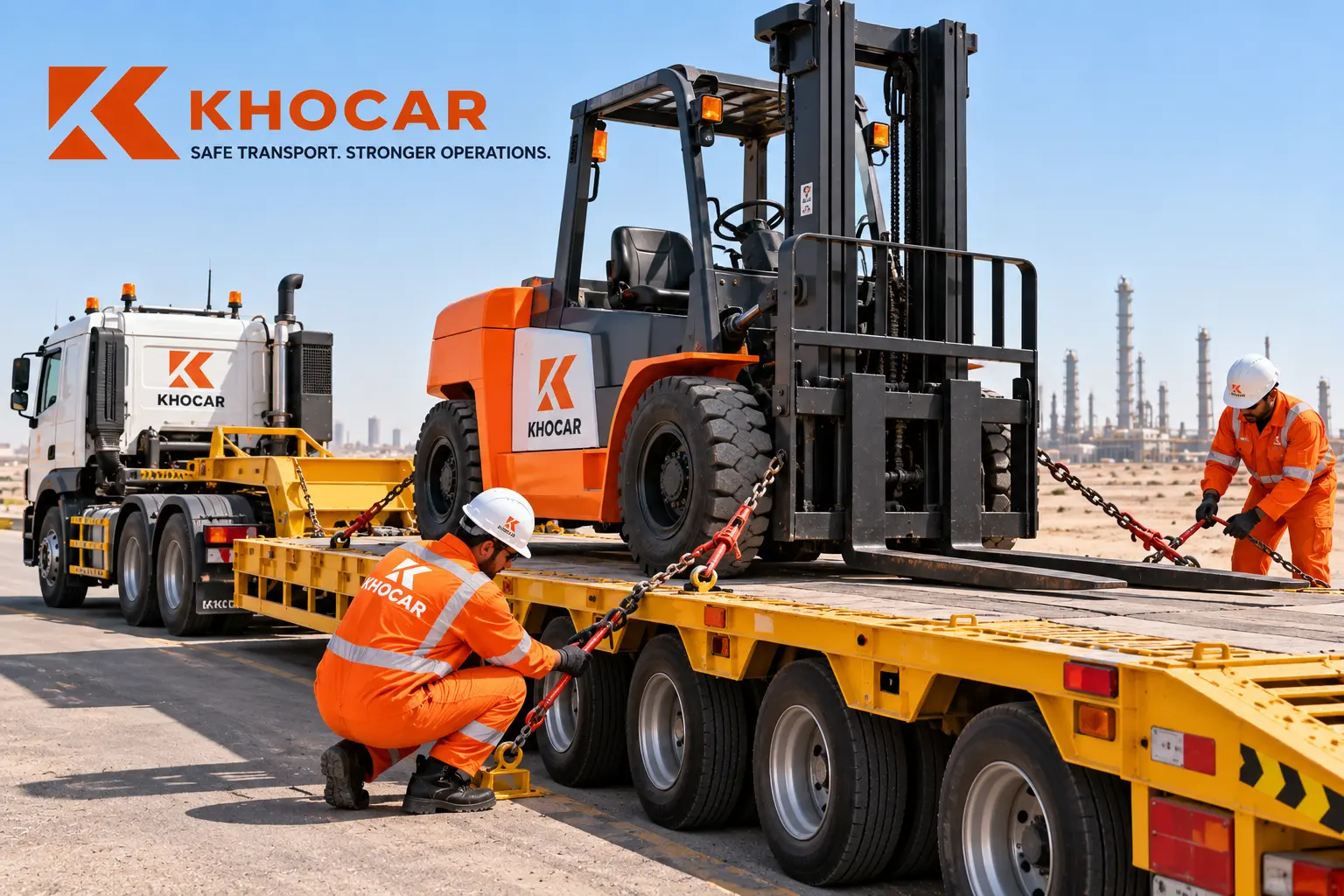
Moving a forklift between warehouses, construction sites, industrial yards, ports, and oilfield facilities sounds straightforward until the machine reaches the road. A forklift is compact compared with a crane or excavator, but it can still create transport challenges because its weight, mast height, fork position, counterweight, turning geometry, and operating condition all affect how it should be loaded and secured. That is why forklift transport UAE planning should start with the machine’s actual transport configuration, not simply the distance between two sites.
For most road moves, the key questions are: What does the forklift weigh? What are its transport dimensions? Can it safely drive onto the trailer? Which trailer configuration provides enough payload and deck space? Will the loaded combination stay within applicable UAE weight and dimension limits? Does the route have heavy-vehicle restrictions? And how will the forklift be restrained so it cannot roll, shift, or become unstable during braking and cornering?
This guide explains how to plan forklift transportation UAE operations, when a lowbed trailer can make sense, what to check before dispatch, and how to build a practical safety checklist for moves in Abu Dhabi and across the UAE.
Key Takeaways
- Start with verified forklift weight and transport dimensions, including the mast, forks, attachments, and any removable components.
- Choose the trailer based on payload, axle configuration, deck dimensions, loading method, and the final loaded height, not just forklift size.
- UAE heavy-vehicle rules regulate gross weight, axle loads, and dimensions; the legal limit is not the same thing as trailer payload capacity.
- Load the forklift in a stable transport position, secure it at appropriate manufacturer-approved or engineered restraint points, and prevent rolling and movement.
- Check route restrictions, permits, site access, and heavy-vehicle movement windows before dispatch, especially for Abu Dhabi and inter-emirate moves.
- Photograph and document the forklift, trailer, restraint arrangement, and loaded dimensions before departure.
Why Forklift Transport in the UAE Requires Planning
Forklifts are designed primarily for lifting and moving materials inside controlled operating environments. Road transport is a different task. The forklift has to be converted from a mobile work machine into a stable road cargo load, and the transport vehicle must remain within the applicable limits for the route. That means a transport plan should consider the forklift, trailer, route, loading area, destination, and documentation as one system.
A common mistake is to treat every forklift as a small load because the machine is shorter than many construction machines. In reality, a high-capacity forklift can be heavy enough to require a substantial lowbed or other suitable heavy-equipment trailer. Even a lighter warehouse forklift can become awkward to transport if its mast is tall, its forks cannot be folded or removed, the machine is not operational, or the pickup site has limited loading space.
The safest approach is to establish the transport configuration before a trailer is dispatched. This prevents a situation where the trailer arrives but the machine does not fit the deck, the loading angle is unsuitable, the combined height is problematic, or the available restraint points are inadequate.
What Information Do You Need Before Moving a Forklift?
Before requesting forklift transportation UAE, collect the machine information that affects trailer selection and road planning. Do not rely only on a generic description such as ‘5-ton forklift.’ The exact model, mast configuration, attachment, and operating condition can change the transport requirement.
| Information | What to Confirm | Why It Matters |
| Make and model | Exact forklift model and configuration | Helps verify manufacturer dimensions and operating weight. |
| Operating/transport weight | Actual machine weight in the planned transport configuration | Determines trailer capacity and axle-load planning. |
| Length | Overall length with forks/attachment in transport position | Determines deck fit and rear/front overhang. |
| Width | Overall widest point | Affects trailer fit and possible over-width considerations. |
| Height | Overall height with mast/forks secured | Affects total loaded height and route clearance. |
| Mast type | Standard, duplex, triplex, etc. | Mast configuration can materially change transport height. |
| Attachment | Forks, clamps, side-shifter or other equipment | Attachments can change dimensions and weight. |
| Condition | Running, non-running, damaged, flat tyre, hydraulic issue | Determines whether self-loading is practical. |
| Pickup site | Gate, access road, loading area and surface | Affects loading method and trailer access. |
| Destination | Gate, turning area, unloading surface and contact | Prevents delivery delays and unsafe unloading. |
How Heavy Is a Forklift for Transport Purposes?
Forklift weights vary widely. A small warehouse forklift may be only a few tonnes, while large rough-terrain, container-handling, or high-capacity industrial forklifts can be substantially heavier. The correct transport decision therefore comes from the actual machine specification rather than a category label.
Use the manufacturer’s data plate, equipment manual, fleet record, weighbridge information, or another reliable specification source to establish the weight. If the machine has an attachment or configuration that changes its mass, account for it. If the weight is uncertain, tell the transport provider that it is estimated rather than presenting an estimate as a verified figure.
Also distinguish forklift operating weight from the payload capacity printed on the forklift. A forklift rated to lift five tonnes is not necessarily a five-tonne machine. The lifting capacity describes what the machine can handle under specified conditions; the transport weight is the mass of the machine itself.
When Is a Lowbed Trailer Suitable for Forklift Transport?
A lowbed trailer can be a practical option when a forklift is too heavy, tall, wide, or otherwise unsuitable for a conventional truck or flatbed. The lower deck can help reduce the overall transport height, while heavy-duty configurations can provide the payload capacity and axle distribution needed for larger machines.
However, ‘lowbed’ is not a single specification. Trailer deck height, usable deck length, width, axle configuration, suspension, ramp arrangement, and payload capacity all matter. KhoCAR’s Lowbed Trailers UAE service describes lowbed options for heavy and oversized equipment and notes support for route planning, permits, experienced drivers, and UAE-wide transport.
For a forklift, the most important trailer question is not simply whether the machine fits on the deck. The transport team should confirm that the trailer can carry the forklift safely, that the loaded height and width work for the route, and that the loading/unloading method is appropriate.
Forklift Lowbed Trailer Requirements
When selecting a forklift lowbed trailer UAE setup, review the following requirements together:
- Payload capacity must exceed the verified forklift transport weight with an appropriate operating margin.
- Axle configuration must be suitable for the total combination and the applicable road limits.
- Deck width and usable length must accommodate the forklift without unsafe overhang or interference with trailer components.
- Deck height should be considered alongside forklift height to establish the final loaded height.
- Loading ramps must be rated and suitable for the forklift’s wheel or tyre configuration and loading weight.
- The trailer deck should provide suitable structural and restraint arrangements for the load.
- The tractor-trailer combination must be appropriate for the route, not just capable of moving the machine inside a yard.
- The trailer and towing vehicle should have current documentation and be operated by appropriately authorized personnel.
UAE Weight and Dimension Rules: What Forklift Transporters Need to Check
UAE road transport planning needs to account for national heavy-vehicle weight and dimension rules as well as local route controls. The UAE Ministry of Energy and Infrastructure states that Cabinet Resolution No. 138 of 2023 sets maximum heavy-vehicle gross weights by axle count, including 21 tonnes for two axles, 34 tonnes for three, 45 tonnes for four, 56 tonnes for five, and 65 tonnes for six axles. The Ministry’s published table of maximum weights and dimensions also lists maximum dimensions for different heavy-vehicle combinations.
These figures should not be interpreted as a forklift payload limit. They concern the heavy vehicle and its permitted configuration. For example, a 65-tonne gross limit for a six-axle heavy vehicle does not mean that the trailer can carry 65 tonnes of forklift. The weight of the tractor, trailer, fuel, equipment and cargo all form part of the overall combination that must be considered.
The UAE legislation portal identifies Federal Decree-Law No. 12 of 2023 as the federal framework regulating heavy-vehicle weights and dimensions, while Cabinet Resolution No. 138 of 2023 is the associated resolution regulating maximum weights, dimensions, and administrative penalties. See the UAE legislation portal for the active Cabinet Resolution. Operators should verify the actual route, vehicle classification, axle configuration, and any applicable permit conditions before dispatch.
Why Gross Weight and Payload Are Not the Same
This distinction is important when arranging heavy forklift transport UAE. Suppose a forklift weighs 18 tonnes. That does not mean an 18-tonne-rated trailer is automatically sufficient for the job. The transport combination also includes the trailer and tractor, and the load must be distributed correctly across the relevant axle groups.
| Term | Meaning for Planning |
| Forklift transport weight | Mass of the forklift in the actual configuration being transported. |
| Trailer tare weight | Weight of the empty trailer. |
| Tractor weight | Weight of the towing vehicle. |
| Gross combination weight | Combined mass of tractor, trailer and forklift/cargo. |
| Axle load | Load carried by each axle or axle group; distribution matters for compliance. |
| Payload capacity | Cargo weight the trailer is designed and rated to carry, subject to the specific configuration and route. |
A trailer can have enough theoretical payload capacity but still be unsuitable if the forklift’s centre of gravity or wheel loads create an unacceptable axle distribution. This is why a transport provider should review both total weight and how that weight sits on the trailer.
Measuring the Forklift Before Loading
Measure the forklift in the exact configuration in which it will travel. A brochure dimension is useful for an initial estimate, but transport planning should reflect the actual machine.
- Length: measure the overall transport length, including forks or the planned attachment position.
- Width: identify the widest point, including mirrors, attachments, guards, or other protrusions where relevant.
- Height: measure the maximum height in the secured transport position.
- Ground clearance and approach angle: confirm that the machine can climb the trailer ramps without contacting the deck or ramp structure.
- Attachment position: record whether forks, clamps, buckets, or other attachments are installed, removed, or separately secured.
- Loose components: identify anything that could move or fall during transport.
Take photographs from the front, rear, both sides, and the top of the mast area where possible. A clear nameplate photograph is particularly useful because it helps confirm the model and rated information.
Loading a Forklift Onto a Lowbed Trailer
Loading is one of the highest-risk stages because the forklift is moving on ramps and the trailer is not yet carrying a stable road load. The loading plan should be agreed before the trailer arrives.
- Confirm the loading area is level, firm, clear of unnecessary personnel, and suitable for the tractor-trailer combination.
- Inspect the trailer deck, ramps, tyres, brakes, visible structure, and restraint equipment before loading.
- Confirm the forklift is suitable for self-loading. If it is damaged or non-running, arrange an appropriate alternative loading method rather than improvising.
- Align the forklift with the ramps and use controlled speed. Avoid abrupt steering or braking while climbing.
- Keep the load configuration consistent with the agreed transport plan and avoid unnecessary movement on the trailer.
- Position the forklift so its weight is appropriately distributed over the trailer’s load-bearing area and axle groups.
- Lower and secure the mast and forks in the transport position according to the equipment manufacturer’s procedure.
- Apply the parking brake and complete the agreed immobilization and restraint procedure before road travel.
Where a forklift cannot safely self-load, a crane, suitable lifting system, or other engineered loading method may be required. The method should be chosen based on the forklift’s weight, lifting points, condition, and manufacturer instructions—not improvised at the site.
How to Secure a Forklift for Road Transport
Load restraint is not a generic ‘add a few chains’ exercise. The restraint system should prevent the forklift from moving forward, backward, sideways, or vertically under the forces expected during braking, acceleration, cornering, and uneven road conditions.
General load-security guidance from the UK’s Driver and Vehicle Standards Agency explains that all loads need to be secure regardless of the vehicle, load size, or journey length, and that poor load security can affect vehicle handling, braking distance, and rollover risk. DVSA guidance on load security is useful as a general load-restraint reference, while the actual UAE movement should follow applicable UAE requirements, the carrier’s procedures, and the forklift/trailer manufacturer’s instructions.
For forklift transportation, the restraint plan should normally address:
- Forward movement during hard braking.
- Rearward movement during acceleration.
- Lateral movement during cornering or evasive manoeuvres.
- Rolling or creeping caused by tyre movement or slope.
- Vertical movement or bouncing over uneven road surfaces.
- Movement of the mast, forks, attachments, or removable components.
Use only suitable rated chains, binders, straps, chocks, blocks, and anchor points for the load and restraint design. Do not attach restraints to vulnerable hydraulic lines, steering components, guards, or other parts not intended to take restraint loads.
Forklift Restraint Checklist Before Departure
| Check | What to Verify |
| Parking brake | Applied according to the transport procedure. |
| Mast | Lowered or positioned as specified for transport and secured against movement. |
| Forks | Lowered and secured so they cannot swing, rise, or become a clearance hazard. |
| Attachments | Secured or removed according to the transport plan. |
| Wheels | Immobilized where required by the restraint plan. |
| Chains/straps | Correctly rated, undamaged, tensioned and attached to suitable points. |
| Anchor points | Suitable for the intended restraint forces and correctly engaged. |
| Load distribution | Forklift positioned so axle/deck loading remains appropriate. |
| Loose items | Removed or separately secured. |
| Final dimensions | Loaded length, width and height checked. |
| Documentation | Transport and permit documents checked before departure. |
When Should Forks, Mast Sections, or Attachments Be Removed?
Whether forklift components should be removed depends on the machine, the transport dimensions, the route, and the manufacturer’s procedure. There is no universal rule that every forklift must have its mast or forks removed.
Removal can sometimes reduce transport height or make loading easier, but it also creates another handling operation and introduces its own risks. If a component is removed, it must be lifted, stored, protected, and transported safely. The transport plan should therefore compare the complete-machine configuration with the disassembled configuration rather than assuming removal is automatically better.
For a tall forklift, a lower transport configuration may be useful if the mast would otherwise create clearance problems. For a normal warehouse forklift on a suitable trailer and route, removing the mast may add unnecessary handling. The decision should be based on measured dimensions, route clearance, equipment instructions, and the actual transport setup.
Forklift Transport Route Planning in Abu Dhabi
Forklift transport Abu Dhabi requires more than calculating kilometres. Commercial freight movements can be affected by route controls, heavy-vehicle movement restrictions, industrial-area access, site gates, and local transport requirements.
Abu Dhabi Mobility’s commercial transport platform, Asateel, is used for commercial transport regulation and permits in Abu Dhabi. The authority states that companies can use Asateel for company operation permits, vehicle permits, and driver permits for freight transport, and that vehicles require an approved functioning tracking device before vehicle permits can be obtained.Abu Dhabi Mobility’s current Commercial Transport and Asateel information should be checked when the move falls within regulated commercial freight activity.
Abu Dhabi has also published heavy-vehicle movement restrictions that can affect scheduling. For example, an announcement effective 27 January 2025 restricted heavy-vehicle movement on Abu Dhabi city roads during specified weekday and Friday periods. Abu Dhabi Mobility’s heavy-vehicle movement update should be consulted together with any later route-specific restrictions because road controls can change.
In late 2025, Abu Dhabi Mobility also announced restrictions affecting heavy vehicles on specific roads including Sheikh Maktoum bin Rashid Road (E11), Al Raha Beach Road (E10), and peak-hour truck movement on part of Al Rawdah Road in Musaffah. The November 2025 route announcement illustrates why a route should be checked close to the actual movement date rather than relying on an old transport schedule.
Inter-Emirate Forklift Transportation
Transport forklift between sites in different Emirates requires coordination beyond the forklift itself. The transporter should confirm the origin and destination authorities, the route, vehicle and driver documentation, movement restrictions, and whether the load falls within standard dimensions or requires additional approval.
An inter-emirate move from Abu Dhabi to Dubai, for example, can pass through different road environments and authority-controlled areas. A route that works for a normal tractor-trailer may not be appropriate for a wide or tall forklift configuration.
- Confirm the exact pickup and delivery addresses, not only the city names.
- Check whether either site has security, gate-pass, escort, or booking requirements.
- Confirm heavy-vehicle movement restrictions for the planned travel period.
- Verify whether the loaded dimensions are within normal limits or need special approval.
- Share the final transport configuration with the driver and site contact before dispatch.
- Keep the permit and movement conditions aligned with the actual loaded vehicle.
Forklift Loading and Unloading Safety at the Destination
Arrival does not end the transport risk. Unloading a forklift from a lowbed involves ramps, reversing or controlled movement, ground conditions, and coordination between the driver and equipment operator.
- Confirm the unloading area before releasing the load. It should be firm, level enough for the planned operation, and free of unnecessary personnel.
- Establish a clear communication method between the driver, forklift operator, banksman/spotter where used, and site supervisor.
- Remove or release restraints only when the trailer is stable and the unloading sequence is ready.
- Inspect the ramp/deck interface before the forklift moves.
- Move slowly and avoid sudden steering or braking on the ramps.
- Keep people outside the forklift’s travel path and avoid standing in pinch points or fall zones.
- Once unloaded, confirm the forklift is stable and parked before the trailer departs.
Site conditions can change between pickup and delivery. If the destination area is congested, soft, sloped, or inaccessible, stop and reassess rather than forcing the original unloading plan.
Transporting a Non-Running or Damaged Forklift
A non-running forklift should not be treated like a normal self-loading machine. A dead battery, hydraulic fault, damaged steering, flat tyre, brake issue, or collision damage can change the loading method and the risks involved.
Before dispatch, tell the transporter exactly what is wrong. The provider may need winching, a crane, auxiliary loading equipment, special ramps, or a different trailer. Trying to push or tow a damaged forklift onto a lowbed without a suitable plan can create uncontrolled movement and injury risk.
- State whether the engine/electric drive operates.
- Confirm whether steering works normally.
- Confirm whether brakes and parking brake function.
- Identify flat or damaged tyres.
- Identify hydraulic leaks or damaged lifting components.
- Provide photographs of the damaged area.
- Confirm whether lifting points or towing points are available and approved.
Transporting Electric, LPG, Diesel, and Rough-Terrain Forklifts
Forklift power type affects the transport preparation, but the exact procedure should follow the equipment manufacturer, carrier, site, and applicable transport requirements.
| Forklift Type | Transport Planning Focus |
| Electric | Secure battery-related components and follow manufacturer/site isolation and transport procedures; protect exposed connectors and prevent unintended movement. |
| LPG-powered | Secure or isolate the fuel system according to applicable procedures; protect the cylinder and valves and follow carrier/site requirements. |
| Diesel | Secure the machine, control loose equipment, and follow applicable fuel and site procedures. |
| Rough-terrain | Expect greater size/weight and potentially different loading angles; verify dimensions and trailer capacity carefully. |
| Container handler/high-capacity | Treat as a specialist heavy load; verify actual mass, dimensions, centre of gravity, axle distribution, and route requirements. |
The important point is not to apply one generic preparation checklist to every forklift. The machine’s power system, size, condition, and site requirements can change the safe transport method.
Common Forklift Transport Mistakes in the UAE
| Mistake | Potential Problem | Better Practice |
| Using the lifting capacity as the transport weight | Trailer may be selected on incorrect data. | Use verified machine weight. |
| Ignoring mast height | Loaded vehicle may have clearance problems. | Measure actual transport height. |
| Choosing a trailer by weight alone | Deck or loading configuration may be unsuitable. | Match capacity, dimensions, ramps and route. |
| Assuming all lowbeds are interchangeable | Trailer may not fit the forklift or route. | Confirm exact trailer configuration. |
| Leaving route planning until dispatch day | Restrictions or permits can delay movement. | Check route and movement conditions early. |
| Using improvised restraint points | Load may not be securely restrained. | Use suitable engineered/manufacturer-approved points. |
| Loading a damaged forklift without disclosure | Unexpected loading hazards can arise. | Tell the transporter about faults before dispatch. |
| Ignoring site access | Trailer may reach the gate but cannot position for unloading. | Confirm access, turning space and ground conditions. |
| Failing to document the loaded condition | Disputes or uncertainty after movement. | Photograph the machine and restraint arrangement. |
A Practical Forklift Transport Checklist
Use this checklist before releasing a forklift for road transport.
- Forklift make and model verified
- Actual transport weight verified
- Length, width and height measured
- Mast/fork configuration confirmed
- Attachments identified and secured or removed
- Machine operating condition confirmed
- Trailer type and payload capacity confirmed
- Axle configuration reviewed
- Loading ramps suitable and inspected
- Pickup site access confirmed
- Destination access confirmed
- Route checked for restrictions and clearance
- Applicable permits/approvals checked
- Movement time confirmed
- Driver and vehicle documentation checked
- Forklift positioned correctly on trailer
- Parking brake applied according to procedure
- Mast and forks secured
- Restraints attached to suitable points
- Wheels/chocks/immobilization measures completed as required
- Loose items removed or secured
- Loaded dimensions checked
- Photos taken before departure
- Emergency and site contacts shared
- Final pre-departure inspection signed off
Example: Moving a 7-Tonne Forklift Between Abu Dhabi Industrial Sites
Consider a contractor moving a seven-tonne rough-terrain forklift from a Musaffah yard to an industrial project site elsewhere in Abu Dhabi. The first step is not to book the smallest trailer that appears to carry seven tonnes. The contractor records the forklift’s actual weight, transport dimensions, mast height, fork position, and whether it can drive normally.
The transporter then selects a suitable trailer configuration and checks the final loaded height and width. The pickup and delivery gates are reviewed, including turning space and the condition of the loading/unloading area. Because the move is in Abu Dhabi, the operator also checks the applicable commercial transport requirements and current heavy-vehicle route restrictions.
At pickup, the trailer is inspected and positioned on suitable ground. The forklift is driven onto the deck under controlled conditions, placed according to the agreed load plan, and secured using appropriate restraints. The mast and forks are placed in the planned transport position, loose components are secured, and the loaded dimensions are verified before departure.
This example shows why forklift transportation UAE is not simply a matter of distance. The actual machine, trailer, route, loading method, restraint system, and timing all contribute to whether the move can be completed safely and without avoidable delays.
How to Prepare a Forklift Transport Request
If you are asking a transport provider for a forklift transport quote, send one complete request rather than only asking for a price. This gives the transporter enough information to assess the correct trailer and route.
| Detail to Send | Example |
| Equipment | Forklift, make/model |
| Weight | Verified or estimated transport weight |
| Dimensions | Length × width × height |
| Mast/forks | Transport position and attachment details |
| Condition | Running / non-running / damaged |
| Pickup | Full site address or location pin |
| Delivery | Full site address or location pin |
| Loading | Self-drive / crane / winch / other |
| Date/time | Preferred date and time window |
| Site contact | Name and phone number |
| Photos | Machine, nameplate, loading area and access |
A complete request also makes it easier to compare quotations. If one provider includes permit coordination, driver support, waiting-time assumptions, or loading assistance and another does not, the two prices are not necessarily quoting the same scope.
How KhoCAR Can Support Forklift Transport in the UAE
KhoCAR’s lowbed transport service is positioned for heavy equipment and oversized machinery movement across the UAE, including Abu Dhabi, Dubai, Sharjah and other Emirates. KhoCAR’s Lowbed Trailers UAE service states that its transport solutions include experienced drivers, route planning, logistics support, and lowbed options for heavy machinery.
For transport planning, KhoCAR also publishes a guide to heavy equipment transport permits in the UAE, covering trailer selection, route approval considerations, documentation, and pre-dispatch checks. This is particularly relevant when a forklift is heavy, wide, tall, or moving through a route with additional controls.
Before requesting transport, customers can also use KhoCAR’s lowbed trailer booking checklist to prepare the equipment type, weight, dimensions, pickup and delivery information, loading method, timing, access details, and photographs.
For contractors comparing transport options, KhoCAR’s existing lowbed trailer specifications guide provides additional context on deck height, axle configuration, capacity, and dimensions. These should be treated as planning concepts, while the exact trailer must be selected for the specific forklift and route.
Final Pre-Dispatch Safety Review
Before the tractor leaves the pickup site, someone responsible for the transport should perform a final walk-around. The purpose is to confirm that the machine presented for transport matches the information used for trailer and route planning.
- Confirm the forklift model and configuration match the transport request.
- Recheck weight and dimensions if the configuration changed.
- Confirm all attachments and loose components are accounted for.
- Inspect restraint equipment for damage or obvious defects.
- Confirm restraints are attached to suitable points and properly tensioned.
- Confirm the forklift cannot roll or move on the deck.
- Verify mast and forks are in the planned transport position.
- Confirm the loaded height and width are known.
- Check that permits and movement conditions match the actual combination.
- Confirm the driver has the route and site contact information.
- Record photographs of the final loaded configuration.
The final check should be treated as a go/no-go decision. If the actual forklift is different from the equipment described during booking, or if the trailer/route configuration has changed, stop and reassess before departure.
Need Forklift Transport in the UAE?
If you need to move a forklift between warehouses, construction sites, industrial yards, ports, or oilfield-related facilities, KhoCAR can help plan the appropriate lowbed transport setup based on the machine, route, loading method, and schedule.
For heavy equipment transport support, visit KhoCAR’s Lowbed Trailers UAE service or contact KhoCAR with the forklift model, weight, dimensions, pickup and delivery locations, photos, and required date.
FAQs
What is the best trailer for forklift transport in the UAE?
The appropriate trailer depends on the forklift’s verified weight, dimensions, mast height, loading method, axle distribution, and route. A lowbed can be suitable for heavier or taller forklifts, but the exact trailer configuration should be matched to the machine and loaded road combination.
Can a forklift be transported on a lowbed trailer?
Yes, a suitable lowbed can be used for forklift transportation when its payload, deck dimensions, loading ramps, axle configuration, and restraint arrangements are appropriate for the forklift and route. The final loaded dimensions and applicable road limits still need to be checked.
Do I need a permit to transport a forklift in the UAE?
Not every forklift movement automatically requires a special oversized-load permit. The need for approval depends on the vehicle/load configuration, weight, dimensions, route, timing, and applicable authority requirements. Heavy-vehicle and commercial transport requirements should be checked before dispatch.
What information should I provide for a forklift transport quote?
Provide the forklift make/model, verified or estimated transport weight, length, width, height, mast and attachment details, operating condition, pickup and delivery locations, loading method, required date/time, site access information, and photographs.
How do you secure a forklift on a trailer?
The forklift should be immobilized and restrained using suitable rated equipment and appropriate restraint points. The restraint plan should control forward, rearward, lateral and vertical movement and should follow applicable procedures and manufacturer guidance.
Should the forklift mast be removed for transport?
Not automatically. Mast removal may reduce transport height in some cases, but it adds handling and reassembly requirements. The decision should be based on measured transport height, route clearance, equipment instructions, and the actual trailer configuration.
Can you transport a non-running forklift?
A non-running forklift can often be transported, but it may require a different loading method such as winching or lifting support. The transporter should know about the mechanical condition before dispatch so the loading plan can be prepared safely.
Can you move a forklift between Abu Dhabi and Dubai?
Inter-emirate forklift transport can be arranged, but the route, vehicle documentation, heavy-vehicle restrictions, site access, and any applicable permits or approvals should be checked for the specific movement.
How do I reduce delays when transporting a forklift?
Send complete machine and route information before dispatch, verify the equipment dimensions, confirm site access, check route restrictions early, prepare the loading area, and make sure the trailer and restraint plan match the actual forklift.
What should I photograph before forklift transport?
Useful photographs include the forklift from all sides, the nameplate, mast and fork configuration, attachments, tyres, damaged areas, and the loading area. After loading, photograph the final position, restraints, and overall loaded configuration.