
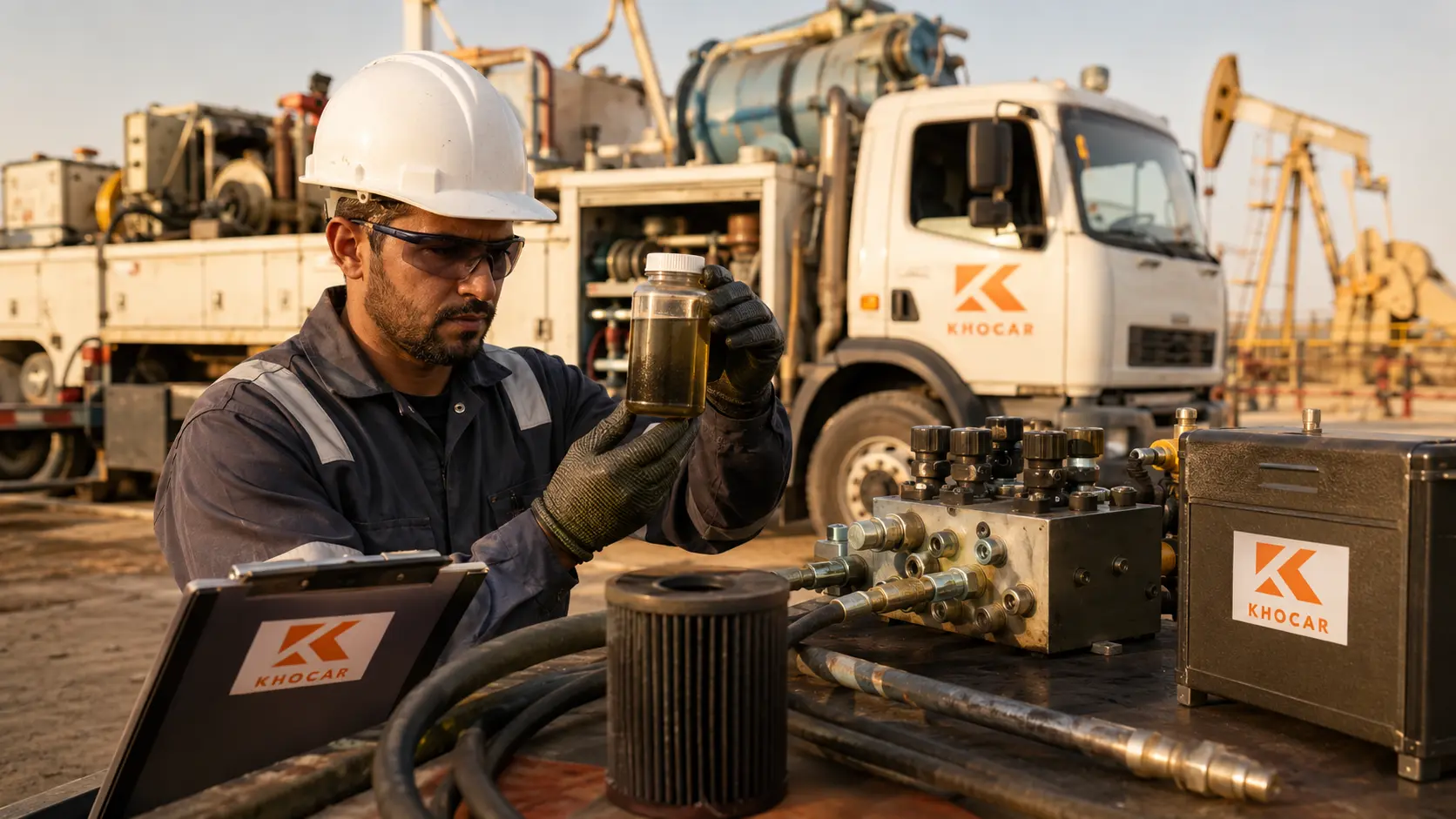
Hydraulic oil contamination is one of those maintenance problems that often looks harmless until the equipment starts losing force, running hot, sticking valves or damaging pumps. In UAE oilfield equipment, the risk is even higher because heat, airborne dust, long duty cycles, transport vibration, remote mobilization and repeated hose connections can push small contamination issues into expensive downtime. The frustrating part is that the most damaging particles may be too small to see. Oil can look clean in a sight glass while still carrying enough fine particles, water or air to shorten component life.
This guide explains the warning signs of contaminated hydraulic oil, how the ISO 4406 oil cleanliness code works, what causes contamination in oilfield hydraulic systems, and how a practical hydraulic contamination control plan can protect pumps, valves, cylinders, winches, hydraulic power units and mobile machinery across Abu Dhabi and the wider UAE.
Key Takeaways
- Hydraulic oil contamination usually means unwanted solid particles, water, chemical degradation products or air in the hydraulic fluid. Each contaminant creates a different failure pattern.
- The most dangerous contamination is not always visible. Bosch Rexroth notes that the human eye can see particles around 40 microns, while many harmful hydraulic clearances are much smaller.
- ISO 4406 oil cleanliness code reports particle counts at 4 microns, 6 microns and 14 microns. A lower code means cleaner oil; each one-code increase roughly doubles the particle count range.
- Common contaminated hydraulic oil symptoms include slower cylinder movement, noisy pumps, foaming, overheating, sticky valves, filter bypass, repeated seal failure, dark or cloudy oil and abnormal particle-count results.
- In UAE oilfield operations, contamination prevention should cover sealed storage, clean transfer, breathers, filtration, oil sampling, hose/quick-coupler discipline, cooler cleaning, moisture control and post-repair flushing.
What Is Hydraulic Oil Contamination?
Hydraulic oil contamination means the fluid contains material or conditions that should not be there at the required level of cleanliness. That can include dust, sand, metal wear particles, fibres, paint flakes, rubber particles, water, degraded oil by-products, air bubbles, foam or mixed-in incompatible fluid. In an oilfield setting, contamination may enter during hose replacement, oil top-up, reservoir breathing, cylinder rod movement, maintenance work, storage, transport, washdown or component wear.
The reason it matters is simple: hydraulic systems transfer power through a fluid film. Pumps, servo valves, proportional valves, control valves, cylinders and motors depend on tight clearances and predictable viscosity. When the fluid carries abrasive particles or water, that film becomes a delivery system for wear. When the fluid carries air, control response becomes spongy and cavitation risk increases. When the oil oxidizes or forms sludge, valves can stick and filters can plug.
Industry sources treat contamination as a major reliability issue. Hydraulics Online states that hydraulic system contamination is responsible for 80% of system failures, while Bosch Rexroth’s oil cleanliness booklet says more than three-quarters of fluid-system problems can be traced back to contaminated oil in its oil cleanliness guidance. The exact percentage will vary by fleet and duty, but the lesson is consistent: clean oil is not a cosmetic target; it is a reliability control.
Why Hydraulic Contamination Control Matters More in UAE Oilfield Work
UAE oilfield equipment operates in a tough combination of heat, dust, long idling periods, remote mobilization, coastal humidity in some areas, frequent transport and high consequence work windows. A hydraulic power unit may sit in a Musaffah yard, move by truck, work near a field location, return for repair, and then mobilize again. Each handoff creates chances for contamination if ports are left uncapped, oil drums are stored poorly, breathers are clogged, fill funnels are shared or maintenance is rushed.
This article should internally support, not duplicate, KhoCAR’s broader oilfield equipment preventive maintenance checklist for UAE operations. That checklist covers many systems; this post goes deeper into hydraulic fluid cleanliness, ISO 4406 codes and contamination prevention. It should also link naturally to KhoCAR’s guide on hydraulic oil overheating in UAE summer because heat and contamination often reinforce each other.
| UAE Factor | How It Raises Contamination Risk | Practical Control |
| Airborne dust and sand | Dust enters reservoirs through poor breathers, open fill points, damaged seals and uncapped hoses. | Use sealed filling, quality breathers, capped couplers and clean transfer equipment. |
| High ambient heat | Heat lowers viscosity, accelerates oxidation and stresses seals, making contamination more damaging. | Trend temperature, clean coolers, verify oil grade and investigate overheating early. |
| Remote mobilization | Small contamination symptoms may be ignored because repair access is limited once equipment reaches site. | Sample and inspect before mobilization; close critical defects in the yard. |
| Frequent hose work | Hose cutting, assembly, uncapped ends and quick-coupler handling can introduce particles. | Flush new hoses, cap ends, clean couplers and document hose replacement quality. |
| Humidity / washdown | Water enters through damaged seals, reservoir vents, poor storage or washdown practices. | Protect fill points, use suitable breathers, check water content and drain/remove free water. |
Contaminated Hydraulic Oil Symptoms: What Crews Notice First
Contaminated hydraulic oil symptoms are not always dramatic. A system can continue working while contamination slowly damages pumps, valves and seals. The best approach is to combine operator observations with inspections, temperature readings, filter indicators and oil analysis. If symptoms repeat after a filter change or hose replacement, treat that as evidence of a deeper contamination source.
| Symptom | Likely Contamination Link | What to Check Next |
| Slow cylinders or weak lifting force | Particle wear, internal leakage, wrong viscosity, aeration or pump wear. | Compare pressure/flow under load; inspect oil, filters, pump noise and cylinder drift. |
| Sticky or erratic valve response | Fine particles, varnish/sludge, water, wrong oil or aeration. | Check ISO 4406 result, valve history, oil temperature and filter bypass evidence. |
| Foaming or milky oil | Air entrainment or water contamination. | Check reservoir level, suction leaks, return-line turbulence, breather condition and water test. |
| Noisy pump or cavitation-like sound | Air, low oil level, suction restriction, high viscosity when cold or contamination-related wear. | Inspect suction line, strainer, oil level, viscosity, filters and reservoir design. |
| Hydraulic oil overheating | Blocked filters/coolers, dirty oil, wrong viscosity, internal leakage or aeration. | Trend temperature under comparable load; review filter restriction and cooler condition. |
| Repeated seal or hose failure | Abrasive particles, heat, wrong oil, pressure spikes or chemical attack. | Inspect failure surfaces, oil analysis, pressure spikes and hose routing. |
| Filter indicator trips early | High particle load, water, sludge, wrong filter, cold oil or collapsing element. | Cut open or inspect element where appropriate; check oil cleanliness and contamination source. |
| Dark oil, burnt smell or sludge | Oxidation, thermal stress, varnish and aged oil by-products. | Check operating temperature, oil life, laboratory analysis and component deposits. |
The Three Main Types of Hydraulic Oil Contamination
1. Solid Particle Contamination
Solid contamination includes dust, sand, metal particles, rubber, paint flakes, fibres, welding debris, hose-cutting residue and wear particles. Bosch Rexroth lists built-in contamination, external contamination and self-generated contamination as major sources, including manufacturing residue, dirt from ambient air, oil top-up contamination, metal wear and seal abrasion in its hydraulic contamination source guidance.
In UAE field work, solid particles are especially important because dust exposure is unavoidable. The target is not to pretend dust does not exist. The target is to stop dust from entering the reservoir and to remove particles before they pass through sensitive clearances.
2. Water and Chemical Contamination
Water can enter through condensation, damaged seals, washdown, poor drum storage or a failed cooler. It can exist as dissolved water, emulsified water that makes oil cloudy, or free water that settles. Hydraulics Online explains that water can lead to shorter component life, cavitation-related damage, oxidation and component wear in its section on water contamination in hydraulic systems.
Chemical contamination also includes incompatible oil mixing, additive depletion, oxidation products, acids and sludge/varnish. If a crew tops up with the wrong oil because the correct drum is not available, the resulting compatibility problem can look like a filter problem, a valve problem or a heat problem.
3. Air and Gaseous Contamination
Air contamination can appear as foam, entrained bubbles or dissolved gas. Bosch Rexroth lists gaseous contamination consequences such as foam formation, inaccurate valve response, loss of energy, pump damage and oxidation in its oil cleanliness booklet. In the field, air problems often trace back to low reservoir level, suction leaks, poor return-line design, turbulent return flow, improper bleeding after repair or damaged seals.
ISO 4406 Oil Cleanliness Code Explained
The ISO 4406 oil cleanliness code is a three-number code used to describe particle contamination in hydraulic oil. Donaldson’s explanation of ISO cleanliness codes states that the three numbers represent particle count ranges at 4 microns and larger, 6 microns and larger, and 14 microns and larger. For example, a code of 22/21/18 means the sample contains a very high number of particles in those three size bands.
The code does not tell you what the particles are. It tells you how many particles are present within size ranges. That is why ISO 4406 should be interpreted with symptoms, equipment type, filter history, operating environment and sometimes laboratory analysis. A particle count that suddenly worsens after a hose replacement tells a different story from a slow increase across months of service.
| ISO 4406 Position | Particle Size Counted | What It Tells You |
| First number | Particles 4 microns and larger | Fine contamination load; useful for spotting small particles that can affect tight clearances. |
| Second number | Particles 6 microns and larger | Mid-size contamination; often watched closely for proportional valves and pumps. |
| Third number | Particles 14 microns and larger | Larger particles; useful for wear debris, dirt ingress and gross contamination trends. |
A practical rule from Donaldson’s ISO code guide is that every one-code increase represents roughly double the particle quantity range, and every one-code decrease represents roughly half. That is why moving from 20/18/15 to 21/19/16 is not a small formatting difference; it can mean a meaningful increase in contamination load.
Example: Reading an ISO 4406 Result
Suppose a hydraulic power unit returns a lab result of ISO 22/19/17. A maintenance team should not simply write “oil dirty.” It should ask:
- Is this cleanliness level acceptable for the most sensitive component in the system?
- Is the result worse than the last sample under comparable conditions?
- Did the sample come from a live, representative location or from a dead zone/drain point?
- Did any recent repair introduce contamination: hose change, cylinder rebuild, pump replacement or top-up?
- Is the filter bypassing, overloaded, wrongly rated or installed incorrectly?
- Are the large-particle counts rising, which may suggest dirt ingress or abnormal wear?
How Contamination Damages Hydraulic Components
Hydraulic damage usually starts at clearances. A hard particle can score a surface, stick a spool, erode an edge or create a leak path. Bosch Rexroth explains that abrasion is caused by hard particles roughly the same size as the component clearance and that even particles around one-third of the clearance width can lead to blockage; the same booklet lists tight fitting tolerances for gear pumps, vane pumps, piston pumps, servo valves and control valves in its fitting tolerance and contamination section.
| Component | Contamination Damage Pattern | Field Clue |
| Pump | Scoring, cavitation damage, loss of efficiency, higher noise and heat. | Whine, unstable pressure, metal debris, falling output after warm-up. |
| Control valve / spool | Sticking, scoring, leakage, delayed response. | Erratic movement, inconsistent actuation, repeated valve cleaning. |
| Cylinder | Rod scoring, seal wear, internal leakage and drift. | Cylinder creeps down, oil film on rod, repeated seal replacement. |
| Hydraulic motor / winch drive | Wear, leakage, heat and loss of torque. | Winch slows under load, heat rises, efficiency drops. |
| Filter | Premature restriction, bypass, element collapse or short service life. | Indicator trips early or contamination remains high after filter change. |
| Cooler / reservoir | Sludge, varnish, poor heat transfer and trapped contaminants. | Temperature climbs, oil darkens, deposits appear in tank or lines. |
How to Sample Hydraulic Oil Without Creating a False Reading
Oil sampling is only useful if the sample represents the system. A contaminated bottle, dirty hose, dead-zone sample port or poor technique can make clean oil look dirty—or dirty oil look acceptable. Parker’s predictive filter-maintenance paper describes an experimental setup using particle counters before and after the element along with flow and temperature sensors in its mechanical filter monitoring study. The point for field teams is practical: contamination data becomes more valuable when it is tied to location, flow, temperature, filter condition and operating state.
Field Sampling Checklist
- Use a clean, sealed sample bottle supplied for oil analysis; do not reuse drink bottles, open containers or dusty funnels.
- Sample from a live, turbulent location where oil is representative of the component or return line being monitored.
- Avoid bottom drains unless the goal is specifically to check settled water or sludge.
- Flush the sample valve or hose according to the lab or procedure before filling the bottle.
- Label asset ID, date, running hours, oil grade, sample location, temperature, recent repairs and symptoms.
- Take trend samples from the same point under similar operating conditions whenever possible.
- Protect the bottle from dust while sampling; cap it immediately.
- Do not compare two results if the sampling point, method or machine state changed without noting it.
Hydraulic Contamination Control Plan for UAE Oilfield Equipment
A useful hydraulic contamination control plan is not one task. It is a chain of small controls that keep dirt, water and air out of the system and remove contaminants already inside.
1. Control Oil Storage and Transfer
- Store drums and totes sealed, shaded and protected from dust and water.
- Use dedicated transfer carts, pumps and hoses for each oil type where practical.
- Filter new oil before it enters the reservoir; new oil is not automatically clean enough for sensitive hydraulics.
- Keep funnels, fill nozzles and quick couplers capped and clean.
- Record batch, oil grade and top-up quantity so cross-contamination can be traced.
2. Protect Reservoir Breathing and Fill Points
- Use breathers suitable for dust and moisture exposure.
- Replace breathers before restriction or saturation makes them ineffective.
- Keep fill caps, inspection covers and tank openings closed except during controlled maintenance.
- Protect reservoirs during washdown and sandblasting/painting work nearby.
3. Make Filtration a System, Not a Guess
Filters should be selected for the component sensitivity, flow, pressure, viscosity, dirt-holding capacity and target ISO code. Bosch Rexroth’s guide lists example recommended oil cleanliness levels, including cleaner targets for high-sensitivity systems such as servo valve technology and proportional valves above 160 bar, in its recommended oil cleanliness table. Do not copy those numbers blindly into a service procedure; use them as a reminder that different hydraulic systems need different cleanliness targets.
- Check filter restriction indicators during operation, not only when the unit is cold and idle.
- Investigate early filter plugging instead of simply installing another element.
- Use offline/kidney-loop filtration where the system needs cleaning without full disassembly.
- After component failure, treat the system as contaminated until flushing, filtration and testing prove otherwise.
4. Control Hose, Coupler and Repair Cleanliness
- Cap hose ends immediately after removal.
- Clean quick couplers before connection, especially in dusty yards or field locations.
- Flush new hose assemblies after cutting/crimping; hose debris can destroy sensitive valves quickly.
- Clean around ports before opening the system.
- After a pump, motor or cylinder failure, inspect downstream contamination risk before restarting.
5. Trend Oil Condition Instead of Reacting Late
- Set a baseline ISO 4406 code for critical assets.
- Track particle count, water, viscosity, acid number/oxidation where relevant, and wear metals where lab analysis is used.
- Combine oil data with temperature, pressure, filter restriction and operating symptoms.
- Escalate sudden changes even if the equipment still runs.
Practical Example: Wireline Hydraulic Unit Before Mobilization
A truck-mounted wireline unit in Abu Dhabi is scheduled for field mobilization. During a pre-mobilization run, the winch responds slowly after the oil warms up. The operator also notices light foam in the reservoir sight glass and the return filter indicator has started moving into the restriction zone earlier than usual. A weak response would be to change the filter and send the unit. A stronger response treats the symptoms as connected evidence.
The maintenance team samples the oil from the correct point, checks the ISO 4406 result, inspects the breather, verifies reservoir level, examines hose routing, checks for suction leaks, cleans the cooler, reviews recent hose replacement work and confirms whether any top-up oil was added from an open container. If the particle count is high, the team filters or flushes as required and investigates the source. If air is present, it corrects suction-side leakage or return-line aeration. If heat is part of the pattern, it also reviews KhoCAR’s hydraulic oil overheating guide.
This is how hydraulic contamination control improves uptime: it turns scattered symptoms into a controlled maintenance decision before the unit reaches site.
When to Filter, Change, Flush or Repair
| Condition | Likely Action | Why |
| Oil slightly above target ISO code but no failure debris | Offline filtration and source control. | Can restore cleanliness if the contamination source is controlled. |
| Oil contaminated with water | Remove water, inspect source, possibly change oil depending on severity. | Water can drive corrosion, oxidation, poor lubricity and filter problems. |
| Oil dark, burnt or oxidized | Lab analysis and likely oil change plus heat/root-cause correction. | Changing oil without correcting heat may repeat the problem. |
| Major pump/motor failure with metal debris | System cleaning/flushing, component inspection and filter change. | Debris can destroy replacement components quickly. |
| Wrong oil added | Assess compatibility; drain/flush if required. | Additive conflict and viscosity mismatch can affect performance and seals. |
| Repeated filter bypass or plugging | Investigate contamination source, element selection and system condition. | A filter indicator is a symptom, not the root cause. |
Maintenance Records That Make Contamination Control Work
Contamination control becomes much stronger when records connect symptoms, oil data and repairs. A record should not say only “hydraulic oil checked.” It should show what was checked, where the sample came from, what the result was, what limit or baseline it was compared with, what action was taken and whether the equipment passed a functional test after maintenance.
- Asset ID, location, running hours and operating condition.
- Oil grade, batch/top-up quantity and date of last oil change.
- Sample point, method, temperature and lab/particle counter result.
- ISO 4406 code and target cleanliness level for that asset.
- Water result, viscosity and wear-metal findings where available.
- Filter element part number, change date and restriction/bypass observation.
- Corrective action: filtration, flushing, oil change, component repair, breather replacement or hose work.
- Return-to-service test: pressure, flow, temperature, response time, noise and leakage.
Need Help with Hydraulic Oil Contamination in UAE Oilfield Equipment?
If your hydraulic equipment is overheating, losing force, foaming, sticking valves, plugging filters early, or showing abnormal ISO 4406 oil cleanliness results, KhoCAR can help you move from symptoms to root cause. Our team supports UAE oilfield contractors with hydraulic inspection, preventive maintenance, industrial spares, hose and component support, oilfield MRO supplies and equipment readiness before mobilization.
For inspection, maintenance support, or oilfield hydraulic parts, visit KhoCAR’s Oilfield Services & Industrial Supplies in the UAE page and share the equipment type, symptoms, oil sample result, photos, operating hours, and mobilization deadline.
FAQs
What is hydraulic oil contamination?
Hydraulic oil contamination is the presence of unwanted particles, water, air, chemical degradation products or incompatible fluids in hydraulic oil. It can damage pumps, valves, cylinders, motors, seals and filters by increasing wear, corrosion, cavitation, leakage and heat.
What are the most common contaminated hydraulic oil symptoms?
Common symptoms include slow hydraulic response, weak lifting force, noisy pumps, foaming, cloudy or milky oil, overheating, sticky valves, early filter restriction, repeated seal failure, cylinder drift, dark oil, burnt smell and abnormal particle-count results.
What is the ISO 4406 oil cleanliness code?
ISO 4406 is a three-number cleanliness code that reports particle count ranges in hydraulic oil at 4 microns and larger, 6 microns and larger, and 14 microns and larger. Lower codes mean cleaner fluid. The code helps teams set targets and trend contamination over time.
Is new hydraulic oil already clean enough?
Not always. New oil may be clean enough for storage and sale but not necessarily clean enough for a sensitive hydraulic system. Many maintenance programs filter new oil during transfer before it enters a reservoir.
How does water get into hydraulic oil?
Water can enter through condensation, damaged seals, poor drum storage, reservoir breathing, washdown, cooler leakage or careless filling. It may appear as dissolved water, cloudy oil or free water, and it can accelerate corrosion, oxidation and wear.
Why is my hydraulic oil foaming?
Foaming usually points to air entrainment, low reservoir level, suction leaks, return-line turbulence, wrong fluid, contamination or poor air release. It should be investigated because air can cause spongy response, noise, heat and pump damage.
Can contaminated hydraulic oil cause overheating?
Yes. Contamination can plug filters and coolers, increase friction, cause internal leakage, damage pumps and change viscosity. Heat can also accelerate oil oxidation, making contamination and sludge problems worse.
How often should hydraulic oil be sampled?
Sampling frequency depends on asset criticality, operating hours, duty cycle, environment, OEM guidance and failure history. Critical UAE oilfield assets may need scheduled sampling plus event-based sampling after repair, overheating, hose failure, contamination or mobilization risk.
Should contaminated hydraulic oil be filtered or changed?
It depends on the contamination type and severity. Particle contamination may be controlled by filtration if the source is corrected. Water, oxidation, wrong oil or major failure debris may require oil change, dehydration, flushing or component repair. Always diagnose the source, not only the oil condition.
Who can help with hydraulic contamination control in the UAE?
KhoCAR supports UAE oilfield operators and contractors with hydraulic inspection, preventive maintenance, industrial supplies and oilfield equipment support. The best starting point is to share the asset details, symptoms, recent work history and any ISO 4406 or oil analysis report.