
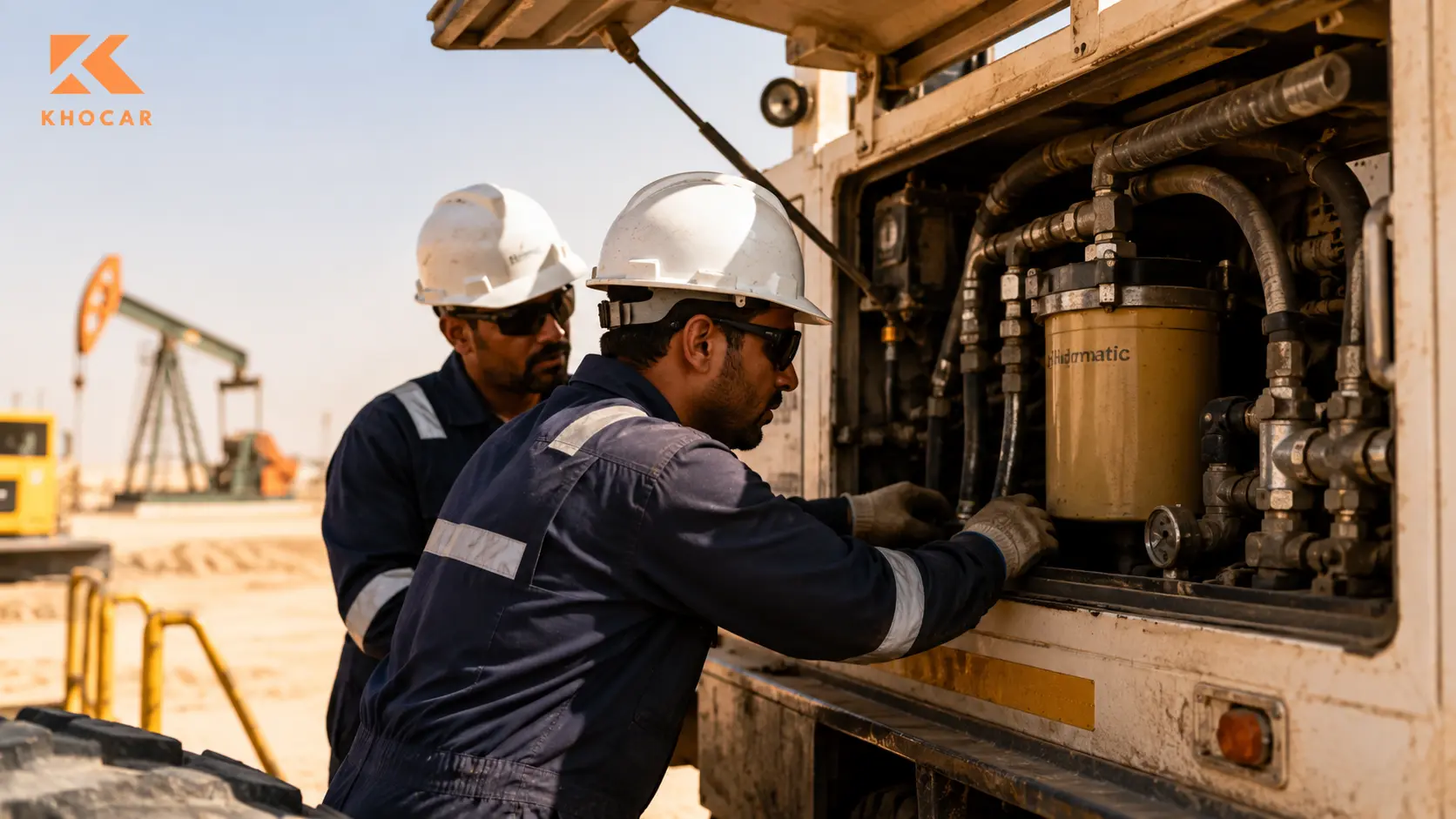
Hydraulic oil overheating is one of the fastest ways for oilfield equipment to lose power, damage seals, slow production, and create unplanned downtime during UAE summer. A hydraulic system may look normal at the start of a shift, but once the ambient heat, dust, long duty cycles, restricted coolers, low oil level, or internal leakage start adding load, hydraulic oil temperature can climb quickly.
The problem is not just hot oil. Hot oil becomes thinner, loses lubricating strength, accelerates oxidation, hardens seals, stresses hoses, and can reduce the efficiency of pumps, valves, motors, cylinders, and hydraulic power packs. For oilfield contractors in Abu Dhabi and across the UAE, this matters because many hydraulic failures happen at the worst possible moment: before mobilization, during a critical maintenance window, or while a crew is waiting on site.
This guide explains why hydraulic system overheating happens, how to recognize it early, what parts and checks help prevent it, and when to arrange hydraulic equipment maintenance or source oilfield hydraulic parts before the heat turns a small issue into a shutdown.
Key Takeaways
- Hydraulic system overheating is usually caused by a mismatch between heat being generated and heat being removed. Restrictions, internal leakage, blocked coolers, low oil levels, wrong hydraulic fluid viscosity, overloaded duty cycles, and contaminated oil all add heat.
- UAE summer makes the problem worse because high ambient temperature, dust, long operating hours, and exposed yard or site conditions reduce the cooling margin that hydraulic equipment depends on.
- There is no single safe hydraulic oil temperature for every machine. Follow the equipment manufacturer’s specification, monitor trends, and treat continuous temperature rise as a warning sign, especially if oil temperature moves above the normal operating range for that system.
- Overheating can damage hydraulic oil, seals, O-rings, hoses, pumps, motors, cylinders, filters, valves, gauges, and coolers. A small heat problem can become a repeat leakage problem if damaged seals or contaminated oil are not addressed.
- The best prevention plan combines daily inspection, clean oil, correct hydraulic fluid viscosity, proper filter changes, cooler cleaning, hose routing checks, oil analysis, spare-part readiness, and a local supplier who can support urgent oilfield hydraulic parts in the UAE.
What Hydraulic System Overheating Means in Oilfield Equipment
Hydraulic system overheating means the hydraulic fluid is operating above the temperature range the system was designed to handle. In simple terms, the system is generating more heat than it can remove. That heat may come from normal work, but overheating usually points to another issue: excessive load, component wear, restricted flow, poor cooling, incorrect oil, contamination, or an operating cycle that is too demanding for the equipment condition.
In oilfield environments, this can affect many assets: wireline logging units, hydraulic power packs, truck-mounted equipment, workshop presses, cranes, winches, excavators, pumping equipment, lifting systems, pressure-control support equipment, and field service vehicles. Any machine that depends on hydraulic pressure, flow, and clean oil can be affected.
KhoCAR already supports the type of oilfield service environment where these issues matter, including hydraulic components, lubricants and greases, seals and O-rings, and repair support through its Oilfield Services & Industrial Supplies in the UAE service page.
Why Do Hydraulic Systems Overheat?
Hydraulic systems overheat when too much power is converted into heat, and the system cannot remove that heat fast enough. Common reasons include low hydraulic oil level, incorrect oil viscosity, clogged filters, blocked oil coolers, worn pumps, internal leakage, relief valve bypass, contaminated oil, poor hose routing, and operating the equipment beyond its cooling capacity.
Why UAE Summer Makes Hydraulic Oil Overheating Worse
UAE summer is a hydraulic maintenance challenge because machines often work in hot, dusty, high-load conditions. The country has an arid climate, and public climate datasets such as the World Bank Climate Knowledge Portal show why heat should be treated as a planning factor, not a background detail. In peak summer, equipment that is parked outdoors, operated under load, or kept idling for long periods has less cooling reserve before oil temperature becomes a problem.
The timing also matters for UAE oilfield contractors. ADNOC has announced major project awards for 2026-2028, which supports continued demand for local maintenance readiness, industrial supplies, and reliable equipment mobilization. That scale of activity makes downtime control and spare-parts planning more important, not less. See the ADNOC project awards announcement for the broader project context.
In practical field conditions, UAE summer creates four overheating pressures at the same time:
- Higher starting temperature: hydraulic oil, hoses, tanks, coolers, and metal surfaces may already be hot before the machine starts work.
- Reduced cooling margin: coolers and fans have to work harder because the surrounding air is already hot.
- More dust and debris: blocked fins, dirty breathers, dusty filters, and contaminated oil reduce heat transfer and increase wear.
- Long duty cycles: oilfield work can involve extended operation, frequent lifting, heavy load cycles, or equipment waiting under partial load.
Common Symptoms of Hydraulic Oil Overheating
Overheating does not always begin with a dramatic failure. The early signs are often small changes in machine behavior, oil appearance, noise, temperature trend, or leakage. Operators and maintenance teams should investigate these symptoms before the equipment reaches repeated high-temperature operation.
| Symptom | What It May Mean | First Checks |
| Hydraulic oil temperature keeps rising during normal work | Cooling cannot remove heat fast enough, or heat generation is unusually high. | Check oil level, cooler cleanliness, fan operation, filter restriction, duty cycle, and relief valve behavior. |
| Loss of hydraulic power after the machine warms up | Oil may be thinning, internal leakage may increase, or pump efficiency may fall at higher temperature. | Compare cold and hot performance; inspect pumps, cylinders, valves, seals, and pressure readings. |
| New leaks around seals, fittings, or cylinders | Heat may have hardened or damaged sealing materials; pressure spikes can also worsen leakage. | Confirm seal material, size, pressure rating, oil compatibility, and temperature exposure. |
| Burnt oil smell or darkened oil | Oil oxidation or thermal stress may be occurring. | Arrange oil inspection or oil analysis; review change intervals and operating temperature history. |
| Noisy pump or cavitation-like sound | Low oil level, suction restriction, incorrect viscosity, or air entrainment may be present. | Check reservoir level, suction lines, breathers, strainers, oil grade, and air leaks. |
| Frequent filter bypass or clogged filters | Contamination, degraded oil, or wrong filter element may be increasing flow restriction. | Replace filters correctly, investigate contamination source, and use proper cleanliness practices. |
Safe Hydraulic Oil Temperature: What Range Should You Watch?
The safe hydraulic oil temperature depends on the equipment design, hydraulic oil type, seal material, hose rating, duty cycle, and OEM limits. Many industrial hydraulic systems are designed to run in a controlled temperature band, but there is no universal number that applies to every oilfield machine. The best rule is to follow the OEM manual and treat sudden changes from the normal baseline as an early warning.
Industry hydraulic guidance often treats very high oil temperature as a red flag. For example, Hydraulics Online notes that oil temperature above 82 degrees Celsius / 180 degrees Fahrenheit should be treated seriously. That does not mean every system should run close to that limit; it means the equipment should be checked before heat damages oil and components.
Hose and fluid limits also matter. Gates hydraulic guidance emphasizes that the fluid manufacturer’s recommended maximum operating temperature must not be exceeded, even if the hose itself has a stated temperature range. See the Gates Safe Hydraulics pocket guide for hydraulic hose safety principles.
| Temperature Situation | Meaning | Recommended Action |
| Normal baseline for that machine | The temperature range the equipment usually maintains under similar load, weather, and duty cycle. | Record temperature trends instead of relying on one isolated reading. |
| Rising above normal range | The system may be generating extra heat or losing cooling capacity. | Investigate load, oil level, cooler, filters, fan, restrictions, and relief valve activity. |
| Continuously high or rising quickly | Risk of oil thinning, seal damage, hose stress, reduced efficiency, and breakdown. | Stop and inspect if safe to do so; follow site safety procedures and OEM guidance. |
| After repair or oil change | Incorrect oil grade, trapped air, contamination, or replacement-part mismatch may be present. | Verify oil specification, filter element, hose routing, cooler flow, and commissioning procedure. |
Main Causes of Hydraulic System Overheating in UAE Oilfield Operations
Most hydraulic overheating cases fall into two categories: too much heat is being generated, or not enough heat is being removed. The exact cause may be simple, but the effect can move through the system quickly. A restricted cooler can raise temperature; high temperature thins oil; thinner oil increases leakage; leakage creates more heat; and the machine begins a repeating failure cycle.
1. Low Hydraulic Oil Level or Undersized Reservoir Cooling
Low oil level reduces the amount of fluid available to absorb and release heat. It can also encourage air entrainment, foaming, pump noise, and cavitation-like symptoms. In mobile or oilfield equipment, low level may be caused by unnoticed leakage, poor refill practices, wrong commissioning, or operating the equipment on uneven ground.
Example: A hydraulic power pack is checked at the start of a day in an Abu Dhabi yard, but the oil level is only slightly above the minimum mark. Under a long duty cycle, the reservoir has less oil volume to absorb heat, the return oil is not cooling properly, and temperature climbs by mid-shift. The visible cause may look like “hot oil,” but the starting problem was insufficient fluid volume and poor pre-shift inspection.
2. Wrong Hydraulic Fluid Viscosity for UAE Heat and Equipment Design
Hydraulic fluid viscosity controls how the oil flows, seals, lubricates, and protects components. If the oil is too thin at operating temperature, internal leakage can increase and pump efficiency can drop. If the oil is too thick during start-up, suction issues, pressure loss, and pump stress can appear. UAE summer conditions make the viscosity selection more important because the oil may reach higher operating temperatures than it would in a cooler climate.
Do not choose hydraulic oil only by habit or by what is available in the store. Confirm the OEM specification, viscosity grade, viscosity index, temperature range, additive package, and compatibility with seals and existing oil. Mixing incompatible oils can also create foaming, deposits, or filter problems.
3. Blocked Hydraulic Oil Cooler or Heat Exchanger
The cooler is often the first place to inspect when hydraulic oil temperature rises in summer. Dust, sand, oil mist, mud, and debris can block fins and reduce heat transfer. A cooler fan may also fail electrically or mechanically, or the cooler may be bypassed, undersized, damaged, or installed where airflow is poor.
In UAE yards and remote work sites, cleaning the cooler face and confirming airflow should be part of routine hydraulic equipment maintenance. A cooler may look present, but if it is clogged with dust or its fan is weak, it cannot protect the oil during sustained work.
4. Clogged Filters and Contaminated Hydraulic Oil
Contamination causes hydraulic systems to work harder and fail sooner. Particles can damage pumps, valves, cylinders, and sealing surfaces; water can reduce lubrication quality and encourage corrosion; degraded oil can form varnish or deposits. ISO 4406 is widely used to communicate hydraulic fluid cleanliness levels, and the ISO 4406 standard overview explains the coding method for solid particles in hydraulic fluid.
Dirty oil can also contribute to overheating by increasing restriction, sticking valves, clogging filters, and damaging components until internal leakage rises. In a dusty UAE environment, breathers, filler points, open containers, poor hose storage, and uncapped fittings are common contamination entry points.
5. Internal Leakage in Pumps, Motors, Cylinders, or Valves
Internal leakage turns useful hydraulic energy into heat. A worn pump may circulate oil without producing the expected flow or pressure. A cylinder with internal bypass may lose force and heat the oil. A valve spool that is worn, damaged, contaminated, or stuck may create pressure drop and heat. The operator may notice weak performance, slower movement, or a system that works cold but struggles hot.
Research on hydraulic cylinder leakage explains why internal leakage can reduce pressure and efficiency and may be harder to detect than an external oil leak. For deeper technical background, see this recent study on detection and classification of internal leakage in hydraulic cylinders.
6. Relief Valve Bypass or Incorrect Pressure Settings
A relief valve that is continuously bypassing is one of the classic heat generators in a hydraulic system. Relief valves are safety and pressure-control devices; they are not meant to be used as a constant flow path during normal operation. If a machine is overloaded, a valve is set incorrectly, or an actuator is blocked, oil can keep passing across the relief valve and converting pressure energy into heat.
A technician should confirm pressure settings with proper gauges and safe procedures. Guessing or adjusting pressure without understanding the system can create equipment damage or safety hazards.
7. Excessive Load, Duty Cycle, or Operator Practice
Some overheating is caused by how the machine is being used. Long continuous cycles, lifting beyond expected capacity, holding a function against the end stop, idling under load, running equipment with poor ventilation, or forcing a machine through a job it was not sized for can all raise heat. In the UAE, the same duty cycle that may be acceptable in cooler months may become risky during peak summer.
This is why maintenance teams should not only ask, “Which part failed?” They should also ask, “How was the equipment being used when the temperature started rising?”
8. Poor Hose Routing Near Heat Sources
Hydraulic hoses exposed to hot exhaust, engine compartments, sharp edges, direct sunlight, vibration, or repeated bending can degrade faster. Heat can harden the cover, weaken reinforcement, damage couplings, and accelerate leakage. A hose may be technically compatible with the system pressure, but still be unsuitable if it is routed too close to a hot manifold or unsupported in a high-vibration area.
Gates hydraulic guidance uses the STAMPED method — size, temperature, application, material, pressure, ends, and delivery/volume — to help choose hose assemblies correctly. That temperature factor is especially important in UAE oilfield equipment where ambient heat and radiant heat combine. See Gates Safe Hydraulics for the hose-selection framework.
9. Breather, Cap, and Reservoir Problems
A blocked or unsuitable reservoir breather can create pressure and contamination problems. In dusty field conditions, the wrong breather can allow dust ingress or restrict airflow. A missing cap, open fill point, or unsealed container can introduce particles and moisture. Once contamination enters the tank, filters may clog faster and components may wear faster, creating a longer-term overheating problem.
10. Mismatched Replacement Parts or Missing Documentation
Wrong-part replacement is a hidden cause of repeat overheating. A filter with incorrect flow rating, a hose with incorrect internal diameter, a fitting that creates restriction, a seal material that cannot handle the temperature, or a replacement pump that does not match the system requirements can all create heat and reliability problems.
KhoCAR’s related Oilfield MRO Supplies Checklist in Abu Dhabi explains why oilfield MRO supplies should be prepared around application, temperature, pressure, fluid compatibility, and supporting documentation rather than vague item names.
What Overheating Damages First
Hydraulic oil overheating rarely damages only one item. It affects the fluid and the components that depend on that fluid. Once oil temperature stays high, the system may begin to fail in layers: oil condition drops, seals become brittle, leakage increases, pump performance falls, and contamination worsens.
| Component | How Heat Affects It | What to Check |
| Hydraulic oil | Oil can thin out, oxidize, darken, lose lubricity, form deposits, or require shorter change intervals. | Confirm oil grade, oil condition, change history, contamination level, and operating temperature trend. |
| Seals and O-rings | Heat can harden, swell, shrink, crack, or permanently deform sealing materials. | Confirm material compatibility such as NBR, FKM, EPDM, PTFE, and temperature range before replacement. |
| Hydraulic hoses | Heat accelerates cover cracking, reinforcement fatigue, coupling leakage, and pressure-related failures. | Check routing, clamps, abrasion points, bends, pressure rating, temperature exposure, and coupling condition. |
| Pumps and motors | Thin or contaminated oil increases wear, leakage, noise, and efficiency loss. | Check pressure, case drain flow where applicable, suction restrictions, and pump noise. |
| Valves | Contamination and heat can cause sticking, leakage, slow response, pressure drop, and control problems. | Inspect filters, cleanliness, oil condition, valve settings, and signs of varnish or debris. |
| Cylinders | Internal bypass, scored rods, worn seals, and damaged wipers can worsen as heat and contamination increase. | Inspect rod condition, seal leakage, drift, force loss, and contamination entry points. |
Hydraulic Equipment Maintenance UAE: Summer Prevention Checklist
The goal of hydraulic equipment maintenance in UAE summer is to catch small problems before they become heat-related failures. The best checklist is simple enough for daily use but specific enough to help maintenance teams identify the cause quickly.
Daily / Pre-Shift Checks
- Check hydraulic oil level using the correct procedure for that machine.
- Look for fresh oil leaks under the machine, around cylinders, hoses, fittings, filters, and pumps.
- Inspect hose routing for abrasion, kinks, rubbing, sharp bends, loose clamps, or heat exposure.
- Check the cooler face for dust, mud, plastic, leaves, or debris blocking airflow.
- Confirm the cooling fan operates when required.
- Watch the hydraulic oil temperature trend during normal operation, not only when a warning light appears.
- Listen for pump noise, cavitation-like sound, whining, or performance changes after the system warms up.
- Do not continue normal operation if the machine loses hydraulic power, smells burnt, or temperature keeps climbing.
Weekly Checks During Peak Summer
- Clean coolers carefully without damaging fins.
- Inspect reservoir breathers and caps for dust entry or blockage.
- Check filter indicators and replace filters according to OEM guidance, not guesswork.
- Review fluid top-up history; repeated top-ups usually mean leakage or poor inspection control.
- Check hydraulic oil appearance for foam, darkening, unusual smell, or visible contamination.
- Inspect seals and O-rings around high-heat or high-pressure areas.
- Confirm operators are not holding functions against relief pressure for long periods.
Monthly / Planned Maintenance Checks
- Perform oil sampling or analysis for critical systems where downtime is costly.
- Review temperature data if the machine has onboard monitoring.
- Check relief valve settings with proper instruments and safe procedures.
- Inspect pump efficiency, cylinder drift, valve leakage, and case drain flow where applicable.
- Confirm hose, filter, oil, and seal specifications against OEM documentation.
- Prepare a summer critical-spares list before mobilization or shutdown work.
- Store hydraulic oil, hoses, seals, and filters in clean, shaded, controlled conditions.
Oilfield Hydraulic Parts to Keep Ready Before Peak Heat
For oilfield teams, prevention is not only about inspection. It is also about having the right oilfield hydraulic parts available when maintenance is planned or when a failure occurs. A missing fitting, seal kit, filter, adapter, or hose can delay a repair even after the fault has been identified.
| Part / Supply Category | Why It Matters | Information to Provide Before Ordering |
| Hydraulic oil | Correct grade and specification for the equipment and summer duty cycle. | Oil grade, OEM spec, viscosity, brand/product, quantity, SDS, product data sheet. |
| Filters and filter elements | Protect pumps, valves, cylinders, and motors from contamination and restriction. | Part number, micron rating, beta ratio if required, flow rating, bypass setting, housing model. |
| Hoses and hose assemblies | Replace damaged, heat-exposed, or leaking lines before failure. | Length, internal diameter, pressure rating, temperature rating, fluid type, end fittings, bend radius. |
| Fittings and adapters | Prevent leaks and incorrect connections during urgent repair. | Thread type, size, pressure rating, material, seal type, photos of old fitting. |
| Seals and O-rings | Replace heat-damaged or leaking sealing components. | Dimensions, material, hardness, application, temperature range, pressure exposure, fluid compatibility. |
| Cooler components | Restore cooling capacity when fans, fins, or heat exchangers underperform. | Cooler model, fan details, electrical rating, dimensions, flow requirements, mounting details. |
| Gauges and test points | Support pressure checks, troubleshooting, and documentation. | Pressure range, connection type, calibration requirement, accuracy class, use location. |
| Pumps, motors, and valves | Support repair when internal leakage or component wear is confirmed. | Equipment model, displacement, pressure/flow rating, port details, control type, serial number. |
For broader parts preparation, KhoCAR’s ADNOC mobilization spare parts checklist is useful for contractors preparing seals, lubricants, hydraulic components, pressure accessories, consumables, tools, and documents before project mobilization.
Troubleshooting Steps When Hydraulic Oil Temperature Keeps Rising
Troubleshooting should be done safely and methodically. Hydraulic systems can store high pressure and create serious injection, burn, crush, and release hazards. Only qualified personnel should inspect, depressurize, repair, or adjust hydraulic systems. Never search for leaks with bare hands, and always follow site safety procedures.
- Confirm the temperature reading. Check whether the sensor, gauge, or warning system is working correctly.
- Compare the current temperature with the machine’s normal baseline under similar load and weather.
- Check hydraulic oil level and look for signs of foaming, aeration, or contamination.
- Inspect cooler airflow, fan operation, cooler cleanliness, and any signs of bypassed or damaged cooling components.
- Check filters, indicators, and recent filter changes. Incorrect filters can create restriction or bypass issues.
- Look for external leaks, wet fittings, damaged hoses, worn cylinder seals, and hot areas in the hydraulic circuit.
- Listen for pump noise and check suction restrictions, blocked breathers, or oil viscosity problems.
- Confirm whether a relief valve is bypassing continuously or a function is being held against pressure.
- Evaluate internal leakage in pumps, cylinders, motors, and valves if the system works cold but weakens when hot.
- Review recent repairs. A wrong hose, fitting, seal, filter, oil grade, or pump replacement may have introduced the overheating issue.
- Document the findings, parts required, oil type, readings, and repair actions for future maintenance planning.
Realistic UAE Oilfield Examples
Example 1: Wireline Logging Unit Losing Hydraulic Performance After Midday
A wireline logging unit works correctly during early morning testing but slows down by midday. The crew notices hotter oil, slower hydraulic response, and a faint burnt smell. Inspection finds dust-blocked cooler fins, a weak cooling fan, and a slightly low oil level. Replacing a pump would not solve the real problem. The correct response is to clean and verify the cooler, restore proper oil level, inspect the oil condition, check filters, and monitor temperature under load.
This type of issue connects naturally with KhoCAR’s wireline logging units repair and maintenance support, especially where hydraulic diagnostics are part of field-readiness work.
Example 2: Hydraulic Power Pack Runs Hot After a Seal Change
A hydraulic power pack receives new seals, but after the repair it runs hotter than before. The team later discovers that the replacement sealing material was not correct for the oil and temperature exposure. The seal begins to distort, leakage increases, and pressure loss creates more heat. The lesson is simple: a seal is not just a shape. Material, hardness, temperature resistance, fluid compatibility, and pressure exposure matter.
Example 3: Heavy Equipment in a Dusty Yard Has Repeated Hose Failures
A machine working in a dusty Abu Dhabi yard keeps developing hose leaks near the same area. The hose specification looks acceptable on paper, but inspection shows the hose is routed too close to a heat source and lacks proper clamps. Heat and vibration weaken the assembly. A better repair includes correct hose selection, improved routing, abrasion protection, heat shielding where appropriate, and cleaner storage of spare hoses and fittings.
How to Build a Better Summer Hydraulic Maintenance Plan
A strong summer plan is built before the first failure. It should connect operations, maintenance, procurement, and documentation so the team is not forced to diagnose, source, approve, and repair under pressure.
- Create a hydraulic equipment list with critical machines, oil type, filter details, hose specs, seal kits, and cooler data.
- Record normal hydraulic oil temperature for each machine under typical operating conditions.
- Identify machines that historically overheat, leak, or lose power during summer.
- Build a critical-spares list for filters, hoses, seals, O-rings, fittings, adapters, gauges, hydraulic oil, and cooler components.
- Store hydraulic consumables in clean, shaded areas and keep fittings capped to reduce contamination.
- Make operators part of the plan by training them to report early symptoms such as heat, smell, noise, slow movement, leakage, or warning lights.
- Use planned maintenance windows to inspect coolers, fans, breathers, filters, and pressure settings instead of waiting for emergency failure.
- Keep product datasheets, SDS documents, certificates, and part records organized for site, audit, and maintenance use.
If the equipment is construction or heavy machinery as well as oilfield support equipment, KhoCAR’s construction machinery repair and maintenance page may also be relevant for broader repair needs in Abu Dhabi.
Need Oilfield Hydraulic Parts or Maintenance Support in the UAE?
Hydraulic overheating should not be ignored until a pump, hose, cylinder, seal, or valve fails. If your oilfield equipment is running hot, losing pressure, leaking after warm-up, damaging seals, clogging filters, or repeatedly needing urgent hydraulic parts, KhoCAR can help you prepare the right next step.
KhoCAR supports oilfield services and industrial supplies in the UAE, including hydraulic parts and components, seals and O-rings, lubricants and greases, industrial supplies, repair support, and practical supply coordination for UAE oilfield conditions.
To help the team respond faster, share the equipment model, hydraulic oil type, current symptoms, temperature readings, photos of the part or nameplate, filter or hose details, pressure rating, connection type, and any document requirements. Better information reduces wrong-part orders and helps maintenance work move faster.
Start here: explore KhoCAR Oilfield Services & Industrial Supplies or contact KhoCAR in Abu Dhabi for support.
FAQs
What causes hydraulic oil overheating?
Hydraulic oil overheating is usually caused by low oil level, incorrect oil viscosity, clogged filters, blocked coolers, internal leakage, relief valve bypass, overloading, poor hose routing, contaminated oil, or fan failure. The system overheats when it creates more heat than it can remove.
What is a safe hydraulic oil temperature?
There is no single safe hydraulic oil temperature for every machine. Follow the OEM manual, oil specification, seal rating, and hose rating. As a practical rule, investigate any temperature that rises above the machine’s normal baseline or remains high during routine operation.
Why do hydraulic systems overheat more in UAE summer?
UAE summer increases the starting temperature of oil, tanks, hoses, and coolers. Hot ambient air, dust, long duty cycles, and outdoor operation reduce the system’s cooling margin, so small restrictions or leaks can cause hydraulic oil temperature to rise faster.
Can wrong hydraulic oil cause overheating?
Yes. If the hydraulic oil viscosity is wrong for the equipment and operating temperature, the system may lose efficiency, create more internal leakage, stress the pump, foam, or fail to lubricate correctly. Always confirm the OEM oil specification before topping up or changing oil.
Can a clogged hydraulic filter cause overheating?
Yes. A clogged or incorrect filter can restrict flow, cause bypass, increase pressure drop, and allow contamination to damage components. Filter problems can contribute to heat and can also be a sign that the oil is contaminated or degraded.
How does a blocked hydraulic oil cooler affect temperature?
A blocked cooler cannot remove enough heat from the hydraulic oil. Dust, mud, oil film, bent fins, failed fans, poor airflow, or incorrect installation can all reduce cooling performance, especially during hot UAE weather.
Why does my hydraulic system work when cold but lose power when hot?
This often points to oil thinning, internal leakage, pump wear, cylinder bypass, valve leakage, or incorrect oil viscosity. As the oil heats up, clearances and leakage paths become more noticeable, reducing pressure and hydraulic power.
Can overheating damage hydraulic seals and O-rings?
Yes. Heat can harden, shrink, swell, crack, or permanently deform seals and O-rings. The correct replacement depends on size, material, fluid compatibility, temperature exposure, and pressure conditions, not just appearance.
What hydraulic parts should oilfield teams keep ready in Abu Dhabi?
Useful hydraulic spares include filters, hoses, fittings, adapters, seals, O-rings, hydraulic oil, gauges, test points, cooler parts, breathers, clamps, and critical pump or valve components. The exact list should match the equipment, duty cycle, and site requirements.
How can operators prevent hydraulic overheating during summer?
Operators can help by checking oil level, watching temperature trends, cleaning coolers, reporting leaks early, avoiding overload, not holding functions against relief pressure, keeping machines ventilated, and reporting unusual noise, smell, or slow movement.
Should hydraulic oil be changed after overheating?
Sometimes, yes. If the oil smells burnt, darkens, foams, loses viscosity, or shows contamination, it may need replacement after inspection or oil analysis. Also check filters, seals, coolers, and the cause of overheating before restarting normal operation.
Where can I source oilfield hydraulic parts in the UAE?
KhoCAR supports oilfield services and industrial supplies in the UAE, including hydraulic parts and components, seals and O-rings, lubricants and greases, filters, hoses, fittings, and repair support for oilfield and heavy equipment applications.