
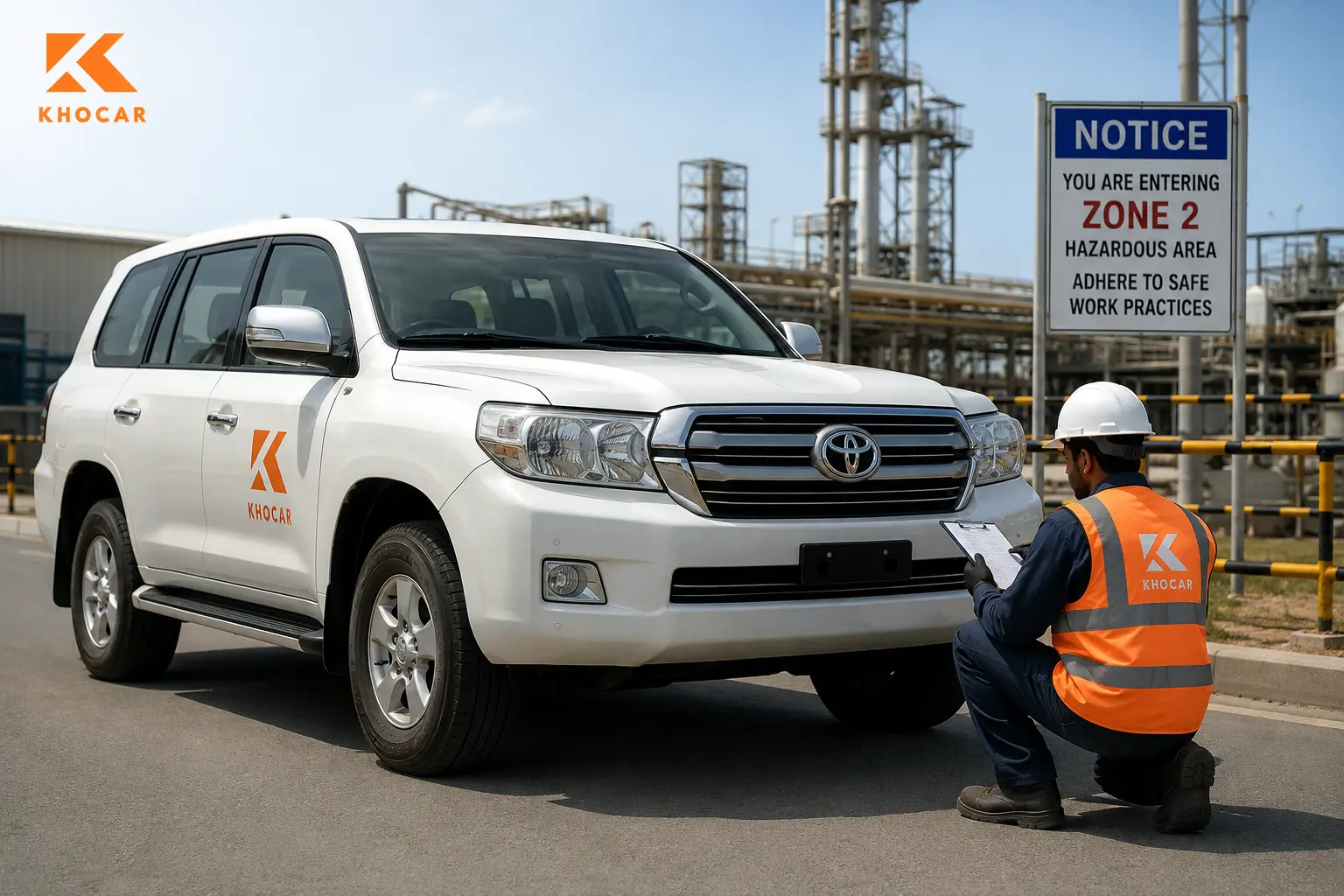
A vehicle can be mechanically sound, legally registered, and perfectly capable of driving on UAE roads, and still be turned away at a hazardous-area site gate. That is why a professional Zone 2 Vehicle Inspection in the UAE is about much more than checking whether the engine starts and the tyres have tread. Inspectors are looking for evidence that the vehicle will not introduce an unacceptable ignition, mechanical or operational hazard into an area where flammable gas or vapour may be present.
For contractors working on ADNOC-related projects, oil and gas facilities, drilling operations, construction sites and other controlled industrial locations, the difference between an inspection-ready vehicle and an ordinary fleet vehicle can directly affect mobilization time.
The good news is that most inspection problems are preventable. If you understand what is checked, verify the vehicle against the site requirement, test safety systems before submission, and prepare the supporting documents, you can eliminate many avoidable failures before the inspector arrives.
Key Takeaways
- Zone 2 describes a hazardous-area classification; it does not mean every vehicle automatically has the same equipment or certification requirement.
- A Zone 2 vehicle inspection normally considers both ordinary vehicle safety and additional controls intended to reduce ignition and operational risks in hazardous areas.
- Common technical checks can include the engine and exhaust system, spark arrestor, emergency engine shutdown or air-intake shutoff, battery/electrical isolation, anti-static provisions, warning systems and other site-specified equipment.
- Inspectors may also examine ROPS, seat belts, brakes, tyres, steering, lights, mirrors, reverse alarms, fire extinguishers, emergency kits, cargo arrangements and visible defects.
- Documentation matters: vehicle registration, previous inspection/certification records, modification evidence and project/site-specific requirements should be consistent and current.
- A third-party Zone 2 inspection or certificate does not automatically guarantee access to every UAE site. The asset still has to satisfy the particular operator, project and HSE requirements.
- The safest preparation strategy is to assess the vehicle against the actual site requirement before mobilization, not after the vehicle reaches the gate.
What Does Zone 2 Mean in the UAE?
In hazardous-area terminology, Zone 2 is an area where an explosive gas atmosphere is not expected during normal operation but, if it occurs, is expected to exist only for a short period. UK HSE’s hazardous-area guidance notes that commonly quoted numerical values—such as less than 10 hours per year for Zone 2—are useful for context but are not officially adopted time limits. The classification is fundamentally based on the likelihood and duration of an explosive atmosphere.
For a vehicle entering such an environment, the practical question is not simply whether the vehicle itself is ‘Zone 2.’ The question is whether the vehicle, its equipment and its safety controls are suitable for the hazardous area and the site’s operating rules. IECEx guidance emphasizes that equipment selection in classified areas needs to be aligned with the applicable protection level, installed correctly and maintained and inspected through appropriate procedures.
Why Is Zone 2 Vehicle Inspection Different From a Normal Vehicle Inspection?
A standard roadworthiness inspection is primarily concerned with whether a vehicle can operate safely on public roads. A hazardous-area inspection adds another layer: whether the vehicle could become an ignition source or fail in a way that creates unacceptable risk in the intended operating environment.
| Inspection Area | Normal Fleet Check | Zone 2 / Hazardous-Area Focus |
| Engine | Leaks, performance, general condition | Leaks, shutdown capability, runaway protection and suitability for the operating environment |
| Exhaust | Condition and emissions-related concerns | Spark control, hot surfaces and approved/suitable spark-arresting equipment where required |
| Electrical | Battery, wiring, lights and accessories | Isolation, ignition-source control and suitability of added electrical equipment |
| Body / structure | Damage and roadworthiness | ROPS where required, secure fittings and absence of hazardous modifications |
| Emergency equipment | Basic road/emergency items | Fire extinguisher, emergency kit and site-specific equipment |
| Documentation | Registration, insurance and routine records | Registration plus inspection/certification evidence and project/site-required documents |
What Inspectors Check During a Zone 2 Vehicle Inspection in UAE
1. Vehicle Identity and Basic Documentation
Before a technical inspection goes very far, the inspector needs to know exactly which asset is being assessed. The vehicle’s identity should match the paperwork and any certificate or inspection record being presented.
- Make, model, year and vehicle identification details
- Registration and ownership/authorization documents as applicable
- Vehicle class and intended operating purpose
- Fuel type and engine configuration
- Previous Zone 2, hazardous-area or third-party inspection records, if applicable
- Details of previous modifications, repairs or safety-system installations
- Project or site information defining where the vehicle is intended to operate
This is an easy area to overlook. A technically compliant vehicle can still be delayed if the identification on a certificate does not clearly correspond with the vehicle presented.
2. General Mechanical Condition
Hazardous-area suitability does not excuse ordinary mechanical defects. Inspectors still need confidence that the vehicle is maintained, reliable and free from conditions that could create a secondary safety problem.
- Engine condition and abnormal noises
- Visible oil, fuel, coolant or hydraulic leaks
- Cooling system and overheating concerns
- Belts, hoses and other exposed components
- Suspension and steering components
- Transmission and driveline condition
- Exhaust integrity and mounting
- Loose, damaged or improvised components
For example, a pickup may have a compliant spark arrestor installed but still be rejected if the exhaust has a leak, the engine bay shows a significant fluid leak or a safety-critical component is visibly damaged. The inspection is about the complete vehicle, not one compliance component.
3. Brakes, Tyres, Steering and Suspension
A hazardous-area vehicle still has to stop, steer and remain stable. Inspectors therefore look for the same fundamentals expected of a professionally maintained fleet vehicle, with additional attention to the consequences of operating on rough or remote industrial roads.
- Service and parking brake operation
- Brake lines, hoses and visible leakage
- Tyre condition, damage and tread
- Correct wheel and tyre fitment
- Steering free play and component condition
- Suspension components and visible damage
- Wheel nuts and wheel security
- Evidence of uneven tyre wear or mechanical instability
4. Engine Shutdown and Diesel Runaway Protection
One of the most important hazardous-area checks for diesel-powered vehicles is the ability to stop the engine if it begins consuming an external flammable vapour source. This is commonly addressed with an air-intake shutoff or emergency engine shutdown system.AMOT’s technical guidance on diesel engine runaway explains that a diesel engine can ingest hydrocarbon vapour through its intake and continue running even after its normal fuel source is shut off. AMOT reports that runaway can begin within roughly 3–12 seconds after vapour is drawn into the intake in its cited testing context.
The practical inspection questions are therefore: Is the shutdown device correctly selected? Is it installed correctly? Can it actually close the intake or perform its intended shutdown function? Is the actuator accessible or automatically triggered as required? Has it been tested? Does its condition match the supporting documentation?NCMT’s spark arrestor and shutdown-valve service describes installation, repair and certification of spark arrestors and shutdown valves for hazardous-area vehicle applications.
5. Spark Arrestor and Exhaust System
The exhaust system is another major focus because hot exhaust particles or sparks can become an ignition source. Where the project or hazardous-area requirement calls for a spark arrestor, inspectors will want to see an appropriate unit, correct installation and a condition that supports continued safe operation.
- Spark arrestor present where required
- Correct mounting and secure fasteners
- No obvious damage, cracks or bypass routes
- Exhaust piping and silencer in sound condition
- No loose or improvised exhaust modifications
- Installation consistent with the equipment and supporting certification/documentation
A useful rule is to avoid treating the spark arrestor as a standalone checkbox. The inspector is assessing the exhaust path as a system. A certified component that is poorly mounted, damaged or bypassed by a modified exhaust can undermine the intended protection.
6. Electrical System, Battery Isolation and Ignition Sources
Electrical equipment can become an ignition source in a hazardous atmosphere, so added accessories and isolation arrangements deserve close attention. This is particularly important on vehicles that have been fitted with beacons, radios, work lights, tracking equipment, refrigeration units, inverters or other aftermarket systems.
- Battery condition and secure mounting
- Battery isolation arrangement where required by the site/project
- Wiring routed and protected from abrasion
- No exposed or damaged conductors
- Secure terminals and connections
- Added electrical equipment identified and suitable for the intended environment where required
- Emergency or isolation controls accessible and functional
ADNOC engineering documentation illustrates the broader principle that equipment installed in classified hazardous areas must satisfy applicable hazardous-area protection requirements. Its electrical engineering guidance references ATEX and IEC 60079-related requirements for hazardous-area equipment. ADNOC’s electrical engineering design guidance Vehicle-specific requirements, however, should always be confirmed against the current project or site specification rather than inferred from a generic electrical standard.
7. Anti-Static Measures and Grounding
Static electricity is another potential ignition mechanism. Depending on the vehicle type and project requirement, inspectors may check anti-static provisions, bonding/grounding arrangements or other controls intended to reduce electrostatic discharge risk. The exact arrangement should be determined by the vehicle design and the site requirement. Do not add or remove grounding components based solely on another vehicle’s configuration.
- Anti-static belt or equivalent provision where specified
- Grounding/bonding connections where required
- Secure mounting and good physical condition
- No damaged or disconnected grounding components
- Correct placement and continuity where the system relies on a physical path to ground
8. Rollover Protection System (ROPS) and Structural Safety
ROPS can be an important part of vehicle safety for off-road and industrial applications. Inspectors may look at the structure, mounting points, welds, fasteners and evidence of damage or unauthorized modification.
- ROPS present when required by vehicle/site specification
- Mounting points secure and free from obvious damage
- No cracks, distortion or unauthorized welding/modification
- Clearance around the structure is maintained
- The ROPS does not interfere with seat belts or other safety equipment
- Supporting documentation is available when required
NCMT identifies rollover protection as one of its core vehicle safety products and services for oil & gas, industrial and off-road applications.Learn more about NCMT’s vehicle safety services
9. Seat Belts, Seats, Mirrors, Lights and Visibility
Basic occupant and road-traffic safety remains part of the inspection. Seat belts should be usable and correctly mounted, mirrors should provide the required visibility, and lights and warning devices should function as intended.
- Three-point seat belts where fitted/required
- Seat belt latches and webbing in good condition
- Seats and head restraints secure
- Mirrors present, secure and usable
- Headlights, brake lights, indicators and reverse lights functional
- Beacon/warning lights where required by site rules
- Reverse alarm or other visibility aids where specified
- No cracked or obstructed visibility-critical glazing
10. Fire Extinguisher and Emergency Equipment
Emergency equipment is often checked because a vehicle entering an oilfield or hazardous industrial environment may be operating far from a conventional workshop or emergency response point.
- Correct fire extinguisher type/capacity for the project requirement
- Extinguisher securely mounted and accessible
- Inspection/service status current
- First-aid kit where required
- Reflective triangles or warning equipment where required
- Torch/flashlight and emergency tools where specified
- Desert or remote-area safety kit where required
- Tow/recovery equipment and vehicle tools where required
NCMT’s vehicle safety services include emergency road supply kits and fire-fighting equipment as part of broader fleet fit-out support.
11. Cargo Protection and Vehicle Modifications
A service vehicle can be rejected for an issue that has nothing to do with the engine. Loose tools, poorly secured cylinders, improvised storage, unsecured cargo or badly installed accessories can create serious hazards in a moving industrial vehicle.
- Cargo securely restrained
- Storage boxes and shelving properly mounted
- Partitions installed where required
- No sharp or exposed edges creating an injury risk
- Heavy equipment positioned and secured appropriately
- Aftermarket accessories do not obstruct emergency equipment
- No unauthorized structural modifications
NCMT vehicle customization and cargo protection
12. Labels, Warning Signs and Identification
Site-specific markings can be part of the approval process. Depending on the operator and project, inspectors may verify warning labels, vehicle identification, company markings, hazardous-area identification or safety instructions. The exact markings should come from the current project/site requirements. Avoid copying another contractor’s stickers or labels simply because the vehicles look similar.
13. Inspection and Certification Records
Documentation is often where otherwise well-prepared vehicles lose time. The inspector needs enough evidence to establish what was installed, what was inspected and what the vehicle is approved or assessed for.
- Current vehicle registration and identification documents
- Current third-party inspection/certification where required
- Zone 2/hazardous-area certificate or report where required
- Certificates for relevant safety equipment when required
- Installation or modification records
- Maintenance and repair records where relevant
- Test/function records for shutdown systems where required
- Site/client-specific approvals or forms
The key principle is consistency. The vehicle, certificate, identification number, installed equipment and project paperwork should all describe the same asset and configuration.
Zone 2 Vehicle Inspection Checklist: Quick Reference
| Inspection Category | What to Verify Before Submission | Common Problem |
| Vehicle identity | VIN/asset identity, registration and paperwork match | Certificate or document belongs to another vehicle |
| Mechanical condition | No significant leaks, defects or loose components | Visible oil/fuel leak or poor maintenance |
| Brakes & steering | Operational and free from obvious defects | Worn components or abnormal play |
| Tyres & wheels | Correct fitment, condition and security | Damage, excessive wear or loose wheel hardware |
| Engine shutdown | Correct device, installation and function test | Untested or incorrectly installed shutdown valve |
| Exhaust | Sound exhaust and required spark arrestor | Damage, poor mounting or bypass |
| Electrical | Protected wiring and required isolation | Exposed wiring or unsuitable accessory |
| Anti-static | Required grounding/anti-static control present | Broken/disconnected component |
| ROPS | Required structure intact and securely mounted | Unauthorized modification or damaged mount |
| Emergency equipment | Extinguisher and site-required kit current | Expired, unsecured or missing equipment |
| Cargo | Tools and equipment restrained | Loose heavy items or poor storage |
| Documentation | Current, consistent and site-appropriate | Expired or mismatched certificate |
How the Zone 2 Inspection Process Usually Works
The exact workflow varies by operator, project and inspection body, but a sensible preparation process follows a predictable sequence.
- Confirm the destination and operating environment. Identify the site, project, vehicle role and hazardous-area requirement before modifying the vehicle.
- Collect the vehicle records. Gather registration, previous inspection records, modification history, equipment certificates and any client forms.
- Perform a pre-inspection assessment. A competent technician checks the vehicle against both normal safety requirements and the specific Zone 2 scope.
- Correct defects before formal inspection. Repair leaks, damaged wiring, loose fittings, defective brakes, tyre issues and any failed safety equipment.
- Test hazardous-area systems. Function-test the shutdown system and inspect the spark arrestor, isolation arrangements, anti-static provisions and other controls that apply.
- Complete the formal inspection. The inspector examines the vehicle, equipment and supporting documents and records findings.
- Close non-conformities. If an item fails, correct it and provide evidence or repeat the relevant inspection/test as required.
- Issue the applicable inspection/certification documentation. The certificate or report should clearly identify the asset and its scope.
- Submit for site approval/access. The site operator reviews the vehicle against its own access rules. A certificate is evidence of compliance with the stated scope; it is not a universal site-access pass.
Common Reasons Vehicles Fail Zone 2 Inspection
- A shutdown valve is fitted but has not been properly tested.
- The spark arrestor is damaged, loose or installed in a way that does not match the intended configuration.
- There are visible fuel, oil, coolant or hydraulic leaks.
- Electrical wiring has been added or modified without adequate protection or documentation.
- The battery isolation arrangement is missing, damaged or inaccessible where required.
- An anti-static component is broken or disconnected.
- ROPS or other structural safety equipment has been modified without appropriate approval.
- Seat belts, brakes, tyres, lights or reverse alarms have obvious defects.
- Fire extinguishers or emergency equipment are missing, expired or poorly secured.
- The vehicle’s documents do not match its identification or installed configuration.
- The contractor relies on a generic checklist instead of the actual project/site requirement.
- The vehicle is presented after last-minute modifications without enough time for testing and corrective work.
Three Practical Examples
Example 1: Diesel Pickup for an Oilfield Support Crew
A diesel pickup is mechanically healthy and recently serviced. It has good tyres, working brakes and a current registration. However, the contractor has added an aftermarket work-light system and the shutdown valve was installed months ago but never function-tested. During a pre-inspection assessment, the contractor should verify the electrical installation, test the shutdown system, inspect the exhaust and spark arrestor, check anti-static provisions and reconcile the vehicle with the available certification records. Fixing those items before the formal inspection is much easier than discovering them at the site gate.
Example 2: Service Truck With Heavy Tools
A service truck has the expected hazardous-area equipment, but the rear compartment contains heavy tools and spare parts that are not adequately restrained. The truck may pass a casual visual inspection as a ‘Zone 2 vehicle,’ yet the cargo itself can create an operational hazard. The preparation should therefore include cargo restraint, secure storage, partitions or tie-downs as appropriate, while keeping emergency equipment accessible. Zone 2 compliance should be treated as part of overall vehicle safety—not as a collection of isolated components.
Example 3: Diesel Generator or Mobile Equipment Unit
A mobile diesel generator is intended for use near a gas-processing area. The equipment may not be a road vehicle, but the same principles apply: identify ignition sources, verify the engine shutdown arrangement, inspect exhaust spark control, review electrical equipment and confirm that the equipment’s certification matches the intended hazardous-area classification. This is why ‘Zone 2 vehicle inspection’ is often used broadly in contractor conversations even when the asset is technically mobile equipment rather than a road vehicle. The underlying objective is hazardous-area suitability.
ADNOC Zone 2 Vehicle Requirements: What Contractors Should Know
Searches for ‘ADNOC Zone 2 vehicle requirements’ often produce lists of equipment such as spark arrestors, shutdown valves, ROPS, fire extinguishers, anti-static devices and other vehicle accessories. Those lists are useful starting points, but they should not be treated as a universal ADNOC checklist. ADNOC operates multiple companies, assets and projects, and contractor requirements can be supplemented by project-specific HSE procedures, vehicle specifications and site-access rules.
For hazardous-area equipment generally, ADNOC engineering documentation shows the importance of recognized hazardous-area protection principles, including IEC 60079 and ATEX-related requirements for relevant equipment. ADNOC engineering standards and specifications should be consulted alongside the current project documentation rather than relying on an old contractor checklist or a third-party blog.
ATEX vs. IECEx: Why You May See Both on Zone 2 Equipment
Contractors sometimes assume that ATEX and IECEx are interchangeable labels. They are related but are not identical certification schemes. The European Commission explains that the ATEX framework covers equipment and protective systems intended for potentially explosive atmospheres, while IECEx is an international certification system based on IEC standards and independent assessment. For Zone 2 applications, the relevant certification, equipment protection level, gas group, temperature class and installation conditions must be suitable for the actual application. A certificate’s existence alone does not prove that the equipment is appropriate for every hazardous area.
How to Prepare a Vehicle 7 Days Before Inspection
| Timing | Preparation Step |
| 7 days before | Confirm site/project requirements and identify the exact vehicle/equipment that will be submitted. |
| 6–5 days before | Collect registration, previous certificates, modification records and equipment documentation. |
| 5–4 days before | Complete a full mechanical and hazardous-area pre-check. |
| 4–3 days before | Repair leaks, brakes, tyres, electrical issues and other defects; replace failed safety equipment. |
| 3–2 days before | Function-test shutdown systems, inspect spark arrestor/exhaust, verify anti-static and isolation arrangements. |
| 2–1 days before | Reconcile the vehicle identity with every certificate and document; confirm all required labels and emergency equipment. |
| Inspection day | Present the vehicle clean, accessible, fully assembled and with the complete document pack. |
What to Bring to a Zone 2 Inspection
- Vehicle registration/identification documents
- Existing Zone 2 or third-party inspection/certification records
- Relevant equipment certificates where required
- Installation/modification records
- Maintenance or repair evidence where relevant
- Project/client vehicle requirements
- Any previous non-conformity or corrective-action records
- A clear list of installed hazardous-area safety equipment
A simple document pack can save significant time because the inspector can verify the physical vehicle against its paperwork without repeated clarification.
Why Professional Pre-Inspection Matters
The most efficient inspection is usually the one where the formal inspector finds nothing unexpected. A professional pre-inspection gives fleet managers an opportunity to identify defects while there is still time to repair them. It also helps prevent a common failure pattern: a contractor installs one or two Zone 2 components, assumes the vehicle is compliant, and only later discovers that the site requires additional equipment or documentation.
NCMT states that it provides inspection and certification services for vehicles, machinery and safety systems and supports vehicle modification and equipment integration for oil, gas and construction applications.See NCMT’s vehicle safety and Zone II certification services
Important: Zone 2 Certification Is Not the Same as Universal Site Approval
This distinction is worth making explicit. A Zone 2 certificate or third-party inspection report demonstrates that the vehicle was assessed against a defined scope and requirements. It does not automatically mean that every ADNOC group company, contractor, refinery, drilling location or private industrial site must admit the vehicle. Site operators can impose additional requirements relating to vehicle age, tracking/IVMS, driver qualifications, emergency equipment, access passes, inspection validity, project documentation and other HSE controls. Therefore, the correct sequence is: site requirement → vehicle assessment → modification/testing → inspection/certification → site submission. Reversing that sequence is one of the easiest ways to lose time.
Get Your Vehicle Ready for Zone 2 Inspection in Abu Dhabi
If your vehicle or mobile equipment needs to enter a hazardous-area oil & gas, industrial or construction site in Abu Dhabi, preparation should start before the inspection appointment. NCMT Integrated Solutions’ Zone II certification service covers vehicle safety and Zone 2 certification, while its broader vehicle safety offering includes rollover protection, spark arrestors, shutdown valves, emergency equipment and fleet fit-out solutions. A pre-inspection assessment can help identify technical or documentation issues early, giving your team time to correct them before formal inspection and site mobilization.
FAQs
What is a Zone 2 vehicle inspection in the UAE?
It is an inspection of a vehicle or mobile equipment unit intended for operation in a hazardous area classified as Zone 2. The inspection can cover normal vehicle safety plus hazardous-area controls such as engine shutdown, spark arresting, electrical isolation, anti-static measures, structural protection and supporting documentation. The exact scope depends on the site, project and applicable requirements.
What do inspectors check on a Zone 2 vehicle?
Inspectors commonly check vehicle identification and documents, mechanical condition, brakes, tyres, steering, exhaust, spark arrestor, engine shutdown or air-intake shutoff, electrical and battery isolation arrangements, anti-static provisions, ROPS where required, seat belts, lights, emergency equipment, cargo security and certification records. The final checklist should be based on the current site/project requirement.
What are the main Zone 2 vehicle requirements in the UAE?
There is no single universal checklist that applies identically to every UAE site. Requirements can include a suitable shutdown system, spark arrestor, electrical/ignition-source controls, anti-static measures, ROPS, emergency equipment, vehicle safety systems and valid inspection/certification documents, with additional project-specific requirements.
Are ADNOC Zone 2 vehicle requirements the same at every site?
Not necessarily. ADNOC-related projects can have additional company, asset, contractor and site HSE requirements. Treat published checklists as preparation guidance and confirm the current requirement with the relevant project or site before inspection.
Does every diesel vehicle entering a Zone 2 area need a Chalwyn valve?
The exact requirement depends on the vehicle, engine, site and project specification. However, diesel engine runaway is a significant hazard where flammable vapours may be present, so diesel vehicles should be professionally assessed for an appropriate air-intake shutoff or equivalent engine overspeed protection where required.
What is the difference between a spark arrestor and a shutdown valve?
A spark arrestor is intended to control sparks or hot particles from the exhaust. A shutdown or air-intake shutoff valve is intended to stop the engine, including in a diesel runaway scenario where the engine may be consuming an external vapour source. They address different hazards and should not be treated as substitutes.
Can a normal roadworthy vehicle pass a Zone 2 inspection?
Yes, it can be a good starting point, but normal roadworthiness does not by itself establish hazardous-area suitability. The vehicle may require additional safety systems, equipment, documentation and testing before it can be accepted for the intended site.
How long does Zone 2 vehicle inspection take in the UAE?
The duration varies with vehicle type, condition, inspection scope and documentation. A straightforward inspection can be much faster when the vehicle is already prepared and accessible. If defects or missing documents are found, corrective work and re-inspection can extend the process.
What causes a Zone 2 vehicle inspection to fail?
Common problems include visible leaks, defective brakes or tyres, damaged exhausts, missing or untested shutdown systems, poor spark-arrestor installation, exposed wiring, missing isolation or anti-static provisions, damaged ROPS, unsecured cargo, expired emergency equipment and inconsistent documentation.
Does a Zone 2 certificate guarantee site approval?
No. A certificate confirms the assessment scope and result under the applicable requirements. The site operator may impose additional access and HSE requirements, so the vehicle still needs to satisfy the specific project’s rules.
Can mobile equipment such as generators and compressors require Zone 2 preparation?
Yes. Hazardous-area controls can apply to mobile diesel-powered equipment as well as road vehicles. The applicable requirements depend on the equipment, hazardous-area classification and site/project specification.
Where can I get Zone 2 vehicle inspection and certification in Abu Dhabi?
NCMT Integrated Solutions provides vehicle safety services and Zone II certification in Abu Dhabi, including hazardous-area vehicle preparation, shutdown valves, spark arrestors and related safety systems. Its service scope should still be matched to the current requirements of the destination site or project.