
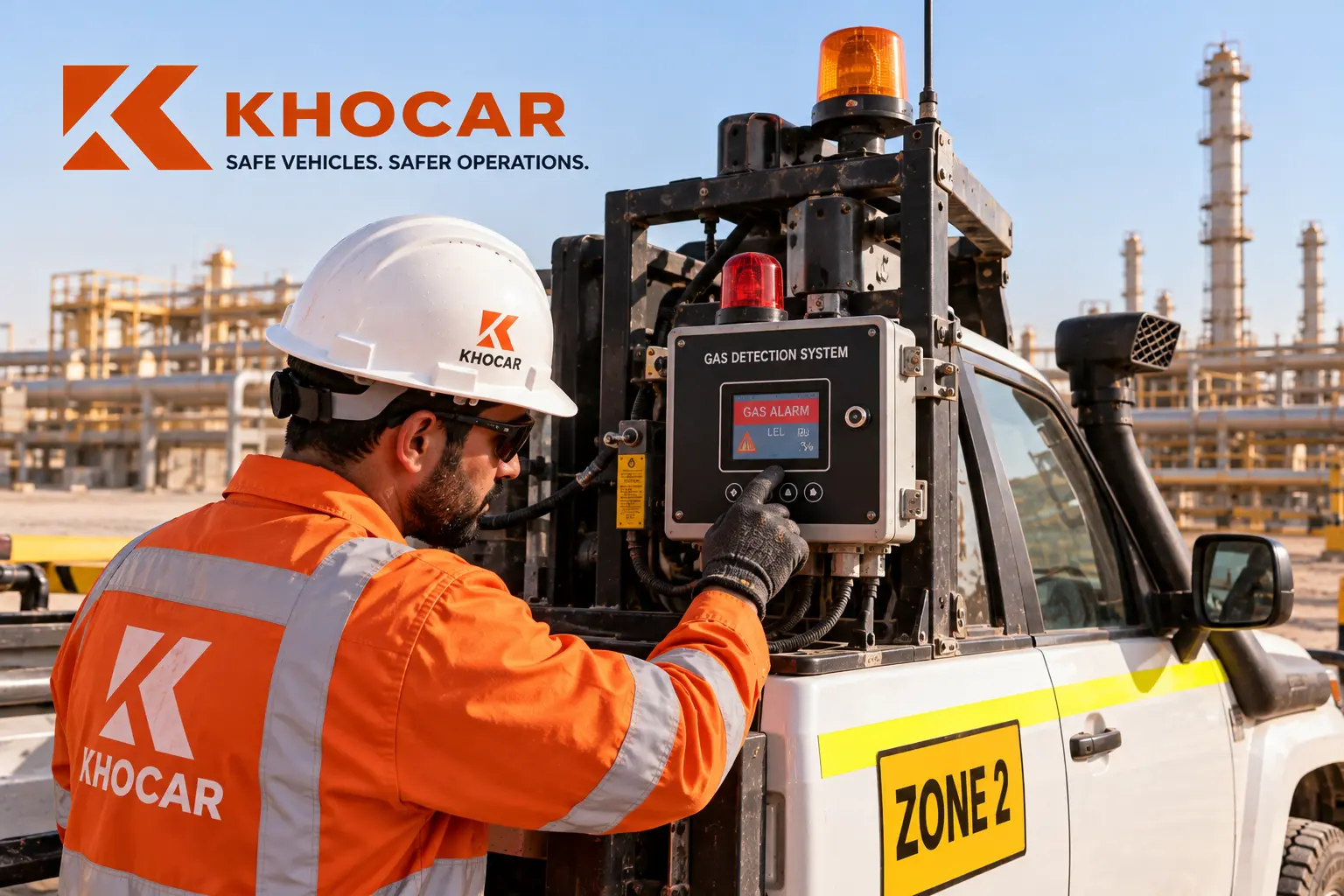
An unexpected gas alarm in an oilfield vehicle is not something a driver should dismiss as a nuisance. A genuine gas release can develop quickly, while a sensor fault, electrical problem, poor installation, or unsuitable alarm configuration can also create repeated alerts that interrupt operations. The challenge is to distinguish a possible hazardous atmosphere from a detector or system fault without putting people at risk. That is why Zone 2 gas detector false alarms must be investigated systematically, not simply silenced.
In UAE oilfields, vehicle gas detection systems may operate amid high temperatures, dust, vibration, humidity changes, vehicle movement, maintenance activity, and exposure to fuels, solvents, cleaning products, or other vapours. Depending on detector technology and manufacturer, these conditions may affect sensor readings or system reliability. At the same time, an unexpected alarm can be an important warning even when the source is not immediately obvious.
This guide explains common causes of vehicle gas detector false alarms, safe first actions, diagnostic checks for qualified personnel, and ways to reduce recurring nuisance alarms. It also explains why alarm handling must preserve the vehicle’s intended safety function and any site-specific Zone 2 requirements.
Key Takeaways
- Treat every gas alarm as potentially real until site procedures and qualified personnel establish otherwise. A history of nuisance alarms does not make the next one safe to ignore.
- Possible causes include actual gas or vapour, sensor drift, environmental changes, cross-sensitivity, contamination, wiring or power faults, vibration, poor sensor placement, and incorrect configuration.
- Drivers should follow the site emergency response procedure, notify the control room or supervisor, and never bypass or disable a detector to continue work.
- A bump test checks sensor response and alarm activation. It does not prove measurement accuracy; calibration checks and full calibration are different activities.
- Repeated alarms should be documented and investigated. Do not change alarm setpoints or substitute components without authorized technical review and site approval.
What Does a Gas Detector Do on a Zone 2 Vehicle?
A vehicle-mounted gas detection system is intended to identify a specified gas or vapour at its sensor and provide an alert or control response when programmed conditions are met. Depending on vehicle design and site requirements, the system may provide audible and visual alarms, dashboard indication, a warning to an operator, or an interface with engine shutdown or another protective function. The exact arrangement varies, so the vehicle’s approved design and operating procedure take precedence over a generic checklist.
Zone 2 describes a hazardous-area classification in which an explosive atmosphere is not likely to occur in normal operation, but if it occurs, it is expected to do so infrequently and for a short duration. That does not mean every vehicle in a Zone 2 location uses the same detector, alarm logic, or shutdown arrangement. Requirements depend on risk assessment, intended vehicle use, site rules, and the specific conversion or installation design.
KhoCAR’s Zone 2 installation services explain hazardous-area vehicle modifications and documentation aligned with project/site requirements.
Review the Zone 2 vehicle conversion checklist before arranging an assessment.
What Is a False Alarm, and What Is a Fault Alarm?
A false alarm generally means the system indicates a gas condition when the target gas is not present at a level that should trigger that alarm. A nuisance alarm is a recurring or unwanted alarm that interrupts work, often because of environmental effects, cross-sensitivity, configuration, or an unresolved defect. A fault alarm is different: it indicates that the detector or system may not be operating correctly, for example because of sensor failure, wiring problems, low supply voltage, or communication loss.
These terms should not be used interchangeably. An alarm can be accurate but unexpected because gas has reached the sensor from an intermittent leak, nearby process activity, or a source the team has not considered. The UK Health and Safety Executive explains that false alarms may be associated with environmental changes, sensitivity to other gases or vapours, and sensor drift.
Read the HSE guidance on selection and use of flammable gas detectors for information about detector performance, alarm levels, and false-alarm sources.
The operational rule is simple: treat the initial alert as real, follow the site response, and let an authorized investigation determine whether it was a gas event, a fault, or a nuisance alarm.
Common Causes of Zone 2 Vehicle Gas Detector False Alarms
Actual gas or vapour reaching the sensor
The first possibility to rule out is a real release. Gas can reach a vehicle sensor because of nearby process activity, a leak, a vent, a temporary release, or a change in wind direction. A reading may rise and fall as the vehicle moves or as the atmosphere changes. If the alarm coincides with work near a well, process equipment, loading area, or other potential release point, follow site procedures rather than troubleshooting electronics in place.
Temperature, humidity, and environmental changes
High ambient temperature and rapid temperature changes can affect some sensor technologies, electronics, enclosures, and signal stability. Humidity changes or condensation can also influence certain sensors. UAE conditions make it important to verify that the detector, enclosure, connectors, and installation are suitable for the environment. Do not assume hot weather alone explains an alarm; it is a factor to investigate, not proof that the alert is false.
Cross-sensitivity to other gases and vapours
Some sensors respond to substances other than their intended target gas. Fuel vapours, solvents, cleaning agents, exhaust-related compounds, or other chemicals may affect readings depending on sensor technology. Cross-sensitivity is product-specific, so qualified technicians should consult the detector manual and sensor data rather than relying on a generic list of interfering substances.
Sensor contamination, poisoning, or ageing
Contamination can interfere with gas reaching the sensing element or change its response. Certain compounds can also reduce sensitivity in some catalytic combustible-gas sensors. OSHA technical guidance notes that silicone compounds and sulfur compounds can desensitize some combustible-gas sensors, while other conditions can produce erratic readings. A sensor that has been exposed to an unsuitable substance may appear to work while responding inaccurately.
See OSHA’s technical manual on combustible gas meters and calibration for sensor-specific cautions.
Sensor drift or calibration problems
Sensor output can drift over time because of normal ageing, exposure history, environmental conditions, or maintenance issues. A detector that is out of calibration may alarm at an incorrect indicated concentration, fail a calibration check, or respond inconsistently. Calibration should follow the exact model’s instructions, approved test gas, required regulator and flow, and site maintenance procedures. Do not calibrate in a hazardous location unless the procedure and site controls explicitly permit it.
Incorrect alarm settings or configuration
A setpoint that does not match the approved design, the wrong gas selection, an incorrect measurement range, or a configuration change can lead to unwanted alarms or dangerous under-reading. Alarm settings should not be changed simply to stop recurring alerts. Any change must be assessed and authorized against the risk assessment, detector specifications, site requirements, and approved vehicle configuration.
Wiring, grounding, power, or communication faults
Loose connectors, damaged cables, water ingress, poor termination, unstable supply voltage, electromagnetic interference, or communication faults can create intermittent readings or fault indications. Vehicles are exposed to vibration and movement, which can reveal a connection problem that was not apparent when stationary. Electrical inspection in hazardous areas must be performed by qualified personnel using approved procedures and equipment.
Vibration, shock, or damaged mounting
Repeated vibration, a recent impact, rough-road travel, or a loose sensor bracket can affect connectors, mounting orientation, or internal components. If alarms began after vehicle repairs, panel removal, a collision, or work on the engine bay, include that event in the fault history. A sensor may be internally damaged even if the housing looks normal.
Poor sensor location or airflow effects
Sensor placement affects what gas can reach the sensing element and how quickly it arrives. Vehicle airflow, ventilation fans, engine heat, shielding, mounting height, and nearby structures may affect local conditions. A sensor installed where gas is unlikely to reach it promptly may under-read; a location exposed to exhaust, cleaning vapours, or other interfering sources may create unwanted readings. Placement should be reviewed against target gas, release scenarios, manufacturer instructions, and approved installation design.
Wrong sensor type, gas setting, or sampling arrangement
A detector must be suitable for the gas it is intended to measure and for the way the sample reaches the sensor. HSE has warned that an unsuitable sampling tube can delay or prevent detection of certain vapours because the substance can be adsorbed onto the tube’s inner surface. This shows that the whole measurement path matters, not only the detector head.
Review the HSE alert on failure to detect dangerous gas because of an incorrectly specified sample tube when troubleshooting remote or pumped sampling systems.
Low battery or unstable supply
A low battery, failing power supply, poor connection, or voltage drop can cause a fault or unreliable operation in some systems. Do not assume a low-voltage indication is harmless. The detector must remain capable of performing its intended safety function, and low-power indications should be handled according to equipment instructions and site procedure.
Incorrect maintenance or unapproved parts
A sensor replacement, software update, wiring repair, or configuration change can introduce compatibility issues if the part or procedure is not approved for the system. A replacement sensor may have a different range, target gas, output, or calibration requirement. Keep records of parts, software/configuration changes, calibration, and tests, and confirm that work preserves the approved installation.
First Actions When a Vehicle Gas Detector Alarms
The driver’s role is to protect people and follow the site response, not to decide immediately that the detector is wrong. A false alarm can look like a real one, and a recurring history does not make the next alert safe to ignore.
- Follow the site emergency procedure and the instructions for the vehicle’s gas detection system.
- Notify the control room, supervisor, or designated site contact using the required communication method.
- If instructed and safe to do so, move to the designated safe location or follow the site evacuation or vehicle shutdown process. Do not drive through a suspected hazardous area to save time.
- Keep personnel clear of the suspected source and follow site instructions about ignition sources, parking, and shutdown.
- Do not silence, reset, bypass, disconnect, or disable the detector merely to continue work. Only use reset functions as directed by the approved procedure after the condition has been assessed.
- Record the time, location, alarm type, displayed reading, other indications, vehicle activity, nearby work, and actions taken, provided recording does not delay the emergency response.
The correct response may vary by alarm level and system design. A detector may be integrated with automatic shutdown or another protective function. Do not defeat that function or restart the vehicle unless the responsible site authority and approved procedure permit it.
A Safe Troubleshooting Workflow for Qualified Personnel
Once the site response has been completed and the vehicle is in a location where inspection is authorized, qualified personnel can work through a structured diagnosis. Troubleshooting should identify the cause, restore the system, and verify its performance. It should not be a sequence of resets until the alarm disappears.
Step 1: Review the event and alarm history
- Record the exact alarm message, channel, gas type, displayed concentration, and whether the system reported a sensor or communication fault.
- Establish whether the alarm was continuous, intermittent, associated with vehicle start-up, or triggered during movement.
- Check whether it coincided with refuelling, cleaning, maintenance, exhaust exposure, nearby process work, or a known release.
- Do not use another instrument as a reason to dismiss the alarm without following site procedures.
Step 2: Confirm the system identity and approved configuration
Verify the detector make and model, sensor type, target gas, measurement range, alarm setpoints, software/configuration version where applicable, and approved installation documentation. Check that recent changes are documented. If information does not match the approved design, refer the issue to the responsible technical authority before making adjustments.
Step 3: Inspect the sensor and its surroundings
Under the applicable safe-work procedure, inspect the sensor housing, mounting, guards, openings, connectors, cable routing, and signs of contamination or damage. Look for obstructed gas access, loose mounting, impact marks, moisture, corrosion, or exposure to cleaning products. Visual inspection is useful but cannot establish that the sensor remains accurate.
Step 4: Check power and signal integrity
Qualified technicians should inspect the approved power supply, connectors, cable terminations, grounding/bonding arrangement where applicable, and communication signals. Follow the manufacturer’s fault-finding procedure and the site’s electrical safety requirements. Do not open or repair equipment in a hazardous area unless the work is permitted and the equipment is made safe according to the relevant procedure.
Step 5: Review maintenance and calibration records
Check the last bump test, calibration check, full calibration, sensor replacement, and any exposure or fault records. Confirm the test gas is appropriate and in date, the regulator and adapter are correct, and the procedure matches the detector manual. A history of passing tests is useful evidence, but it does not rule out a new fault or a real gas event.
Step 6: Test according to the manufacturer’s instructions
A bump test or function check confirms that gas can reach the sensor and expected alarms activate. It does not establish the accuracy of the indicated concentration. A calibration check compares the response with a known test-gas concentration within the manufacturer’s tolerance; full calibration adjusts the response when required. OSHA recommends following manufacturer guidance and removing instruments from service when they fail required checks.
See OSHA’s detailed guidance on bump tests, calibration checks, and full calibration. Do not improvise test gas, flow rates, adapters, or calibration steps.
Step 7: Escalate, repair, and verify
If the sensor fails a test, the cause remains unclear, the alarm repeats, or the system shows a fault, remove the vehicle from relevant duty according to site procedures and refer it to authorized service personnel. Replace or repair only with compatible approved components. After work, complete the prescribed test and document the result before the vehicle returns to service.
Bump Test vs Calibration Check vs Full Calibration
| Activity | Purpose | What It Does Not Prove |
| Bump test / function check | Confirms gas reaches the sensor and alarms respond. | Does not measure accuracy of the reading. |
| Calibration check | Compares displayed response with known test-gas concentration against specified tolerance. | Does not necessarily adjust the detector. |
| Full calibration | Adjusts detector response to match specified calibration gas according to procedure. | Does not prove suitability for every gas or eliminate all system faults. |
| Functional/system test | Checks alarms, outputs, shutdown interfaces, or other functions as prescribed. | Does not replace the full maintenance regime. |
Testing frequency depends on detector type, manufacturer recommendations, exposure history, site rules, and risk assessment. OSHA describes a recommendation for verifying portable monitor function before each day’s use, but vehicle-mounted systems may have different approved maintenance instructions. Use the applicable manufacturer and site requirements rather than applying one frequency universally.
How UAE Oilfield Conditions Can Contribute
The operating environment is an important part of a recurring gas detector false alarm investigation, but it should never be used as a shortcut diagnosis.
| Condition | Possible Effect | What to Review |
| High heat and temperature cycling | May affect sensor output, electronics, seals, or stability depending on design. | Temperature ratings, enclosure condition, location, fault history. |
| Dust and contamination | May obstruct sensor openings or affect components. | Sensor face, guards, cleaning procedure, exposure records. |
| Humidity or condensation | May affect some sensing technologies or electrical connections. | Ingress protection, connector condition, condensation evidence. |
| Vehicle vibration and road shock | May loosen connections or damage mounting/components. | Brackets, cable strain relief, connectors, recent impacts. |
| Fuel, solvents, or cleaning agents | May create a real vapour reading or interfere with some sensor types. | Products used, safety data, cross-sensitivity, cleaning timing. |
| Nearby process activity | May expose the sensor to an actual intermittent release. | Location, wind conditions, process status, site incident records. |
KhoCAR’s Zone 2 vehicle checklist for ADNOC site access in Abu Dhabi highlights confirming whether the site expects gas detection, alarms, automatic shutdown, manual shutdown, and particular sensor placement.
Diagnostic Clues: What Patterns May Suggest
Patterns can help direct an investigation, but they are not proof. Use them to prioritize checks after the site response, not to decide whether an alarm was genuine.
| Observed Pattern | Possible Areas to Investigate | Important Caution |
| Alarm appears after cleaning | Cleaning vapour, cross-sensitivity, sensor contamination. | Do not assume no gas is present. |
| Alarm occurs mainly during movement | Vibration, loose connector, airflow change, or changing atmosphere. | Movement may also take the vehicle near a real source. |
| Reading fluctuates with temperature | Environmental sensitivity, sensor drift, electrical issue. | Verify using approved test procedures. |
| Fault follows sensor replacement | Part compatibility, configuration, wiring, calibration procedure. | Do not operate until approved setup is confirmed. |
| Alarm repeats at the same location | Possible site gas source, local airflow, or sensor placement issue. | Treat as possible real release and notify site safety staff. |
| Detector fails bump/calibration test | Sensor degradation, contamination, wrong gas, expired test gas, or setup error. | Remove from service according to procedure. |
| Several vehicles alarm in the same area | Environmental/process condition or shared exposure. | Escalate to site control; do not assume fleet-wide fault. |
Alarm Setpoints: Why You Should Not Raise Them to Stop Nuisance Alarms
Changing alarm thresholds may reduce alerts, but it can also delay warning or prevent the intended protective action. Alarm setpoints must be based on target gas, detection purpose, risk assessment, response time, site requirements, and approved system design. HSE guidance discusses balancing personnel protection with false-alarm prevention and considering the lower explosive limit, likely leak size, occupied areas, and response actions.
If nuisance alarms are frequent, investigate the cause rather than increasing the setpoint without authorization. Possible solutions may include correcting sensor location, replacing a degraded sensor, addressing electrical faults, verifying the correct sensor type, improving maintenance, or revisiting the design through a formal engineering review. Any modification should be documented, approved, and tested.
The HSE’s guidance on gas detection and alarm reliability emphasizes detector suitability, maintenance, reliability, fault conditions, and procedures for responding to and recording alarms.
When Should a Sensor Be Replaced?
Sensor replacement may be appropriate when the sensor fails the manufacturer’s checks, cannot be calibrated within specified limits, has exceeded its stated service life, has suffered a damaging exposure, or shows physical damage. The decision should be based on manufacturer guidance, fault evidence, and the approved maintenance process.
- Do not replace a sensor with a visually similar part unless compatibility is confirmed.
- Check target gas, range, output, connection, environmental rating, and required configuration.
- Follow the approved replacement and calibration procedure.
- Record the part number, date, reason for replacement, and test results.
- Verify alarms and any connected shutdown/control functions as required before returning it to service.
If the same fault returns after replacement, do not continue swapping parts without diagnosis. Investigate the power supply, wiring, installation location, system configuration, environmental exposure, and the possibility of a genuine gas source.
Preventing Recurring Gas Detector Nuisance Alarms
- Maintain a written inspection, function-check, calibration, and service schedule based on manufacturer and site requirements.
- Keep calibration and bump-test records accessible to the maintenance team.
- Use correct test gas, adapters, regulators, flow rates, and unexpired cylinders.
- Train drivers and supervisors to recognize alarm versus fault indications and follow the site response.
- Record every alarm event, including location, conditions, action taken, and final cause when known.
- Inspect sensor mounting, connectors, wiring protection, and enclosures during authorized maintenance.
- Review chemical exposure from cleaners, solvents, fuel vapours, and maintenance materials.
- Confirm sensor placement and type remain suitable if the vehicle, engine bay, layout, or operating duty changes.
- Use only compatible parts and approved configuration changes.
- Trend repeated events by vehicle, sensor, location, operating conditions, and maintenance history.
- Investigate alarms at a common location as a possible site condition rather than automatically blaming each vehicle.
- Conduct a formal review if alarms are repeatedly reset, bypassed, or ignored.
Example: Repeated Gas Alarms on a Zone 2 Service Vehicle
Imagine a service vehicle triggers a combustible-gas alarm several times during a week. The first event occurs near an operating area; a later event occurs shortly after the engine bay has been cleaned. The driver reports that the reading falls after the vehicle moves, and the maintenance team suspects a faulty sensor.
A safe investigation preserves the initial response to each alarm, notifies the site, and reviews event locations and conditions. Qualified personnel inspect records, check whether the detector is configured for the intended gas, review cleaning products and cross-sensitivity information, examine the sensor and wiring, and carry out the manufacturer’s prescribed checks in an authorized location. If the sensor fails, the vehicle remains out of relevant service until the system is repaired and verified. If tests pass, the team still needs to consider whether the alarm represented a real intermittent gas presence at the original location.
This approach avoids two dangerous assumptions: that every recurring alarm is a detector fault, and that replacing a sensor automatically resolves the problem. The goal is to establish the cause and restore confidence in the complete detection system.
What Records Should Be Kept?
A reliable record helps maintenance teams spot repeat patterns and demonstrates that alarms were handled systematically. The exact record format should follow the operator’s management system and site requirements.
- Vehicle registration/fleet ID and detector make, model, serial number, and sensor type.
- Date, time, location, alarm/fault code, displayed reading, and alarm level.
- Operating conditions, nearby work, cleaning or maintenance activity, and site notifications.
- Immediate actions taken and the person/role notified.
- Inspection findings, test gas details, bump-test/calibration results, and calibration due date.
- Parts replaced, software/configuration changes, repairs, and authorization records.
- Final diagnosis, verification results, return-to-service approval, and follow-up actions.
How KhoCAR Can Help With Zone 2 Vehicle Gas Detection
If a vehicle’s gas detection system repeatedly alarms, shows a fault, or requires technical review, the first priority is to follow the site response and keep the vehicle out of hazardous-area duty until the issue has been assessed as required. Any repair or configuration change should preserve the approved safety function and relevant site requirements.
KhoCAR provides Zone 2 installation support in Abu Dhabi for vehicles and equipment, including hazardous-area modifications and documentation aligned with applicable project and site requirements.
You can also review the Zone 2 vehicle conversion checklist before requesting an assessment.
When contacting a service provider, share vehicle details, detector make and model, alarm/fault history, site requirements, maintenance records, recent changes, and diagnostic reports that can be safely collected. Do not send a vehicle back into a hazardous area simply because the alarm has stopped.
FAQs
What causes a gas detector to give false alarms on a vehicle?
Possible causes include actual gas or vapour, environmental changes, sensor drift, cross-sensitivity, contamination, sensor ageing, wiring or power faults, vibration, poor sensor placement, and incorrect configuration. Treat every alarm as potentially real until the approved response and investigation establish the cause.
Can hot weather cause a vehicle gas detector false alarm?
Temperature changes can affect some sensor technologies or electronics, depending on design and rating. Heat alone does not prove an alarm is false. Follow site response and have qualified personnel investigate environmental conditions alongside possible gas presence and equipment faults.
Should the driver reset a gas detector after a false alarm?
The driver should follow site procedure and must not reset, bypass, or disable the detector just to continue working. Reset actions should occur only when the approved procedure allows them and responsible personnel have assessed the condition.
What is the difference between a bump test and calibration?
A bump test confirms gas reaches the sensor and alarms activate. A calibration check compares the reading with a known test-gas concentration. Full calibration adjusts detector response. Follow the manufacturer’s procedure for the specific model.
How often should a vehicle gas detector be calibrated?
There is no single interval for every vehicle-mounted detector. Follow manufacturer instructions, site requirements, risk assessment, exposure history, and maintenance program. Additional checks may be required after a failed test, damaging exposure, repair, or other event.
Can cleaning chemicals trigger gas detector alarms?
Some vapours may interfere with certain sensor types or produce a response, depending on the detector and chemical. Check manufacturer cross-sensitivity information and product safety data, and investigate rather than assuming the alarm is harmless.
Can I increase the alarm threshold to stop nuisance alarms?
Not without an authorized engineering review and approval. Raising a threshold can delay warning or weaken the safety function. Investigate sensor suitability, location, contamination, calibration, wiring, configuration, and possible real gas sources first.
What should happen if the gas detector fails a bump test?
Follow manufacturer and site procedures, remove the instrument or vehicle from relevant service as required, and have authorized personnel investigate. Do not return it to hazardous-area duty until required repair, testing, and approval are complete.
Why do several vehicles alarm in the same area?
A shared location may have an actual intermittent gas source, local airflow effects, environmental conditions, or another common factor. Notify site control and investigate the area. Do not assume multiple alarms prove that every detector is faulty.
Does a Zone 2 vehicle always need a gas detection and shutdown system?
Not every vehicle setup is identical. Requirements depend on risk assessment, vehicle use, approved design, and project/site rules. Confirm specific requirements with the responsible site authority and qualified conversion provider.