
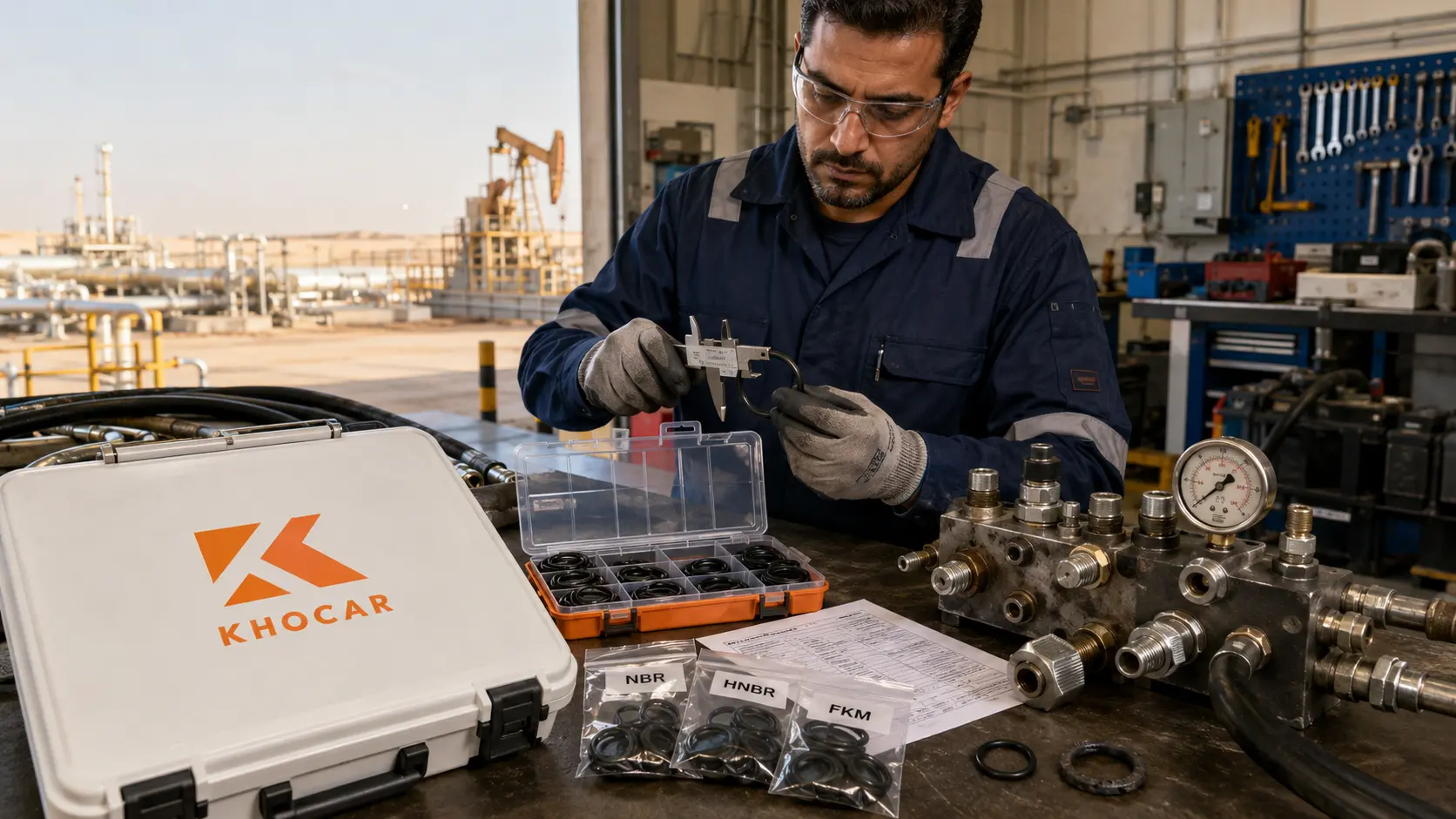
Choosing between Viton vs NBR O-rings can look like a simple temperature comparison until a seal swells in hydraulic oil, hardens beside a hot engine, extrudes under a pressure spike, or blisters after a gas-system blowdown. For UAE contractors, the decision is even less forgiving: equipment may start in a hot Musaffah yard, mobilize through desert dust, run long hydraulic cycles and then face a client requirement for sour-service or rapid-gas-decompression evidence.
KhoCAR created this guide to explain where NBR, HNBR and FKM fit, what their published temperature ranges really mean, and why “H₂S-resistant” should describe a qualified compound rather than a rubber family in general.
The short answer is that NBR is often the practical choice for ordinary oil hydraulics, HNBR adds heat and mechanical durability, and FKM, often requested by the Viton™ brand name, extends high-temperature and chemical capability. But the correct oilfield O-ring material must match the actual fluid, pressure, temperature, motion, groove, and gas-decompression duty.
Key Takeaways
Viton vs NBR O-rings is not a contest with one permanent winner. Standard NBR is usually the economical baseline for compatible petroleum oils and moderate-temperature hydraulics. HNBR keeps much of NBR’s oil resistance while improving thermal stability, oxidation resistance, and mechanical performance. FKM, including genuine Viton™ formulations, is usually the strongest of the three for sustained heat, hot oil, fuel and many aggressive chemicals. However, published temperature ranges are compound examples rather than blanket ratings, and a seal that handles temperature may still fail because of fluid additives, extrusion, dynamic wear, poor gland design or rapid gas decompression. For H₂S service, specify the complete compound, cure system, hardness and relevant ISO 23936-2 or NORSOK M-710 qualification—not just “HNBR” or “Viton.”
Viton vs NBR O-Rings: What Is the Main Difference?
The main difference is the polymer structure and the performance balance it creates. NBR is a nitrile elastomer valued for oil resistance, useful low-temperature flexibility and affordability. HNBR begins as nitrile rubber, then hydrogenation saturates much of the polymer backbone; that change improves resistance to heat, oxygen, ozone and mechanical stress. FKM is a fluorocarbon elastomer family designed for high temperature and broad chemical resistance. Viton™ is a trademarked family of fluoroelastomers from Chemours, not the generic name for every FKM seal.
That naming distinction matters in procurement. The official Viton™ fluoroelastomer information describes products formulated for chemical and high-temperature exposure. A quotation that says only “Viton equivalent” may refer to an unverified FKM compound with different fluorine content, cure chemistry, low-temperature behavior, RGD resistance or traceability. Ask for the manufacturer, compound code and data sheet.
| Factor | NBR | HNBR | FKM / Viton™ |
| What it is | Nitrile rubber (Buna-N) | Hydrogenated nitrile rubber | Fluoroelastomer; Viton™ is one FKM brand |
| Illustrative static range | -35°C to +100°C | -35°C to +150°C | -25°C to +200°C |
| Mineral oil / hydraulic oil | Usually very good | Usually very good | Usually excellent; verify fluid additives |
| Heat and oxidation | Moderate | Better than NBR | Strongest of these three in many hot-oil duties |
| Ozone / weathering | A weakness unless protected or specially compounded | Improved over NBR | Generally strong |
| Mechanical toughness | Good general-purpose balance | Often excellent strength, wear and extrusion resistance | Compound-dependent; can be less forgiving in some dynamic duties |
| Sour gas / H₂S | Do not assume suitability | Qualified oil-and-gas compounds are widely available | Qualified oil-and-gas compounds are available; check amines and RGD |
| Typical selection logic | Cost-effective standard oil hydraulics | Hotter, harder mechanical hydraulic and oilfield service | High-temperature oil, fuel and broader chemical exposure |
| Relative cost | Lowest | Medium | Highest of these three |
Range note: These are examples from listed Parker static compounds, not universal limits. The Parker O-Ring Guide gives NBR examples to 100°C, HNBR examples to 150°C and standard FKM examples to 200°C, while warning that pressure, temperature and other maxima are interrelated. Always use the selected compound data sheet and OEM limits.
Quick answer: Choose NBR for compatible mineral-oil systems that remain within the proven temperature and pressure envelope. Move to HNBR when heat, oxidation, wear or extrusion resistance makes standard NBR marginal. Consider FKM/Viton when sustained high temperature, hot oil, fuels, aromatics or broader chemical exposure drives the requirement. For sour gas or high-pressure gas, select only an application-qualified compound with suitable aging and RGD evidence.
What Is NBR, and When Is It the Right Oilfield O-Ring Material?
NBR stands for nitrile butadiene rubber and is also called Buna-N. It is the most familiar general-purpose O-ring material in hydraulic and petroleum-oil service because it combines useful oil resistance, good sealing behavior, broad availability and low cost. In the Parker guide, standard NBR compounds are listed for mineral oil and mineral-oil products and for compatible hydraulic systems. That makes NBR a sensible starting point for many pumps, valves, cylinders, hydraulic manifolds, filter housings and workshop repair kits.
NBR is not one fixed material. Its acrylonitrile content changes the balance between fuel/oil resistance and low-temperature flexibility, while fillers, plasticizers, cure system and hardness change compression set, wear and extrusion behavior. A black 70 Shore A O-ring from one supplier is therefore not automatically interchangeable with every other black 70 Shore A ring.
Where NBR performs well
Moderate-temperature mineral-oil hydraulics: common in service equipment, workshop machinery and many mobile hydraulic circuits.
Static oil seals: plugs, covers, manifolds and filter housings where the fluid and temperature are known.
Cost-controlled preventive maintenance: when seals are replaced at planned intervals and downtime consequences are manageable.
Low-temperature flexibility: standard NBR often starts at a lower temperature than standard FKM, although UAE projects should still consider refrigerated storage, transport and export duty.
Where standard NBR becomes risky
Heat, hot air, oxygen and ozone age standard NBR faster than HNBR or FKM. It can harden, crack, lose elastic recovery or take a permanent compression set. That weakness matters near engines, exhaust systems, unshielded hydraulic lines, hot pump casings and equipment stored outdoors. NBR can also swell or soften in incompatible fuels, solvents, additives or process chemicals. A temperature listed as “acceptable” in a catalogue does not prove long life at that temperature—especially when pressure, movement and chemical exposure occur together.
What Is HNBR, and Why Is It Common in Demanding Hydraulics?
HNBR means hydrogenated nitrile butadiene rubber. Hydrogenation reduces the unsaturation in the NBR backbone, improving thermal stability and resistance to oxidation and ozone. In practical terms, HNBR is often the bridge between standard NBR and FKM: it keeps strong compatibility with many oils while adding a higher temperature ceiling and excellent mechanical strength.
For UAE oilfield equipment, that balance is valuable. Hydraulic winches, power packs, wireline units, pumps and mobile machinery can expose O-rings to hot oil, vibration, pressure cycling, dust-driven abrasion and repeated maintenance. A properly selected HNBR compound can offer better resistance to hardening, wear and extrusion than standard NBR without automatically moving to the cost and chemical profile of FKM.
When HNBR is usually worth the upgrade
Operating temperature approaches the proven NBR limit: especially where heat is continuous rather than a brief excursion.
Dynamic or high-pressure duty is severe: for example reciprocating components, pressure cycling or larger extrusion gaps.
Outdoor aging matters: because equipment sees oxygen, ozone and heat during storage as well as operation.
Oil-and-gas qualification is required: because specialist HNBR compounds are available with sour-aging and RGD test evidence.
A useful example is Trelleborg’s HNBR XploR™ H9T21 compound data, which lists a -40°C to +160°C service range and independent testing to NORSOK M-710 Rev. 3 and ISO 23936-2 for rapid gas decompression. Those numbers apply to that named compound—not to every HNBR O-ring. The lesson is to buy test-backed compounds, not to copy a polymer family’s best published figure.
What Is FKM, and Is Every FKM O-Ring Viton?
FKM is the ASTM family designation for fluorocarbon elastomers. Viton™ is a well-known Chemours brand within that family. In everyday maintenance language, “Viton O-ring” is often used to mean any FKM ring, but technically and commercially they are not identical statements. Different FKM types and cure systems are optimized for different fuels, acids, steam, low-temperature duty, bases, amines or RGD conditions.
Standard FKM’s main advantage is high-temperature stability combined with excellent resistance to hot oil, fuel, aromatic hydrocarbons and many chemicals. Parker lists standard FKM compound examples from -25°C to +200°C for static applications and describes them for high temperature, hot oil, aromatic solvents and broad chemical resistance. Specialty FKM compounds may go beyond those limits or improve low-temperature, water-glycol, acid or decompression performance.
When FKM/Viton is a strong choice
Sustained high-temperature oil service: where NBR or HNBR would have insufficient margin.
Fuel and aromatic-hydrocarbon exposure: when the exact compound has documented compatibility.
Low gas permeability and compression-set control are important: subject to pressure-cycle and RGD validation.
Chemical exposure is mixed or aggressive: provided the full fluid composition has been checked rather than relying on a generic resistance chart.
Where FKM can still fail
FKM is not universally chemical-proof. Some hot aqueous fluids, steam, ketones, esters, bases and amine-containing systems can require a specialty FKM, FEPM, EPDM, FFKM or another material. Standard FKM can also be less attractive where very low-temperature flexibility or highly dynamic abrasion is the controlling factor. In high-pressure gas, chemical compatibility does not guarantee RGD resistance. A premium polymer selected for the wrong duty can fail faster than a less expensive compound selected correctly.
How to Choose Between NBR vs HNBR vs FKM in UAE Oilfield Equipment
A defensible seal selection begins with the duty, not the color of the removed O-ring. Use the following sequence before requesting a quotation or approving a substitute.
1. Identify every fluid—not only the base oil
Record the full product name and grade of the hydraulic oil, lubricant, fuel, drilling fluid, completion fluid, cleaning chemical or process stream. Additives can change compatibility. Also consider temporary exposure during flushing, preservation, washdown and maintenance. A seal may spend most of its life in mineral oil but fail during a short cleaning cycle with an incompatible solvent.
2. Use actual seal temperature, not the weather forecast
Ambient UAE heat matters, but the O-ring experiences the temperature of the surrounding metal and fluid. Measure or estimate cold start, normal continuous temperature, peak temperature, excursion duration and shutdown heat soak. KhoCAR’s hydraulic system overheating guide for UAE summer explains how low oil level, internal leakage, relief-valve bypass, blocked coolers and contamination can raise oil temperature beyond the normal baseline. Fixing that root cause may be more important than installing a higher-temperature O-ring.
3. Define pressure, clearance and motion
Pressure does not act alone. Extrusion risk depends on pressure differential, gland clearance, seal hardness, temperature-softened modulus, pressure cycling and whether the seal is static, rotary or reciprocating. A harder O-ring or a back-up ring may be needed, but extra hardness can make assembly and low-pressure sealing more difficult. Confirm the groove and extrusion gap instead of using material alone as the solution.
4. Check contamination and surface condition
Dust, wear debris, scored rods, damaged grooves and dirty assembly tools can destroy any elastomer. Repeated seal failure after a fluid or hose problem should trigger contamination control and surface inspection. The related hydraulic oil contamination guide covers ISO 4406 trending, clean transfer, filtration, hose flushing and post-failure cleaning for UAE equipment.
5. Separate continuous duty from emergency exposure
A seal may be rated for a short temperature excursion yet unsuitable for months of continuous service. Likewise, a material may tolerate static gas pressure but not repeated fast depressurization. Ask what happens during start-up, shutdown, blowdown, pressure testing, transport and storage—not only during steady operation.
| Application scenario | Likely starting point | Why | What must be verified |
| General mineral-oil hydraulic circuit at moderate temperature | NBR | Good oil compatibility and economical replacement cost | Actual oil, additives, dynamic duty, pressure, groove and measured temperature |
| Hot mobile hydraulics, winches or power packs | HNBR | Improved heat, oxidation and mechanical margin over standard NBR | Continuous temperature, rod speed, pressure spikes, contamination and extrusion gap |
| Hot oil, diesel, fuel or aromatic-hydrocarbon exposure | FKM / Viton™-type compound | Broad hydrocarbon and high-temperature capability | Exact chemistry, low-temperature start-up, water/steam, additives and dynamic suitability |
| High-pressure gas with planned or emergency blowdown | RGD-qualified HNBR or FKM | Base polymer name does not prove decompression resistance | Qualification standard, gas mix, pressure, temperature and decompression rate |
| Sour service containing H₂S and CO₂ | Application-qualified oil-and-gas compound | H₂S aging, gas permeation and RGD can combine | H₂S/CO₂ partial pressures, amines, water cut, hydrocarbons, temperature and exposure time |
| Long outdoor storage or weather-exposed static seal | HNBR or FKM often preferable to standard NBR | Better oxidation and ozone resistance | Packaging, shelf-life control, UV/ozone exposure and fluid compatibility |
H₂S-Resistant Seals: Why the Compound Qualification Matters
An H₂S-resistant seal is an elastomer compound that has been shown to retain acceptable properties in a defined sour environment. The label does not mean unlimited resistance to every concentration, partial pressure, temperature or exposure time. Sour service may include H₂S, CO₂, methane, hydrocarbons, brine, water, corrosion inhibitors, methanol and amines. Each can affect swelling, hardness, tensile properties, compression set and gas permeation.
For oil and gas production media, ISO 23936-2 covers elastomers in contact with oil-and-gas production media and remains current after ISO’s 2022 confirmation. Qualification evidence should match the application closely enough to support the material decision. A generic chemical-resistance chart is useful for screening, but it is not a sour-service certificate.
H₂S aging and rapid gas decompression are different risks
H₂S aging is the chemical and physical change caused by sour-media exposure. Rapid gas decompression, also called explosive decompression, occurs when high-pressure gas absorbed into the elastomer expands faster than it can escape during depressurization. The expanding gas can create internal cracks, blisters or splitting even when the outside of the O-ring looks acceptable before removal.
That distinction changes procurement. A compound may have useful H₂S compatibility but lack evidence for repeated blowdown. Conversely, an RGD-resistant compound still needs chemical-aging compatibility with the actual gas and liquid mixture. The gas composition, operating pressure, saturation time, temperature and decompression rate all influence risk.
What documentation should you request for sour-gas O-rings?
Manufacturer and compound code, not only polymer family, color or hardness.
Material data sheet and batch traceability, including cure date or shelf-life controls where required.
Sour-aging test evidence relevant to H₂S/CO₂ composition, temperature and exposure.
RGD qualification such as applicable ISO 23936-2 or NORSOK M-710 testing for high-pressure gas duty.
Hardness and physical-property results before and after aging, including volume, tensile and elongation changes.
Application drawing or gland confirmation including size standard, squeeze, stretch, clearance and back-up-ring arrangement.
Deviation approval if replacing an OEM compound with an alternative.
Three Practical UAE Oilfield Selection Examples
Example 1: A wireline unit develops hot hydraulic leaks
A truck-mounted wireline unit operates normally when cold but begins leaking around a manifold after several hours. The removed NBR rings are hard and flattened. The wrong response is to order the same size in FKM automatically. The better process is to measure hot oil and manifold temperature, check cooler airflow, oil level, relief-valve activity and contamination, then review the fluid data sheet and gland. If the temperature is genuinely above the NBR compound’s continuous capability, HNBR may provide the required heat and mechanical margin. FKM may be justified if the temperature or chemistry demands it, but only after confirming dynamic and low-temperature needs.
Example 2: A pressure-control assembly will see sour gas and blowdown
The purchase request says “Viton O-rings for H₂S.” That is incomplete. Engineering should add the gas composition, H₂S and CO₂ partial pressures, maximum temperature, operating pressure, exposure time, test fluid, expected decompression rate and governing equipment specification. The correct answer may be a qualified HNBR, FKM, FEPM or FFKM compound. What matters is documented performance in the intended sour-aging and RGD envelope—not brand recognition alone.
Example 3: A maintenance kit contains mixed black O-rings
A field technician finds several unmarked black rings with the correct dimensions. Installing one may restore the seal briefly, but color does not identify NBR, HNBR or FKM. The correct action is to quarantine untraceable stock, confirm size and compound against the bill of materials, and store replacements in labeled, sealed packaging. In critical oilfield work, a cheap ring without traceability can create the most expensive leak on the asset.
How O-Ring Failure Appearance Helps Narrow the Cause
A failed O-ring can provide clues, but appearance should be combined with the service history and measurements. Record the installation date, operating hours, fluid, temperature trend, pressure events and failure timing before discarding the seal.
Hard, shiny or cracked surface: often points to heat, oxidation, ozone or excessive age.
Soft, swollen or gummy seal: suggests chemical incompatibility or fluid/additive absorption.
Flat seal that does not recover: indicates compression set, excessive heat, long service or poor compound choice.
Nibbled or feathered edges: often indicate extrusion through a clearance gap under pressure.
Spiral or twisted damage: can occur in reciprocating service because of rolling, poor lubrication or installation.
Internal blisters or splits after depressurization: raise concern for rapid gas decompression.
One-sided abrasion or cuts: suggest surface damage, eccentricity, sharp edges, contamination or installation damage.
Safety note: Do not troubleshoot a pressurized hydraulic or gas system by touch. Isolate, depressurize and verify zero energy using the equipment and site procedure. High-pressure fluid injection and sour-gas exposure can be life-threatening.
Oilfield O-Ring Procurement Checklist
A strong request for quotation gives the supplier enough information to reject the wrong material. Send the following details whenever the seal is safety-critical, repeatedly failing or needed for high-temperature hydraulics or sour gas:
Equipment and location: asset, component, OEM, model, serial number and where the O-ring sits.
Size and standard: inside diameter, cross-section, AS568/ISO size or verified drawing.
Seal duty: static, reciprocating, rotary, vacuum, internal pressure or external pressure.
Fluid details: brand, grade, SDS or data sheet, additives, cleaners and any mixed process media.
Temperature envelope: minimum, normal continuous, maximum and excursion duration at the seal.
Pressure envelope: normal, peak, cycling frequency, extrusion gap and decompression profile.
Material requirement: polymer, compound code, hardness, cure system and required approval.
Gas-service evidence: H₂S/CO₂ aging and RGD qualification where applicable.
Quantity and traceability: batch certification, shelf-life requirement, packaging and delivery date.
Failure evidence: photos, removed seal condition, operating history and previous part number.
Common Mistakes When Comparing Viton vs NBR O-Rings
Treating Viton and FKM as perfectly interchangeable terms. Viton is a specific brand family; generic FKM can vary widely by type and compound.
Choosing by maximum temperature alone. The fluid, pressure, motion, time and groove can reduce usable margin.
Assuming HNBR automatically means H₂S-qualified. Only the documented compound and test scope support that claim.
Using color as material identification. Black O-rings may be NBR, HNBR, FKM or another elastomer.
Upgrading the polymer while ignoring the root cause. Overheating, contamination, damaged grooves and pressure spikes will damage premium seals too.
Buying only by dimensions. Size, hardness, tolerance, surface finish, cure and traceability all matter.
Using old or poorly stored stock. Heat, ozone, UV, deformation and open packaging can age an O-ring before installation.
Need the Right O-Rings for UAE Oilfield Equipment?
If you are comparing NBR vs HNBR vs FKM for a hydraulic system, wireline unit, pump, pressure-control assembly or sour-gas application, KhoCAR can help you source the correct sealing material and supporting industrial spares. Start with KhoCAR’s Oilfield Services & Industrial Supplies in the UAE page, then send the equipment details, fluid, temperature, pressure, dimensions, compound requirement and mobilization deadline. For a direct technical or procurement enquiry, contact the KhoCAR team in Abu Dhabi. The more complete the duty data, the faster the team can screen out an unsuitable seal and identify the documentation your project requires.
FAQs
Which is better: Viton or NBR O-rings?
Viton/FKM is usually better for sustained high temperature, hot oil, fuel and many chemicals, while NBR is often better value for compatible mineral-oil hydraulics at moderate temperature. Neither is universally better. Choose using the exact fluid, continuous and peak temperature, pressure, motion, groove design and required qualification.
What is the difference between NBR and HNBR O-rings?
HNBR is hydrogenated nitrile rubber. Compared with standard NBR, it normally provides better heat, oxidation, ozone and mechanical resistance while retaining useful oil compatibility. HNBR is often selected for hotter or more demanding hydraulic and oilfield duty, but the compound data sheet still controls.
Is Viton the same as FKM?
Not exactly. FKM is the generic ASTM family designation for fluorocarbon elastomers. Viton™ is a Chemours brand of fluoroelastomer products within that family. A generic FKM seal is not automatically a genuine Viton product or equivalent to a particular Viton grade.
What temperature can NBR O-rings handle?
A standard Parker NBR compound example is listed from about -35°C to +100°C in static service, but NBR temperature range varies by formulation, duty and exposure time. Dynamic service, hot fluids, pressure and chemical exposure can reduce usable life. Always use the chosen compound and OEM limits.
What temperature can HNBR O-rings handle?
Standard HNBR examples in Parker’s guide reach about +150°C static service, while a specialist Trelleborg oil-and-gas HNBR compound lists +160°C. These are compound-specific figures, not a universal HNBR rating. Continuous temperature, fluid, pressure, motion and aging must all be checked.
What is the typical Viton O-ring temperature range?
Standard FKM compound examples are commonly listed around -25°C to +200°C for static service. Specialty FKM formulations can improve low-temperature, chemical or high-temperature performance. “Viton temperature range” should therefore be tied to the exact Viton or FKM grade and application.
Are Viton O-rings resistant to H₂S?
Some FKM/Viton-type oil-and-gas compounds can be suitable for defined sour service, but the generic material name is not proof. Request compound-specific sour-aging and rapid-gas-decompression evidence that matches the H₂S/CO₂ composition, pressure, temperature, exposure time and decompression conditions.
Is HNBR suitable for sour gas?
Qualified HNBR compounds are widely used in oil-and-gas applications because HNBR can combine oil resistance, mechanical strength, heat resistance and RGD performance. However, standard HNBR is not automatically an H₂S-resistant seal. Verify the named compound’s ISO 23936-2 or NORSOK M-710 evidence and duty limits.
Which O-ring is best for high-temperature hydraulics?
HNBR is often the first upgrade from NBR for hotter, mechanically demanding hydraulic service. FKM may be preferred when temperature or chemical exposure exceeds HNBR capability. The correct choice also depends on oil additives, pressure, speed, extrusion gap, contamination and the measured temperature at the seal.
Why do new O-rings keep failing?
Repeated failure usually indicates a system problem or specification mismatch: overheating, incompatible fluid, contamination, pressure spikes, excessive clearance, damaged grooves, poor surface finish, incorrect size, installation cuts, wrong hardness or untraceable material. Preserve the failed seal and review the full service history before fitting another ring.
Editorial accuracy note: Temperature ranges and compatibility statements in this article are screening guidance. Final selection belongs to competent engineering personnel using the OEM specification, current compound data, project requirements and application testing where necessary.