
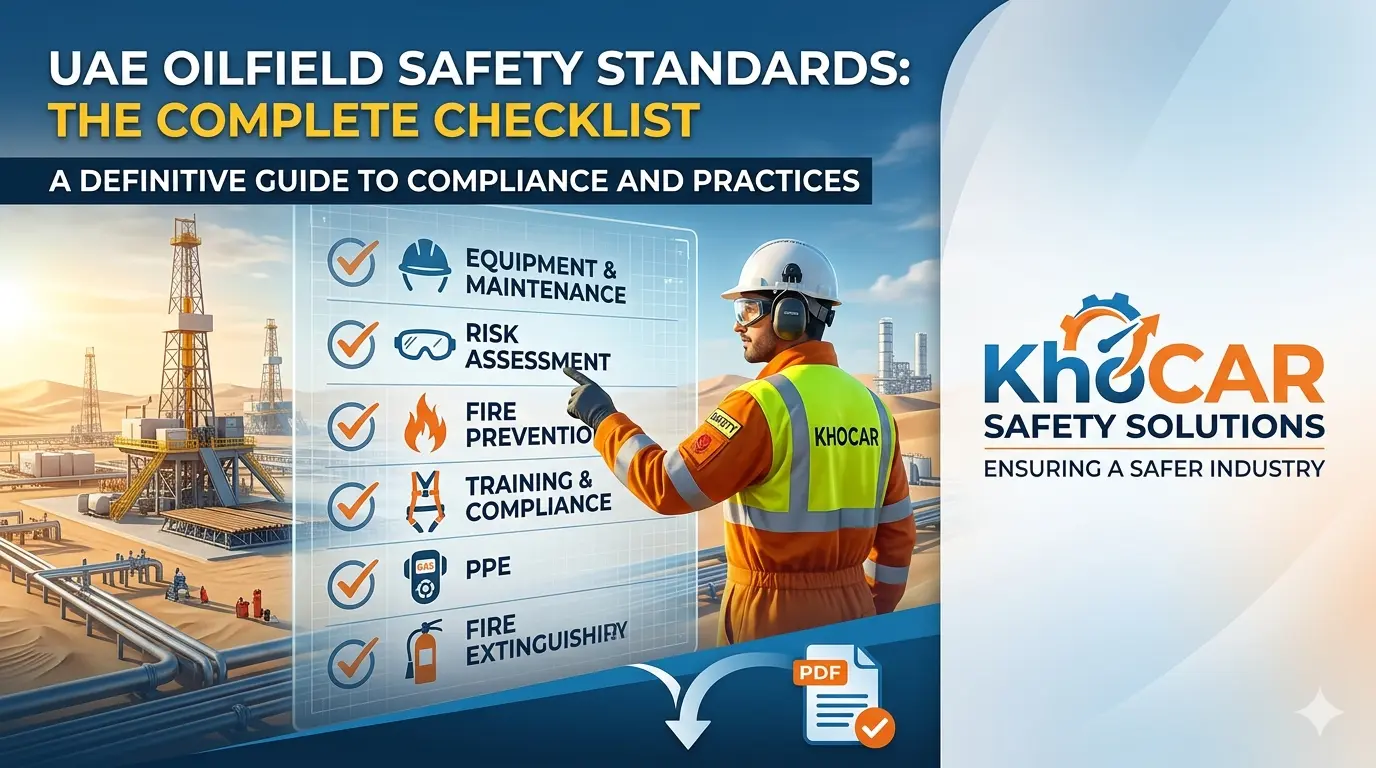
Operating in the UAE’s oil and gas sector comes with high stakes. From offshore rigs to sprawling onshore facilities, every piece of equipment and every service provider must meet strict safety standards to prevent accidents, protect personnel, and ensure uninterrupted operations.
For equipment suppliers and service providers, understanding and adhering to these standards isn’t optional; it’s a business-critical requirement. If it’s personal protective equipment (PPE), explosion-proof tools, or emergency shutdown systems, compliance is a matter of both legal obligation and operational safety.
This guide provides a comprehensive checklist of UAE oilfield safety standards for equipment and service providers. By following it, you can ensure your operations meet regulatory requirements, align with international best practices, and maintain a safe working environment for everyone on site.
By the end of this post, you’ll have a clear roadmap to evaluate your equipment, verify supplier compliance, and identify any gaps before they become costly or dangerous mistakes.
The Regulatory Landscape in the UAE
The UAE’s oil and gas sector is one of the most advanced and heavily regulated industries in the world. Compliance with safety standards is overseen through a combination of federal regulations, emirate-level guidelines, and international standards adoption. Understanding this landscape is the first step for equipment suppliers and service providers to operate safely and legally.
Key Regulatory Bodies
Abu Dhabi National Oil Company (ADNOC)
Sets operational and safety standards for upstream and downstream activities in Abu Dhabi.
Ministry of Human Resources & Emiratisation (MoHRE)
Oversees occupational safety for all employees across oilfield operations.
Local Authorities & Free Zone Regulators
Specific zones, like Jebel Ali or Fujairah oil terminals, may have additional safety requirements.
Integration with International Standards
UAE regulations often incorporate globally recognized standards to ensure safety, reliability, and interoperability:
API (American Petroleum Institute) standards for equipment design, installation, and maintenance.
ISO certifications (45001 for occupational safety, 9001 for quality management) are applied across oilfield operations.
IECEx & ATEX certifications for equipment used in hazardous areas.
Navigating these regulations can be complex, especially when multiple standards overlap or vary by emirate. This is why having a structured safety checklist is critical; it ensures every piece of equipment, every tool, and every service aligns with both local and international expectations.
Core Safety Standards Every Oilfield Supplier Must Know
For suppliers and service providers in the UAE oil and gas sector, understanding the key safety standards is non-negotiable. These standards ensure equipment reliability, protect personnel, and help operators comply with both local regulations and international best practices.
1. International Standards Adopted in the UAE
API (American Petroleum Institute) Standards: Widely recognized in UAE operations, API standards define design, material, and performance requirements for oilfield equipment. Commonly referenced standards include:
- API 6A – Wellhead and Christmas tree equipment
- API 16A – Blowout preventers and related equipment
- API 8C – Drilling and production hoisting equipment
ISO Certifications: ISO standards are applied across processes and management systems to ensure quality and safety:
- ISO 45001 – Occupational health and safety management
- ISO 9001 – Quality management for suppliers and service providers
- ISO/TC 67 – Specific guidance for the oil and gas industry
2. Hazardous Area Equipment Certifications
Oilfields often contain flammable gases, vapors, or dust. Equipment operating in these environments must comply with strict certification standards:
ATEX Certification: Ensures equipment meets EU standards for explosive atmospheres; widely recognized in UAE operations.
IECEx Certification: International standard for explosion protection, covering design, testing, and installation.
Understanding which certification applies to a piece of equipment or a service is critical. Using uncertified or misclassified equipment can result in safety incidents, legal penalties, and operational downtime.
Practical Takeaway
Suppliers and service providers should maintain thorough documentation proving compliance with these standards. Certificates, inspection reports, and material traceability are not just bureaucratic requirements; they are critical evidence that your equipment and services are safe and reliable.
Equipment Safety Checklist: What to Inspect & Verify
Ensuring compliance in the UAE oilfields means checking not just equipment functionality, but also certifications, documentation, and adherence to international standards. This checklist covers essential categories for every supplier and service provider.
Personal Protective Equipment (PPE)
Proper PPE is the first line of defense for oilfield personnel:
- Helmets, flame-resistant (FR) coveralls, gloves, and boots
- Eye and face protection certified to EN/ANSI/NFPA standards
- Respiratory protection where required
- Verification: Check expiry dates, certification labels, and batch traceability
Gas Detection & Monitoring Systems
- Fixed and portable H2S, LEL, and multi-gas detectors
- Calibration logs and functional test records
- Verification: Confirm devices are ATEX or IECEx certified and calibrated according to manufacturer guidelines
Explosion-Proof & Intrinsically Safe Tools
- ATEX/IECEx-certified hand tools, lights, and power tools
- Non-sparking materials for use in hazardous zones
- Verification: Check equipment marking, certification documents, and service history
Emergency Shutdown Systems (ESD) & Relief Devices
- Safety valves, emergency shutdown panels, and pressure relief systems
- SIL (Safety Integrity Level) ratings where applicable
- Verification: Review test logs, maintenance records, and certification compliance
Fall Protection & Working at Heights Gear
- Harnesses, lanyards, anchor points, and lifelines
- Inspection for wear, tear, and certification compliance
- Verification: Maintain inspection logs and replacement schedules
Fire Safety Equipment
- Fire suppression systems, extinguishers, and fire-resistant cabinets
- Escape kits and emergency response gear
- Verification: Ensure equipment meets UAE fire safety codes and undergoes regular maintenance
Documentation & Traceability
- Certificates of conformity, OEM documentation, and material traceability reports
- Third-party inspection and testing reports
- Verification: Ensure all documents are up-to-date, properly filed, and accessible during audits
This checklist sets the foundation for both safety and compliance.
Service Provider / Supplier Compliance Checklist
For oilfield service providers and equipment suppliers, compliance goes beyond hardware. Proper documentation, training, and operational practices are just as critical to ensure safety, regulatory adherence, and operational efficiency.
Vendor Documentation
- Certificates of conformity for all supplied equipment
- Material traceability, batch numbers, and manufacturing records
- Verification: Ensure documents match the delivered equipment and are readily available for audits
Third-Party Inspections
- Independent quality and safety inspections before installation or operation
- Non-destructive testing (NDT) reports and calibration certificates
- Verification: Maintain signed inspection reports and ensure alignment with API, ISO, and IECEx/ATEX standards
Site Inspection & Installation Plans
- Pre-installation site assessments for compatibility and safety
- Proper documentation of installation procedures and risk assessments
- Verification: Confirm plans are reviewed and approved by certified safety engineers
Training & Competency
- Ensure personnel are trained on equipment usage, emergency procedures, and UAE safety regulations
- Maintain records of certifications, refresher courses, and competency tests
- Verification: Training records should be up-to-date and auditable
Stock & Emergency Readiness
- Availability of certified spare parts, emergency response equipment, and rapid-deployment tools
- Verification: Conduct regular inventory audits and ensure equipment meets operational readiness standards
Maintenance & Audit Records
- Scheduled preventive maintenance for all equipment and systems
- Documentation of corrective actions, inspections, and replacements
- Verification: Keep detailed logs to demonstrate compliance during internal and external audits
Common Compliance Mistakes to Avoid
Even experienced suppliers and service providers can make errors that compromise safety, regulatory compliance, and operational efficiency. Recognizing these common pitfalls helps prevent costly mistakes and ensures equipment and personnel remain fully protected.
Using Uncertified or Misclassified Equipment
- Supplying or operating tools, instruments, or PPE without the proper ATEX, IECEx, or API certification.
- Risk: Non-compliant equipment can fail in hazardous environments, leading to accidents or legal penalties.
Ignoring Zone Classification Requirements
- Overlooking the specific hazardous zone classifications in different oilfield areas.
- Risk: Incorrect equipment placement or usage can create explosive hazards and violate regulatory requirements.
Poor Documentation and Traceability
- Missing certificates, expired calibration logs, or incomplete material traceability.
- Risk: During audits or inspections, a lack of proper documentation can result in fines or operational shutdowns.
Neglecting Maintenance and Inspection Schedules
- Skipping regular maintenance, inspections, or replacement cycles for critical equipment.
- Risk: Equipment failure, safety incidents, and non-compliance with UAE regulations.
Inadequate Personnel Training
- Deploying staff without proper training on equipment use, safety protocols, or emergency procedures.
- Risk: Human error becomes a major factor in accidents, injuries, and operational downtime.
Overlooking Local Regulations
- Assuming international standards alone are sufficient without checking the UAE-specific legal requirements.
- Risk: Non-compliance with local authorities, including ADNOC, MoHRE, or free zone regulators.
Tip: Avoiding these mistakes requires a proactive approach; thorough documentation, certified equipment, regular audits, and proper training. This is where partnering with a reliable, certified oilfield safety provider like KhoCAR makes a tangible difference.
Why Choose a Certified Oilfield Safety Partner
Navigating the complex landscape of UAE oilfield safety standards can be challenging. From understanding international certifications to maintaining compliance with local regulations, the stakes are high. Partnering with a certified oilfield safety provider ensures you stay ahead of these requirements while keeping your operations safe and efficient.
De-Risk Your Operations
- Certified partners supply equipment and services that meet international and UAE-specific safety standards.
- Reduced the likelihood of accidents, equipment failure, or regulatory penalties.
Verified Certifications and Documentation
- Every piece of equipment comes with proper certificates of conformity, inspection reports, and material traceability.
- Ensures you are always audit-ready and compliant with ADNOC, MoHRE, and other authorities.
Comprehensive Support and Maintenance
- Beyond supplying certified equipment, a reliable partner provides installation, preventive maintenance, and emergency support.
- Keeps your systems operational, reducing downtime and extending equipment lifespan.
Local Expertise with International Standards
- Experienced partners understand UAE regulations while aligning with API, ISO, ATEX, and IECEx standards.
- This ensures that compliance is both thorough and practical, avoiding unnecessary delays or operational hurdles.
Tailored Compliance Solutions
- From PPE to complex emergency shutdown systems, certified partners can tailor solutions for specific site requirements.
- Saves time, reduces risk, and ensures that your operations meet every regulatory and safety requirement.
By choosing a certified partner, you not only safeguard your workforce but also streamline procurement, installation, and compliance processes, creating a foundation for safer, more efficient oilfield operations.
How KhoCAR Helps You Tick Every Box
KhoCAR makes UAE oilfield safety compliance simple and reliable. We deliver certified equipment, complete documentation, and end-to-end support from installation to maintenance. Our tailored solutions ensure your operations meet every regulatory requirement while keeping your workforce safe.
Stay compliant and protect your team: explore KhoCAR’s oilfield services and industrial supplies today and take the first step toward safer, more efficient operations.
FAQs
1. What safety certifications are required for oilfield equipment in the UAE?
Oilfield equipment used in hazardous environments in the UAE must meet internationally recognized safety certifications such as ATEX and IECEx for explosive atmospheres, as well as applicable API standards for mechanical integrity and performance. ATEX/IECEx certification confirms the equipment is safe to use in classified zones, and API standards ensure suitability for oilfield pressure and operational demands.
2. Why is ATEX/IECEx certification important for oil & gas operations in the UAE?
ATEX/IECEx certification verifies that equipment will not ignite flammable gases or dust in hazardous areas; a common risk in oilfields. UAE operators and regulators require these certifications because even small ignition sources can lead to catastrophic incidents in zones with hydrocarbons.
3. Do oilfield workers in the UAE need specialized safety training?
Yes. Workers on UAE oilfields should complete safety training that aligns with international standards (OSHA, NEBOSH, IADC/OPITO) and local regulatory expectations. This includes hazard recognition, emergency response, work‑at‑height safety, and handling toxic gases like hydrogen sulfide (H₂S).
4. Can uncertified equipment be used on UAE oilfield sites?
No. Operators typically refuse access to equipment that lacks proper certification (ATEX/IECEx/APIs) because uncertified tools can pose ignition risks and are non‑compliant with safety regulations. Using uncertified equipment can also lead to contract breaches or denied site entry.
5. What documentation should suppliers provide for oilfield safety compliance?
Suppliers must provide:
- Certificates of conformity (ATEX/IECEx/API)
- Material traceability and batch reports
- Inspection and calibration logs
- Third‑party inspection documentation
This ensures transparency and audit readiness.
6. What is the difference between API standards and IECEx/ATEX certifications?
API standards govern the performance, design, and reliability of oilfield equipment (e.g., wellhead or pressure gear), while ATEX/IECEx certifications specifically address safety in explosive atmospheres. In practice, compliant equipment often meets both sets of requirements depending on its application.
7. Are there UAE‑specific safety requirements for oilfield operations?
Yes. Beyond international certifications, operators like ADNOC and local regulators may require additional approvals, vendor registration, and compliance checks for equipment and personnel before permitting site access.
8. How often should oilfield safety equipment be inspected?
Safety equipment in high‑risk environments should be inspected regularly, often annually or as defined by risk assessment and regulatory bodies. Regular inspections help detect wear, calibration drift, or non‑compliance before critical failures occur.
9. What role do third‑party inspections play in oilfield safety compliance?
Third‑party inspection provides independent verification that equipment meets the necessary technical and safety standards. This reduces the risk of counterfeit parts and assures operators that what they’re installing or using is compliant and reliable.
10. How can UAE oilfield service providers stay audit‑ready?
Maintaining detailed records, including certificates, inspection reports, maintenance logs, and training records, ensures readiness for both internal and external audits by operators and regulators. Timely documentation demonstrates safety commitment and simplifies compliance verification.