
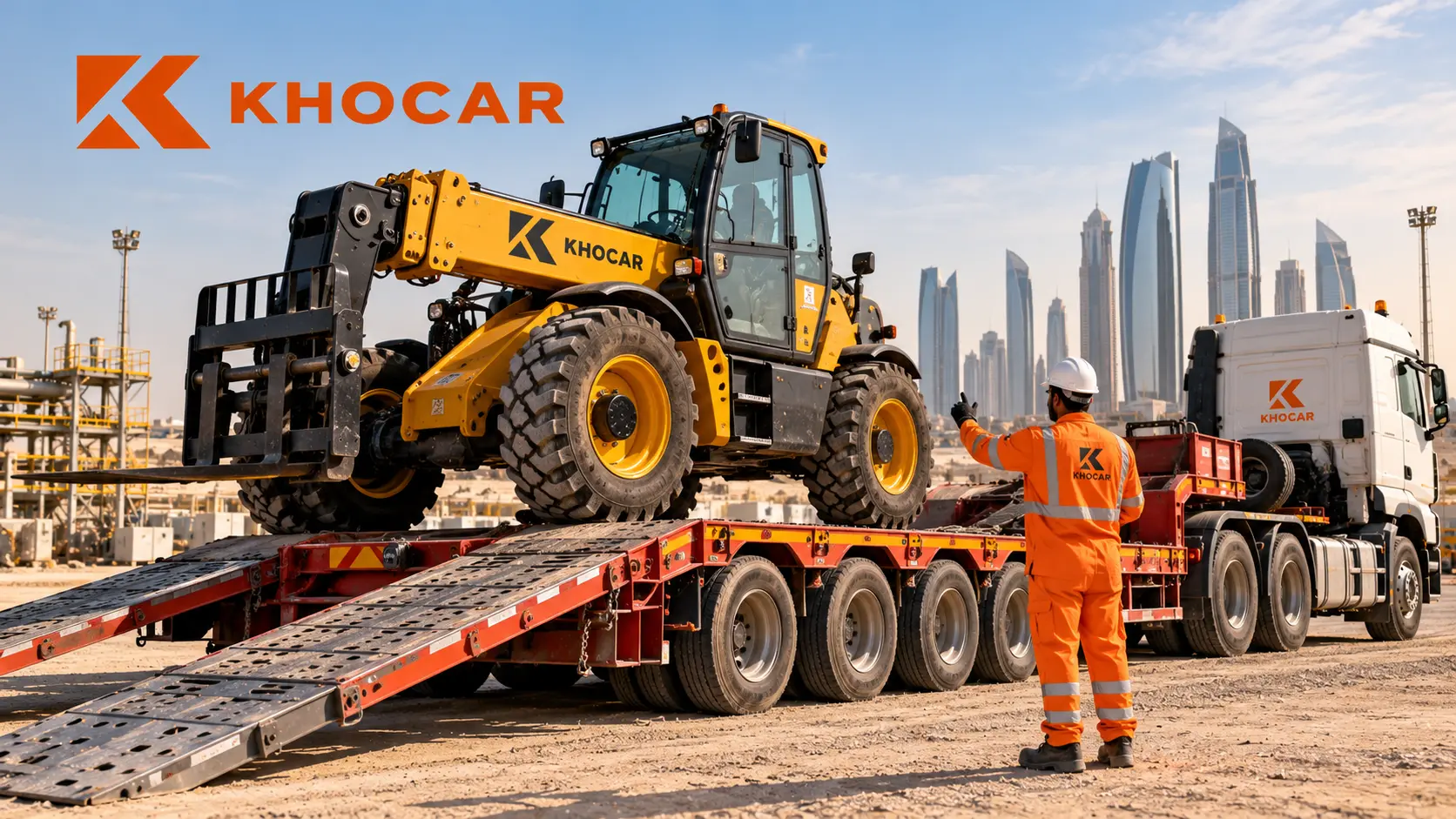
Telehandler transport in the UAE requires more planning than simply choosing a trailer with enough deck space. A telescopic handler combines a heavy chassis, large tyres, a long boom, a front attachment and, on some models, frame levelling or stabilisers. Its transport profile can change significantly depending on the model, tyres, boom position and attachment fitted. Those details influence trailer choice, loading angle, overall height, axle loading, tie-down arrangements and the route the transporter can legally use.
For contractors moving equipment between construction projects, industrial yards, ports and oilfield facilities, the most reliable approach is to plan from the machine’s actual transport configuration. Confirm the operating manual, machine weight, dimensions, approved tie-down points and attachment instructions before arranging collection. Then match the load to a suitable lowbed or other rated trailer, inspect the loading area, prepare a controlled loading plan and verify the route and any permit requirements.
This guide explains how to plan telehandler transportation in the UAE, including trailer selection, loading and unloading, securing the machine, attachment handling, route checks and delivery coordination. It also explains why general forklift transport advice cannot always be applied to a telescopic handler without checking the machine-specific instructions.
Key Takeaways
- Choose the trailer from the telehandler’s actual transport weight, dimensions, ground clearance, wheelbase, tyre configuration and attachment arrangement.
- A lowbed trailer may help reduce overall transport height, but the correct option depends on deck capacity, axle loads, loading geometry and the machine’s dimensions.
- Use the telehandler manufacturer’s transport instructions. Boom position, attachment position, tie-down points and the number and rating of restraints vary by model.
- Plan loading on firm, level ground with suitable ramps, a trained operator, a spotter and an exclusion zone. Do not improvise ramp angles or tie-down points.
- Check the complete loaded dimensions and axle loads, not just the telehandler’s published operating height or machine weight.
- UAE heavy-vehicle weight and dimension rules, special-load permits and Abu Dhabi heavy-vehicle movement restrictions may affect the route and schedule. Confirm the current rules with the relevant authority and transporter.
- Record the machine condition, attachment details, restraints, route checks and delivery handover to reduce disputes and avoidable downtime.
Why Telehandler Transport Needs Its Own Plan
A telehandler, also called a telescopic handler, is not simply a forklift with a longer mast. It uses a telescopic boom to position forks, buckets, work platforms or other approved attachments. That boom and attachment arrangement can affect overall length, transport height, centre of gravity and tie-down choices. Some machines have outriggers or frame-levelling systems, while others have different chassis and steering configurations.
A conventional forklift transport checklist can still offer useful background, but a telehandler has additional considerations: the boom must be put into the transport position specified by its manufacturer; the attachment may need to be lowered, secured or removed; and tie-down points must be identified from the exact model manual. KhoCAR’s existing forklift transport guide covers general forklift movement, while this article focuses on the extra checks that matter for telescopic handlers.
Key machine details to confirm
- Manufacturer, model, serial number and machine configuration.
- Transport weight as equipped, including any attachment that will remain fitted.
- Overall transport length, width and height in the prescribed transport position.
- Wheelbase, tyre size, ground clearance and approach/departure angles where relevant.
- Approved tie-down points and any restrictions on securing the boom or attachment.
- Whether the machine has outriggers, removable counterweights or other transport-specific components.
- Any special instructions for air intake, exhaust, cab doors, windows or loose accessories.
Do not estimate these details from a similar-looking machine. Telehandlers in the same product family may have different boom lengths, tyres, attachments or optional equipment. The machine’s own data plate, operator manual and attachment documentation should take precedence.
Choosing a Suitable Trailer for a Telehandler
Trailer selection is a capacity and geometry decision. A trailer may have sufficient nominal payload but still be unsuitable because its deck is too short, its ramps are too steep, its axle distribution is inappropriate or the loaded height exceeds a route limit. Start with the machine’s verified transport profile and ask the transport provider to confirm the proposed combination.
| Trailer option | When it may be suitable | Checks before confirming |
| Lowbed / low-loader | When reduced deck height is useful for a tall machine or the load requires a suitable heavy-equipment platform. | Payload, axle configuration, deck dimensions, loaded height, ramp geometry, ground clearance and tie-down points. |
| Step-deck trailer | When the machine dimensions and height profile suit the raised front deck and lower rear deck. | Whether the machine can be positioned safely, deck transitions, axle loads and overall loaded height. |
| Flatbed / platform trailer | For compatible telehandlers whose weight and transport dimensions fit within the rated platform and route limits. | Deck height, ramps, machine clearance, restraint points, legal dimensions and load distribution. |
| Specialized heavy-equipment transporter | For heavier or unusual configurations requiring engineered loading arrangements or a more complex route plan. | Transporter capacity, route survey, permit needs, escort requirements if applicable and written loading plan. |
When a lowbed trailer is worth considering
A telehandler lowbed trailer can be helpful when deck height is a major constraint. Lowering the deck can reduce the loaded vehicle’s overall height, potentially providing more clearance margin beneath bridges, gantries and overhead services. It can also make certain loading arrangements more practical. However, a lowbed is not automatically the best option for every telehandler.
The transporter still needs to verify the deck’s rated payload, axle configuration, loading angle, ramp strength, deck length and the telehandler’s ground clearance. A low deck can be offset by a steep ramp, a sharp break-over angle or a deck arrangement that does not support the machine at the correct points. The complete combination must be checked.
Questions to ask the transporter
- What is the trailer’s rated payload for this exact configuration?
- Can the trailer accommodate the machine’s wheelbase, tyre width and transport length?
- What will the overall loaded height and width be after the telehandler is secured?
- How will the machine be loaded, and are the ramps rated for its wheel loads?
- Are suitable rated tie-down points available at the required locations?
- Have the tractor, trailer and load axle weights been checked for the planned route?
- Who will verify permits, route restrictions and movement windows before dispatch?
Calculate the Complete Transport Profile
Before booking a trailer, calculate the loaded transport dimensions and weight using the machine’s actual configuration. Published dimensions may describe the telehandler in an operating position, with a particular attachment, or under assumptions that differ from the planned transport arrangement. Use the manufacturer’s specified transport position and verify any removable or separately transported component.
Weight and payload
Confirm the telehandler’s transport weight from the machine documentation. Add the weight of any attachment or accessory that will travel with it, along with any other cargo that the transporter is carrying. The combination must remain within the trailer’s rated capacity and the permitted gross and axle weights. A trailer’s advertised payload is not a substitute for an axle-load calculation.
The UAE’s Cabinet Resolution regulating heavy-vehicle weights and dimensions sets a regulatory framework for permitted weights and dimensions and controls for certain non-divisible loads. The relevant limits and permit process depend on the vehicle configuration, route and competent authority. The transporter should verify the current applicable requirements rather than assume that a particular trailer arrangement is automatically compliant.
Overall height, width and length
Measure or verify the height of the loaded combination from the road surface to its highest point, including any part of the telehandler or attachment that remains fitted. Check width and length in the same transport configuration. Consider whether the attachment can be secured within the machine’s outline or must be carried separately.
Do not use a generic maximum-height number from an old article or a different emirate as a substitute for checking the current rules. If the load exceeds a permitted dimension, the applicable authority may require a special permit or impose conditions. Confirm the actual route and permission before the truck leaves the yard.
Axle loads and load position
A telehandler’s mass must be distributed across the trailer and tractor in a way that respects the applicable axle limits and the equipment manufacturers’ instructions. Moving the machine a short distance forward or backward on the deck can change axle loading. The transporter should calculate the position, not rely on visual balance alone.
Keep a record of the final machine position and loaded measurements. If the attachment is removed or the trailer configuration changes, recheck the transport profile and weight distribution.
Prepare the Telehandler Before Loading
Preparation begins before the trailer arrives. Confirm that the machine can be moved safely, that the loading area is ready and that all personnel understand the plan. A telehandler with a mechanical defect, leaking hydraulic system, damaged tyre or faulty brake may require a different recovery or loading method. Do not assume it can be driven onto a trailer just because it starts.
Inspect the machine and accessories
- Check tyres for damage, embedded debris and visibly low pressure.
- Look for fluid leaks, damaged hoses, loose panels or unsecured components.
- Confirm the boom can retract and lower as required by the transport procedure.
- Inspect the attachment locking system and confirm the attachment is correctly secured.
- Secure forks, buckets, work platforms and other loose items according to their instructions.
- Close and latch cab doors, windows and access panels.
- Remove loose tools, materials and personal items from the cab and machine.
- Record existing damage with clear photographs before loading.
Set the machine to its prescribed transport position
Many telehandler manuals instruct operators to retract the boom and lower it before transport, but the exact sequence and attachment position can differ by model. For example, Genie’s GTH-1056 operator manual gives model-specific transport instructions, including retracting the boom, using a spotter and securing the chassis at designated tie-down points. Treat this as an example of why the manual matters, not as a universal procedure for every brand.
If an attachment could contact the tyres or chassis when the boom is retracted or tilted, follow the relevant attachment instructions. Never force an attachment into a position that risks damage or leaves the machine unstable.
Loading and Unloading Safely
Loading is a high-risk phase because the telehandler must climb a ramp while its weight shifts across the tyres and trailer. A ramp that is too steep, poorly secured, too narrow or insufficiently rated can cause loss of traction, structural failure or a tip-over. Plan the manoeuvre before moving the machine.
Prepare the loading area
- Use firm, level ground that can support the transporter, trailer and telehandler.
- Position and secure the tractor-trailer according to the transport plan so it cannot roll or shift.
- Confirm that ramps are compatible with the trailer and rated for the machine’s weight and wheel loads.
- Check the ramp-to-deck transition, available clearance and break-over geometry.
- Remove mud, oil, loose gravel and other material that could reduce tyre grip.
- Establish an exclusion zone and keep unnecessary personnel clear.
- Assign a trained operator and a spotter with clear, agreed signals and reliable communication.
- Check overhead clearance and the space needed to align the machine before the climb.
Control the loading movement
Follow the telehandler and trailer manufacturers’ instructions for loading direction, boom position, speed and steering. Keep the machine aligned with the ramps and make movements slowly and smoothly. Do not make a sharp steering correction while climbing a ramp. If the machine becomes misaligned, stop and follow the planned safe method to reposition it rather than improvising on the incline.
Keep people away from the sides of the ramps, the space behind the machine and any potential crush zone. The spotter should stand where they remain visible to the operator and outside the machine’s path. If communication is lost, stop the manoeuvre.
After the machine is on the deck
- Position the machine at the agreed location to achieve the planned axle distribution.
- Apply the parking brake and place controls in the manufacturer-specified safe state.
- Lower the boom and attachment to the prescribed transport position.
- Switch off the machine, remove the key and follow any isolation steps required by the manual.
- Use wheel chocks if specified by the transport plan or manufacturer.
- Recheck clearances, weight distribution and loaded dimensions before securing the load.
Unloading needs the same level of planning as loading. The receiving area must be level, firm and clear, and the transporter must be secured before ramps are deployed. Remove restraints only in the planned sequence, keeping personnel clear of any movement that may occur as tension is released.
Secure the Telehandler Correctly
The telehandler must be restrained against forward, rearward, sideways and upward movement as required by the applicable load-securing method. The restraint arrangement should be based on the machine manual, transport regulations, load weight, geometry and the rated capacity of the chains, straps, binders and anchor points.
Use designated tie-down points
Identify the tie-down points in the manual for the exact model. Do not attach chains to hydraulic cylinders, boom sections, steering components, axles, guardrails or other parts unless the manufacturer explicitly identifies them for that purpose. Do not assume that a visible hook or opening is a rated anchor point.
Some manuals specify chassis tie-down points and warn against securing the front of the boom. Other models may have different requirements. Follow the instructions for the actual machine and do not copy a restraint diagram from a different telehandler.
Match the restraint equipment to the load
- Use chains, straps, binders and connectors with suitable working load limits and in serviceable condition.
- Confirm the trailer anchor points are rated for the intended restraint forces.
- Protect restraints from sharp edges and avoid contact that could damage hydraulic lines, wiring or painted components.
- Secure the attachment or forks separately if required by the manufacturer.
- Prevent the boom and attachment from moving during transit using the prescribed method.
- Ensure restraints do not interfere with lights, licence plates or required safety equipment.
- Reinspect the entire arrangement after tensioning and before the vehicle moves.
A final restraint check
Walk around the loaded combination and verify every restraint against the plan. Check that hooks are correctly seated, binders are locked, chains are not twisted or damaged, and no restraint is attached to an unapproved component. Confirm the load has not shifted while the restraints were tightened. The driver should know what to do if a stop is required for a load check during the journey.
Transporting Attachments and Accessories
Telehandlers may use pallet forks, buckets, lifting hooks, work platforms, jibs or other attachments, depending on the model and approved configuration. These items can change the machine’s transport dimensions and may have their own weight, securing and handling requirements.
Keep the attachment fitted or remove it?
There is no universal answer. Keeping an attachment fitted may simplify handling, but it can increase length, affect clearances and create additional securing requirements. Removing it may reduce the machine’s transport profile, but the attachment then needs its own safe lifting, loading and restraint plan. Decide using the machine manual, attachment instructions, trailer geometry and the route profile.
If the attachment travels separately
- Confirm the attachment’s weight, dimensions and designated lifting or handling points.
- Use lifting equipment and slings rated for the attachment and its centre of gravity.
- Protect hydraulic connectors and cap or secure lines according to the manufacturer’s instructions.
- Prevent forks, cutting edges, hooks or other protrusions from creating hazards.
- Secure the attachment against sliding, rolling, tipping and bouncing.
- Keep attachment identification and delivery records with the machine documentation.
Route Planning and UAE Transport Requirements
A suitable trailer and secure load do not guarantee that the route is suitable. Check the complete loaded dimensions and weights against the route, road restrictions, access points, worksite gates and delivery window. A route that works for a standard flatbed may not work for a tall lowbed combination or a telehandler with an attachment still fitted.
Check weight, dimensions and permits
The UAE’s official heavy-vehicle weights and dimensions legislation and its associated schedules should be consulted for applicable limits. Loads that exceed normal limits may be subject to special permit controls, depending on the load and competent authority. Do not assume that a telehandler is exempt because it is self-propelled equipment when carried on a trailer.
The UAE Government’s road safety guidance notes that non-standard loads require official permission from the competent authority. The transporter should determine whether the specific machine and trailer combination needs a permit, escort, route approval or other conditions.
Account for Abu Dhabi movement restrictions
For telehandler delivery in Abu Dhabi, check current heavy-vehicle movement restrictions before selecting the dispatch time. Abu Dhabi Mobility’s notice on restricted movement hours announced restrictions for heavy vehicles on Abu Dhabi city roads during specified weekday and Friday periods. The applicable restriction can change, and the route may pass through different jurisdictions, so reconfirm the current rule with the relevant authority before dispatch.
Do not rely on an old schedule copied into a job sheet. Confirm the latest restrictions, whether the proposed vehicle and route are covered, and whether any permit or exception applies.
Plan for physical route constraints
- Bridge and gantry clearances, overhead cables and temporary site structures.
- Narrow roads, roundabouts, tight turns and trailer off-tracking.
- Roadworks, diversions, temporary weight limits and access restrictions.
- Site gate width and height, turning space, ground bearing capacity and unloading access.
- Time windows for heavy vehicles, site access bookings and security clearance.
- Suitable parking or staging locations if delivery cannot occur immediately.
For more general context on heavy equipment route planning, see KhoCAR’s mobile crane transport guide and lowbed loading and unloading guidance. The telehandler’s own dimensions, loading geometry and attachment arrangement should remain the basis of the final plan.
Documents and Information to Prepare Before Dispatch
Clear information reduces last-minute calls and makes it easier for the transporter to select the right equipment. Prepare a short transport pack and share it with the driver, dispatcher, site contact and receiving team as appropriate.
| Item | What to include |
| Machine identification | Make, model, serial number, asset ID and current condition. |
| Weight and dimensions | Verified transport weight and dimensions in the intended transport position. |
| Attachment details | Attachment type, weight, dimensions and whether it travels fitted or separately. |
| Trailer plan | Trailer type, rated capacity, loading method, deck position and restraint arrangement. |
| Route check | Planned route, height/width/weight checks, restrictions and confirmed permits if needed. |
| Loading arrangements | Site address, contact, ground condition, ramp requirements and exclusion zone. |
| Delivery arrangements | Receiving contact, site access hours, unloading area and equipment needed. |
| Condition record | Pre-load photos, defects, loose parts and any agreed exceptions. |
| Handover record | Arrival time, condition on receipt, missing items and acknowledgement by receiving party. |
Common Telehandler Transport Mistakes
Choosing a trailer by payload alone
Payload is only one part of the decision. A trailer can have enough capacity but still fail the dimensional, axle-load or loading-geometry checks. Verify the complete combination.
Assuming the boom can be secured like a fixed load
The boom is a machine component with model-specific transport instructions. Do not attach restraints to convenient-looking boom sections or cylinders unless the manual permits it. Use the specified transport position and tie-down points.
Forgetting the attachment
A fork, bucket or jib can change overall length and weight, and may affect loading or securing. Include it in the plan from the start, even if it will be transported separately.
Using unverified dimensions
Operating dimensions, brochure dimensions and transport dimensions are not necessarily the same. Confirm the actual configuration, including tyre options, cab accessories and attachment.
Leaving route checks until the truck arrives
A late discovery of a low bridge, heavy-vehicle restriction or permit requirement can cause delays and extra costs. Check the route before dispatch and reconfirm if the configuration changes.
Improvising the loading method
Do not choose ramp angles, use makeshift extensions or attempt to turn on a ramp without an approved procedure. If the planned loading geometry is unsuitable, stop and arrange a safer method.
Example: Moving a Telehandler to an Oilfield Facility
A contractor needs to move a rough-terrain telehandler from a maintenance yard in Musaffah to an oilfield project outside Abu Dhabi. The machine has large tyres and a pallet-fork attachment. The delivery team initially requests a lowbed trailer, but the dispatcher does not book it until the details are checked.
- The team confirms the machine model, transport weight, dimensions and prescribed boom position from the operator manual.
- They determine whether the forks will remain fitted or travel separately, then update the loaded length and restraint plan.
- The transporter checks lowbed payload, deck dimensions, axle distribution, ramp geometry and the machine’s ground clearance.
- The route is reviewed for loaded height, access restrictions, heavy-vehicle movement windows and permit requirements.
- The loading area is prepared, a trained operator and spotter are assigned, and the telehandler is inspected before movement.
- After loading, the machine is secured at the designated points, all restraints are checked, and the final loaded profile is recorded.
- At delivery, the receiving team confirms access and unloading arrangements, inspects the machine for transport damage and signs the handover record.
The benefit of this sequence is not just safer loading. It also gives the dispatcher a clear basis for choosing the trailer, the driver a workable plan, and the receiving team enough information to prepare the site.
Telehandler Transport Checklist
Use this checklist as a planning aid alongside the machine manual, transport provider’s procedures and applicable regulations.
- Machine model and serial number verified.
- Transport weight and dimensions confirmed for the actual configuration.
- Attachment plan agreed and separately transported items identified.
- Trailer payload, dimensions, axle loads and loading geometry checked.
- Route and site access reviewed for height, width, weight, turns and restrictions.
- Current permit and movement-window requirements confirmed with the relevant authority.
- Loading area firm, level, clear and large enough for safe manoeuvring.
- Ramps and loading equipment rated and secured according to the plan.
- Operator and spotter briefed; exclusion zone established.
- Telehandler inspected; boom and attachment placed in the specified transport position.
- Designated tie-down points and rated restraints used.
- Final restraint, dimensions and load distribution checks completed.
- Pre-load photographs and dispatch records saved.
- Receiving team prepared for access, unloading and handover inspection.
Need Help Planning Telehandler Transport in the UAE?
Successful telehandler transportation depends on matching the machine’s real transport profile with the trailer, route, loading method and securing arrangement. Before requesting a delivery, prepare the make and model, transport weight and dimensions, attachment details, collection and delivery locations, and any site access restrictions.
KhoCAR supports oilfield services and industrial equipment requirements in the UAE. To discuss equipment movement alongside your wider site requirements, visit KhoCAR’s Oilfield Services & Industrial Supplies page. Share the machine details and delivery plan so the transport requirements can be assessed before dispatch.
FAQs
What trailer is best for telehandler transport in the UAE?
It depends on the telehandler’s weight, transport dimensions, ground clearance, attachment, loading geometry and route. A lowbed may help reduce overall height, but its payload, axle configuration, ramps and deck dimensions must suit the machine.
Can a telehandler be transported on a lowbed trailer?
Yes, if the lowbed and tractor combination is rated and dimensionally suitable for the specific machine. Verify payload, axle loads, deck space, loaded height, ramp angle, tie-down points and any permit requirements.
Should the telehandler boom be extended during transport?
Do not transport the boom extended unless the manufacturer’s specific instructions explicitly prescribe an approved configuration. Many manuals require the boom to be retracted and lowered for transport. Follow the manual for the exact model.
Can the attachment remain fitted during transport?
Sometimes. The decision depends on the attachment, transport dimensions, weight distribution, clearances and the manufacturer’s instructions. If removed, the attachment needs its own handling and restraint plan.
How should a telehandler be secured to a trailer?
Use the manufacturer-designated tie-down points and suitable rated restraints. Do not attach chains to cylinders, boom sections or other components unless the manual specifically permits it. Secure accessories separately where required.
Do I need a permit to transport a telehandler in the UAE?
Permit requirements depend on the loaded dimensions, weight, vehicle configuration, route and competent authority. Confirm the current rules before dispatch, especially if the load exceeds standard limits.
Are there heavy-vehicle movement restrictions in Abu Dhabi?
Abu Dhabi has announced restricted movement periods for heavy vehicles on city roads. Check the current Abu Dhabi Mobility rules and the planned route before dispatch, because restrictions and applicable conditions may change.
Can a telehandler be driven onto the trailer under its own power?
Only if the machine is serviceable and the loading method, ramps, surface and operator conditions are suitable under the manufacturer’s instructions. A machine with defects may require a different approved loading method.
What should be checked before loading a rough-terrain telehandler?
Confirm tyres and machine condition, boom and attachment position, ramp capacity and geometry, ground condition, trailer security, spotter communication and the planned exclusion zone.
How do I calculate the loaded height?
Use the height of the complete loaded combination measured from the road surface to its highest point in the actual transport configuration. Confirm the measurement and route clearance with the transporter rather than relying only on brochure dimensions.
Can a forklift transport checklist be used for a telehandler?
Some general checks overlap, but telehandlers have a telescopic boom and attachments that create additional configuration and securing requirements. Use the telehandler’s own manual and adapt the transport plan to its actual dimensions and designated tie-down points.
What information should I give a telehandler transport company?
Provide the make, model, transport weight and dimensions, attachment details, collection and delivery locations, access constraints, preferred delivery window and any known permit or site requirements.
What should happen at delivery?
The receiving team should verify the machine and attachments, inspect for transport damage, confirm the unloading area is ready, oversee unloading safely and record the condition at handover.
Does a lowbed automatically solve height restrictions?
No. It may reduce deck height, but the total loaded height still needs to be calculated and checked against the planned route and applicable rules.