
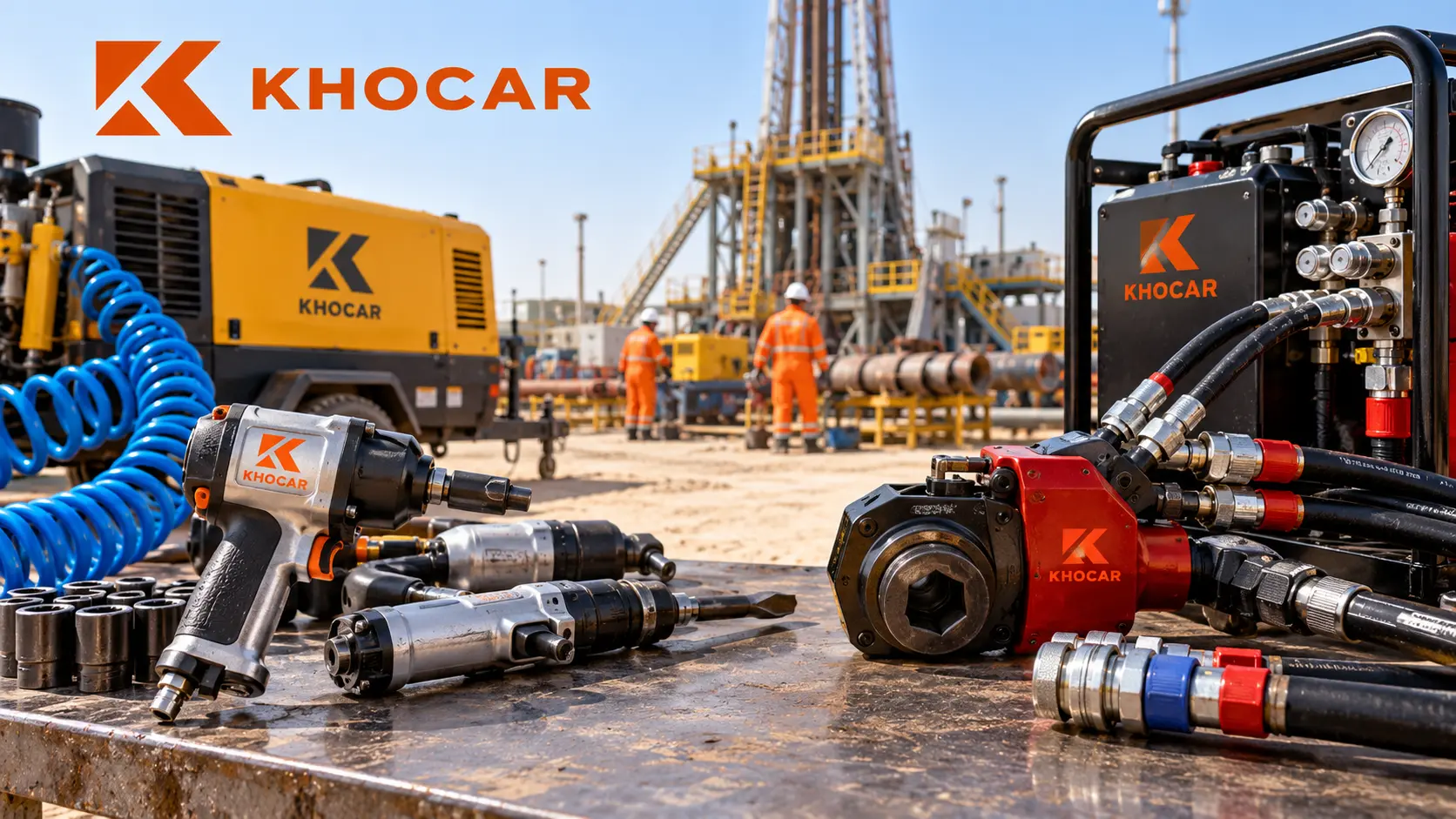
Choosing between pneumatic and hydraulic tools for oilfield maintenance is not simply a question of which tool produces more power. The better choice depends on the job, the force and control required, the utilities available at the worksite, the operating environment, and how the equipment will be maintained. A compact air-powered impact wrench may be ideal for repeated fastening in a workshop, while a hydraulic torque wrench or cutter may be more suitable when a task demands controlled high force in a restricted space. In other situations, neither power source is automatically the right answer until the team checks the tool specification and site conditions.
For oil and gas contractors in Abu Dhabi and across the UAE, the decision can affect maintenance time, portability, reliability, worker exposure, and total operating cost. Compressed air needs a suitable supply and can be expensive to generate; hydraulic equipment needs compatible fluid-power components and careful control of stored pressure and leak hazards. Neither system is inherently safe in every hazardous area, and neither should be selected based on a generic claim that it is always more powerful or more efficient.
This guide compares pneumatic vs hydraulic tools for oilfield maintenance in practical terms. It explains where each option tends to fit, what to inspect before purchase, how to evaluate safety and operating costs, and how to write a better tool specification or procurement request for UAE oilfield work.
Key Takeaways
- Pneumatic tools use compressed gas, usually air, and are often practical for repetitive workshop tasks where a reliable air supply is available.
- Hydraulic tools use pressurized liquid and are commonly chosen for high-force, controlled tasks such as torqueing, lifting, cutting, crimping or spreading, depending on the tool design.
- There is no universal winner. Compare the specific tool models, required output, duty cycle, control, access, utilities, maintenance and site rules.
- Compressed air is not free energy. Compressor electricity, leaks, pressure drops, dryers, filters and distribution losses all affect operating cost.
- Hydraulic systems can create serious injection hazards. Never search for a leak with bare hands, and release stored pressure using the approved procedure before maintenance.
- A pneumatic or hydraulic tool is not automatically suitable for a hazardous area. Verify the complete equipment’s suitability and the site’s approval requirements.
- For procurement, specify the job, load or torque, working pressure, duty cycle, accessories, connection type, documentation and delivery requirements instead of asking only for a tool by name.
1. What Is the Difference Between Pneumatic and Hydraulic Tools?
Pneumatic and hydraulic tools are both forms of fluid-power equipment, but they use different working media. Pneumatic tools use compressed air or another suitable gas. Hydraulic tools use a pressurized liquid, commonly hydraulic oil. The distinction matters because gases compress significantly under pressure, while hydraulic liquids are comparatively incompressible in normal operating conditions. That difference influences force transmission, control, system design, energy storage and how the equipment responds under load.
The ISO definition for hand-held power tools distinguishes tools driven by compressed air or gas as pneumatic tools and tools driven by hydraulic liquid as hydraulic tools. See the definitions in the ISO 11148 series. In practical terms, however, the label alone does not tell a buyer whether a particular tool is suitable. Output force, torque, speed, controls, duty cycle and application limits must come from the manufacturer’s data.
How pneumatic tools work
A compressor raises air pressure, and a receiver, treatment equipment and pipe or hose network deliver air to the tool. A pneumatic motor or impact mechanism converts that energy into rotation, impact or another mechanical action. Common examples include impact wrenches, drills, grinders, chipping hammers, air ratchets and certain pumps. The tool’s actual performance depends on its rated inlet pressure, required airflow, hose size, couplings, air quality and the capacity of the supply system.
How hydraulic tools work
A hydraulic power pack or another approved pressure source delivers fluid through hoses to a tool. Depending on the design, the tool converts hydraulic pressure and flow into rotation, linear movement or controlled force. Examples include hydraulic torque wrenches, cutters, crimpers, jacks, pullers, spreaders and certain heavy-duty pumps. Correct pressure and flow, fluid compatibility, couplings, hose ratings and pressure-release arrangements are essential to the complete system.
2. Pneumatic vs Hydraulic Tools: Quick Comparison
| Decision factor | Pneumatic tools | Hydraulic tools |
| Energy source | Compressed air or suitable gas | Pressurized liquid, usually hydraulic oil |
| Typical strengths | Frequent repetitive work, compact tools, rapid operation for suitable tasks | High force and controlled output in many heavy-duty applications |
| Power supply | Compressor, receiver, air treatment and distribution network | Hydraulic power unit or compatible pressure source, fluid and hoses |
| Control | Can be very effective for impact or rapid operation; precision depends on tool and setup | Often well suited to controlled force or torque when paired with suitable controls |
| Portability | Portable when a suitable air source is available; hoses can limit reach | Portable hand tools may use a remote power pack; hoses and power-pack weight matter |
| Main maintenance needs | Air leaks, filters, lubrication where specified, moisture control, hose and coupling checks | Fluid condition, leaks, hose and fitting condition, couplings, seals, pressure and power-pack checks |
| Potential hazards | Hose whip, noise, flying attachments, exhaust air, dust disturbance and stored air pressure | High-pressure fluid injection, hose failure, unexpected movement, hot fluid and stored pressure |
| Cost drivers | Compressor energy, air treatment, leaks, network capacity and tool upkeep | Tool and power-pack cost, hydraulic fluid, hose assemblies, filtration and service |
| Best selection basis | Choose when the task and air infrastructure make it practical | Choose when the task’s force, control and operating requirements justify the system |
This is a screening comparison, not a substitute for product data. Pneumatic and hydraulic tools cover many different designs, so compare the exact models and accessories that would perform the task.
3. When Pneumatic Tools Make Sense in Oilfield Maintenance
Pneumatic tools are often a strong option for workshops, maintenance bays and other locations where compressed air is already available and correctly sized. They can suit repetitive fastening, drilling, grinding and chipping tasks, provided the tool is designed for the job and the worksite can manage noise, exhaust air, hose routing and other hazards.
Repeated fastening and workshop work
Air impact wrenches and ratchets can be useful where technicians remove or install many fasteners. They are commonly found in mechanical workshops because an existing air network can serve multiple tools. However, impact tools should not be treated as calibrated torque tools unless the manufacturer specifically supports that use. Where a fastener requires a defined final torque, follow the approved tightening method and use the specified calibrated tool for verification.
Cleaning, grinding and surface preparation
Certain air-powered grinders, blow-off devices and chipping tools may suit maintenance and surface-preparation work. The task must still be assessed for dust, particles, noise, vibration and the possibility of creating an ignition source or disturbing hazardous residues. Compressed air should never be used casually to blow contaminants toward people or into an uncontrolled work area.
Why an existing air network matters
A pneumatic tool may be inexpensive to purchase but expensive to run if the compressor is undersized, the distribution line is restrictive, or leaks are widespread. The Australian Government’s business guide to compressed air notes that compressed-air systems can be significant electricity users and that losses from leaks and inefficient use can be substantial. Those figures describe compressed-air systems broadly, not a guaranteed percentage for any particular UAE site. The useful lesson is to assess the whole air system, not just the tool’s purchase price.
Pneumatic selection checks
- Confirm the tool’s required inlet pressure and air consumption at the intended operating rate.
- Check whether the compressor can supply the tool while other equipment is running.
- Verify hose internal diameter, length, couplings and regulator capacity to avoid unnecessary pressure drop.
- Check filters, moisture removal and lubrication requirements against the manufacturer’s instructions.
- Plan for hose restraint, safe routing, noise control, eye and face protection, and secure tool attachments.
- Confirm the tool is suitable for the actual environment, including any hazardous-area restrictions.
4. When Hydraulic Tools Are the Better Fit
Hydraulic tools are often considered when the task requires high force, controlled movement or a compact tool that can be connected to a remote power pack. Their advantage is not that every hydraulic tool is stronger than every pneumatic tool. The advantage is that hydraulic designs can provide the required force or torque in applications where an air-powered alternative may be unsuitable, unavailable or less practical.
Controlled torque and heavy fastening
Hydraulic torque wrenches are used in some bolting applications where a specified torque procedure and suitable reaction arrangement are required. Tool selection must consider the bolt size and grade, joint design, required torque, socket and drive compatibility, reaction point, available clearance, and the manufacturer’s operating limits. The final method should follow the joint or equipment procedure rather than a generic torque table.
Cutting, crimping, lifting and spreading
Hydraulic cutters, crimpers, jacks, pullers and spreaders can be appropriate for jobs requiring substantial linear force. For example, a maintenance team may need to remove a seized component, crimp a specified connector, lift a load within an approved lifting plan, or cut a designated material. Each application has different requirements. Confirm tool capacity, accessory compatibility, stroke, jaw opening, rated load, pressure and inspection criteria before use.
Remote power and access constraints
A hydraulic tool can be useful where the operator needs to hold a relatively compact tool while the power pack sits away from the immediate work point. That arrangement can help in some restricted-access tasks, but hoses still require careful routing and protection. The power pack also needs a suitable location, stable setup, maintenance access and an approved energy-isolation method.
Hydraulic selection checks
- Confirm the required force, torque, stroke, speed and duty cycle from the task specification.
- Match the tool to the power pack’s rated pressure and flow, including required controls and return arrangements.
- Verify hose, coupling and fitting ratings for the complete system.
- Check fluid type, temperature limits, filtration and manufacturer maintenance requirements.
- Plan safe reaction points, load support and protection against unexpected movement.
- Ensure operators understand stored pressure and the approved depressurization process.
5. Which Tool Is More Powerful?
The useful answer is: compare the required output with the rated output of specific tools. Hydraulic systems can deliver high force and torque in many industrial applications, while pneumatic tools can provide excellent performance for tasks such as impact fastening, drilling and grinding. It is misleading to compare the power sources without naming the job, tool size, supply conditions and operating limits.
For a procurement decision, write down the output the job actually needs. That might be a torque range, cutting capacity, lifting capacity, impact energy, rotational speed, stroke or cycle time. Then compare the manufacturer’s data for candidate tools. Include any derating, operating pressure, air consumption, hydraulic flow, accessory restrictions and required calibration or verification.
A practical example
Imagine a crew must loosen a large bolted joint during a planned shutdown. A pneumatic impact wrench might be suitable for initial removal if the fastener and access conditions allow it, but it may not provide the controlled, documented tightening method required for reassembly. A hydraulic torque wrench could be a better fit for the specified final tightening procedure. The decision is task-specific, not a rule that one technology replaces the other.
6. Safety: Neither Power Source Is Automatically Safer
Oilfield maintenance takes place around heavy equipment, stored energy, pressure systems, hot surfaces and, in some locations, flammable atmospheres. The selected tool must be part of the task risk assessment and permit-to-work controls. A tool that is suitable in a workshop may not be approved for use in a classified hazardous area or around a particular process.
Pneumatic hazards to control
Compressed air can cause hose whip, propel attachments or particles, create damaging noise and disturb dust or contaminants. OSHA’s power-operated hand tool requirements include securing pneumatic tools to their hoses and maintaining retainers on impact tools where applicable. These are US construction requirements, not a substitute for UAE law or site rules, but they provide useful examples of established controls.
- Use compatible hoses and couplings, with positive retention where required.
- Inspect hoses, fittings and tool attachments before use.
- Isolate and depressurize the line before disconnecting or servicing the tool.
- Use required eye, face, hearing and other task-specific protection.
- Never direct compressed air at a person or use it to clean skin or clothing.
Hydraulic hazards to control
Hydraulic pressure can cause unexpected movement, component ejection or serious injection injury. A pinhole leak may be difficult to see, but a high-pressure fluid jet can penetrate skin. HSE’s work equipment maintenance guidance emphasizes releasing stored energy, including compressed air and hydraulic pressure, before maintenance and isolating equipment where necessary.
- Never check for a suspected leak with bare hands. Use the approved inspection method and keep clear of pressurized lines.
- Depressurize and isolate the system according to the manufacturer’s procedure before disconnecting hoses or fittings.
- Inspect hoses, couplings, seals and fittings for damage, abrasion, leaks or unauthorized modification.
- Support loads mechanically where required. Do not rely on hydraulic pressure alone to hold a load unless the engineered system and procedure specifically allow it.
- Use the correct pressure-rated tool, hose and power pack as a matched system.
- Treat suspected hydraulic injection as a medical emergency, even if the entry wound looks small.
Hazardous-area suitability
Do not assume a pneumatic tool is automatically acceptable in a hazardous area because it has no electric motor, or that a hydraulic tool is automatically acceptable because its main power source is fluid pressure. The complete tool, accessories, hot surfaces, mechanical impact, static electricity, exhaust, nearby equipment and task conditions may all matter. Follow the site’s hazardous-area classification, permit conditions, approved-equipment list and applicable standards. Where a task is near a classified area, obtain approval from the responsible site authority before bringing the tool into use.
For UAE operations, KhoCAR describes its broader offering in oilfield services and industrial supplies, including hazardous-area installation services. That service page should not be read as blanket approval for any particular tool; the specific equipment and project requirements still need to be verified.
7. Total Cost of Ownership: Look Beyond the Purchase Price
A fair pneumatic-versus-hydraulic comparison includes the full system and its expected workload. A lower-cost tool can become the more expensive option if it requires additional infrastructure, consumes more energy, causes delays, or needs frequent repairs. Conversely, a specialist hydraulic tool and power pack may not be economical for a task that occurs only occasionally and can be completed safely with existing equipment.
| Cost category | Questions for pneumatic tools | Questions for hydraulic tools |
| Initial purchase | What is the tool price and required air-treatment equipment? | What is the tool price, power-pack cost and required hose/accessory set? |
| Energy | What is the compressor’s incremental electricity demand at the required flow? | What is the power-pack demand and expected duty cycle? |
| Infrastructure | Are air lines, receivers, dryers, filters and regulators already available? | Is a compatible power pack available and can it be positioned safely? |
| Maintenance | What are the filter, lubrication, hose, coupling and leak-check requirements? | What are the fluid, filter, seal, hose, coupling and pressure-check requirements? |
| Downtime | Could pressure drop or competing air demand reduce performance? | Could power-pack availability, fluid leaks or hose damage stop the job? |
| Training | Do operators understand air isolation, hose hazards and tool limits? | Do operators understand pressure isolation, load control and injection hazards? |
| Accessories | Are the correct sockets, retainers, bits and guards included? | Are the correct sockets, reaction arms, dies, jaws and adapters included? |
How to compare costs fairly
Use the same job scope and expected workload for each option. Estimate operating hours, cycle time, number of tools used simultaneously, utility consumption, maintenance intervals, consumables, inspection needs and the cost of downtime. Include the cost of required accessories and the time needed to set up and isolate the equipment. If the site already has a well-maintained air network, that may favor pneumatic tools for routine work. If the job needs a specific high-force tool and compatible hydraulic power pack is already available, hydraulic equipment may be the practical choice.
Avoid applying a single generic efficiency percentage to every site. Compressor performance, leaks, pressure settings, system design, load profile and maintenance condition vary. Measure the actual site system when energy cost is a material part of the decision.
8. Decision Matrix: Which Should You Choose?
| Job or condition | Likely starting point | What to verify before deciding |
| High-volume routine fastening in an equipped workshop | Pneumatic impact wrench or ratchet may fit | Fastener procedure, air supply, noise, torque requirements and accessories |
| Specified high-torque bolting procedure | Hydraulic torque tool may fit | Required torque, joint procedure, reaction arrangement, calibration/verification and clearance |
| Cutting or crimping requiring high linear force | Hydraulic tool may fit | Material, capacity, stroke, die/jaw, pressure and approved method |
| Grinding or drilling with an established air network | Pneumatic tool may fit | Tool rating, dust/noise controls, air quality, guards and hazardous-area approval |
| Remote work with no reliable compressor supply | Hydraulic tool with portable power pack may fit, if appropriate | Power-pack transport, access, hose routing, duty cycle and task requirements |
| Work in a classified hazardous area | No automatic preference | Site approval and suitability of the complete tool and task setup |
| Occasional low-force maintenance | Compare existing tools and total cost | Frequency, setup time, utility access, ergonomics and safe operating method |
Treat the matrix as a first-pass guide. It does not replace a task-specific risk assessment or the tool manufacturer’s operating instructions.
9. A Practical Tool-Selection Checklist for UAE Oilfield Teams
Before approving a pneumatic or hydraulic tool, document the following. This makes the decision easier to review and helps procurement obtain comparable quotations.
- Job description and asset/equipment ID.
- Required output: torque, force, capacity, speed, stroke or cycle time.
- Expected frequency and duty cycle.
- Available utilities: compressed air, hydraulic power pack or other approved supply.
- Operating pressure, airflow or hydraulic flow required by the tool.
- Access limitations, hose reach and work positioning.
- Environmental conditions, including dust, heat, moisture and possible chemical exposure.
- Hazardous-area classification and site approval requirements.
- Required accessories, reaction arrangements, guards and consumables.
- Inspection, maintenance, calibration or test documentation required.
- Operator training and PPE requirements.
- Spare parts availability, repair support and expected lead time.
- Total ownership cost, including energy, maintenance, setup and downtime.
10. Common Selection Mistakes
Choosing by brand or price alone
A known brand or low price does not prove the tool is suitable for the required duty. Compare model-specific ratings, accessories, service support and documentation.
Assuming all tools with the same drive size are equivalent
Two tools with the same square drive, fitting or nominal size can differ substantially in output, air consumption, pressure requirement and operating limits. Use exact model data.
Ignoring the power source
A pneumatic tool may underperform if the air supply cannot maintain the required pressure and flow. A hydraulic tool may be unsuitable if the power pack cannot deliver the specified flow, or if the hose routing and pressure controls are inadequate.
Overlooking the final operation
The tool used to remove a component may not be the right tool for reinstallation or final verification. Plan the whole maintenance sequence, including inspection, tightening, testing and records.
Treating a general safety claim as site approval
Statements such as “air-powered,” “non-electric” or “industrial grade” do not establish hazardous-area suitability. Get approval for the actual tool and work conditions.
11. Example: Planning a Maintenance Job at an Abu Dhabi Oilfield Facility
A maintenance supervisor is preparing a work pack for a planned equipment shutdown. The team needs to remove fasteners from a guard, cut a seized component, and reassemble a bolted connection to a defined procedure. Instead of ordering one tool type for every stage, the supervisor breaks the work into separate tasks.
- For routine guard fasteners, the team checks whether a pneumatic ratchet or impact wrench is compatible with the fasteners, access and available air supply.
- For the seized component, the team identifies the material and geometry, then checks whether a hydraulic cutter, puller or another approved method is suitable. Tool capacity and safe reaction points are confirmed.
- For the final bolted connection, the team follows the equipment or joint procedure and selects the specified torqueing or tensioning method. An impact wrench is not assumed to provide documented final torque.
- Before work begins, the supervisor confirms energy isolation, pressure release, hose inspection, required PPE, permit conditions and hazardous-area restrictions.
- After completion, the team records the tools used, any defects found, the final inspection results and the maintenance actions needed.
This approach can use both technologies where they make sense. It avoids treating the decision as a contest between pneumatic and hydraulic equipment when the actual objective is safe, repeatable maintenance.
12. Procurement: What to Include in an RFQ
A request that says only “pneumatic tool” or “hydraulic tool” invites clarification and increases the chance of receiving an unsuitable model. Provide the supplier with the operating requirement and ask for a model-specific response.
| RFQ field | What to provide |
| Task | Exact maintenance operation and asset/application |
| Required output | Torque, force, cutting capacity, speed, stroke or other measurable requirement |
| Tool type | Preferred type if already specified, otherwise state performance requirement |
| Power source | Available air pressure/flow or hydraulic pressure/flow and power-pack details |
| Duty cycle | Expected operating frequency and duration |
| Access | Working clearance, reach, hose length and positioning constraints |
| Accessories | Sockets, dies, jaws, reaction arms, guards, couplings and adapters |
| Environment | Dust, heat, moisture, chemicals and hazardous-area status |
| Documentation | Datasheet, manual, conformity documents, inspection or calibration records as applicable |
| Service support | Spare parts, repair options, warranty and expected lead time |
| Delivery | Site location, required date, quantity and packaging requirements |
For broader maintenance sourcing, the existing oilfield spare parts RFQ guide explains why equipment details, part references, quantities, delivery information and documentation should be specified before an order is finalized. The same discipline helps tool procurement: give suppliers enough information to quote the right equipment, not just a product category.
Need Oilfield Maintenance Equipment in the UAE?
If your team is evaluating pneumatic or hydraulic tools for oilfield maintenance, start with the task requirements, available power source, site conditions and manufacturer specifications. A tool that suits one maintenance bay may not be suitable for another asset or a classified operating area.
KhoCAR supports oilfield services and industrial supply requirements across the UAE, including hydraulic components, general industrial supplies, pressure-control accessories and machinery repair and maintenance. Share the task details, equipment information, required output, power-source specifications, accessories, documentation needs and delivery location so the requirement can be assessed clearly.
Explore KhoCAR’s Oilfield Services & Industrial Supplies in the UAE to discuss relevant equipment and maintenance supply requirements.
FAQs
What is the main difference between pneumatic and hydraulic tools?
Pneumatic tools use compressed air or another suitable gas, while hydraulic tools use pressurized liquid, commonly hydraulic oil. This affects system design, control, power supply, maintenance and safety considerations.
Are hydraulic tools more powerful than pneumatic tools?
Hydraulic tools can provide high force and controlled torque in many applications, but it depends on the tool design and size. Compare the rated output of specific models against the job requirement rather than assuming one power source is always stronger.
Which tools are best for oilfield maintenance?
There is no single best category. Pneumatic tools may suit repetitive workshop tasks where a reliable air supply is available. Hydraulic tools may suit high-force, controlled tasks such as torqueing, cutting, crimping or lifting. The exact application and site requirements determine the choice.
Are pneumatic tools safe in hazardous areas?
Not automatically. The complete tool and work setup must meet the site’s hazardous-area rules and task controls. Air-powered does not mean universally approved for a classified location.
Are hydraulic tools safe to use near oil and gas equipment?
They can be used when the specific tool, application, site approval and safety controls are appropriate. Hydraulic pressure creates hazards including fluid injection, hose failure and unexpected movement, so isolation and inspection procedures are essential.
Do pneumatic tools cost less to operate?
Not necessarily. The tool itself may be affordable, but compressor energy, air treatment, leaks, pressure drop and maintenance contribute to total cost. Compare the whole system and actual workload.
What maintenance do pneumatic tools need?
Follow the manufacturer’s instructions for inspection, lubrication where required, air filtration, moisture control, hose and coupling checks, attachment retention and general servicing.
What maintenance do hydraulic tools need?
Follow the manufacturer’s instructions for fluid and filter condition, hose and fitting inspection, coupling checks, leak control, pressure checks and maintenance of the power pack and tool.
Can I use the same tool for removal and final tightening?
Sometimes, but do not assume so. Removal and final tightening may have different requirements. Use the approved joint procedure and the specified tool or verification method for the final torque or tension.
What should I check before buying a pneumatic impact wrench?
Confirm drive size, rated torque or impact output, required inlet pressure, airflow, duty cycle, hose and coupling size, socket compatibility, ergonomics, noise, maintenance needs and the task’s final fastening requirements.
What should I check before buying a hydraulic torque wrench?
Confirm required torque range, bolt and joint requirements, tool fit and clearance, reaction arrangement, pump pressure and flow, hose and coupling ratings, socket compatibility, operating procedure and any required verification records.
How do I compare pneumatic and hydraulic tool costs fairly?
Compare the same job scope and workload, including purchase price, power source, energy, accessories, setup time, maintenance, training, inspections, downtime and service support.
What should an oilfield tool RFQ include?
Include the task, asset, required output, operating conditions, power-source specifications, accessories, environmental and hazardous-area constraints, documentation, service support, quantity and delivery requirements.
Does a pneumatic tool require a compressor?
Most conventional pneumatic tools require a suitable compressed-air supply, usually from a compressor and associated receiver, treatment and distribution equipment. The required pressure and airflow depend on the tool model.
Can hydraulic tools be operated from any hydraulic power pack?
No. The tool and power pack must be compatible in pressure, flow, fluid, connections, controls and operating limits. Use the manufacturer-approved combination or confirm compatibility before operation.