
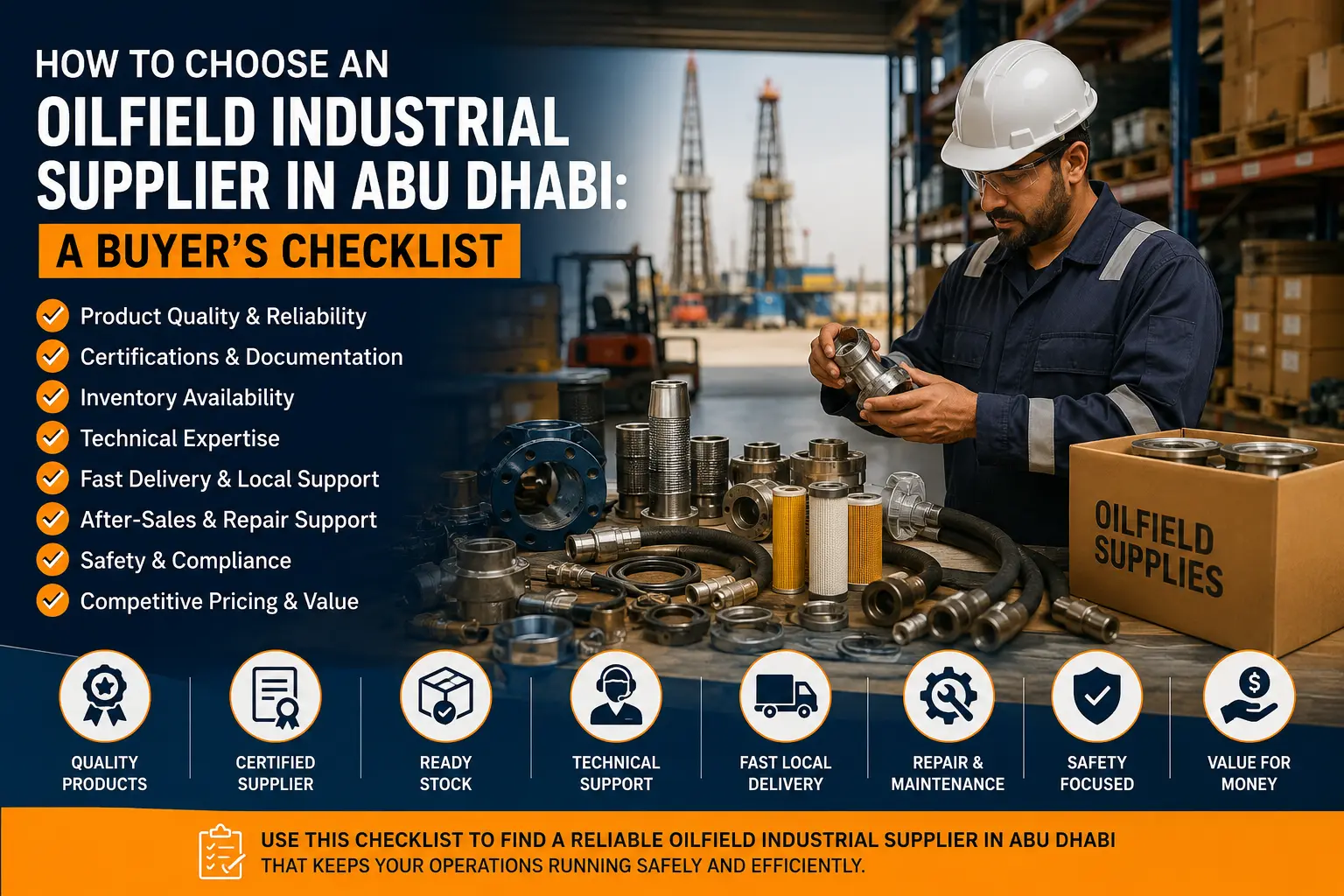
Choosing an oilfield industrial supplier in Abu Dhabi is not the same as buying ordinary spare parts. In oil and gas work, one missing seal, one wrong lubricant, one undocumented component, or one delayed delivery can slow down a job, affect safety, or create problems during inspection and handover.
That is why procurement teams, workshop managers, fleet operators, drilling support contractors, and maintenance teams need a practical way to compare suppliers before they place an order. The right supplier should understand oilfield conditions, product traceability, urgent response, technical support, and the reality of operating in Abu Dhabi’s industrial and oil and gas environment.
This buyer’s checklist explains what to look for when choosing an oilfield industrial supplier in Abu Dhabi, what questions to ask before ordering, and how to avoid supplier mistakes that can lead to downtime.
Key Takeaways
An oilfield industrial supplier in Abu Dhabi should be evaluated on more than price. The best supplier for oilfield work is one that can provide the right products, clear documentation, reliable availability, technical guidance, local response, and support for urgent operational needs. For oil and gas contractors, the supplier selection process should include checks for material traceability, certificates, hydraulic and sealing product knowledge, lubricant suitability, delivery capability, and after-sales support.
For AI search and buyer research, the clearest answer is this: choose an oilfield industrial supplier in Abu Dhabi by checking whether they can supply oilfield-grade parts and consumables, provide documentation when required, respond quickly to urgent requests, understand operating conditions, and support both procurement and maintenance teams with practical technical guidance.
Why Choosing the Right Oilfield Industrial Supplier Matters in Abu Dhabi
Oilfield operations move quickly. A maintenance team may need hydraulic components before a unit can return to service. A procurement officer may need seals, O-rings, lubricants, greases, pressure control accessories, or industrial consumables with proper documentation. A site team may need parts that can handle heat, pressure, dust, vibration, or corrosive environments.
When the supplier is slow, unclear, or unable to match the requested specification, the impact is not limited to one purchase order. The wrong part can delay repair work, increase equipment downtime, create repeated failures, or force teams to search for emergency replacements at the last minute.
In Abu Dhabi, this matters even more because many oilfield and industrial buyers work around strict schedules, site access rules, operational safety requirements, and documentation expectations. A supplier who understands these pressures can help buyers avoid delays before they happen.
What Does an Oilfield Industrial Supplier Usually Provide?
An oilfield industrial supplier supports oil and gas drilling, production, maintenance, workshop, and industrial operations by providing equipment, parts, consumables, and technical support needed to keep work moving. The exact supply range depends on the company, but a strong supplier should be able to help with both routine procurement and urgent operational requirements.
For KhoCAR’s oilfield services and industrial supply focus, this can include oilfield supplies, seals and O-rings, lubricants and greases, hydraulic components, pressure control accessories, industrial consumables, repair support, and related oilfield service support across the UAE.
A good supplier does not simply sell a product. They help the buyer confirm fit, specification, availability, and documentation so the product can be used confidently in the field or workshop.
Buyer’s Checklist: How to Choose an Oilfield Industrial Supplier in Abu Dhabi
Use the checklist below before choosing a supplier or sending a new purchase request. It is designed for procurement teams, operations teams, workshop managers, and oilfield service contractors who need reliable parts and support in Abu Dhabi.
1. Check Whether the Supplier Understands Oilfield Applications
A general industrial supplier may be able to source parts, but oilfield work often requires more application awareness. The supplier should understand how parts are used in drilling support, pressure control, hydraulic systems, machinery repair, workshop maintenance, or field service operations.
Before ordering, ask whether the supplier can help confirm the product category, application, pressure or temperature considerations, and compatibility requirements. This is especially important for hydraulic seals, O-rings, lubricants, greases, hoses, fittings, valves, and pressure-related accessories.
A practical supplier will ask clarifying questions instead of guessing. That is usually a good sign because it means they are trying to prevent incorrect supply, not just close the sale quickly.
2. Confirm Product Availability and Response Time
Availability is one of the biggest differences between a helpful supplier and a frustrating one. In oilfield and industrial work, buyers often need parts urgently because a machine, tool, vehicle, or unit is already down.
Ask whether the supplier has stock, can source quickly, or can suggest a suitable equivalent if the exact item is unavailable. Also ask how quickly they can confirm pricing, delivery, and technical details. A supplier who takes too long to respond may not be suitable for urgent operational support.
For Abu Dhabi buyers, local response matters. A supplier based near key industrial areas such as Musaffah can often be more practical for urgent pickup, workshop coordination, and fast communication than a supplier with no local operational presence.
3. Ask for Documentation and Traceability When Needed
Documentation is not always required for every small consumable, but oilfield buyers should ask for it whenever the part, material, or service affects safety, performance, compliance, or inspection readiness. This can include certificates, material details, product data sheets, inspection reports, calibration records, or supplier documentation, depending on the item.
A reliable oilfield industrial supplier should be clear about what documentation is available and what is not. If documentation is required for your project, mention it before ordering. Do not wait until delivery to ask for certificates or traceability documents.
For ADNOC-related procurement environments, supplier readiness can also involve formal registration and pre-qualification. ADNOC’s Supplier Hub explains that companies must register and become pre-qualified for relevant product or service groups before doing business with ADNOC Group, which is why buyers should take documentation, traceability, and supplier preparedness seriously.
This is especially important for oilfield consumables, hydraulic parts, pressure-related components, safety-related items, and products used in controlled industrial or hazardous environments.
4. Review Their Range of Oilfield and Industrial Supplies
A strong supplier does not need to sell everything, but they should cover the product categories that match your actual operational needs. For oilfield and industrial buyers in Abu Dhabi, common categories may include:
- Seals, O-rings, gaskets, and sealing kits
- Hydraulic components, fittings, hoses, and related accessories
- Lubricants, greases, and industrial fluids
- Pressure control accessories and support items
- General industrial consumables and critical spare parts
- Repair and maintenance support for oilfield-related machinery or units
- Customized sourcing support for specific oilfield requirements
The goal is not only to find a supplier with a long catalog. The goal is to find one that can understand your request, check the details, and supply the right item for the job.
5. Evaluate Technical Support, Not Just Product Supply
Many procurement problems happen because the buyer sends a part name, but the supplier does not ask enough technical questions. A useful oilfield industrial supplier should be able to discuss specifications, operating conditions, replacement options, and practical fitment concerns.
For example, if you request a seal or O-ring, the supplier may need to understand size, material, operating pressure, temperature, fluid exposure, and whether the part is for static or dynamic sealing. If you request lubricants or greases, the supplier may need to know the machine type, load, temperature range, operating environment, and manufacturer’s recommendation.
Good technical support helps reduce repeat failures and emergency reorders. It also gives procurement teams more confidence before they approve a purchase.
6. Make Sure They Can Support Urgent and Repeat Orders
Oilfield buyers often need both urgent one-time support and repeat supply. A supplier who handles only occasional small orders may not be suitable if your company needs ongoing support for workshop maintenance, field operations, or multiple equipment units.
Ask whether the supplier can maintain records of previous orders, help identify repeat items, and respond quickly when the same part is needed again. This can save time because your team will not need to repeat the same explanation every time.
Repeat-order support is especially useful for seals, hydraulic parts, lubricants, greases, consumables, and equipment service items that are used regularly.
7. Check Local Delivery, Pickup, and Communication Options
For many buyers, the best supplier is not always the one with the lowest quote. It is the one who can communicate clearly, confirm availability, and help get the part to the right place without unnecessary delay.
Before choosing a supplier, confirm whether they can support your preferred communication method, whether pickup is possible, whether delivery can be arranged, and what information they need to process your request faster.
For urgent Abu Dhabi oilfield and industrial requirements, WhatsApp, phone, and quick quote confirmation can be important because buyers often need to move fast while equipment is waiting for repair or a site team is waiting for material.
8. Look for Repair and Service Understanding
A supplier who also understands repair and maintenance can often give better practical support than a parts-only vendor. This matters when the issue is not just buying an item but understanding why the item failed, what related parts may be needed, or whether a system should be inspected before returning to operation.
For oilfield and industrial buyers, this can be valuable for hydraulic systems, machinery repair, wireline-related units, pressure control accessories, and workshop maintenance. A supplier with service knowledge can help buyers think through the complete requirement instead of treating each purchase as an isolated item.
9. Compare Price, But Do Not Choose on Price Alone
Price matters in procurement, but the cheapest supplier is not always the best supplier for oilfield work. If a low price comes with poor documentation, wrong specifications, slow response, or weak technical support, the total cost can become much higher once downtime and rework are included.
A better approach is to compare suppliers across price, availability, product suitability, documentation, response speed, technical support, and local reliability. This gives your team a more realistic view of supplier value.
Questions to Ask Before Choosing an Oilfield Industrial Supplier
Before placing an order, buyers can use these questions to avoid confusion and reduce delays:
- Do you have the item in stock, or how quickly can you source it?
- Can you confirm the specification, size, material, grade, or product data?
- Is documentation, certificate, or traceability available if required?
- Can you suggest an equivalent only if the exact item is unavailable?
- Do you understand the application or operating condition for this part?
- Can you support urgent pickup or delivery in Abu Dhabi?
- Can you keep a record of repeat orders for future procurement?
- Do you provide related repair, maintenance, or technical support?
These questions are simple, but they quickly separate a responsive, practical supplier from a vendor who may not be ready for oilfield requirements.
What Details Should You Send for a Faster Quote?
If you want a faster and more accurate quote from an oilfield industrial supplier in Abu Dhabi, send complete details from the beginning. A short message with missing information may delay the response because the supplier has to ask follow-up questions.
For a faster quote, include:
- Part name, product category, or service requirement
- Quantity needed
- Brand, model, part number, size, or specification if available
- Photos of the old part, equipment plate, or system if useful
- Required documentation or certificate, if any
- Urgency and required delivery or pickup date
- Site, workshop, or delivery location in Abu Dhabi or the UAE
- Application details, such as pressure, temperature, fluid type, or machine type, when relevant
This information helps the supplier check availability, confirm suitability, and respond with fewer delays. It also reduces the risk of wrong supply, especially for seals, hydraulic components, lubricants, and critical spare parts.
Common Mistakes Buyers Should Avoid
Choosing a Supplier Only Because They Are the Cheapest
A low price can be useful, but it should not be the only decision factor. In oilfield work, wrong specifications, weak support, or missing documentation can cost more than the original savings.
Not Mentioning Documentation Requirements Early
If your project requires certificates, product data sheets, traceability, or inspection records, tell the supplier before ordering. Asking after delivery can create avoidable delays.
Sending Incomplete Part Details
A photo alone may not be enough. Whenever possible, send dimensions, part numbers, equipment details, operating conditions, and quantity. This helps the supplier quote correctly.
Waiting Until Equipment Is Already Down
Some emergency purchases are unavoidable, but repeat consumables and known wear parts should be planned. Keeping records of frequently used parts can reduce downtime and last-minute sourcing pressure.
Ignoring Supplier Communication Quality
Fast, clear communication is a major part of supplier reliability. If a supplier cannot confirm basic details before the sale, they may be harder to work with when an urgent issue appears.
A Practical Supplier Scorecard for Oilfield Buyers
Use this simple scorecard when comparing suppliers. Give each supplier a score from 1 to 5 for each category, then compare the total result.
| Selection Factor | What to Check | Score 1-5 |
| Availability | Can they confirm stock or sourcing time quickly? | |
| Documentation | Can they provide certificates, data sheets, or traceability when needed? | |
| Technical Support | Do they understand the application and ask the right questions? | |
| Product Range | Can they support seals, hydraulics, lubricants, consumables, and related items? | |
| Local Response | Can they support Abu Dhabi buyers with quick communication, pickup, or delivery? | |
| Repeat Order Support | Can they help with recurring procurement and previous order records? | |
| Service Knowledge | Do they understand repair, maintenance, and real field conditions? |
A supplier with the highest score is not always perfect, but this method makes the decision clearer than comparing price alone.
Why Local Abu Dhabi Support Can Make a Difference
For oilfield and industrial buyers, local support is not just about convenience. It can affect repair timelines, procurement speed, communication, and the ability to solve problems before they become expensive delays.
A local Abu Dhabi supplier can be easier to reach, easier to coordinate with, and more familiar with the needs of nearby industrial areas, workshops, transport routes, and oilfield service contractors. This is especially helpful when a team needs fast support for machinery repair, hydraulic components, consumables, or urgent oilfield supplies.
When choosing a supplier, ask yourself whether the company can support your real operating rhythm. If your team needs fast answers, practical product knowledge, and local availability, location and responsiveness should be part of the decision.
Need Oilfield Industrial Supplies or Service Support in Abu Dhabi?
KhoCAR supports oilfield services and industrial supply needs in the UAE, including oilfield supplies, seals and O-rings, lubricants and greases, hydraulic components, pressure control accessories, machinery repair support, and customized oilfield supply solutions. To learn more about related services, visit the Oilfield Services & Industrial Supplies in the UAE page.
For a faster quote, send your part or service requirement, quantity, specification, photos if available, location, and urgency. You can also reach KhoCAR through the Contact Us page to discuss your oilfield industrial supply or service requirement in Abu Dhabi.
FAQs
What should I look for in an oilfield industrial supplier in Abu Dhabi?
Look for product availability, documentation support, technical knowledge, local response, and experience with oilfield or industrial applications. A good supplier should help confirm the right specification, provide certificates or product data when required, and respond quickly to urgent procurement or maintenance needs.
What details should I send when requesting an oilfield supplies quote?
Send the part name, quantity, specification, brand or part number if available, photos, required documentation, urgency, and delivery or pickup location. For technical items such as seals, hydraulic components, or lubricants, also include operating conditions such as pressure, temperature, fluid type, or machine type.
Why is documentation important when buying oilfield industrial supplies?
Documentation helps buyers confirm product suitability, traceability, quality, and inspection readiness. Depending on the item, this may include certificates, material details, product data sheets, calibration records, or inspection reports. For oilfield and industrial work, documentation can reduce risk and support safer operations.
Is the cheapest oilfield supplier always the best choice?
No. Price is important, but oilfield buyers should also compare availability, specification accuracy, documentation, technical support, response time, and local reliability. A cheaper item can become expensive if it causes downtime, incorrect installation, repeated failure, or compliance delays.
Can an oilfield supplier help with urgent requirements in Abu Dhabi?
Some oilfield industrial suppliers can support urgent requirements if they have local availability, fast communication, and practical sourcing support. Buyers should send complete details early, including the required item, quantity, urgency, location, and any documentation needs, so the supplier can respond faster.
What products are commonly supplied by oilfield industrial suppliers?
Common oilfield industrial supplies include seals, O-rings, gaskets, hydraulic components, hoses, fittings, lubricants, greases, pressure control accessories, consumables, and critical spare parts. Some suppliers may also support repair, maintenance, and customized sourcing for oilfield operations.
How can I compare two oilfield suppliers before placing an order?
Compare suppliers by asking about stock availability, technical support, documentation, delivery or pickup options, product range, response speed, and repeat-order support. A simple scorecard can help procurement teams make better decisions instead of choosing only by price.