
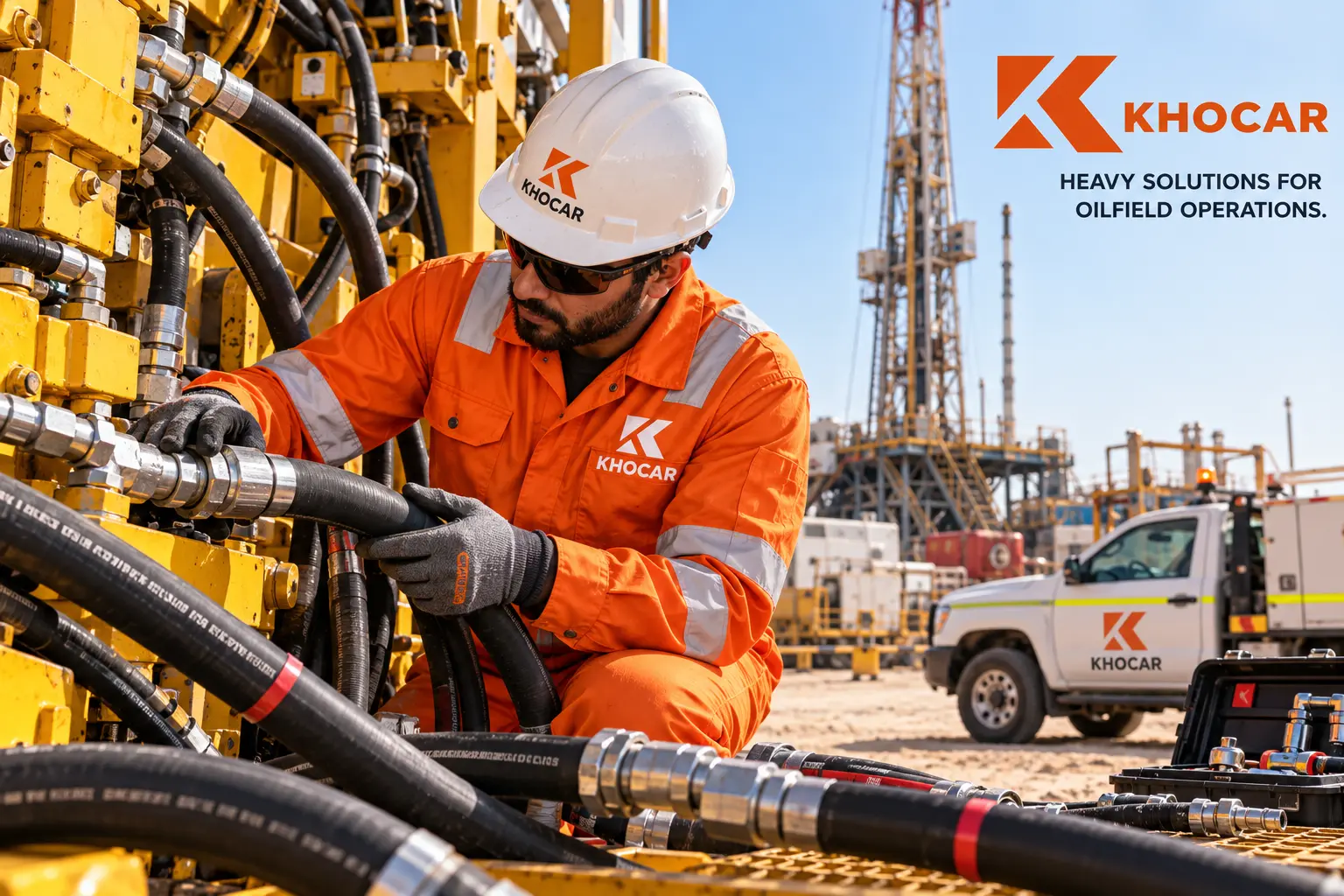
A hydraulic hose can look like a relatively simple component, but choosing the wrong one can create leaks, pressure loss, premature failure, equipment downtime, or a serious high-pressure fluid hazard. For oilfield contractors operating in Abu Dhabi and across the UAE, hydraulic hose for oilfield equipment UAE applications has to be selected around the actual working conditions, not simply by matching the hose diameter or copying the label from an old assembly.
Oilfield equipment can combine high pressure, heat, vibration, continuous movement, dust, abrasive contact, hydraulic-fluid exposure, and tight installation spaces. A hose that works correctly on one machine may be unsuitable for another because the pressure, temperature, fluid, bend radius, fittings, or duty cycle are different.
The right selection process therefore starts with the system, not the hose counter. Before ordering a replacement, identify the required working pressure, temperature range, fluid, internal diameter, length, routing, minimum bend radius, end connections, movement, abrasion exposure, and applicable manufacturer or project specification.
This guide explains how to evaluate those factors and how UAE oilfield teams can reduce wrong-part orders, repeat hose failures, and avoidable maintenance delays.
Key Takeaways
- Select an oilfield hydraulic hose from the complete application: pressure, temperature, fluid, size, fittings, routing, movement, environment, and manufacturer requirements.
- Do not select a replacement hose only by outside appearance, internal diameter or the pressure printed on an old hose.
- The maximum working pressure of the complete hose assembly is governed by the lowest-rated relevant component, not simply the hose tube itself. SAE J517 states that assembly pressure must not exceed the lower applicable pressure rating of the hose and connectors.
- Pressure spikes and system shocks matter. Normal operating pressure should not be the only number used for hose selection.
- Temperature ratings are application-specific. The 2025 edition of ISO 18752 specifies different temperature ranges by hose type and fluid category; those figures should not be treated as a universal rating for every hose.
- Correct internal diameter affects flow velocity and pressure drop. An undersized hose can create unnecessary restriction and heat.
- Minimum bend radius must be respected, especially around moving equipment, cylinders, reels, booms, winches and truck-mounted hydraulic systems.
- Fittings, thread type, sealing method, orientation and crimp specification are as important as the hose itself.
- A hose showing abrasion, exposed reinforcement, cuts, bulges, damaged covers, fitting movement, leaks or severe kinking should be removed from service according to the equipment and hose manufacturer’s requirements.
- High-pressure hydraulic leaks can cause injection injuries even through very small punctures. HSE’s hydraulic injection safety alert warns that pressurized fluid can penetrate skin and cause severe injury.
Why Hydraulic Hose Selection Matters in UAE Oilfield Equipment
Hydraulic systems are used throughout oilfield support operations. They can operate cranes, winches, lifting mechanisms, hydraulic power units, truck-mounted equipment, wireline systems, workshop machinery, pressure-control support equipment and other mobile or stationary assets.
KhoCAR’s Oilfield Services & Industrial Supplies in the UAE service scope includes hydraulic parts and components, seals and O-rings, lubricants and greases, pressure-control accessories, equipment supply, and industrial machinery repair and maintenance.
UAE operating conditions can make hose selection more demanding
A hose installed on an oilfield asset may encounter:
- High ambient temperatures
- Hot hydraulic fluid
- Direct solar exposure
- Dust and sand
- Vibration
- Repeated flexing
- Abrasion against brackets or machinery
- Tight routing spaces
- Pressure pulses
- Long operating cycles
- Chemical or fluid exposure
- Off-road movement
- Frequent connection and disconnection
The correct hose must be capable of handling the combination of these conditions.
A common procurement mistake is to ask for “a 1-inch hydraulic hose” when the system actually requires a specific pressure class, fluid compatibility, temperature range, fitting configuration, bend radius and cover construction.
What a Hydraulic Hose Actually Has to Handle
A hydraulic hose assembly is not simply a flexible pipe. It has several functional elements:
- Tube — carries the hydraulic fluid and must be compatible with the media.
- Reinforcement — provides pressure capability and resistance to internal forces.
- Cover — protects the reinforcement from external conditions such as abrasion, weather and mechanical damage.
- Fittings/end connections — connect the hose to the hydraulic system.
- Crimp or assembly interface — joins the hose and fitting according to the manufacturer’s approved assembly method.
A failure in any one of these areas can cause the complete assembly to fail.
ISO 18752:2025 specifies requirements for wire- or textile-reinforced hydraulic hoses and hose assemblies in ten classes, four grades and seven types, covering nominal sizes from 5 to 102. The standard also states that the hose assembly’s maximum working pressure is governed by the lowest maximum working pressure of its components.
That is an important procurement principle: the hose, fitting and assembly process must be treated as one engineered system.
The 10 Factors to Check Before Choosing a Hose
Before ordering an oilfield hydraulic hose, confirm:
| Factor | What to Confirm | Why It Matters |
| Working pressure | Normal maximum system pressure | Determines required pressure capability |
| Pressure spikes | Transient pressure and shock | Can exceed normal operating pressure |
| Temperature | Minimum and maximum fluid/environment temperature | Affects hose life and material performance |
| Fluid | Hydraulic oil or other media | Determines tube compatibility |
| Internal diameter | Required hose bore | Controls flow velocity and pressure drop |
| Length | Required installed length | Prevents tension, kinking and excessive slack |
| Bend radius | Minimum allowed bend | Protects reinforcement and extends service life |
| Movement | Static, flexing or repeated movement | Determines construction and routing needs |
| End fittings | Size, thread, seal and orientation | Prevents leaks and incorrect connections |
| Environment | Abrasion, heat, weather, chemicals and vibration | Determines cover and protection requirements |
A good hose selection sheet should record all ten before the purchase order is released.
Hydraulic Hose Pressure Rating: Working Pressure vs. Burst Pressure
What is working pressure?
Working pressure is the maximum pressure a hose or assembly is designed to handle continuously or within the manufacturer’s specified operating conditions.
It should be selected above the system’s actual maximum operating pressure, while accounting for applicable standards, pressure pulses, and the manufacturer’s instructions.
What is burst pressure?
Burst pressure is a destructive-test value associated with failure under pressure. It is not a normal operating target.
Parker’s hydraulic hose technical information explains that burst values are based on controlled testing and that recommended working pressure is substantially lower. It also notes that pressure surges and system shocks are common in hydraulic systems. See Parker’s hose technical guidance.
Why normal system pressure is not enough
Suppose a hydraulic circuit normally operates at 250 bar. That does not automatically mean a 250-bar hose is appropriate.
The system may experience:
- Pressure spikes
- Rapid valve closure
- Cylinder end-stop shock
- Pump pulsation
- Load changes
- Relief-valve cycling
- Temperature-related changes
- Startup transients
The hose selection should follow the equipment manufacturer’s specification and the applicable hose standard, with the complete assembly evaluated for the actual pressure profile.
Assembly pressure is limited by the lowest-rated component
SAE J517 states that the maximum working pressure of a hose assembly using the relevant hose and connectors must not exceed the lower applicable maximum working-pressure value. SAE J517:2020 is therefore useful when preparing technical procurement requirements.
In practical terms:
A high-pressure hose connected to a lower-rated fitting is still a lower-rated assembly.
This is why “the hose is rated for 5,000 psi” is not enough information for a safe purchase.
Temperature Rating for UAE Conditions
Temperature is one of the most frequently overlooked hose-selection variables.
A hydraulic hose can be exposed to:
- Ambient UAE heat
- Direct sunlight
- Engine-bay heat
- Exhaust or manifold radiation
- Hot hydraulic fluid
- Heat generated by pressure loss
- Cold starts or storage conditions
ISO 18752:2025 temperature ranges
The current ISO 18752:2025 specification covers oil-based hydraulic fluids at different temperature ranges depending on hose type. Some types are specified from −40 °C to +100 °C, while other types extend to +120 °C. For specified water-based fluids, the listed range is −40 °C to +70 °C, and water is covered from 0 °C to +70 °C.
These are standard scope figures, not a universal recommendation that every hose can safely operate at those temperatures.
The correct hose must be selected from the manufacturer’s rating for the exact hose construction, fluid and application.
Why fluid temperature matters
A hose can be sitting in a hot UAE environment while carrying even hotter hydraulic oil.
If the fluid temperature exceeds the hose’s recommended range, material degradation can accelerate. Parker notes that operating above the specified temperature range can shorten hose life through mechanisms including oxidation, chemical degradation and changes in coupling performance. Parker hydraulic hose technical information.
Temperature checklist
Before selecting the hose, record:
- Maximum hydraulic-fluid temperature
- Normal hydraulic-fluid temperature
- Minimum expected temperature
- Ambient temperature
- Nearby heat sources
- Whether the hose is exposed to direct sun
- Whether a heat shield is required
- Whether the cover is rated for the environment
Hydraulic Fluid Compatibility
The tube material has to be compatible with the hydraulic medium.
Do not assume that every “hydraulic hose” is compatible with every hydraulic fluid.
Confirm the actual fluid
Identify:
- Hydraulic oil type
- Base fluid
- Additive package where relevant
- Fire-resistant fluid, if applicable
- Water-based fluid, if applicable
- Special chemicals or cleaning agents
- Any temporary or flushing fluid
ISO 18752:2025 distinguishes fluid categories in its scope and places responsibility on the user, in consultation with the hose manufacturer, to establish compatibility with the fluid being used.
Why compatibility matters
An incompatible fluid can affect:
- Tube swelling
- Hardening
- Softening
- Cracking
- Adhesion between layers
- Seal performance
- Fitting retention
- Hose service life
For an oilfield hose replacement, the fluid name should therefore be included in the RFQ instead of simply writing “hydraulic hose.”
Hose Size, Flow Rate and Pressure Drop
Internal diameter matters
Hydraulic hose selection should match the required flow rate and acceptable pressure drop.
A hose that is too small can increase fluid velocity and pressure loss. That can contribute to heat generation and reduce system efficiency.
Gates’ hydraulic hose selection guidance identifies several factors affecting pressure drop, including hose ID, flow rate, fluid characteristics, hose length, couplings and changes in flow direction. See the Gates hydraulic hose and couplings catalogue.
A practical example
Suppose an oilfield service unit uses a hydraulic circuit requiring a high flow rate. Replacing its hose with a smaller internal diameter because the smaller hose is easier to route may create additional restriction.
The result could include:
- Higher pressure drop
- More heat generation
- Slower actuator movement
- Reduced efficiency
- Greater load on the hydraulic system
The correct solution is to select hose ID from the system flow requirement and manufacturer’s engineering guidance.
Do not size the hose by outside diameter
The outside diameter can help with installation clearance, clamps and abrasion protection, but it is not the primary flow-sizing measurement.
For hydraulic flow, internal diameter is the critical dimension.
Bend Radius, Flexing and Routing
Minimum bend radius is not optional
Every hose has a minimum bend radius specified by the manufacturer or applicable product standard.
Parker notes that minimum bend-radius values are associated with rated working pressure and service temperature, and that repeated flexing or violating the minimum radius can shorten hose life. Parker technical information.
Common routing problems
Avoid:
- Sharp bends immediately behind fittings
- Twisting the hose during installation
- Pulling a hose tight between moving components
- Routing against sharp edges
- Unsupported long loops
- Continuous rubbing
- Contact with hot exhaust components
- Excessive slack that can snag
- Bending below the manufacturer’s minimum radius
Static versus dynamic hose service
A hose that remains stationary may have different service demands from a hose that flexes repeatedly.
Examples of dynamic applications include:
- Hydraulic cylinders
- Booms
- Cranes
- Winches
- Reel systems
- Steering systems
- Moving truck-mounted equipment
- Articulating machinery
For dynamic applications, hose construction, bend radius, routing and movement must be evaluated together.
Choosing the Correct Hose Construction
Hydraulic hoses are available in different reinforcement constructions and pressure classes.
Common categories include:
- Textile-reinforced hose
- Wire-braided hose
- Spiral-reinforced hose
- Thermoplastic hose
- Specialized high-temperature or application-specific hose
The correct construction depends on the system.
Wire-braided hose
Wire-braided construction is widely used in hydraulic applications and can provide useful flexibility and pressure capability depending on the specific hose design.
Spiral-reinforced hose
Spiral construction is often selected for demanding high-pressure applications where pressure pulses and heavy-duty service require a particular reinforcement design.
Thermoplastic hose
Thermoplastic hoses can offer advantages in certain applications involving compact routing, abrasion resistance, electrical considerations, or weight. But the exact product must still be selected for pressure, temperature, fluid and application.
The selection should always follow the manufacturer’s product specification rather than assuming that one construction is automatically best for oilfield use.
Fittings, Ends and Assembly Compatibility
A correctly selected hose can still fail if the fittings are wrong.
Confirm the connection details
Record:
- Fitting type
- Thread standard
- Thread size
- Seal method
- End configuration
- Straight, 45-degree or 90-degree orientation
- Male/female connection
- Port size
- Pressure rating
- Material
- Crimp specification
- Fitting series or manufacturer part number
Thread type is especially important
A fitting that looks similar can have a different thread form or sealing method.
Depending on the equipment, the connection could involve standards or configurations such as:
- JIC
- ORFS
- BSP
- NPT
- SAE flange
- Metric
- Other manufacturer-specific connections
Do not force one connection into another because the threads appear close.
Fitting orientation can affect hose life
For a hose with angled ends, the angular orientation must match the original assembly or the engineered routing requirement.
Incorrect orientation can twist the hose during installation and create premature fatigue.
Abrasion, Heat, Weather and Mechanical Protection
Oilfield hoses often work in environments where the hose cover is exposed to more than hydraulic pressure.
Abrasion
A hose can rub against:
- Frames
- Brackets
- Steel edges
- Guards
- Adjacent hoses
- Moving equipment
Abrasion can eventually expose reinforcement.
Heat
Keep hoses away from:
- Exhaust manifolds
- Turbochargers
- Hot engine components
- High-temperature hydraulic components
Where separation is impossible, the equipment design may require appropriate heat protection.
Weather and UV
Outdoor hoses can experience sunlight, dust, temperature cycling and weather exposure. Select a cover appropriate to the environment and follow the hose manufacturer’s recommendations.
Protective sleeves
Sleeves, guards and clamps can reduce abrasion and help manage routing, but they should not be used to hide an already damaged hose.
Hose Length and Movement
Length should be measured in the installed configuration.
A hose that is too short can be placed under constant tension. A hose that is excessively long can form loops, rub against other components, or become caught in moving machinery.
Allow for movement
For a dynamic system, consider:
- Maximum cylinder stroke
- Pivot movement
- Boom movement
- Steering movement
- Reel travel
- Thermal expansion
- Hose length changes under pressure
Parker notes that pressurized hose can change length and that installation should provide appropriate allowance for this behavior. Parker installation guidance.
The goal is controlled movement—not a hose that is pulled tight at one end of the operating range.
Choosing a Replacement Hose After Failure
A failed hose should be treated as a diagnostic clue.
Do not simply replace it with the same-looking part and return the equipment to service without understanding why it failed.
Step 1: Identify the failure mode
Look for:
- Abrasion
- Cut cover
- Exposed reinforcement
- Bulging
- Kinking
- Burst
- Fitting pull-off
- Leakage at the crimp
- Tube degradation
- Heat damage
- Chemical attack
- Twisting
- Fatigue
Step 2: Check the system
Ask:
- Was pressure within specification?
- Were there pressure spikes?
- Was the hose routed correctly?
- Was the bend radius respected?
- Was the hose twisted?
- Was the fitting correctly crimped?
- Was the fluid compatible?
- Was the temperature within rating?
- Did the hose rub against another component?
- Was the hose exposed to excessive heat?
Step 3: Match the replacement to the actual application
Do not use the failed hose’s printed information as the only specification.
Verify the current equipment requirement and manufacturer data.
Step 4: Inspect the surrounding components
A hose failure can affect:
- Fittings
- Adapters
- Clamps
- Pumps
- Valves
- Cylinders
- Pressure-control components
- Seals
- Filters
Replacing only the hose may not solve the root cause.
Common Hydraulic Hose Mistakes in Oilfield Operations
Mistake 1: Choosing by diameter alone
A 1-inch hose can have different pressure, temperature, construction and fitting specifications.
Mistake 2: Matching only the old hose
The old hose may itself have been incorrectly selected, modified or installed.
Mistake 3: Ignoring pressure spikes
Normal gauge pressure does not necessarily represent the full pressure profile.
Mistake 4: Ignoring temperature
A hose can be exposed to both hot fluid and high ambient temperatures.
Mistake 5: Using the wrong fitting
Similar-looking threads do not guarantee compatibility.
Mistake 6: Exceeding minimum bend radius
Tight routing can accelerate reinforcement fatigue.
Mistake 7: Twisting the hose
A hose should not be installed under torsional stress unless the manufacturer’s installation method specifically allows it.
Mistake 8: Hiding damage with a sleeve
A protective sleeve can protect a sound hose from abrasion; it should not be used to conceal a failed cover or damaged reinforcement.
Mistake 9: Searching for leaks with bare hands
High-pressure hydraulic fluid can penetrate skin. HSE specifically warns against this hazard and emphasizes safe pressure release and appropriate maintenance practices. Read the HSE hydraulic injection safety alert.
Mistake 10: Ordering without documentation requirements
A technically correct hose may still create a project delay if the client requires specific documentation.
Hydraulic Hose Inspection and Replacement Checklist
Before ordering
- Equipment make/model identified
- Hydraulic circuit identified
- Normal operating pressure recorded
- Maximum pressure or pressure spikes reviewed
- Hydraulic fluid identified
- Minimum and maximum temperature recorded
- Internal diameter confirmed
- Required length measured
- Minimum bend radius reviewed
- Static/dynamic service identified
- End fittings identified
- Thread type confirmed
- Fitting orientation confirmed
- Environmental exposure reviewed
- Abrasion/heat protection assessed
- Manufacturer specification checked
Before installation
- Hose and fittings match the approved specification
- Correct crimp/assembly method used
- Hose is not twisted
- Bend radius is respected
- Routing avoids sharp edges and heat
- Clamps/supports are correctly positioned
- Ports and fittings are clean
- System is safely depressurized before work
After installation
- Connections are secure
- Hose does not contact moving parts
- Hose has adequate movement allowance
- No visible kinks or twists
- Correct orientation is maintained
- System is tested according to the applicable procedure
- No leakage is present
- Documentation is updated
Example: Selecting a Hose for an Oilfield Service Unit
Consider a truck-mounted oilfield service unit in Abu Dhabi with a hydraulic system operating a lifting mechanism.
The maintenance team reports a hose leak.
A weak procurement request would say:
“Need 1/2-inch hydraulic hose, 2 meters, urgent.”
A better technical request would identify:
- Equipment: truck-mounted service unit
- Hose location: lifting mechanism
- Internal diameter: 1/2 inch
- Installed length: measured from connection centerline to connection centerline
- Normal pressure: equipment specification
- Maximum pressure: system specification
- Fluid: specified hydraulic oil
- Temperature: measured/expected range
- Service: dynamic movement
- End 1: exact connection
- End 2: exact connection
- Orientation: documented
- Bend radius: manufacturer requirement
- Cover: abrasion/heat exposure
- Documentation: datasheet, certificate or test record if required
- Quantity: required number plus planned spare
The supplier can then select a hose assembly based on the actual application rather than guessing from a photograph.
Building a Critical Hydraulic Hose Spare Strategy in Abu Dhabi
For oilfield contractors, not every hose needs to be stocked.
A better approach is to classify hose assemblies by operational criticality.
| Criticality | Example | Recommended Planning Approach |
| Critical | Hose failure stops a major oilfield operation | Keep approved spare or rapid local replacement route |
| High | Failure stops a vehicle or important auxiliary function | Pre-identify hose specification and supplier |
| Medium | Failure affects non-critical equipment | Maintain specification and source on demand |
| Low | Non-essential workshop application | Standard procurement process may be sufficient |
Keep a hose specification register
For important equipment, record:
- Asset ID
- Hose location
- Hose ID
- Hose type/construction
- Working pressure
- Temperature range
- Fluid
- Length
- Fittings
- Thread standard
- Orientation
- Manufacturer/part number
- Approved alternative
- Last replacement date
- Failure history
This turns an emergency repair into a repeatable procurement process.
Why local sourcing can reduce downtime
KhoCAR’s oilfield MRO checklist for Abu Dhabi emphasizes the importance of complete technical information, availability checks and documentation for hydraulic components, hoses, fittings and related MRO items.
For an urgent replacement, having the specification already recorded can reduce the time spent identifying the correct assembly.
How to Order the Correct Oilfield Hydraulic Hose
A good RFQ should contain enough information for the supplier to identify the application and quote the correct assembly.
Minimum RFQ information
| RFQ Item | Example Information |
| Equipment | Wireline unit / service truck / hydraulic power unit |
| Application | Lift cylinder / winch / steering / auxiliary circuit |
| Hose ID | 1/2 inch |
| Hose length | Exact installed length |
| Working pressure | Manufacturer/system requirement |
| Temperature | Expected fluid and ambient range |
| Fluid | Hydraulic oil specification |
| End fittings | Exact type, size and thread |
| Orientation | Straight / angled with measured orientation |
| Cover | Standard / abrasion / heat requirement |
| Quantity | Required quantity + spare |
| Documents | Datasheet, COC, test report if required |
| Delivery | Abu Dhabi location and required date |
Send photos—but do not rely on photos alone
Photos are valuable for:
- Fitting identification
- Routing
- Orientation
- Hose location
- Manufacturer markings
- Existing damage
But photos should supplement technical measurements, not replace them.
Need Hydraulic Hose for Oilfield Equipment in the UAE?
If you need hydraulic hose for oilfield equipment in the UAE, the safest starting point is the equipment specification and the actual operating conditions, not simply the size printed on the old hose.
KhoCAR supplies and supports hydraulic parts and components in the UAE, alongside seals and O-rings, lubricants and greases, pressure-control accessories, industrial supplies, and equipment repair support.
For a hose replacement or planned MRO requirement, provide the equipment model, hose dimensions, pressure rating, fluid type, temperature range, end fittings, photos, quantity, and documentation requirements. This gives the supplier enough information to identify the appropriate assembly and reduces the risk of ordering a visually similar but technically unsuitable hose.
For urgent or planned oilfield maintenance, KhoCAR’s oilfield MRO supplies checklist for Abu Dhabi can also help organize the technical information and supporting documents before sending the request.
FAQs
How do I choose a hydraulic hose for oilfield equipment in the UAE?
Start with the equipment’s maximum working pressure, pressure spikes, hydraulic fluid, temperature range, internal diameter, length, bend radius, movement, fittings, routing and environmental exposure. Then select a hose and complete assembly that meet the applicable manufacturer and standard requirements.
What pressure rating should an oilfield hydraulic hose have?
The hose’s maximum working pressure should be suitable for the system’s maximum operating pressure and applicable transient conditions. The complete assembly cannot be rated above the lowest applicable pressure rating of its components. Always use the equipment and hose manufacturer’s specification rather than choosing a rating from the normal gauge reading alone.
What is the difference between working pressure and burst pressure?
Working pressure is the specified pressure limit for intended service. Burst pressure is associated with destructive testing and is not a normal operating limit. A hose should never be selected with the expectation that it can operate near its burst pressure.
Does UAE heat affect hydraulic hose selection?
Yes. Ambient heat, direct sunlight, engine-bay temperatures and hot hydraulic fluid can all affect hose service life. The hose’s specified temperature range must be compatible with the actual application, and heat shielding or improved routing may be necessary in some installations.
What hydraulic hose standard should I use?
Common references include SAE J517 and ISO 18752, but the applicable standard depends on the equipment, hose type, manufacturer specification and project requirements. ISO 18752:2025 is a current international specification for certain wire- or textile-reinforced hydraulic hoses and assemblies, while SAE J517 covers common hydraulic hose specifications for mobile and stationary equipment.
Can I replace a hydraulic hose with one of the same diameter?
Not safely based on diameter alone. Pressure, temperature, fluid compatibility, hose construction, bend radius, fitting type, length and application must also match.
How do I know if a hydraulic hose needs replacement?
Warning signs include leaks, cuts, abrasion, exposed reinforcement, bulges, kinks, damaged covers, fitting movement, heat damage, corrosion around fittings and unusual hose movement. Follow the hose and equipment manufacturer’s inspection and replacement requirements.
Can a damaged hydraulic hose be repaired with tape or a clamp?
A temporary external patch should not be treated as a proper repair for a high-pressure hydraulic hose assembly. The correct approach is to follow the manufacturer’s and equipment owner’s approved repair or replacement procedure.
How important are hydraulic hose fittings?
They are critical. A correctly selected hose can still fail if the fitting type, thread, seal, orientation, crimp or pressure rating is wrong. The complete assembly should be specified and assembled using an approved method.
What information should I send a hydraulic hose supplier in Abu Dhabi?
Send the equipment model, hose location, internal diameter, length, working pressure, fluid, temperature, end fittings, thread type, orientation, application type, photos, quantity, delivery location and required documentation.
How can oilfield contractors reduce emergency hydraulic hose delays?
Maintain a hose specification register for critical assets, pre-identify approved assemblies and fittings, keep essential spare hoses where justified, record failure history, and use a local supplier that can support urgent sourcing and documentation.
Are hydraulic hoses a safety risk in oilfield equipment?
Yes. High-pressure hydraulic fluid can cause injection injuries if it penetrates the skin. HSE warns that even very small high-pressure releases can cause serious injury. Never search for a hydraulic leak with bare hands, and follow the equipment’s pressure-release and lockout procedures before maintenance.
Can a hydraulic hose supplier identify the replacement from a photo?
A photo can help identify routing, fittings and markings, but it is rarely enough by itself. Measurements, pressure, fluid, temperature, length, application and equipment information are needed to confirm the correct assembly.
Where can I source oilfield hydraulic hoses and components in Abu Dhabi?
KhoCAR provides oilfield services and industrial supplies in the UAE, including hydraulic parts and components, seals and O-rings, lubricants and greases, pressure-control accessories and equipment repair support. The supplier should be given the complete hose specification and documentation requirements before an assembly is selected.