
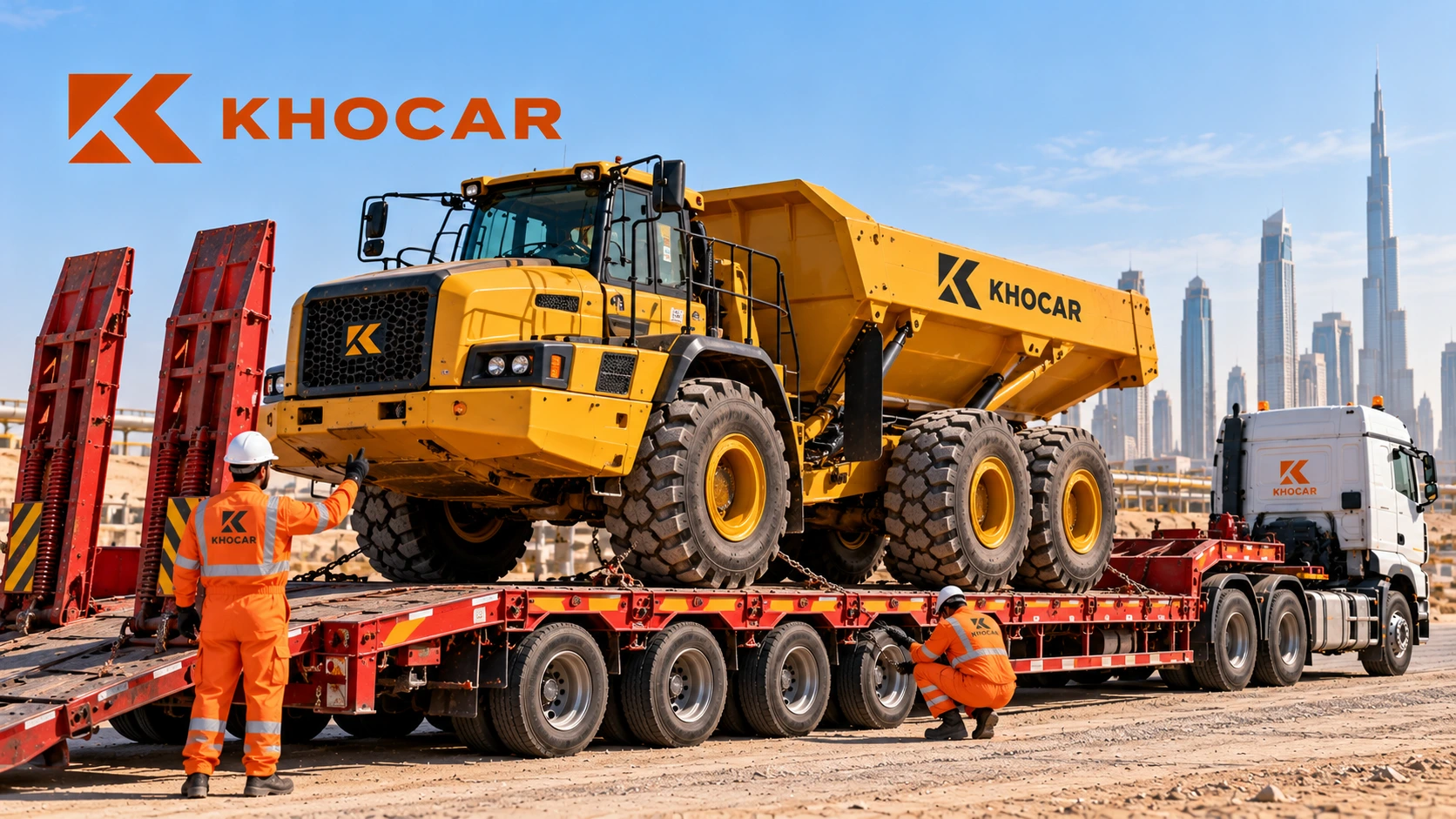
Transporting an articulated dump truck is not the same as moving a standard road truck. These machines are built for rough terrain, high payloads and demanding site conditions, and their overall dimensions, operating mass, axle arrangement and articulation joint can create a complex transport profile. For contractors arranging articulated dump truck transport UAE, the first task is to establish the exact machine configuration and confirm that the selected lowbed, loading method and route can accommodate it safely and legally.
A successful move starts well before the truck reaches the trailer. Transport planners need the manufacturer’s shipping dimensions and mass, the condition of the machine, suitable loading access, verified tie-down points, trailer capacity and axle-load distribution. They also need to check route restrictions, permits where applicable, overhead and side clearances, timing restrictions and site entry conditions. A route that works for a conventional tipper or smaller machine may not be suitable for a large articulated dump truck.
This guide explains how to plan articulated dump truck transport in the UAE, choose a suitable lowbed, prepare the machine, manage loading and securing, and coordinate delivery. Actual requirements depend on the specific model, transport configuration, emirate, road authority and site. Use the machine manual, approved transport plan and applicable authority instructions as the controlling references.
Key Takeaways
- Identify the exact articulated dump truck model, operating configuration, transport mass and dimensions before selecting a trailer.
- Lowbed selection must account for deck height, usable deck length, width, payload rating, axle group capacity, approach angle and loading method.
- Articulated steering and a central oscillation joint affect machine positioning and stability. Follow the manufacturer’s instructions for transport preparation and articulation restraint where specified.
- Secure the machine only at approved tie-down points using rated equipment and a documented restraint plan. Do not rely on the parking brake alone.
- Check the complete loaded combination, including tractor, trailer, machine, axle loads, overall dimensions, ground clearance and route restrictions.
- Confirm current permit, escort, timing and route requirements with the relevant UAE authority and transport provider. Rules can vary by emirate and movement.
- Document pre-loading inspection, loading checks, securement, dispatch release and delivery condition.
Why Articulated Dump Truck Transport Needs Special Planning
An articulated dump truck (ADT) usually has a front tractor section and a rear dump-body section connected through an articulation joint. Depending on the design, the joint permits steering and relative movement between the sections, while an oscillation feature helps the machine maintain wheel contact on uneven ground. The machine’s geometry differs from a rigid-frame dump truck, and the transport plan must account for those design features.
Dimensions and mass vary significantly by model
An ADT’s empty transport mass, overall length, width, height and axle loads vary by manufacturer, model, tyre configuration, body arrangement and fitted equipment. A machine’s rated payload is not the same as its transport mass. Use the manufacturer’s specification or machine-specific shipping data, including any attachments, accessories, fuel and removable equipment that will remain on board.
Articulation changes loading and restraint considerations
The joint allows the front and rear sections to move relative to each other during operation. For transport, the machine should be positioned and restrained in the configuration specified by the manufacturer. If a transport lock or articulation restraint is supplied, confirm its condition and use it as directed. Do not assume the joint can be left free, or that an improvised restraint is acceptable.
Off-road capability does not guarantee road transport suitability
ADT tyres, ground clearance and traction help the machine operate on rough terrain, but they do not remove the need to verify ramp capacity, loading surface, approach angle and traction during loading. A machine that works well on a construction site may still be difficult to load onto a lowbed with a steep transition or limited approach space.
Step 1: Collect Machine Transport Data
Before requesting a lowbed, create a transport data sheet for the exact machine. Do not plan from a product family name alone.
- Manufacturer, model, serial or fleet identification and year where available.
- Transport mass in the planned configuration, not rated payload or gross operating capacity alone.
- Overall transport length, width and height, including mirrors, exhaust, beacon, body position and any protruding components.
- Axle configuration, wheelbase, tyre dimensions and any manufacturer data relevant to load distribution.
- Fuel level, loose equipment, removable accessories and items that need to be detached or secured.
- Manufacturer instructions for travel, towing, lifting, tie-down points, articulation lock and transport preparation.
- Known defects, tyre condition, brake condition, steering condition and any restrictions affecting loading or movement.
If a specification sheet gives several dimensions, confirm which applies to the machine as it will be transported. A raised body, raised exhaust, non-standard tyres or fitted options can change the transport envelope. If reliable dimensions or mass cannot be confirmed, obtain them before dispatch rather than relying on visual estimates.
Step 2: Select a Suitable Lowbed Trailer
A lowbed or low-loader trailer can reduce the loaded combination’s overall height by carrying the machine on a low deck. However, not every lowbed is suitable for every ADT. The selection must be based on verified machine data, trailer specifications, loading geometry and route requirements.
| Selection factor | What to verify | Why it matters |
| Payload capacity | Trailer and tractor ratings, including actual permitted combination limits. | The machine’s transport mass must be within the rated and legally permitted capacity. |
| Deck length | Usable deck length and axle positions with the machine correctly positioned. | The truck must fit without unsafe overhang or an unsuitable load distribution. |
| Deck width | Deck width, tyre placement and any permitted overwidth arrangement. | Tyres and body must be supported, and total width must comply with the movement plan. |
| Deck height and loaded height | Deck height plus the machine’s highest point in transport configuration. | The complete combination must clear bridges, overhead lines, signs and other structures. |
| Ramp and approach geometry | Ramp length, angle, transition points, surface and load rating. | Steep ramps or abrupt transitions can cause grounding, loss of traction or loading damage. |
| Axle groups and suspension | Axle ratings, load distribution, tyre ratings and suspension configuration. | Loads must be distributed within equipment ratings and applicable road limits. |
| Securement points | Rated anchor points and a feasible restraint layout. | Tie-down equipment needs suitable geometry and verified attachment locations. |
| Route and maneuverability | Turning radius, trailer combination length, ground clearance and road restrictions. | A combination that fits the deck may still be unable to traverse the intended route. |
Check loaded height, not just trailer deck height
Loaded height is the deck height plus the highest point of the ADT in its transport configuration. Check it against the route’s actual clearance information and required margin. Do not rely on a general map or an assumption that a highway route has sufficient clearance. Route surveys may be needed where the load is tall or the road environment is uncertain.
Confirm axle loads and load distribution
The machine’s weight must be distributed across the trailer and tractor within their ratings and applicable limits. Placement affects kingpin or fifth-wheel loading, trailer axle group loads and steering axle load. The transport provider should use the relevant weight and configuration data to plan positioning and, where necessary, verify the arrangement using suitable weighing or engineering methods.
Consider detachable gooseneck and alternative trailer designs
Depending on machine mass, loading access and trailer availability, a detachable gooseneck or another heavy-haul configuration may be considered. The choice should be made from the machine’s dimensions, loading method, axle loading and route. Do not select a trailer solely because it has a low deck or a high advertised payload.
Step 3: Plan the UAE Route and Required Approvals
Route planning for heavy equipment transport in the UAE should be confirmed for the actual vehicle combination, cargo dimensions, origin, destination and travel date. Requirements can differ between emirates, road types and types of oversize or overweight movement. A general statement that a permit is always required, or never required, would be unreliable without those details.
Check permits and authority requirements
Ask the transport provider to identify the competent authority for each road segment and confirm any permit, route approval, escort, movement window or notification requirement. The UAE Government road safety information provides general road-safety context, but it does not replace route-specific heavy-transport approval.
For Abu Dhabi movements, consult Abu Dhabi Mobility for current authority information and applicable restrictions. For other emirates, confirm requirements with the relevant authority and road operator. Retain permit copies and the approved route with the dispatch file.
Survey route constraints
- Bridge and culvert restrictions, posted limits and any known structural limitations.
- Overhead bridges, gantries, signs, cables and other vertical-clearance constraints.
- Road width, lane restrictions, temporary works, construction zones and narrow access points.
- Roundabouts, sharp turns, junction geometry, median openings and trailer off-tracking.
- Gradients, ramps, speed humps, uneven surfaces and locations with limited ground clearance.
- Time-of-day restrictions, congestion, escort coordination and safe stopping locations.
- Destination gate width, turning space, ground bearing capacity, unloading area and site access hours.
Check site-specific movement conditions
The delivery site may impose requirements beyond public-road rules, such as induction, PPE, designated routes, speed limits, spotters, vehicle checks and approved unloading zones. Confirm these requirements with the receiving site before dispatch. If the final access road is unpaved or uneven, inspect it for bearing capacity, slope, overhead obstructions and room to maneuver the loaded combination.
Step 4: Prepare the Articulated Dump Truck for Transport
Secure the dump body and movable equipment
Place the body and other movable components in the manufacturer-specified transport position. Confirm that the body is fully lowered and any body restraint or locking device is applied if the design requires one. Secure loose tools, fire extinguishers, accessories and other equipment so they cannot move during transit.
Inspect tyres, brakes and steering
Check tyre condition and inflation according to the manufacturer’s instructions, and inspect for cuts, damage or objects embedded in the tread. Confirm that the parking brake and required braking systems operate as intended. Any defect that affects loading, securing or transport should be assessed before the machine is moved.
Address articulation and isolation
Follow the specific operator manual for articulation lock use, steering isolation, battery isolation and other transport preparation steps. Some procedures may require the engine to be shut down, controls isolated or a specific lock fitted. The correct sequence varies by model. Never improvise around a steering or articulation system.
Remove or protect vulnerable protrusions
Identify mirrors, beacons, exhaust components, handrails or accessories that could exceed the transport envelope or be damaged by tie-down equipment. Remove or protect components only as permitted by the manufacturer, and include the final configuration in the dimension check.
Document the machine’s condition
Take dated photographs of the body, tyres, glass, lights, steps, handrails, visible damage and accessories before loading. Record existing defects and loose or missing items with the responsible parties. A documented condition check helps resolve disputes and supports safe handover.
Step 5: Prepare the Loading Area and Equipment
Loading should take place on a firm, stable and suitably level surface with adequate space for the tractor, trailer, ADT and support personnel. Check the surface for soft shoulders, loose material, potholes, standing water, slope or other conditions that could affect ramp stability and traction.
- Confirm the trailer is positioned and secured according to the loading procedure, with the tractor and trailer configuration appropriate for loading.
- Verify ramps, deck, supports and any loading aids are rated for the machine and loading configuration.
- Keep the loading route clear of personnel, unrelated vehicles and obstructions.
- Agree a single designated signaler and reliable communications between operator, driver and ground crew.
- Check lighting, visibility, weather and surface conditions before starting.
- Confirm the machine operator is competent and familiar with the loading procedure.
- Use the designated exclusion zone and stop work if communications or stability are uncertain.
Never rely on improvised ramps, unverified supports or a trailer’s appearance to judge capacity. If the loading area is not suitable, reposition the equipment or prepare an engineered alternative before moving the machine.
Step 6: Load the ADT onto the Lowbed
Use the approved loading method
The loading sequence should follow the transport plan, trailer design and machine manual. Depending on the configuration, the ADT may be driven onto the trailer or loaded by another engineered method. Confirm that the approach angle, ramp surface and transitions are compatible with the machine’s ground clearance and wheel geometry.
Maintain controlled movement
Move at a controlled speed, avoid abrupt steering or braking, and follow the designated signaler’s instructions. Keep personnel out of the machine’s path and away from pinch points. Stop immediately if the machine loses traction, the ramps move, the trailer shifts or the operator loses visual or radio communication.
Position the machine for the planned load distribution
Positioning should follow the load calculation and trailer plan, not simply place the machine at the center of the deck. The ADT’s axle distribution, articulation geometry, body position and trailer axle groups affect the final loading. If the planned position cannot be achieved safely, stop and have the transport lead reassess the arrangement.
Lower, secure and recheck
Once the machine is in position, apply the specified parking and isolation procedures, lower movable equipment, and install any transport lock required by the manufacturer. Before personnel approach the machine to attach restraints, confirm that it is stable and cannot move unexpectedly. The transport supervisor should authorize the next step.
Step 7: Secure the ADT for Road Transport
Securement must be designed for the machine’s mass, expected transport forces, trailer anchor points and manufacturer-approved tie-down locations. Use rated chains, binders, straps or other equipment appropriate to the load and applicable standards. The number, rating, angle and placement of restraints should be set by the approved securement plan, not by a generic rule.
Use approved tie-down points
Use the manufacturer-designated tie-down points or other locations specifically approved for transport. Do not attach chains to steering cylinders, hydraulic lines, articulation components, thin bodywork or other parts not designed to take restraint loads. Protect vulnerable edges and prevent restraint equipment from damaging hoses, cables or painted surfaces.
Prevent rolling and movement
Use the planned restraint arrangement to prevent forward, rearward and lateral movement and to address vertical movement as required. Chocks or supplementary devices may be appropriate when included in the plan, but should not replace required tie-downs. The parking brake is a supplementary measure, not a substitute for mechanical securement.
Check articulation restraint
If the manufacturer provides a transport lock for the articulation joint, confirm it is installed and secured as directed. Verify that it is compatible with the selected tie-down layout and does not introduce a new hazard. Do not use the articulation joint or its hydraulic components as improvised anchor points.
Inspect the final restraint arrangement
- Confirm all restraint equipment is rated, undamaged, correctly connected and tensioned according to its instructions.
- Verify anchor points and attachment locations match the approved plan.
- Check that chains and binders cannot contact or damage hoses, wiring, tyres or fragile components.
- Ensure the machine and trailer have adequate clearance and no part is likely to shift into the tractor or trailer equipment.
- Recheck overall height, width, length, load position and axle-load assumptions after final positioning.
- Record photographs and the responsible person’s securement inspection before dispatch.
Step 8: Dispatch, En Route Checks and Delivery
Before leaving the loading site
Complete a dispatch review of permits and route documents, load securement, lighting, warning signs or flags where required, tyres, trailer connections, braking systems and communication arrangements. The driver should understand the route, restrictions, planned stops and emergency contacts. Do not dispatch until unresolved defects or approval gaps are closed.
En route monitoring
Follow the approved route and any permit conditions. Stop in a safe, designated location to inspect the load when the transport plan, authority conditions or equipment instructions require it. Recheck restraint tension and the condition of the load after a significant stop or event such as hard braking, severe road vibration or an unexpected route diversion. Do not conduct roadside adjustments in an unsafe location.
Unloading and handover
Before unloading, inspect the receiving area, trailer position, ground condition, ramps and available maneuvering space. Confirm that the unloading plan and communications are understood. Remove restraints only after the machine and trailer are stable and the procedure permits it. Record delivery condition, any damage, outstanding defects and the receiving party’s acceptance.
Common Transport Mistakes to Avoid
- Selecting a lowbed based only on advertised payload without checking actual deck dimensions, axle loads and route suitability.
- Using rated payload as a substitute for the ADT’s actual transport mass.
- Ignoring the highest point of the machine or assuming the body and accessories are in transport configuration.
- Leaving the articulation joint or dump body in a configuration not permitted by the manufacturer.
- Attaching restraints to components that are not designed for tie-down loads.
- Treating parking brakes or wheel chocks as a complete securement plan.
- Assuming one UAE emirate’s approval or route condition automatically applies to another.
- Loading on soft, sloping or unstable ground, or using unverified ramps.
- Failing to document machine condition, securement and delivery handover.
Illustrative Planning Example
A contractor needs to move an articulated dump truck from a plant yard to a remote construction project in another emirate. The machine’s rated payload is prominently shown in the brochure, but the transport planner does not use that figure to select the trailer. Instead, the team obtains the machine’s actual transport mass and dimensions in the intended configuration, including the dump body position, tyres and accessories.
The transport provider checks trailer payload and axle ratings, deck width and length, loaded height, ramp angle and the machine’s approved tie-down points. The route is reviewed for clearance, turning constraints, road restrictions and site access. Where permits or escorts may apply, the provider confirms the current requirements with the relevant authority before the move is scheduled.
At the loading yard, the team verifies the trailer and ground conditions, assigns a signaler, loads the machine under the approved procedure and positions it according to the load plan. The articulation restraint is installed if specified by the manufacturer, the machine is secured using rated equipment and the final dimensions are checked. Dispatch proceeds only after the documents and securement inspection are complete. The example illustrates a process, not a substitute for a machine-specific transport calculation.
Transport Planning Checklist
- Machine model, transport mass and dimensions verified.
- Manufacturer transport instructions and approved tie-down points reviewed.
- Lowbed capacity, deck dimensions, ramp geometry and axle loading checked.
- Loaded height, width, length, ground clearance and turning requirements reviewed.
- Route surveyed or validated; relevant permits, escort and timing requirements confirmed.
- Machine inspected and prepared; body, articulation and loose equipment secured as specified.
- Loading area, ramps, personnel roles and communication arrangements checked.
- Machine positioned according to the load plan and secured with rated equipment.
- Final restraint, dimensions, connections, permits and dispatch documents checked.
- Delivery access, unloading plan and handover records arranged.
Plan Your Articulated Dump Truck Transport with KHOCAR
Reliable articulated dump truck transport UAE starts with verified machine data, a suitable lowbed, a realistic route plan and a securement method built around the actual equipment. Confirm the loading procedure, axle distribution, articulation restraint, permits and site access before the move is scheduled. This reduces avoidable delays and helps the team identify transport risks before the truck reaches the loading ramp.
For heavy equipment transport planning and related lowbed requirements, visit KHOCAR’s lowbed trailer services or explore its oilfield services and industrial supplies. Share the machine model, dimensions, transport mass, origin and destination so the movement can be assessed against the actual job requirements.
FAQs
What trailer is best for articulated dump truck transport in the UAE?
The best trailer depends on the exact ADT’s transport mass, dimensions, axle distribution, loading access and route. A lowbed may suit many moves, but the transport provider must verify payload, deck size, ramp geometry, axle ratings and loaded height for the specific machine.
Can an articulated dump truck be driven onto a lowbed?
It may be driven onto a lowbed if the machine, trailer, ramp arrangement, surface and loading procedure are suitable. Follow the manufacturer’s instructions and the approved loading plan. Do not attempt loading on steep, unstable or unverified ramps.
How do I calculate the trailer capacity needed for an ADT?
Start with the machine’s actual transport mass in the intended configuration, then check trailer and tractor ratings, axle-group loads, load position and applicable legal limits. The machine’s rated payload is not its transport mass. A transport specialist should verify the combination and load distribution.
Does articulated steering need to be locked during transport?
Follow the specific manufacturer’s transport instructions. If the machine has a designated articulation or steering lock for transport, confirm whether it is required and install it as directed. Do not improvise a lock or use hydraulic components as tie-down points.
Do I need a permit to transport an articulated dump truck in the UAE?
Permit requirements depend on the loaded combination’s dimensions and weight, the route, emirate, road authority and movement conditions. Ask the transport provider to confirm current requirements for the exact trip before dispatch.
How should an articulated dump truck be tied down on a lowbed?
Use a documented restraint plan based on machine mass, approved tie-down points, trailer anchors and rated securement equipment. The arrangement must prevent movement in all relevant directions and follow manufacturer guidance and applicable requirements. Do not rely on the parking brake alone.
What should be checked before loading an articulated dump truck?
Confirm the machine’s transport data, body and articulation configuration, tyre and brake condition, ramp capacity and angle, loading surface, communication plan, trailer position and approved loading procedure.
How can I avoid overhead clearance problems during transport?
Calculate total loaded height using the actual trailer deck height and the highest point of the machine in transport configuration. Validate route clearances and any permit conditions, and survey uncertain sections before the move.
Can one transport approval be used throughout the UAE?
Do not assume so. Requirements can vary by emirate, road authority, route and movement. Confirm the approvals and restrictions that apply to every relevant part of the trip.
What records should be kept for heavy equipment transport?
Keep machine specifications, transport plan, permits and route approvals, loading inspection, securement photographs, dispatch checks, en route inspection records where required, and delivery condition and handover documentation.