
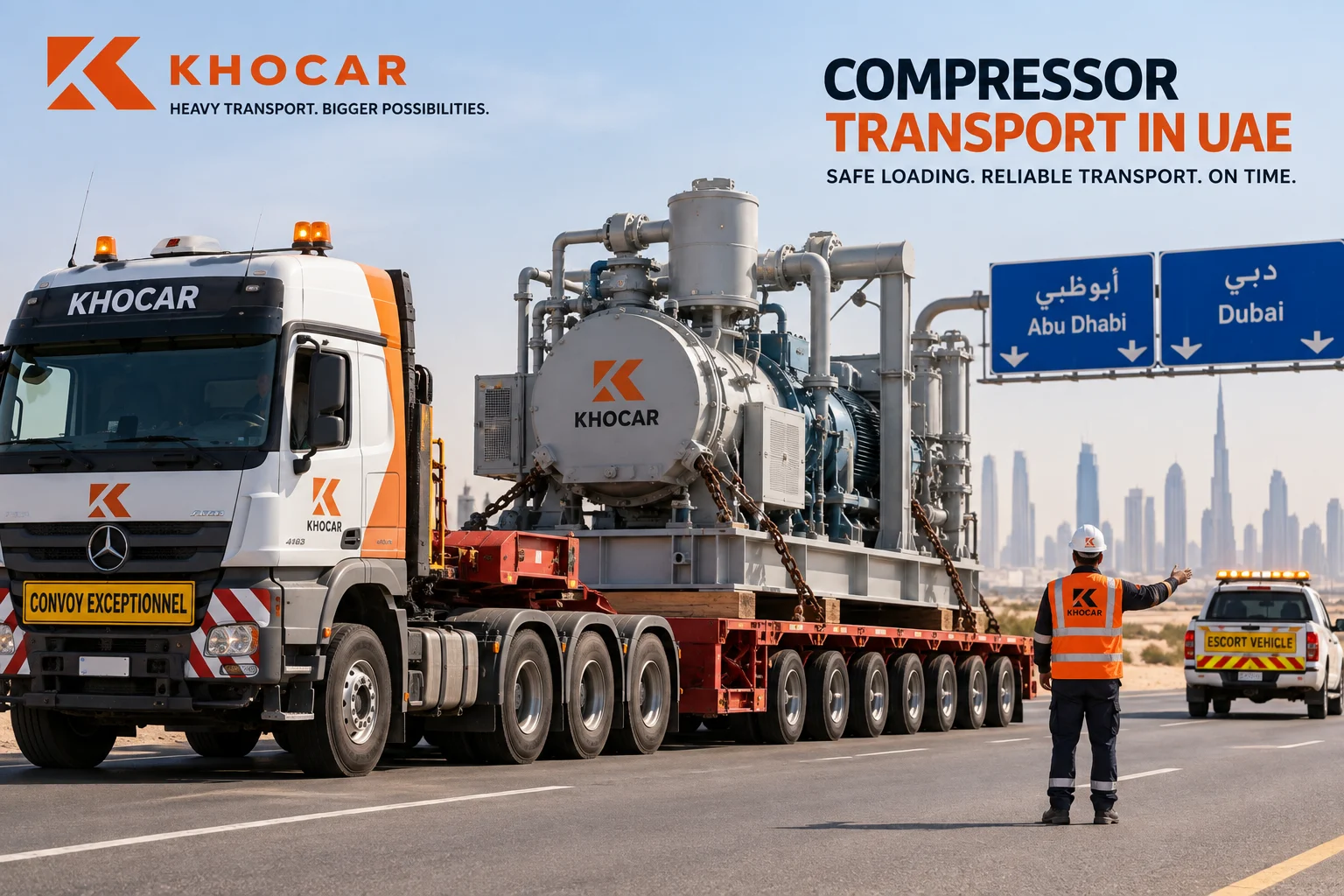
Moving a compressor across the UAE can look straightforward until the actual transport profile is calculated. A compressor may be heavy, tall, wide, unevenly loaded, difficult to lift, or sensitive to rough handling. Add a lowbed trailer, site access restrictions, route limitations, loading equipment, and possible permit requirements, and the job becomes a logistics exercise rather than a simple truck booking.
Good compressor transport UAE planning therefore starts before the trailer arrives: identify the compressor, confirm its weight and dimensions, select the right trailer, inspect the loading point, plan the route, and coordinate the delivery window. For Abu Dhabi projects, the plan also needs to account for the emirate’s commercial transport and heavy-vehicle controls.
This guide explains how contractors, oilfield companies, industrial operators, workshops, and project teams can plan compressor transportation in the UAE more systematically: from lowbed selection and loading to load securing, route planning, documentation, and final unloading.
Key Takeaways
- A compressor should be transported according to its actual weight, dimensions, center of gravity, condition, lifting points, and loading method—not simply by equipment name.
- A lowbed trailer is often useful for tall or heavy compressors because its lower deck can help manage overall transport height, but the correct axle configuration, capacity, deck length, ramps, and restraint points still have to be checked.
- The UAE regulates heavy-vehicle weights and dimensions. The published federal limits include maximum gross weights that vary by axle count and standard maximum dimensions; loads outside normal limits may require a special transportation permit.
- Abu Dhabi route planning must consider commercial transport permits and heavy-vehicle movement restrictions. Published restrictions have also been introduced for specific major roads, so the route should be checked close to the movement date.
- Safe loading requires a firm, level area, compatible lifting/handling equipment, controlled pedestrian access, appropriate anchor points, balanced weight distribution, and a documented pre-departure inspection.
- The fastest way to obtain a practical transport plan is to provide the compressor model, weight, full dimensions, pickup and delivery locations, loading method, photos, required date, and any site-access constraints in the first request.
1. Why Compressor Transport Requires More Planning Than a Standard Equipment Move
A compressor is not automatically an oversized load, and it is not automatically a routine load either. The transport method depends on the complete combination of compressor plus trailer. A compact workshop compressor may fit on a conventional truck, while a large industrial or oilfield compressor package may require a lowbed, multi-axle configuration, crane support, route planning, and special approvals.
The most important planning mistake is treating the transport as a distance problem. “Move this compressor from Abu Dhabi to Al Ain” does not tell a haulier whether the job is feasible. The transport team needs to know what the compressor weighs, how tall it is, where its weight is concentrated, whether it can be driven or must be lifted, whether accessories remain attached, and how the destination will receive it.
The UAE’s federal heavy-vehicle framework makes this particularly important. The Ministry of Energy and Infrastructure states that Cabinet Resolution No. 138 of 2023 regulates heavy-vehicle weights and dimensions on UAE roads. Published maximum gross weights vary by axle count, reaching 65 tonnes for six-axle heavy vehicles, while standard vehicle dimensions also have defined limits. Loads that exceed the normal limits may fall under the special transportation-permit provisions for non-divisible loads. See the Ministry’s published maximum heavy-vehicle weights and dimensions for the regulatory framework.
2. Start With the Compressor’s Transport Profile
Before choosing a trailer, build a transport profile. This is the information the logistics team will use to determine trailer capacity, loading method, restraint strategy, route constraints, and whether additional coordination is needed.
2.1 Confirm the Weight
Use the manufacturer’s data plate, technical manual, certified weighing record, or project documentation where available. Distinguish between dry weight and transport weight. A compressor package may include a frame, motor, receiver, separator, cooler, skid, control panel, piping, fluids, guards, and accessories. Removing or adding components can materially change the transport weight.
Do not assume the advertised equipment weight is the final transport weight. For a skid-mounted compressor, ask whether the quoted mass includes the complete skid and all permanently mounted equipment. If the compressor has been modified for an oilfield application, use the actual configuration being moved.
2.2 Record Length, Width, Height and Ground Clearance
Measure the compressor in its transport configuration. Height should be measured from the lowest supporting surface to the highest fixed point. Width should include protruding components that cannot be removed. Length should account for frames, pipework, guards, lifting structures, or other permanent projections.
| Measurement | Why It Matters | What to Record |
| Weight | Trailer capacity, axle loading, permits and stability | Exact or verified estimated transport weight |
| Length | Deck fit, overhang and turning requirements | Overall transport length in metres |
| Width | Road clearance and oversize assessment | Maximum width including fixed projections |
| Height | Total loaded height and overhead clearance | Compressor height plus trailer deck height |
| Ground clearance | Ramp angle and loading risk | Lowest point and underside clearance |
2.3 Identify the Center of Gravity and Lifting Points
A compressor package may not be evenly weighted. The motor, receiver, engine, cooler, or other components can create a high or offset center of gravity. If the equipment must be crane-loaded, the lifting plan should use manufacturer-designated lifting points or an engineered method appropriate to the load.
The UK Health and Safety Executive’s guidance on machine lifting emphasizes identifying the center of gravity for unbalanced loads, using suitable lifting equipment, considering sling angles, and using competent people for lifting operations. These principles are useful when planning a compressor loading operation even though UAE legal requirements must be followed for the actual job. See HSE guidance on [safe lifting by machine](https://www.hse.gov.uk/work-equipment-machinery/lift-equipment.htm).
3. Choosing the Right Lowbed Trailer for a Compressor
A lowbed trailer is often a practical option for large compressors because the deck sits lower than many conventional trailer configurations. That can create additional vertical clearance and make tall industrial machinery easier to move. However, “lowbed” describes a family of configurations rather than one universal specification.
3.1 Match Trailer Capacity to the Actual Load
The trailer should be selected for the compressor’s actual transport weight and how that weight is distributed. A trailer with sufficient nominal capacity is not necessarily appropriate if the compressor concentrates load over a small section of the deck or creates an axle-loading problem.
3.2 Check Deck Length and Width
The compressor should sit securely within the usable deck area, with any overhang understood before dispatch. The deck width must accommodate the load and leave a practical path for securing equipment. If the compressor is wider than normal road dimensions, the transport provider should identify that early rather than discovering it at the gate.
3.3 Consider Deck Height and Overall Loaded Height
For tall compressor packages, deck height is a route-planning variable. The relevant measurement is not the compressor height alone; it is the combined height of the compressor and trailer in the final transport configuration. This total should be compared with the route’s known clearance constraints and any permit conditions.
3.4 Consider Axle Configuration and Weight Distribution
The trailer’s axle arrangement affects how the load is carried. A heavy compressor may require a different configuration from a smaller industrial unit. Weight distribution should be considered before loading so that the equipment is not simply placed where it “fits” on the deck.
KhoCAR’s [Lowbed Trailers UAE service](https://services.khocar.com/lowbed-trailers-uae/) describes lowbed solutions for industrial equipment, generators, compressors, cranes and other heavy or oversized machinery, with route planning and transport coordination as part of the service.
3.5 Use the Compressor’s Condition to Choose the Loading Method
A running compressor may be capable of self-loading only in unusual circumstances and should not be assumed to be suitable for driving onto a trailer without a task-specific assessment. Many stationary industrial compressors are loaded with a crane, while skid-mounted packages may use ramps, winches, or other controlled methods depending on their design and site conditions.
4. Preparing the Compressor Before Loading
Preparation reduces both loading risk and transit problems. The compressor should arrive at the loading point in a condition suitable for lifting and transport.
- Confirm whether the compressor is operational or non-operational.
- Remove loose tools, panels, hoses, accessories and unsecured items that could fall during transit.
- Secure doors, guards, covers and other components according to the equipment manufacturer’s instructions.
- Check whether fluids must be drained or isolated for the particular equipment and transport arrangement.
- Protect exposed gauges, controls, pipework, electrical connections and other vulnerable components.
- Identify manufacturer-designated lifting points and confirm that they are accessible.
- Check the compressor skid or frame for visible damage that could affect lifting or securing.
- Take photographs of the compressor before loading, including the nameplate and lifting points.
- Provide the haulier with accurate dimensions and the transport weight before dispatch.
If the compressor is an oilfield or industrial package, documentation can also be part of the handover. A transport file may include equipment identification, weight and dimensions, lifting information, site contacts, delivery instructions and any permit or access documentation required by the project.
5. How to Load a Compressor Onto a Lowbed Trailer
The loading operation should be planned as a controlled lifting or vehicle-movement task rather than improvised after the trailer arrives. The loading area should be firm and level, traffic and pedestrians should be separated from the operation, and the handling equipment should be suitable for the load.
HSE guidance on [safe loading and unloading](https://www.hse.gov.uk/workplacetransport/factsheets/loading.htm) recommends level, firm loading areas, controlled access, even load distribution and secure loads. It also highlights the need to agree loading arrangements in advance when more than one company is involved.
5.1 Prepare the Loading Area
- Use a firm, level surface capable of supporting the trailer and lifting equipment.
- Keep unrelated vehicles and pedestrians outside the loading zone.
- Check for overhead power lines, pipework, structures and other clearance hazards.
- Confirm the trailer is positioned and immobilized before loading begins.
- Ensure ramps, crane access, forklifts or other handling equipment are compatible with the compressor.
5.2 Use the Correct Lifting Equipment
If a crane is used, the lifting plan should account for the compressor’s weight, center of gravity, lifting points, sling arrangement, boom configuration, radius and ground conditions. The crane should not be selected simply because its headline lifting capacity exceeds the compressor weight; the actual lift configuration matters.
5.3 Position the Compressor for Stability
The compressor should be positioned so that the trailer remains stable and the load can be restrained effectively. Avoid loading decisions based solely on where the compressor fits. The position should account for axle loading, center of gravity, deck structure, restraint points, route conditions and the manufacturer’s transport requirements.
5.4 Protect the Compressor During Loading
Use appropriate packing, chocks, protective materials or engineered supports where required. Avoid dragging the compressor across the deck if doing so could damage the skid, frame or trailer. The loading crew should keep people clear of suspended loads and pinch points.
6. Securing the Compressor for Road Transport
Securing is a separate engineering decision from loading. Once the compressor is in position, the restraint system must control movement under braking, acceleration, cornering and road irregularities. The restraint method should be appropriate to the compressor’s frame, anchor points, weight and configuration.
HSE’s [load-security guidance](https://www.hse.gov.uk/logistics/load-security.htm) states that transported goods should be secured to the vehicle and that risks around loading, unloading, vehicle-pedestrian separation and falling loads should be managed. Its guidance on [securing loads](https://www.hse.gov.uk/workplacetransport/vehicles/securingloads.htm) also stresses the importance of strong, compatible anchor points and suitable securing equipment.
| Pre-Departure Check | What to Verify |
| Restraints | Chains, straps, bolts or other restraints are suitable and correctly installed |
| Anchor points | Trailer anchor points are compatible with the restraint system |
| Weight distribution | Compressor position does not create an avoidable axle-loading or stability issue |
| Loose items | No tools, covers, panels or accessories can shift during transit |
| Clearance | Total height and width are known in the final transport configuration |
| Protection | Sensitive components are protected from impact, movement and weather as required |
| Documentation | Transport, access and permit documents are available to the driver/team |
Do not improvise restraints from unsuitable materials. The goal is not to make the compressor look tied down; it is to create a restraint system capable of controlling the load throughout the planned journey.
7. UAE Weight, Dimension and Permit Considerations
Compressor transport UAE planning should distinguish between a heavy vehicle’s legal limits and the physical capability of the trailer. A trailer may be technically capable of carrying a compressor while the resulting vehicle-and-load combination still requires special approval because of weight, width, height, length or route conditions.
The Ministry of Energy and Infrastructure’s published information on Cabinet Resolution No. 138 of 2023 states that maximum gross weights vary by axle count: 21 tonnes for two axles, 34 tonnes for three, 45 tonnes for four, 56 tonnes for five and 65 tonnes for six. It also lists standard maximum dimensions for several heavy-vehicle combinations. For loads that are not easily divisible, the framework allows an exception above standard limits only after a special transportation permit is obtained and the stated conditions are satisfied. Read the [federal heavy-vehicle weight and dimension guidance](https://www.moei.gov.ae/en/media-center/news/31/1/2024/table-of-maximum-weights-and-dimensions-of-heavy-vehicles-on-federal-roads-announced) before treating a compressor movement as routine.
The exact approval path can depend on the route, emirate, vehicle, load and transport operator. This article is therefore a planning guide, not a substitute for checking the applicable authority requirements for a specific movement.
8. Abu Dhabi Route Planning for Heavy Compressor Transport
For heavy compressor transport Abu Dhabi projects, route planning can affect the schedule as much as the trailer itself. A route that looks shortest on a map may not be the best route for a heavy or oversized combination because of road restrictions, bridge conditions, clearances, traffic peaks, industrial-area access or project gate requirements.
8.1 Check Commercial Transport Requirements
Abu Dhabi Mobility states that its Asateel platform is used for commercial transport activities including freight transport. The platform supports company, vehicle and driver permits, and the authority states that vehicles must have functioning approved tracking devices for applicable permits. See the official [Commercial Transport and Asateel information](https://admobility.gov.ae/en/digital-services/commercial-transport) when planning an Abu Dhabi freight movement.
8.2 Check Heavy-Vehicle Movement Restrictions
Abu Dhabi Mobility announced in January 2025 that heavy vehicles, including trucks, tankers and heavy equipment, would be restricted on Abu Dhabi city roads Monday through Thursday from 6:30–9:00 AM and 3:00–7:00 PM, with different Friday restrictions. Because restrictions can be updated, the published times should be treated as a reference point rather than a permanent timetable. Check current authority instructions and road signage immediately before dispatch. The original [Abu Dhabi Mobility heavy-vehicle movement announcement](https://admobility.gov.ae/en/news/update-to-restricted-movement) provides the published schedule and effective date.
8.3 Check Route-Specific Restrictions
Route restrictions can also be more specific than general city-wide movement windows. In November 2025, Abu Dhabi Mobility announced restrictions affecting Sheikh Maktoum bin Rashid Road (E11), Al Raha Beach Road (E10), and peak-hour truck movement on part of Al Rawdah Road in the Musaffah area, with alternative routes identified for heavy vehicles. This is a good example of why route planning should use current authority information rather than relying on an old route plan. See the [Abu Dhabi Mobility announcement on the E10, E11 and Musaffah restrictions](https://admobility.gov.ae/en/news/itc-bans-truck-movement-on-sheikh-maktoum-bin-rashid-road-and-al-raha-beach-road).
8.4 Plan the Route Around the Load, Not Just the Truck
For a compressor, route planning should evaluate the loaded vehicle’s overall height, width, length and weight. Consider bridge and overhead clearances, tight turns, industrial-zone gates, construction detours, roadworks, traffic restrictions and the final approach to the site.
- Confirm pickup and delivery coordinates rather than relying on the city name.
- Check the final 1–5 km of the route as carefully as the highway portion.
- Confirm whether the destination gate accepts lowbeds at the proposed time.
- Check whether the site has turning space for the tractor-trailer combination.
- Coordinate any escorts, access passes or site inductions in advance.
- Reconfirm route restrictions close to dispatch, especially for Abu Dhabi movements.
9. Planning the Pickup and Delivery Windows
Transport schedules often fail at the site rather than on the road. A trailer can reach the correct industrial area and still lose hours because the compressor is not ready, a crane is unavailable, a gate pass has not been approved, or the unloading area is occupied.
9.1 Pickup Readiness
- Compressor is fully prepared and accessible.
- Loading equipment and competent operators are present.
- Site contact is available when the driver arrives.
- Gate pass, induction and access documents are ready.
- The loading zone is clear and level.
- The final compressor dimensions and weight match the transport booking.
9.2 Delivery Readiness
- The receiving site has a confirmed unloading area.
- The crane, forklift or other handling equipment is booked if required.
- The delivery contact is available.
- The site has enough room to position the lowbed safely.
- Any project-specific PPE, induction or security requirements are understood.
- The receiving team knows the compressor’s approximate arrival window.
10. A Practical Example: Moving an Industrial Compressor From Musaffah
Consider a hypothetical skid-mounted industrial compressor moving from a Musaffah workshop to an industrial project site elsewhere in Abu Dhabi. The compressor is not self-propelled and must be crane-loaded. Its dimensions and weight place the combination near the project’s transport planning limits.
A weak transport request would simply say: “Need lowbed from Musaffah to site tomorrow.” A stronger request provides the compressor’s model, transport weight, length, width and height; photographs; pickup gate; delivery coordinates; crane availability; desired movement window; and site contact.
The transport team can then evaluate the appropriate lowbed configuration, loading arrangement, restraint points, route, permit questions and delivery timing. If the route intersects a restricted road or movement window, the team can address that before dispatch rather than after the compressor is already loaded.
This example illustrates an important principle: the quality of the first transport brief often determines how much rework is needed later.
11. Common Compressor Transport Mistakes in the UAE
11.1 Booking by Distance Alone
A short route can still be difficult if the compressor is tall, wide, heavy or difficult to load. Distance is only one variable.
11.2 Using the Compressor’s Dry Weight
If the transport configuration includes additional equipment, the dry weight may understate the actual load. Confirm what is included in the quoted weight.
11.3 Choosing the Trailer Before Measuring the Load
Trailer selection should follow the compressor’s transport profile. Choosing a trailer first and trying to make the compressor fit afterward reverses the correct planning sequence.
11.4 Leaving Route Restrictions Until Dispatch Day
A route that worked for another truck last month may not be appropriate for today’s heavy combination. Authority restrictions and project access conditions can change.
11.5 Ignoring the Final Site Approach
The last kilometre can be the hardest part. Tight turns, gates, soft shoulders, construction barriers or limited unloading space can prevent a lowbed from reaching the planned unloading point.
11.6 Treating Load Securing as an Afterthought
Restraint planning should happen before loading. The compressor’s frame and the trailer’s anchor points need to work together; improvised restraints can create avoidable risk.
11.7 Failing to Coordinate Loading and Unloading Companies
If the transporter, crane contractor and receiving site are different companies, responsibilities should be agreed before the vehicle arrives. HSE guidance similarly recommends advance coordination when multiple companies are involved in loading and unloading.
12. Compressor Transport UAE Checklist
| Planning Item | Information to Confirm |
| Compressor identification | Make, model, package type and operating condition |
| Transport weight | Verified weight or reliable manufacturer/project documentation |
| Dimensions | Overall L × W × H plus ground clearance |
| Center of gravity | Known or assessed for lifting and placement |
| Lifting points | Manufacturer-designated points or approved lifting method |
| Trailer | Capacity, deck size, deck height and axle configuration |
| Loading | Crane, ramp, winch, forklift or self-loading arrangement |
| Securing | Anchor points, restraints and protection method |
| Pickup | Exact address, gate, site contact and readiness |
| Delivery | Exact address, unloading area, handling equipment and contact |
| Route | Road suitability, restrictions, clearances and final access |
| Permits | Applicable heavy-vehicle, commercial transport or special movement approvals |
| Timing | Movement window, site hours and contingency |
| Documents | Equipment data, access documents and transport approvals |
13. How to Request a Compressor Transport Quote Faster
A complete request helps a transport provider evaluate the job without several rounds of questions. Send the following in one message:
- Compressor type and make/model.
- Actual or verified estimated transport weight.
- Overall length, width and height.
- Pickup address or map pin.
- Delivery address or map pin.
- Whether the compressor can move under its own power.
- Loading method and whether a crane or forklift is available.
- Unloading method and destination handling equipment.
- Required date and preferred movement window.
- Photos of the compressor from multiple sides, including the nameplate where possible.
- Any known oversize, access, permit, security or site restrictions.
KhoCAR’s [lowbed trailer booking checklist](https://services.khocar.com/details-to-book-a-lowbed-trailer-in-the-uae/) provides a similar information framework for heavy equipment movements, including equipment type, weight, dimensions, pickup and drop-off details, loading method, timing, site access and photos.
14. How KhoCAR Supports Heavy Equipment Transport in the UAE
For contractors and industrial teams that need compressor transportation UAE support, the practical objective is not simply to find a trailer. The objective is to coordinate the trailer, driver, loading plan, route, site access and delivery sequence around the equipment.
KhoCAR’s [Lowbed Trailers UAE](https://services.khocar.com/lowbed-trailers-uae/) service covers heavy and oversized equipment transport across the UAE and specifically lists compressors among the industrial equipment it can transport. The service page also describes route planning, transport coordination and experienced drivers for heavy machinery movements.
For jobs where the main question is whether a lowbed movement needs route approval or special permits, KhoCAR also publishes a guide to [heavy equipment transport permits and lowbed route approval in the UAE](https://services.khocar.com/heavy-equipment-transport-permits-uae/). For a project-specific transport requirement, providing complete compressor details early allows the transport team to assess the job more accurately.
Plan Your Compressor Transport Before Dispatch Day
If you need compressor transport in Abu Dhabi or anywhere in the UAE, start with the equipment details rather than a generic truck request. Share the compressor’s weight, dimensions, pickup and delivery locations, loading method, photos and required movement date. That gives the transport team the information needed to evaluate lowbed selection, loading, securing, route planning and site coordination.
For heavy compressor transport, industrial equipment movement or oversized machinery logistics, visit KhoCAR’s Lowbed Trailers UAE service to discuss the transport requirement and arrange the appropriate support.
FAQs
What is the best trailer for transporting a compressor in the UAE?
A lowbed trailer is often suitable for large or tall compressors because its lower deck can help manage overall transport height. The correct choice still depends on the compressor’s weight, dimensions, axle-loading requirements, deck fit, loading method and route.
Can an air compressor be transported on a lowbed trailer?
Yes, many industrial and heavy air compressors can be moved on lowbed trailers when the trailer configuration, load capacity, dimensions, securing method and route are suitable. Smaller compressors may not need a lowbed.
How do I calculate the transport height of a compressor?
Measure the compressor from the supporting base to its highest fixed point, then add the lowbed’s loaded deck height. The resulting overall loaded height is the figure that matters for route-clearance planning.
Do compressors need to be drained before transport?
Not necessarily in every case. Whether fluids should be drained or isolated depends on the compressor design, manufacturer instructions, transport configuration and project requirements. Confirm the correct preparation procedure before loading.
Do I need a permit to transport a compressor in the UAE?
Not every compressor movement automatically requires a special permit. Permit requirements depend on the vehicle, load, dimensions, weight, route, emirate and applicable restrictions. Loads exceeding normal weight or dimension limits may require special transportation approval.
What information should I give a compressor transport company?
Provide the compressor make/model, transport weight, length, width, height, pickup and delivery locations, loading and unloading methods, photos, required date and time, site-access details, and any known permit or route restrictions.
How is a compressor secured on a lowbed trailer?
The restraint method should be selected according to the compressor’s frame, weight, center of gravity and the trailer’s anchor points. Appropriate chains, straps, bolts, chocks or other engineered restraints may be used depending on the load; the system should be checked before departure.
Can a non-running compressor be transported?
Yes. A non-running compressor can be transported, but the loading plan may require a crane, winch, forklift or other handling equipment. The transport provider should know that the equipment is non-operational before dispatch.
How far in advance should I arrange compressor transportation in the UAE?
There is no universal lead time because availability, route complexity, permits and site readiness vary. Earlier planning is especially useful for heavy or oversized compressors because trailer selection, route checks, access approvals and lifting arrangements may require coordination.
Can a compressor be transported between Abu Dhabi and Dubai?
Yes, inter-emirate compressor transport is possible, subject to the applicable vehicle, load, route, permit and movement requirements. The final route should be checked for current restrictions and the destination’s access conditions.
What causes delays when transporting compressors?
Common causes include inaccurate weight or dimensions, wrong trailer selection, missing permits or access approvals, unavailable loading equipment, restricted movement windows, poor site access, incomplete securing plans and a destination that is not ready to unload.
Does compressor size affect the transport route?
Yes. The compressor’s loaded height, width, length and weight can affect route selection. Tall or wide loads may face clearance, road-access or permit constraints that do not apply to standard equipment.
Is lowbed trailer transport suitable for oilfield compressors?
It can be suitable for many skid-mounted or heavy oilfield compressor packages. The specific trailer, loading method, securing arrangement and route should be selected from the equipment’s actual transport profile and the project’s site requirements.
What should be checked before a lowbed leaves the pickup site?
Confirm that the load is correctly positioned and secured, loose items are removed, dimensions are known, restraints and anchor points are properly installed, access and permit documents are available, and the load has not shifted during loading.
Can the same lowbed be used for every compressor?
No. Compressors differ substantially in weight, dimensions, center of gravity, skid design and loading requirements. Trailer capacity, deck dimensions, axle configuration and route constraints should be checked for each movement.
Why is route planning important for compressor transport in Abu Dhabi?
Heavy-vehicle movement in Abu Dhabi is subject to commercial transport controls and published road restrictions. Specific roads can also have restrictions or alternative routes. Checking current authority information helps avoid unsuitable routes and timing conflicts.
What photos should I send for a compressor transport quote?
Useful photos include front, rear and side views, the nameplate, lifting points, skid or frame, any protruding equipment, and the loading area. Photos of access gates and tight site approaches can also help with planning.
How can I get a faster compressor transport quote in the UAE?
Send the complete transport profile in the first message: equipment type, model, weight, dimensions, pickup and delivery points, loading method, unloading method, photos and required date. This reduces back-and-forth and lets the provider assess the job more efficiently.
Planning note: Road restrictions, permit procedures and site requirements can change. Confirm the current authority requirements and project-specific conditions before dispatch.