
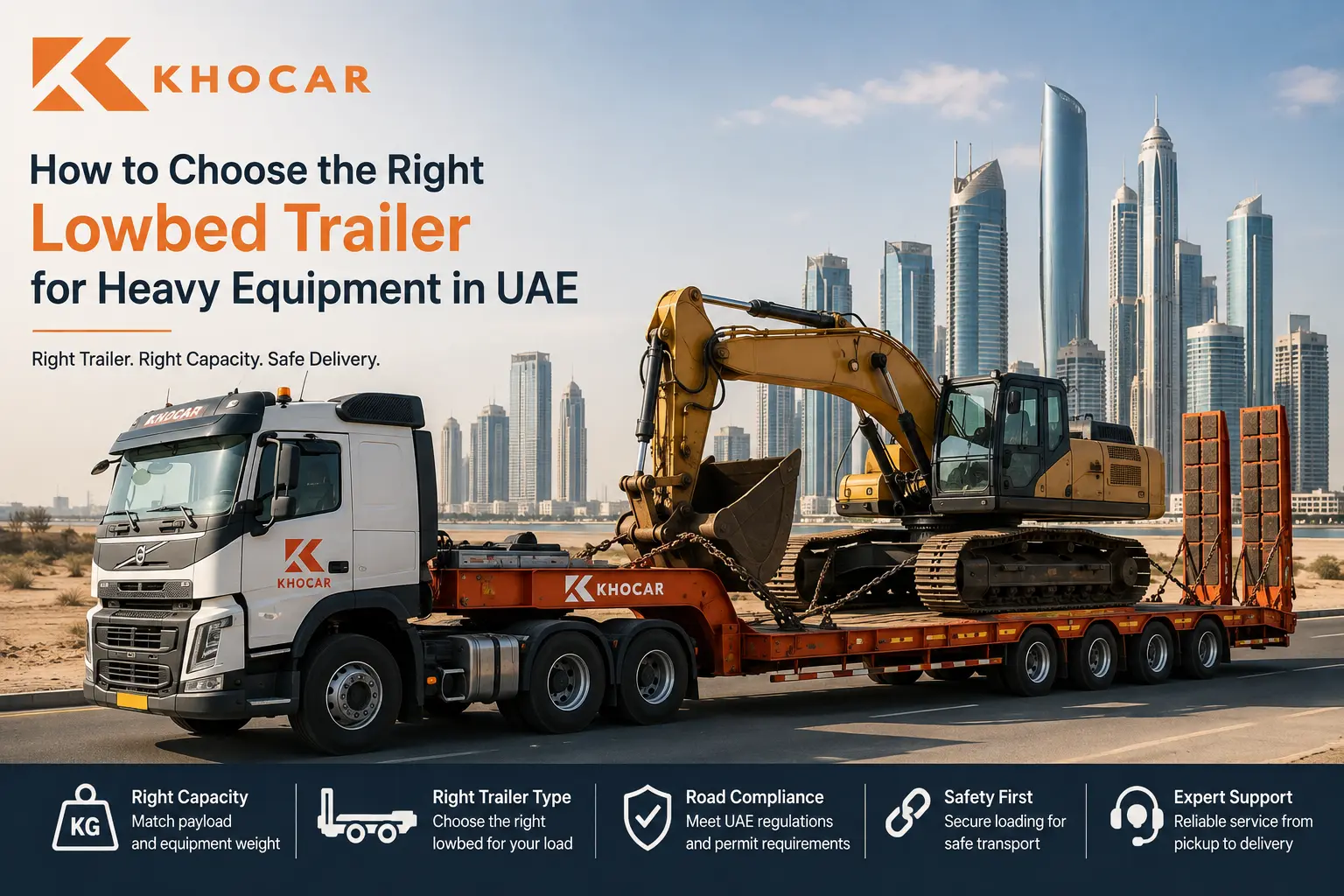
A 30-ton excavator does not become a 30-ton transport problem simply because a trailer is rated for 30 tons. The machine’s height, width, centre of gravity, loading method, weight distribution, deck height, route restrictions and permit requirements can all change which trailer is actually suitable. That is why choosing a lowbed trailer for heavy equipment in the UAE should start with the machine and the journey, not with whichever trailer happens to be available.
Lowbed trailers are designed to carry tall, heavy and often oversized machinery closer to the road surface than conventional trailers, giving transport planners more usable vertical clearance. But the lowest deck is not automatically the best deck, and the trailer with the highest advertised capacity is not automatically the safest or most economical choice. The correct setup must match the cargo, axle configuration, legal limits, and route.
UAE federal rules also make weight and dimension compliance a serious consideration: the Ministry of Energy and Infrastructure states that maximum gross weights vary by axle count, reaching 65 tonnes for six-axle heavy vehicles, while oversized or overweight non-divisible loads can require a special transportation permit.
The Ministry of Energy and Infrastructure’s current heavy-vehicle weight and dimension guidance provides the regulatory baseline for this decision.
Key Takeaways
- Choose the trailer around the actual machine: weight, length, width, height, ground clearance, loading points and centre of gravity all matter.
- Payload capacity is not the same thing as legal road capacity. Axle loads, total combination weight and dimensions must be checked together.
- Deck height is especially important for tall machinery because the loaded transport height is roughly the machine’s transport height plus the trailer deck height and any supports or blocking.
- More axles can distribute heavy loads across the road surface, but axle count alone does not guarantee legal or safe transport.
- A standard lowbed may be ideal for an excavator or loader, while an extendable, detachable-gooseneck or heavier multi-axle configuration may be better for unusually tall, long, or heavy equipment.
- UAE oversized and overweight movements may require permits and route coordination. Do not wait until dispatch day to determine whether approvals are needed.
- Loading and unloading conditions are part of trailer selection. A trailer that technically carries the machine is not useful if the equipment cannot safely get on or off it.
- Before requesting a quote, provide equipment type, exact or estimated weight, full dimensions, pickup/drop-off locations, loading method, preferred date/time, and photos.
Why the Right Lowbed Trailer Matters for Heavy Equipment Transport
Heavy equipment is expensive, difficult to manoeuvre and often impossible to replace quickly. A transport decision that looks minor at the quotation stage can affect project schedules, road compliance, loading safety and equipment condition. Using an underspecified trailer can create obvious problems, but using an unnecessarily large trailer can also increase cost, route restrictions and permit complexity.
The objective is therefore not to find the biggest lowbed trailer available. It is to select the smallest suitable configuration that safely accommodates the machine and satisfies the applicable technical and regulatory requirements for the route.
What Is a Lowbed Trailer and When Should You Use One?
A lowbed trailer is a heavy-haul trailer with a deck positioned relatively close to the road. The low deck reduces the height added underneath the cargo, which is particularly useful when transporting tall machinery such as excavators, bulldozers, loaders, cranes, generators and industrial equipment.
KhoCAR’s UAE lowbed service describes lowbed trailers as suitable for construction equipment, industrial machinery and oversized loads, with options for rental with experienced drivers and end-to-end transport support. Its service coverage includes Abu Dhabi, Dubai, Sharjah and other Emirates.
KhoCAR’s Lowbed Trailers UAE service explains the company’s heavy-equipment transport and logistics offering.
How to Choose a Lowbed Trailer: 10 Factors to Check
1. Equipment Weight and Actual Payload
Start with the machine’s actual transport weight, not a rough category such as ‘large excavator.’ A manufacturer’s operating weight may differ from the transport configuration if attachments, fluids, counterweights, or accessories are removed or added.
- Manufacturer plate or manual weight.
- Actual transport configuration, including attachments and removable components.
- Whether the quoted weight is exact or estimated.
- Any concentrated weight or unusual centre-of-gravity condition.
- Trailer tare weight and the complete vehicle combination when checking road limits.
2. Overall Equipment Dimensions
Measure the machine in the exact configuration in which it will travel. Length, width and height all affect trailer selection and route planning.
- Overall transport length.
- Maximum width at the widest point.
- Height in transport position.
- Ground clearance.
- Boom, arm, bucket, counterweight or mast position.
- Whether attachments will be removed before loading.
3. Deck Height and Total Transport Height
The main advantage of a lowbed is its low deck. But you should calculate the complete loaded height rather than simply choosing the lowest advertised deck.
- Machine transport height.
- Trailer deck height.
- Ramps, blocking, cradles or supports.
- Any removable attachments that change the height.
- Bridge, overhead-line, gate and site-clearance conditions along the route.
4. Trailer Width and Load Overhang
Cargo width should be checked against the trailer’s usable deck and the legal width of the loaded combination. A wider deck may improve stability, but an over-width movement can introduce permit and route restrictions.
- Trailer deck width.
- Machine width.
- Any overhang beyond the deck.
- Overall loaded width.
- Need for escort or route coordination if applicable.
5. Axle Configuration and Weight Distribution
Axle count is not just a capacity number. It determines how the load is distributed across axle groups and the road. A heavy machine concentrated over one section can create an axle-loading problem even when the trailer’s overall rating appears adequate.
- Number of trailer axles.
- Axle-group spacing.
- Prime-mover and trailer combination.
- Where the machine’s heaviest components will sit.
- Suspension/load-equalization characteristics.
- Applicable axle-weight limits for the route.
6. Usable Deck Length and Loading Method
Overall trailer length is not the same as usable cargo deck length. Gooseneck geometry, ramps, axle placement and rear structure can change where the machine can actually sit.
- Usable well/deck length.
- Ramp length and angle.
- Whether the machine can drive onto the trailer.
- Need for a crane or lifting equipment.
- Clearance for tracks, wheels and attachments.
- Space needed for safe tie-down points.
7. Trailer Type: Standard Lowbed, Lowbed Semi-Trailer, RGN and Extendable Options
Different lowbed designs solve different transport problems. A detachable or removable gooseneck can simplify loading of self-propelled equipment; an extendable configuration can help with long cargo; a heavier multi-axle lowbed can distribute dense loads.
- Standard lowbed for common heavy machinery.
- Lowbed semi-trailer for medium-to-heavy equipment movement.
- Removable gooseneck (RGN) where low-angle loading is advantageous.
- Extendable lowbed for unusually long cargo.
- Multi-axle heavy-haul configurations for dense or very heavy loads.
8. Suspension, Ramps and Load-Securing Equipment
Trailer construction affects how the machine behaves during loading, braking, cornering and uneven-road travel. The right trailer should also have a practical securing arrangement.
- Mechanical or hydraulic suspension as appropriate.
- Ramp design and loading angle.
- Rated tie-down points.
- Chains, binders and restraints suitable for the cargo.
- Wheel/track chocks or other stabilisation measures where appropriate.
- Inspection of deck, ramps, tyres and securing equipment before departure.
9. Route, Permits and UAE Legal Limits
Trailer selection and route approval should be considered together. UAE federal law requires heavy-vehicle operators to comply with total and axle weights and maximum dimensions, while non-divisible loads that exceed normal limits can be moved only under the applicable permit controls.
- Total combination weight.
- Axle and axle-group loads.
- Overall loaded length, width and height.
- Route restrictions and bridge clearances.
- Oversized/overweight permit requirements.
- Authority-specific timing or route approvals where applicable.
10. Pickup, Site Access and Delivery Conditions
A trailer can be technically perfect and still fail the job if the pickup site has a narrow gate, soft ground, tight turning radius or no suitable loading area.
- Exact pickup and delivery locations.
- Gate width and height.
- Internal site roads and turning areas.
- Ground conditions at loading point.
- Crane/forklift availability.
- Site induction, gate pass or restricted-access requirements.
- Delivery time window and traffic restrictions.
Lowbed Trailer Capacity in UAE: Why the Number Alone Is Not Enough
When buyers ask for ‘a 50-ton lowbed,’ they are usually referring to cargo payload. But transport planning has at least three separate weight questions: how much cargo the trailer is designed to carry, how much the complete vehicle combination weighs, and how that weight is distributed across the axles.
| Term | Meaning | Why it matters |
| Payload | Weight of the cargo being carried. | Must be within the trailer’s engineered capacity. |
| Tare/empty weight | Weight of the vehicle/trailer without the cargo, subject to the legal definition used. | Adds to total road weight. |
| Gross/total vehicle weight | Vehicle plus cargo across all axles. | Must remain within applicable legal limits unless a permitted exception applies. |
| Axle/group load | Weight carried by a particular axle or axle group. | Poor distribution can create non-compliance even when total weight looks acceptable. |
Under the UAE federal framework, the Ministry of Energy and Infrastructure states that maximum gross weights vary by axle count: 21 tonnes for two axles, 34 tonnes for three, 45 tonnes for four, 56 tonnes for five and 65 tonnes for six. These figures are regulatory limits for the applicable heavy-vehicle configurations, not universal trailer payload ratings.
The Ministry’s published table of maximum heavy-vehicle weights and dimensions explains the federal limits and the special-permit treatment for non-divisible loads.
That distinction is crucial. A trailer manufacturer or rental company may advertise a much higher technical payload than the amount that can legally travel on a particular UAE route without special approval. The transport provider therefore needs to assess the complete vehicle, load distribution and route—not just the trailer brochure.
UAE Weight and Dimension Limits: What Buyers Should Know
Federal Decree-Law No. 12 of 2023 regulates heavy-vehicle weights and dimensions in the UAE. The law defines total vehicle weight as the weight using all axles, including the load, and requires operators to avoid exceeding prescribed total and axle weights and maximum dimensions.
The official UAE legislation text provides the legal definitions and operator obligations.
The Ministry’s published summary states maximum dimensions for several heavy-vehicle combinations. For example, a truck head and semi-trailer combination is listed at a maximum overall length of 21 m, width of 2.6 m and height of 4.6 m. A truck head, trailer and semi-trailer combination is listed at up to 28 m overall length, with the same 2.6 m width and 4.6 m height. These are not permission to move every oversized machine at those dimensions; route and load-specific requirements still apply.
For loads that are not easily divisible, the federal framework allows exceptions to normal weight and dimension limits only under special transportation-permit controls. The Ministry specifically notes that the permit process considers whether practical alternatives exist, road and infrastructure safety, the permit period and other controls.
How to Choose a Lowbed Trailer for an Excavator in UAE
Excavators are one of the most common lowbed loads, but ‘excavator’ is not a sufficient specification for trailer selection. A compact 15-ton excavator and a large 50-ton crawler excavator can require very different configurations.
- Record the excavator’s transport weight with the bucket, boom, counterweight, and other components that will remain installed.
- Measure overall transport height with the boom and arm positioned exactly as they will travel.
- Measure track width and overall machine width at the widest point.
- Confirm the machine’s overall length and whether the boom/bucket can be folded or repositioned.
- Check whether the excavator can climb the trailer ramps under its own power.
- Allow for safe tie-down positions and sufficient deck length around the machine.
- Check whether the loaded height or width creates a permit/route issue.
- Confirm whether the pickup or delivery site has adequate access for the trailer and turning movement.
For example, an excavator may weigh 28 tonnes but become a much more complicated movement if its transport height approaches the route’s clearance envelope or its track width creates an over-width load. Conversely, a heavier but compact machine may be easier to move if its dimensions remain within the route’s practical limits.
Lowbed Trailer Types UAE: Which Configuration Fits Which Load?
| Trailer setup | Best suited to | Main advantage | Watch-outs |
| Standard lowbed | Excavators, loaders, bulldozers, generators and common heavy machinery | Simple, versatile heavy-equipment transport | May not suit extreme height, length or weight. |
| Lowbed semi-trailer | Medium/heavy machinery and industrial equipment | Good balance of stability and manoeuvrability | Exact usable deck and axle configuration must be checked. |
| Removable gooseneck / RGN | Self-propelled machinery and low-clearance loading situations | Can provide a low loading angle and easier drive-on loading | Configuration and route requirements vary. |
| Extendable lowbed | Long machinery, structures and project cargo | Additional deck length | Longer combination can affect turning, route planning and permits. |
| Multi-axle heavy-haul lowbed | Dense or very heavy industrial cargo | Spreads load across more axles | Higher cost and more complex route/permit planning. |
Lowbed Trailer vs Flatbed: Which Should You Choose?
A flatbed can be an efficient choice for cargo that is heavy but not unusually tall and can be loaded safely with the available equipment. A lowbed becomes more attractive when the machine’s height, weight, loading method or stability requirements make a conventional platform less suitable.
| Consideration | Lowbed | Flatbed |
| Deck height | Lower; useful for tall machinery | Higher than a lowbed |
| Tall excavator/crane equipment | Often preferred | May create additional transport height |
| Heavy concentrated load | Can be configured with multiple axles | Depends heavily on trailer rating and axle setup |
| Drive-on loading | Ramps/gooseneck can simplify equipment loading | Loading method varies |
| Oversize complexity | Can still require permits | Can still require permits |
| Typical use | Heavy construction/industrial machinery | General cargo and machinery that fits conventional dimensions |
Examples: Matching the Trailer to the Equipment
Example 1: 22-Ton Excavator
A contractor needs to move a 22-ton excavator from a yard in Abu Dhabi to a construction project. The machine is compact enough to fit within the available deck width, can load under its own power, and does not create an unusual overall height. A standard lowbed with an appropriate axle configuration may be the most efficient solution. The transport team still needs the exact machine dimensions, route, and site access details before confirming the trailer.
Example 2: 45-Ton Generator
A large generator may be shorter than an excavator but much denser. The key issue becomes weight distribution and lifting/loading method. A trailer with sufficient payload rating is not enough; the load must be positioned so axle groups remain within applicable limits, and the trailer deck must have suitable securing points.
Example 3: Tall Industrial Machine
A 30-ton industrial machine could create a more difficult movement than a heavier excavator if its transport height is high. Here, deck height becomes a priority. A lower configuration may reduce total height, but route clearance and permits must still be checked. The cheapest trailer is irrelevant if the loaded machine cannot clear the route.
Common Mistakes When Choosing a Lowbed Trailer
Choosing by tonnage alone Two machines with the same weight can require different trailers because their dimensions, centres of gravity and loading methods differ.
Using operating weight instead of transport weight Attachments, counterweights and accessories can change the actual transport configuration.
Ignoring deck height A trailer that carries the weight may still make the total loaded height unsuitable for the route.
Assuming more axles automatically solves everything Axle count must be combined with actual axle spacing, suspension, load placement, tractor configuration and legal limits.
Forgetting loading and unloading A trailer needs to work at both ends of the journey, not only on the highway.
Checking permits after booking Permit requirements can affect the trailer configuration, route, schedule and total cost.
Providing only city names Exact pickup and delivery points matter for access, route selection and site restrictions.
Relying on advertised maximum capacity A technical rating is not the same as the legally permitted load for a particular route.
Underestimating site access Tight gates, soft ground, low overhead structures or restricted industrial zones can delay a move.
Waiting until the last minute Heavy equipment transport often needs more coordination than ordinary trucking.
Lowbed Trailer Booking Checklist for UAE Projects
Before requesting a lowbed trailer quote, gather the following information. It allows the transport provider to assess trailer selection, route, permit risk and loading requirements much faster.
- Equipment type and manufacturer/model.
- Exact or estimated transport weight.
- Length × width × height in transport configuration.
- Ground clearance and track/wheel dimensions where relevant.
- Photos from multiple sides, including the nameplate if available.
- Pickup location and exact site access point.
- Drop-off location and exact site access point.
- Whether the machine can move under its own power.
- Loading method: ramps, crane, forklift or other lifting arrangement.
- Unloading method and available equipment at destination.
- Required transport date and preferred time window.
- Whether the route passes through restricted, industrial, port or oilfield areas.
- Any site access, induction or gate-pass requirements.
- Whether the load is expected to be oversized or overweight.
- Whether the transport provider is expected to coordinate permits and route approvals.
KhoCAR’s lowbed trailer booking guide provides a similar practical checklist for faster quoting and smoother dispatch.
How Much Does the Right Lowbed Trailer Cost?
There is no single UAE lowbed trailer rental price because the transport configuration changes with the job. Weight, trailer type, axle configuration, distance, equipment dimensions, route, permits, loading requirements, urgency and rental duration can all affect the quotation.
A lower price can be misleading if it assumes the wrong trailer, excludes permit coordination or does not account for loading support. Conversely, a higher quote may include the correct heavy-duty configuration, experienced driver, route planning and end-to-end logistics.
KhoCAR’s guide to lowbed trailer rental cost in the UAE explains the major factors that can change a lowbed transport quote.
When Do You Need a Heavy Equipment Transport Permit in the UAE?
Not every heavy-equipment move automatically needs a special permit. The need depends on the loaded vehicle’s dimensions and weights, the nature of the load, the route and the applicable authority requirements. If a load exceeds normal limits or requires controlled movement, permit and route coordination may be necessary.
The federal framework specifically provides for special transportation permits for non-divisible loads that exceed normal weight or dimension limits. The permit decision is not simply a formality: the rules contemplate practical alternatives, infrastructure impact and road-user safety.
The UAE Ministry of Energy and Infrastructure’s guidance on heavy-vehicle limits and permits should be checked alongside the competent authority’s route-specific requirements.
For Abu Dhabi projects, buyers should also account for site-specific access and authority-controlled areas. A route that looks straightforward on a map may require additional coordination because of restricted industrial zones, project gates, timing windows or site safety rules.
KhoCAR’s heavy-equipment transport permit guide explains when permit and route checks may be necessary for UAE lowbed movements.
Safety Checks Before the Lowbed Leaves the Yard
Trailer selection is only one part of safe heavy-equipment transport. Before departure, the carrier should confirm the vehicle and load are ready for the journey.
- Verify the machine weight and dimensions against the approved transport plan.
- Check tyre condition, brakes, lights, suspension and trailer structure.
- Inspect ramps and loading equipment.
- Position the machine according to the load plan.
- Confirm axle/group loading is within the applicable limits or permit conditions.
- Use suitable chains, binders, restraints and tie-down points for the equipment.
- Secure movable components such as booms, buckets, blades or outriggers as required.
- Check that the load cannot shift during braking, cornering or uneven-road travel.
- Verify required permits, route instructions and escort arrangements before departure.
- Recheck the load after initial movement and at appropriate stops when required by the operating procedure.
The UAE heavy-vehicle law places responsibility on operators to ensure loads are properly distributed, fixed and stabilized, and to establish procedures that prevent weight and dimension violations.
Federal Decree-Law No. 12 of 2023 sets out these operator obligations.
Why Choose KhoCAR for Lowbed Trailer Transport in UAE?
KhoCAR provides lowbed trailer rental and transport across the UAE for excavators, bulldozers, loaders, cranes, generators, industrial machinery and oversized equipment. Its service includes rental with experienced drivers, scheduled or urgent transport, route planning, permit support and delivery coordination.
KhoCAR’s Lowbed Trailers UAE service outlines the current service scope and UAE-wide coverage.
KhoCAR’s existing technical content also emphasizes that trailer selection should be based on equipment weight, dimensions, deck height, axle configuration, route and loading requirements. That approach is important because the correct trailer is a transport solution—not simply a rental category.
KhoCAR’s lowbed trailer specifications guide provides additional detail on dimensions, capacity, deck height, axle configuration and legal considerations.
Need the Right Lowbed Trailer for Your Heavy Equipment?
Do not book a lowbed based on tonnage alone. Send KhoCAR the equipment type, weight, full dimensions, pickup and drop-off locations, photos, loading method, and required date. The team can assess the trailer configuration, transport requirements, and whether permit or route coordination may be needed.
Request Lowbed Trailer Transport from KhoCAR and get the right heavy-equipment transport solution for your UAE project.
FAQs
How do I choose the right lowbed trailer for heavy equipment in the UAE?
Start with the equipment’s exact transport weight, length, width, height, ground clearance and loading method. Then match those details to the trailer’s payload, axle configuration, usable deck length, deck height, suspension, and the legal requirements of the route.
What is the most important factor when choosing a lowbed trailer?
There is no single factor, but actual equipment weight and dimensions are the starting point. After that, axle loading, deck height, route, permits and loading method determine whether a particular trailer configuration is appropriate.
What lowbed trailer is best for an excavator in the UAE?
For a typical excavator, a suitable standard lowbed or lowbed semi-trailer may be appropriate, but the correct configuration depends on the excavator’s transport weight, dimensions, loading method, axle distribution and route. Larger or unusually wide/tall excavators may need a heavier or specially configured lowbed.
How much weight can a lowbed trailer carry in the UAE?
It depends on the trailer design, axle configuration, prime mover, cargo distribution and applicable road limits. A trailer’s technical payload rating is not automatically the same as the legally permitted cargo weight for a specific UAE route.
Does a heavier load always need more axles?
Not necessarily, but additional axles can help distribute a heavy load across more axle positions. The correct number depends on the complete vehicle configuration, load placement, legal axle limits, and route requirements.
What is lowbed trailer deck height and why does it matter?
Deck height is the distance from the road surface to the trailer’s cargo platform. A lower deck reduces the height added beneath the machine, which can be critical when transporting tall equipment under bridges, gates, and other clearance restrictions.
Do lowbed trailers need permits for oversized equipment in the UAE?
Sometimes. If the loaded vehicle exceeds normal weight or dimension limits, carries a non-divisible oversized load, travels on a restricted route or requires controlled movement, special permits or route approvals may apply. The exact requirement should be checked for the route and load.
Can a lowbed trailer transport a crane or generator?
Yes. Lowbed trailers are commonly used for cranes, generators, industrial machinery and other heavy equipment, provided the trailer configuration, load distribution, dimensions, loading method and route are suitable.
What information does a lowbed trailer company need for a quote?
Provide equipment type, manufacturer/model, weight, length, width, height, photos, pickup and delivery locations, loading/unloading method, preferred date/time and any site-access or permit requirements.
Is a lowbed trailer better than a flatbed for heavy equipment?
For tall, heavy or oversized machinery, a lowbed can offer advantages because its lower deck reduces total transport height. A flatbed can still be suitable for equipment that fits within its dimensions and loading requirements.
How much does lowbed trailer rental cost in the UAE?
Pricing depends on trailer configuration, equipment weight and dimensions, distance, route, permits, loading requirements, urgency and rental duration. A reliable quote requires the actual transport details.
Can KhoCAR provide a lowbed trailer with a driver in the UAE?
Yes. KhoCAR’s lowbed trailer service includes rental with experienced drivers for heavy and oversized equipment transport across the UAE.
Can KhoCAR handle permits and route planning for heavy equipment?
KhoCAR states that its lowbed transport service includes route planning, permits and logistics support for oversized and heavy machinery movements. The exact approvals depend on the load, route and competent authority requirements.