
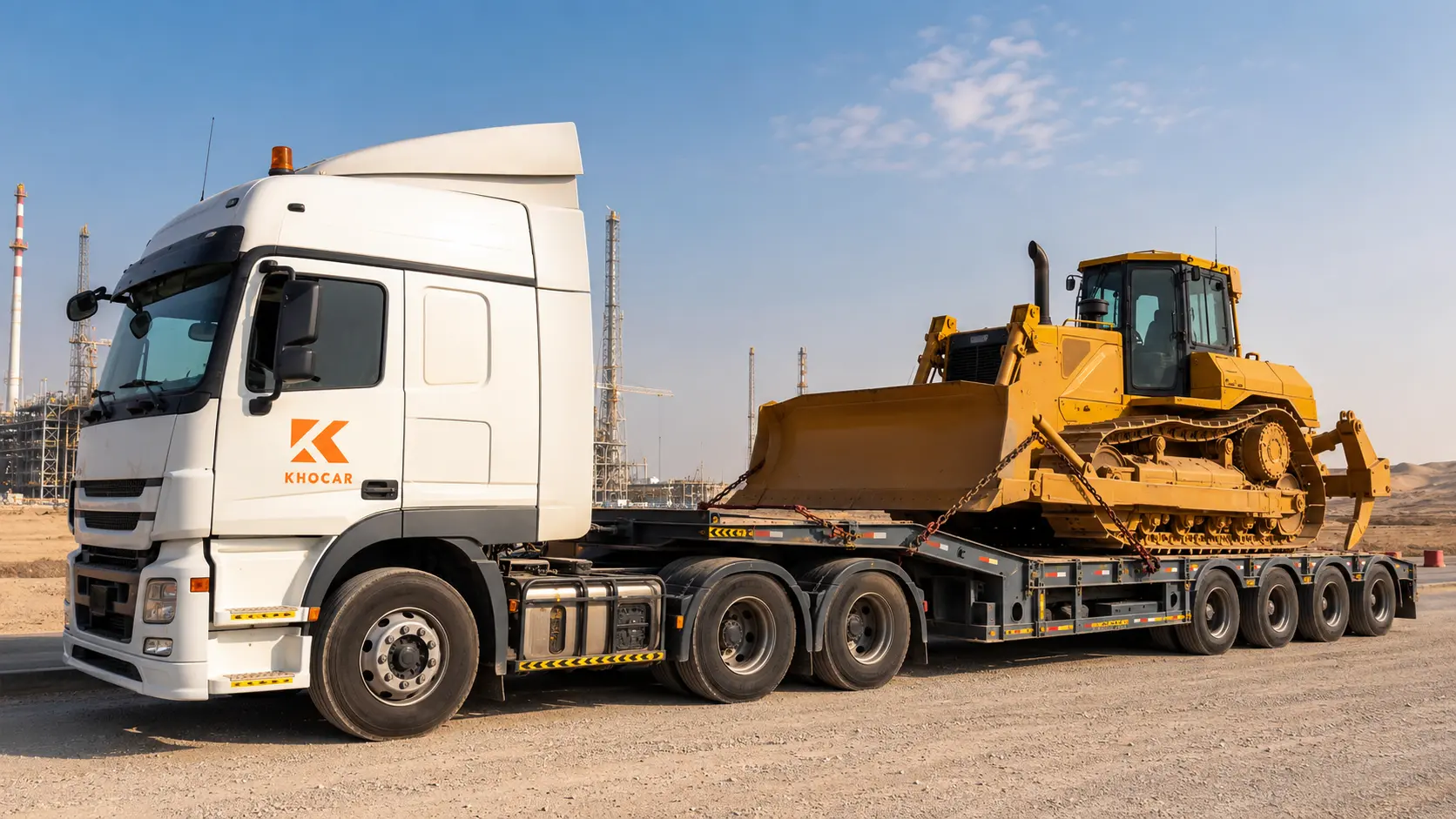
Bulldozer transport UAE projects can go wrong before the machine reaches the ramp. A dispatcher may receive only a model name, then discover at pickup that the dozer has an extra-wide blade, LGP tracks, a rear ripper or a non-running powertrain. That single missing detail can change the required deck width, loading method, axle distribution, route, permit and travel window.
UAE federal-road guidance illustrates why the loaded envelope matters: the announced maximum dimensions for a tractor and semi-trailer are 21 metres long, 2.6 metres wide and 4.6 metres high, while a six-axle heavy vehicle has a stated maximum gross weight of 65 tonnes. An indivisible load beyond applicable limits may require a special permit and conditions. The practical lesson is simple: choose the transport combination from verified machine data and the complete route—not from the trailer’s advertised payload alone.
This guide explains what to measure, how to match a lowbed trailer, what a controlled loading plan should cover, how to prepare the dozer for securement and which UAE permit and movement checks belong in the dispatch file.
Key Takeaways
- Book from the actual machine configuration. Model name alone does not confirm operating weight, blade width, track width, height, ground clearance or rear-attachment overhang.
- Confirm both machine weight and the complete loaded combination. Trailer payload, axle distribution, tractor limits, registration data and road-authority limits are separate checks.
- Measure final loaded width and height after the blade, ripper, exhaust, canopy, chains and deck position are decided; catalogue dimensions are planning inputs, not a departure measurement.
- Use firm, level ground, a controlled exclusion zone, inspected ramps and one agreed communication system. The loading method must follow the OEM transport instructions and the approved site plan.
- Rated securement devices need suitable machine and trailer anchor points, protection from sharp edges, correct tension and a documented recheck. Blade and ripper movement must also be controlled.
- Verify permits, route restrictions, facility access, gates, overhead clearances and permitted travel times immediately before dispatch because local controls can change.
- A non-running bulldozer is a recovery move, not a routine self-loading job; declare the fault early so winch, crane, steering, braking and unloading arrangements can be engineered.
Quick answer: To transport a bulldozer in the UAE, first verify its operating or transport weight, blade and track width, height, overall length, ground clearance, ripper or winch, running condition and approved lifting or tie-down points. Match those facts to a lowbed’s usable deck, rated payload, axle layout, ramp or detachable-neck geometry and tractor. Then confirm the loaded combination against current road limits, permits, route restrictions and site access. Load on firm level ground under a competent plan, secure the machine with rated equipment, measure the final envelope and complete a documented departure check.
Why Bulldozer Transport Needs Machine-Specific Planning
A bulldozer is compact compared with some cranes or excavators, but its transport problem is unusually concentrated. Much of the mass sits low over the tracks, while the blade can create a width that is far greater than the tractor body. A ripper, winch or drawbar adds length and can alter the center of gravity. Steel track shoes create different ramp-traction and deck-protection concerns from rubber-tyred equipment. Low-ground-pressure (LGP) undercarriages can be wider and use wider shoes than standard or XL configurations.
Those differences explain why “send a 60-ton lowbed” is not an adequate transport instruction. A trailer may have enough nominal payload yet still be unsuitable because the dozer cannot climb its ramp safely, the blade does not fit the usable deck or side-extension plan, the concentrated track load is not acceptable, the loaded height conflicts with an underpass, or the combined axle loads do not work. The dispatch decision needs a load case: one identified machine, in one configuration, on one tractor-trailer combination, over one checked route.
The Four Transport Envelopes to Confirm
| Envelope | What it means |
| Machine envelope | Actual weight and dimensions in the condition presented at pickup, including blade, tracks, ripper, winch, canopy and loose components. |
| Trailer envelope | Usable deck length and width, deck height, neck and wheel-well restrictions, ramp capacity and angle, axle layout and approved extensions. |
| Loaded envelope | Overall tractor-trailer-load length, width, height, gross weight and axle distribution after final positioning and securement. |
| Route envelope | Road and bridge controls, turning space, gradients, overhead and side clearances, gate openings, surface bearing capacity and travel-time restrictions. |
Do Not Confuse Payload with Permission
A trailer’s rated payload answers an equipment question: what the trailer is designed and approved to carry under stated conditions. A road limit or permit answers a legal and route question: what the complete vehicle may move on a specified road under current conditions. Neither replaces the tractor rating, registration limits, axle-load calculation, tyre capacity, coupling capacity or route assessment. The smallest allowable figure in the complete system becomes the practical limit.
What Information Should You Collect Before Booking a Lowbed?
The fastest quote is not the one requested with the fewest details; it is the one that does not need to be rebuilt at the pickup gate. Ask for the machine data plate, exact model and serial or product identification number, OEM transport page where available, and current photographs from all four sides. A short walk-around video is useful when attachments, access or condition are uncertain. Then confirm the following fields.
| Data to collect | Why it changes the plan | How to verify |
| Exact make, model and configuration | Separates standard, XL, LGP, waste-handler and other variants. | Data plate, OEM manual and clear photos. |
| Operating or transport weight | Sets the starting load case; fuel, attachments and guarding may change it. | OEM data plus installed-equipment list; weigh if uncertainty is material. |
| Overall length | Ripper, winch, drawbar and blade position can change deck fit and overhang. | Measure in the agreed transport configuration. |
| Maximum width | The blade or LGP shoes may be the widest point and can trigger an oversize review. | Measure blade corners, tracks and any side guards. |
| Maximum height | Loaded height depends on machine height plus the actual deck position. | Measure machine; then measure the final loaded combination. |
| Blade type and position | Straight, angle, semi-U, U, PAT and foldable blades have different envelopes. | Photos, blade model and permitted transport position. |
| Rear attachment | Ripper, winch or counterweight changes length, weight and center of gravity. | Photograph and identify installed assembly. |
| Track shoe width and condition | Affects overall width, deck contact, ramp traction and contamination. | Measure shoe width; inspect for mud, oil and damage. |
| Ground clearance | Determines breakover and ramp/neck clearance. | OEM drawing plus actual undercarriage inspection. |
| Running, steering and braking condition | Determines whether self-loading is possible or a recovery system is required. | Operator confirmation and functional check before dispatch. |
| Pickup and delivery access | Gate width, turning radius, gradients, soil and overhead hazards can defeat a road-suitable plan. | Site survey, coordinates, photos and access contact. |
| Schedule and authority constraints | Travel windows, permits and facility approvals affect mobilisation timing. | Current authority and site confirmation. |
KhoCAR’s lowbed booking information guide is a useful companion when gathering pickup, delivery and cargo details. For a bulldozer, add blade geometry, rear attachment and running condition explicitly.
Operating Weight Is Not Always Shipping Weight
Manufacturer brochures may publish operating weight for a defined configuration that includes specified fluids, operator allowance, blade, tracks or ripper. A shipping weight may exclude some of those items. Site modifications—ROPS protection, fire suppression, belly guards, sweeps, extra counterweight or a different blade—can move the real machine away from the brochure value. Record exactly which published number you used and what it includes. If the margin to a trailer, axle or permitted limit is small, obtain a certified weight rather than treating a catalogue figure as proof.
Measure the Widest Point, Not Just the Track Gauge
The blade frequently governs width. Measure the extreme corners in the approved transport position, considering tilt and angle. Do not fold, rotate, remove or support a blade unless the manufacturer’s method and competent lifting plan allow it. If blade removal is selected, its weight and dimensions do not disappear: they become a second cargo item requiring suitable lifting, dunnage, securement, deck space and handling at destination.
How to Select the Correct Lowbed Trailer for a Bulldozer
Lowbed selection is a compatibility exercise rather than a single capacity lookup. The transporter should document the load assumptions and check the actual tractor and trailer records before assignment. When the margins are tight, use an engineered load-distribution calculation or weighing process.
1. Establish the Verified Load Mass
Start with the dozer in its pickup condition, then include any blade parts, ripper teeth, spare track shoes, tools, mats, dunnage and other cargo carried on the combination. Compare this load with the trailer’s approved payload and the ratings of ramps, deck, extensions, tyres, axles, suspension, kingpin/coupling and tractor.
2. Check Usable Deck Geometry
Catalogue deck length and width can be misleading if wheel wells, gooseneck structure, hydraulic equipment or ramps reduce the usable footprint. Plot both track contact patches and attachments. Confirm permitted overhang, side extensions or outriggers, their rated use and how the machine will transition onto them. Never treat loose timber or improvised steel as a substitute for an approved extension system.
3. Model Loaded Height and Ground Clearance
A low deck can provide essential height margin, but the loading transition must still clear the dozer’s undercarriage, blade linkage, drawbar or ripper. Check ramp angle, breakover points and departure geometry. The theoretical loaded height is machine height plus deck height at its final position; the departure measurement must verify the actual result on level ground.
4. Distribute Weight Across the Combination
The heaviest machine position is not automatically the center of the deck. Position must produce acceptable kingpin or drawbar load, trailer axle-group loads and tractor axle loads while preserving steering and braking performance. Track length creates a distributed contact patch, but dozer mass can still overload a deck zone or axle group if placed by eye. Mark the approved deck position before loading.
5. Match the Loading System to the Machine and Site
Rear ramps may suit a functioning dozer when their capacity, width, traction and approach geometry are acceptable. A detachable gooseneck or front-loading lowbed can reduce the approach angle for low-clearance equipment. A non-running machine may need a rated winch system, snatch-block arrangement or crane. The delivery site must support the same unloading method; a machine that can be loaded at a workshop is not automatically unloadable on soft desert ground.
| Selection factor | Acceptance question | Common trap |
| Rated payload | Verified dozer and carried accessories are within the lowest applicable equipment rating. | Payload does not prove legal gross or axle compliance. |
| Usable deck | Both tracks and planned supports fit approved load-bearing surfaces. | Check neck, wheel wells, ramps, extensions and overhang. |
| Deck height | Final loaded height has route and permit margin. | Measure after loading; do not rely only on addition. |
| Ramp or neck | Capacity, width, angle and traction suit the dozer and ground. | Check breakover and manufacturer procedure. |
| Axle layout | Load position yields acceptable tractor and trailer axle distribution. | Use a load calculation or weights where required. |
| Securement points | Rated anchor locations exist in the required directions. | Machine lifting eyes are not automatically tie-down points. |
| Site compatibility | Truck can enter, align, stabilize, load/unload and exit. | Survey gates, turns, slopes, soil and overhead hazards. |
For more detail on trailer terminology and capacity inputs, see KhoCAR’s lowbed trailer specifications, dimensions and capacity guide. If the basic trailer category is still unclear, use the Lowbed vs Flatbed comparison; the present article addresses the next, bulldozer-specific planning layer.
Worked Manufacturer Example: One Dozer Family, Different Transport Envelope
An OEM example shows why the model family is not enough. Caterpillar’s archived D6K product data lists an operating weight of 12,886 kg for the XL configuration and 13,467 kg for the LGP configuration. It also lists standard shoe widths of 560 mm for XL and 760 mm for LGP, with blade widths of 3,077 mm and 3,360 mm respectively. Published ROPS/canopy height is about 2,958 mm and ground clearance is about 360 mm. The page also describes a foldable blade intended to bring transport width within 2.55 m in the applicable configuration.
| Manufacturer data point | XL configuration | LGP configuration |
| Published operating weight | 12,886 kg | 13,467 kg |
| Published standard shoe width | 560 mm | 760 mm |
| Published blade width | 3,077 mm | 3,360 mm |
| Published ROPS/canopy height | 2,958 mm | 2,958 mm |
| Published ground clearance | 362 mm | 360 mm |
Source note: Caterpillar D6K product data. Values are illustrative and configuration-specific; verify the actual machine and current OEM transport instructions.
Review the Caterpillar D6K manufacturer data used for this example.
The lesson is not that every D6K requires the same trailer. It is that a variant change can add 581 kg, widen each standard shoe by 200 mm and change blade width by 283 mm. A foldable blade may reduce road width only when it is the installed OEM arrangement and is prepared exactly as instructed. Attachments, wear packages and machine condition can still change the real transport envelope. Verify the data plate, installed equipment and physical measurement before dispatch.
Pre-Loading Inspection Checklist
Inspection should be completed before the trailer blocks a gate or loading bay. Separate machine readiness, trailer readiness and site readiness so a single “all good” message cannot hide an unresolved defect.
Bulldozer Readiness
- Confirm the exact machine identity, configuration, recorded weight basis and approved transport position.
- Test start, propulsion, steering, service brake, parking brake, horn and any required reversing warning system under the site procedure.
- Check fuel, engine oil, coolant and hydraulic systems for leakage that could contaminate tracks, ramps or public roads.
- Inspect track shoes for packed mud, stone, oil or loose material; clean them in the approved wash or containment area.
- Check blade, tilt and angle mechanisms; ripper, winch or drawbar; pins, locks, guards and loose tooling.
- Identify OEM-approved tie-down or transport points. Do not assume lifting eyes are suitable for longitudinal or lateral restraint.
- Secure cab contents and remove or restrain loose antennas, beacons, tools, fire extinguishers or access panels as required.
- Record photographs before loading, including all attachments and any pre-existing damage.
Trailer and Tractor Readiness
- Verify the assigned registration, approved capacities and combination—not merely the trailer type requested in the quotation.
- Inspect deck, welds, structure, hydraulic systems, locking mechanisms, tyres, wheels, suspension, lighting, brakes and coupling condition.
- Confirm ramps or detachable neck are rated, fully functional, correctly supported and wide enough for the measured track position.
- Lay approved deck protection, friction material or dunnage only where the load plan specifies; secure it against movement.
- Inspect chains, binders, webbing if applicable, edge protection and anchor points; quarantine equipment with unreadable tags, deformation, cracks, severe wear or damaged hooks.
- Mark the target machine position and keep the necessary rated securement equipment accessible without entering a pinch zone.
Loading-Area Readiness
The UK Health and Safety Executive’s loading guidance—used here as a practical international benchmark, not UAE law—calls for loading areas that are clear of traffic and pedestrians, away from overhead electrical cables, and on firm, level ground. It also emphasizes applied brakes and stabilizers, even load distribution and agreed arrangements between the companies involved. [HSE loading and unloading guidance]
- Barricade an exclusion zone sized for the machine, trailer, spotter escape paths and possible rollback.
- Check ground bearing capacity, cross-fall, gradient, soft shoulders, sand, trenches, drainage covers and buried-service restrictions.
- Provide adequate lighting without glare or deep shadow if work is permitted outside daylight.
- Stop unrelated vehicle and pedestrian movements through the loading area.
- Confirm emergency arrangements, spill response, recovery plan and the person with stop-work authority.
How to Load a Bulldozer onto a Lowbed Trailer
Safety boundary: The following is a planning sequence, not an operating instruction for a specific bulldozer or trailer. The competent transport team must use the current OEM manuals, site risk assessment, approved method statement, equipment ratings and local rules. Stop if conditions differ from the plan.
- Hold a task briefing. Identify the loading supervisor, dozer operator and one primary spotter; review hand or radio signals, exclusion zone, stop signal, deck target and emergency response.
- Position and stabilize the combination. Use firm, level ground, align tractor and trailer, apply parking brakes and deploy approved supports or stabilizers as required by the trailer manufacturer.
- Configure and inspect the loading system. Lower and lock ramps or detach the neck using the manufacturer procedure. Confirm contact, capacity, width, alignment, traction and absence of oil, mud or loose debris.
- Perform the operator’s pre-start check. Confirm visibility, controls, warning devices, steering and braking. OSHA’s earthmoving-equipment rule is a useful international benchmark for access-road capability, brakes, horns and reverse alarms or a spotter where rear visibility is obstructed.
- Align before climbing. Place tracks square to the ramp centerlines. Avoid correcting a poor approach with a sharp turn on the ramp, which can create side loading or allow a track to leave its supported surface.
- Climb slowly and continuously. Use the permitted travel direction and lowest practical controlled speed. The spotter stays visible from a protected position and stops the movement if alignment, traction or clearance becomes uncertain.
- Cross transition points under control. Monitor blade linkage, belly guards, undercarriage, ripper and drawbar at the ramp-to-deck or neck transition. Stop before contact rather than trying to power through it.
- Move to the marked load position. The loading supervisor checks track contact and the planned center-of-gravity position relative to the tractor and trailer axle groups.
- Place attachments in the approved transport position. Lower or support the blade and ripper as the OEM and load plan require without overloading or damaging the deck. Do not use hydraulic pressure alone as movement restraint.
- Shut down and make safe. Place transmission and controls in the specified position, apply the parking brake, stop the engine, isolate as required, remove the key and wait for stored energy or hot-surface hazards to be controlled.
- Close and lock the trailer. Raise and secure ramps or reconnect the neck. The operator and spotter remain clear of hydraulic pinch and crush zones.
International reference: OSHA 29 CFR 1926.602 for earthmoving equipment. Apply only the requirements governing your UAE project; use this source as a technical benchmark.
Securement and Final Departure Checks
Load securement is a designed restraint system. It must resist forward, rearward, lateral and vertical movement using the approved machine points, trailer anchors and rated devices. The required number, capacity, direction and pretension of restraints depend on the load, applicable rules and engineering method. This guide does not prescribe a universal chain count.
Build a Traceable Securement Plan
- Use only rated, identifiable chains, binders, shackles or other devices compatible with the approved anchor points and expected load direction.
- Confirm the working load limit of every component in a restraint path; the lowest-rated component limits that path.
- Arrange opposing longitudinal and lateral restraint without relying on the parking brake, transmission, hydraulics or friction alone.
- Control blade, ripper, winch cable, removable panels and other attachments against movement permitted by their design and transport procedure.
- Protect restraints from sharp edges and hot surfaces; prevent contact that can cut, crush, bend or loosen them.
- Avoid routing through hydraulic hoses, cylinders, track components or lifting eyes unless the OEM specifically identifies them for securement.
- Tension with approved tools, secure binder handles and remove loose tails or equipment from the deck.
- Photograph each restraint and anchor point, record device identification where required and obtain competent sign-off.
The European Commission states that up to 25% of truck accidents in the EU are linked to inadequately secured cargo. That is not a UAE accident statistic, but it is a useful reminder that load restraint deserves its own verification rather than a quick visual glance. [European Commission cargo securing]
Measure the Final Loaded Combination
After the dozer is positioned, attachments are set, ramps or neck are locked and restraints are installed, measure the maximum loaded width and height and confirm overall length where relevant. Use a suitable calibrated or verified measuring method on level ground. Include the real highest and widest points—blade corners, ripper, exhaust, canopy, folded components, chain hardware and trailer structure. Record the figures in the dispatch file and compare them with the planned route and permit, not only the quotation.
| Departure gate | Evidence to verify |
| Mechanical | Parking brake and shutdown state; attachments supported; ramps/neck locked; no loose parts, leaks or debris. |
| Securement | Correct devices and points; rated components; opposing restraint; edge protection; tension; binder handles secured. |
| Dimensions | Final loaded length, width and height measured and recorded; permit/load-plan values still match. |
| Weight | Gross and axle-distribution evidence acceptable for the assigned combination and route. |
| Vehicle | Tyres, wheels, coupling, brakes, lights, mirrors/cameras, signage and warning equipment checked. |
| Documents | Registration, driver records, permit/approval, route, contacts, method statement and delivery acceptance available. |
| Route and weather | Current restrictions, closures, wind, visibility, flooding and facility conditions checked immediately before departure. |
| Recheck plan | Safe stopping points and required securement inspections identified; driver knows defect escalation process. |
Recheck After Initial Movement and at Planned Stops
Restraints can settle as a tracked machine beds onto the deck or as dunnage compresses. The transport plan should define a safe early stop and later inspection intervals in accordance with the governing procedure. Recheck tension, anchors, attachment position, deck contact and any sign of rubbing or movement. Do not climb onto the trailer at an unsafe roadside location. If securement, load position or trailer condition is doubtful, stop in a safe place and escalate.
UAE Weight, Dimension, Permit and Route Context
UAE transport controls must be verified for the exact emirate, road, vehicle, load and date. The federal figures below come from the Ministry of Energy and Infrastructure’s January 2024 announcement of the heavy-vehicle table under Cabinet Resolution No. 138 of 2023. They provide a screening baseline, not a permit decision and not permission to use every road or facility.
| Vehicle/combination | Announced maximum gross weight | Announced maximum dimensions |
| 2 axles | 21 tonnes | — |
| 3 axles | 34 tonnes | — |
| 4 axles | 45 tonnes | — |
| 5 axles | 56 tonnes | — |
| 6 axles | 65 tonnes | — |
| Tractor + semi-trailer | Check applicable axle-count gross limit | 21 m long × 2.6 m wide × 4.6 m high |
Source note: UAE Ministry of Energy and Infrastructure, 31 January 2024. Confirm the current legislation, implementation status, exemptions and authority conditions before movement.
Official sources: MoEI heavy-vehicle limits announcement and Cabinet Resolution No. 138 of 2023.
When Might a Bulldozer Need an Oversize or Overweight Permit?
The MoEI announcement states that a special permit can be granted for indivisible loads exceeding maximum weights or dimensions when the relevant conditions are met. A bulldozer blade wider than the normal width limit, a loaded combination above a dimension threshold, or a weight/axle case outside ordinary limits should therefore trigger authority review—not an assumption that warning boards or an escort alone make the move lawful.
Permit preparation commonly depends on confirmed vehicle and trailer details, load description, measured dimensions, weight and axle information, route, timing, traffic-control or escort arrangements and supporting documents. Exact requirements vary by authority and movement. Submit accurate values: if the loaded dozer does not match the permit application, the safe response is to stop and correct the plan.
For a broader document workflow, read KhoCAR’s UAE heavy-equipment transport permit guide. Always verify the live authority service and project conditions.
Peak-Hour and Route Restrictions Can Change the Dispatch Plan
A compliant load can still be delayed by movement controls. Abu Dhabi Mobility announced that from 27 January 2025, heavy vehicles were restricted in Abu Dhabi City from 6:30–9:00 and 15:00–19:00 Monday to Thursday, and from 6:30–9:00 and 11:00–13:00 on Friday. In a separate November 2025 announcement effective 1 December 2025, it prohibited heavy vehicles on parts of E11 and E10 and described alternative routes and an E30 peak-hour restriction in Musaffah. These examples show why a route approved last month should not be reused without a fresh check.
Check the current Abu Dhabi heavy-vehicle timing announcement and Abu Dhabi route-restriction announcement, together with the current map, permit and facility instructions before dispatch.
Compliance note: The dates and controls above are included as documented examples available when this article was prepared in July 2026. They can be amended, suspended or supplemented. The transporter and driver must verify current UAE, emirate, police, road-owner, port, free-zone, oilfield and client requirements for the actual movement.
Route Survey and Delivery-Site Checklist
- Confirm the approved route in both directions, including any mandated entry gate, holding area and final approach.
- Check bridge, pavement and axle restrictions; vertical clearance at bridges, signs, gantries, cables, pipe racks and facility structures.
- Check side clearance at barriers, toll points, cones, street furniture and narrow gates for the real blade width.
- Model turning paths at roundabouts, U-turns, interchanges, site corners and the unloading alignment; allow for trailer off-tracking.
- Review gradients, cross-fall, soft shoulders, sand encroachment, roadworks, flood risk and temporary diversions.
- Confirm the authorised travel time, escort or traffic-management conditions, weather limits and communication protocol.
- Verify the delivery surface can support tractor, trailer, stabilizers and bulldozer during unloading and exit.
How to Transport a Non-Running Bulldozer
Declare “non-running” accurately. A machine that starts but cannot steer, brake, raise the blade or release its parking brake may be harder to load than one that is fully dead but prepared for recovery. Record which functions are unavailable, why the machine failed, whether the tracks roll, whether the blade and ripper can be positioned, and whether fluids are leaking. Obtain OEM recovery instructions before towing, winching, lifting or releasing stored energy.
| Condition | Critical question | Plan required |
| Starts and drives; one hydraulic function unavailable | Can the attachment be placed and mechanically supported in the approved transport position? | OEM support/lock method, spill control and safe loading assessment. |
| Does not start; tracks roll and steering path can be controlled | Can a rated winch recover it without uncontrolled yaw or rollback? | Engineered pull path, rated winch/anchors, blocks, operator and exclusion zone. |
| Parking brake cannot release or final drive is locked | Will dragging damage machine, deck or securement and create uncontrolled forces? | OEM release/disconnection procedure or lifting plan. |
| Tracks do not roll or machine is unstable/damaged | Is crane loading or specialist recovery required? | Lift study, verified mass/center of gravity, approved lifting points and crane plan. |
| Leak or fire damage | Can it be made safe for people, trailer and public road? | Isolation, drainage/containment, hazardous-residue controls and acceptance decision. |
Winching is not simply attaching a cable and pulling. The system includes the winch, rope, hooks, shackles, blocks, anchors, trailer structure and pull geometry. Every component needs an adequate rating, and everyone must remain outside the recoil and crush zones. If the machine cannot be unloaded by the planned method at destination, do not dispatch it merely because the workshop can get it onto the trailer.
Practical Example: Moving a D6-Class Dozer from Musaffah to an Abu Dhabi Site
Consider a contractor requesting same-day transport for a “D6 dozer.” The first photograph shows an LGP undercarriage and wide blade; a second shows a rear ripper. The booking team pauses the quotation and asks for the data plate, full model/configuration, current photos, weight basis, blade measurement and running condition. The machine operates normally, but the pickup yard has soft sand near the gate.
- The planner compares verified machine data with the actual lowbed’s usable deck, ramp geometry, payload and axle layout. The blade, not the tracks, governs maximum width.
- Because the machine is wider than the ordinary width figure in the federal table, the compliance team checks the applicable special-permit process and any escort or marking condition.
- The route review identifies current Abu Dhabi movement restrictions, a suitable authorized route and a delivery window agreed with both sites.
- The pickup area is moved onto a firm, level prepared pad so the trailer can align without one ramp settling into sand.
- The load plan marks the track position and center-of-gravity target. The operator loads under one spotter, attachments are placed per the OEM procedure, and rated restraints are installed.
- The team measures the final loaded width and height, confirms the values match the permit and route, photographs the securement and completes the departure gate.
- A safe early recheck point is included. The delivery site confirms ground bearing, gate width and the same controlled unloading space before the vehicle leaves Musaffah.
This extra verification may add planning time, but it avoids the expensive failures: the wrong deck arriving, a blade unable to clear the gate, a permit containing incorrect dimensions, a ramp sinking during loading or a driver reaching the delivery site during a restricted movement window.
Common Bulldozer Transport Mistakes—and the Better Control
| Mistake | Why it fails | Better control |
| Booking by model name only | Variants and attachments change weight and dimensions. | Verify data plate, configuration, photos and physical measurements. |
| Using advertised trailer payload as the only check | Gross, axle, tractor, coupling, tyre, deck and road limits may govern. | Approve the complete load case and assigned combination. |
| Measuring the tracks but not the blade | Blade corners often define transport width. | Measure the widest point in the approved transport position. |
| Loading on sand or cross-fall | Ramp settlement or trailer lean can create misalignment and rollover risk. | Prepare firm, level ground or change the loading location. |
| Sharp steering corrections on ramps | A track can side-load or leave the supported ramp surface. | Square the approach and stop to realign before climbing. |
| Relying on hydraulics to hold attachments | Pressure can decay or a component can fail. | Use the OEM transport position and approved mechanical restraint/support. |
| Assuming lifting eyes are tie-down points | The point may not be rated for the restraint direction. | Use OEM-identified transport points or engineered approval. |
| Copying a previous route or permit | Restrictions, roadworks and load details change. | Verify current route, controls and actual loaded values for every move. |
| Hiding a non-running condition | Assigned ramps, crew and recovery equipment may be unsuitable. | Declare each unavailable function before dispatch. |
| No delivery-site assessment | The dozer may arrive but cannot unload or the lowbed cannot turn out. | Confirm gate, ground, space, overhead hazards and exit route. |
Bulldozer Transport UAE Booking and Dispatch Checklist
Use this condensed checklist as a handover tool; attach supporting evidence rather than marking unknown items as complete.
| Gate | Required evidence |
| 1. Machine identity | Make, exact model/variant, serial/PIN, data plate and four-side photographs. |
| 2. Machine envelope | Weight basis, length, maximum width, height, track shoe width, ground clearance and center-of-gravity information. |
| 3. Attachments | Blade type/position, ripper, winch, drawbar, guarding, removable items and transport locks/supports. |
| 4. Condition | Starts, drives, steers, brakes, hydraulics function, tracks roll, leaks controlled and loose debris removed. |
| 5. Lowbed match | Assigned tractor/trailer IDs; usable deck; payload; ramps/neck; extensions; anchors; tyres; axle/load calculation. |
| 6. Site readiness | Coordinates, contacts, gates, turns, surface, slopes, overhead hazards, exclusion zone and unloading acceptance. |
| 7. Compliance | Current limits checked; permit/escort/traffic plan approved where applicable; documents match actual vehicle and load. |
| 8. Route and timing | Authorized route, closures, movement restrictions, weather, holding points and emergency contacts verified. |
| 9. Loading and securement | Briefing, operator/spotter, marked position, attachment state, rated restraints, photographs and sign-off. |
| 10. Departure and transit | Final dimensions/weight evidence, vehicle checks, early restraint recheck and delivery communication complete. |
Decision rule: If the machine identity, weight, maximum dimensions, running condition, trailer assignment, route or permit status is unknown, the move is not ready for dispatch. Convert the unknown into verified evidence or revise the plan.
Arrange the Right Lowbed Trailer for Your Bulldozer
KhoCAR Services supports lowbed trailer services across the UAE for bulldozers and other heavy machinery. Share the exact dozer model and configuration, data-plate photo, operating or transport weight, maximum dimensions, blade and rear-attachment details, running condition, pickup and delivery coordinates, access photographs and required date. The team can use that information to evaluate a suitable trailer configuration and plan the transport scope.
Need a quotation or want the load details checked before booking? Contact KhoCAR Services with the machine and route information. If you are comparing project costs, also review the UAE lowbed trailer rental cost guide.
FAQs
What type of trailer is used to transport a bulldozer in the UAE?
A lowbed or low-loader is commonly selected because its lower deck can reduce loaded height and its heavy-duty configuration can accommodate tracked machinery. The exact trailer must be chosen from verified dozer weight, track footprint, blade width, ground clearance, loading method, axle distribution, route and permit conditions.
How much does bulldozer transport cost in the UAE?
Cost depends on the dozer’s verified weight and dimensions, trailer and tractor configuration, pickup and delivery access, distance, permits, escorts, loading or recovery equipment, travel window, waiting time and return logistics. Provide accurate blade, ripper and running-condition details for a dependable quotation.
Does a bulldozer need a special transport permit in the UAE?
It may. The need depends on the actual loaded vehicle’s dimensions, gross and axle loads, route and current authority rules. UAE federal guidance states that special permits may be granted for qualifying indivisible loads above maximum weight or dimension limits. Confirm the current process with the relevant authority before movement.
What dimensions are needed to book bulldozer transport?
Provide overall length, maximum width and height in the intended transport configuration, plus track shoe width, track contact length, ground clearance, blade type and width, rear attachment and any removable or foldable components. Measure the final loaded combination again before departure.
Is the bulldozer blade removed for transport?
Not automatically. Some blades may have an OEM foldable or transport arrangement; others may remain installed, or removal may be selected under an approved lifting and transport plan. Blade removal creates a separate heavy cargo item and requires handling, support, securement and reinstallation arrangements.
Can a bulldozer drive onto a lowbed trailer?
A functioning bulldozer may self-load when the OEM instructions, trailer ratings, ramp or neck geometry, ground condition, operator competence, exclusion zone and approved method support it. A non-running, leaking, steering-defective or brake-defective machine needs a different recovery assessment.
How is a bulldozer secured to a lowbed?
Use a documented securement plan with rated devices, approved machine and trailer anchor points, opposing restraint, attachment control, edge protection and tension verification. Do not rely on the parking brake, transmission, hydraulics or friction alone, and do not assume lifting eyes are approved tie-down points.
How many chains are required to secure a bulldozer?
There is no responsible universal answer without the machine mass, anchor geometry, device ratings, applicable regulation and engineered restraint method. The competent transporter must calculate or select the required arrangement and verify every component’s working load limit and condition.
What is the maximum normal heavy-vehicle width in the UAE?
The UAE Ministry of Energy and Infrastructure’s January 2024 table announced 2.6 metres as the maximum width for the listed heavy-vehicle categories, including tractor and semi-trailer combinations. Verify current implementation, road-specific rules and special-permit conditions for the actual move.
How do LGP tracks affect bulldozer transport?
Low-ground-pressure configurations commonly use wider shoes and may have a wider overall undercarriage than standard or XL versions. That can change deck fit, ramp alignment, side-extension requirements, securement geometry and the loaded width used for route and permit review.
Can a non-running bulldozer be transported?
Yes, when its condition is disclosed and a suitable recovery and unloading plan is approved. The team must know whether the tracks roll, brakes release, steering can be controlled, attachments can be positioned and fluids are contained. Winching or crane loading requires rated equipment and specialist controls.
What should be checked at the pickup site before the lowbed arrives?
Confirm gate and turning space, firm level loading ground, overhead and side hazards, exclusion-zone control, machine accessibility, operator availability, attachment position, recovery needs and an exit route. Share current photos and coordinates with the transporter.
Do Abu Dhabi truck movement restrictions apply to bulldozer transport?
They can apply to the transporting heavy vehicle. Abu Dhabi publishes peak-hour and route restrictions that may affect timing and routing. Because controls change, verify the current authority instructions, permit, road map and facility rules immediately before dispatch.
How early should I book a lowbed for a bulldozer?
Book as soon as the machine configuration, route and project date are known. Oversize dimensions, special permits, escorts, restricted travel windows, non-running recovery, remote oilfield access or difficult loading surfaces require more planning time than a routine compliant move.
What information should I send for a bulldozer transport quotation?
Send the make, exact model and variant, data-plate photo, weight basis, maximum dimensions, blade and ripper details, track width, running condition, pickup and delivery coordinates, access photographs, required date, site contacts and any known permit or facility restrictions.