
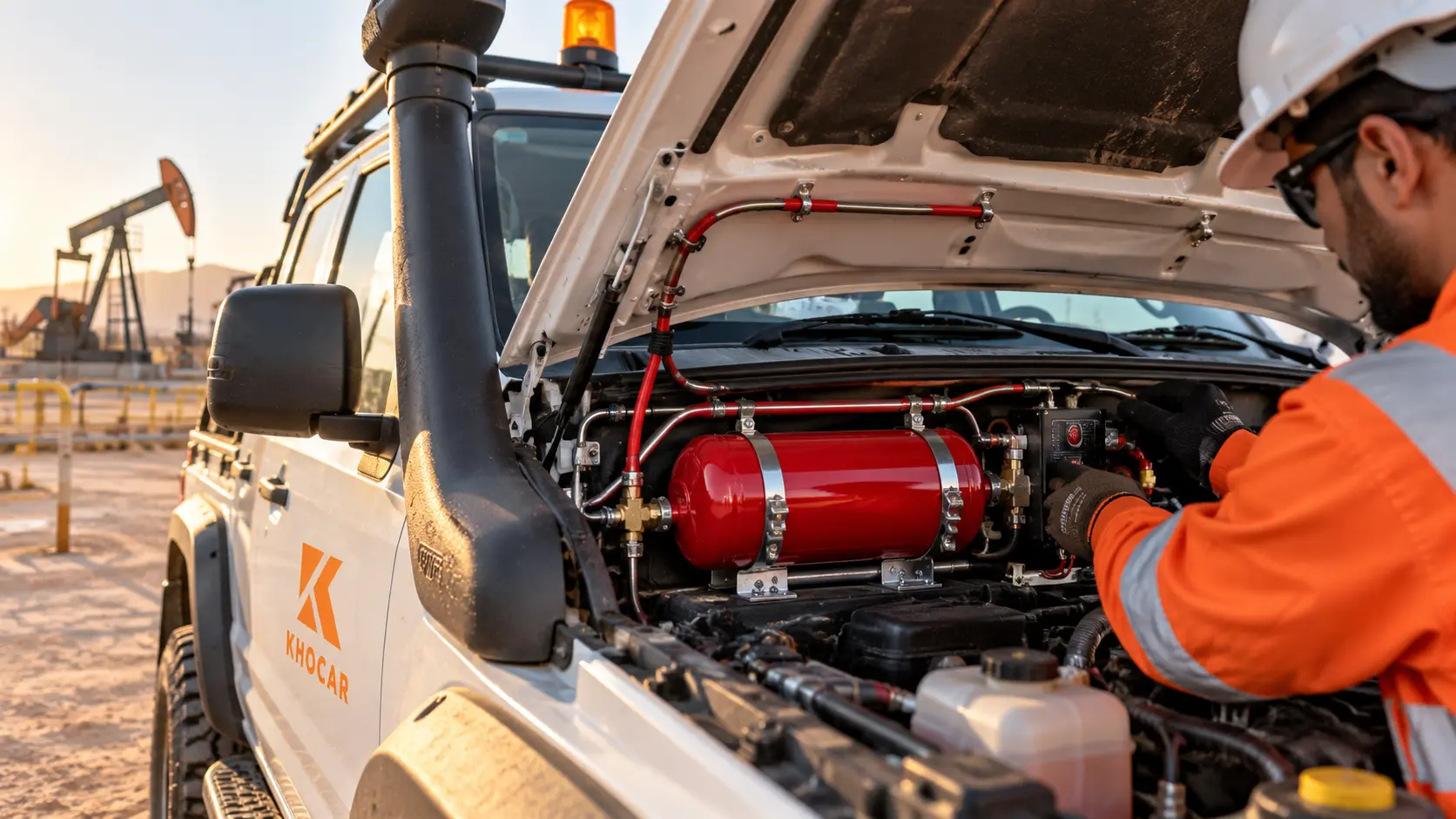
A vehicle fire in an oilfield can become a serious emergency before flames are visible from outside the cab. Hot engine components, leaking fuel, damaged electrical wiring, turbocharger surfaces, and pressurized hydraulic oil can all contribute to a fire. Where a vehicle works near flammable gas or vapour, a fire can also introduce an ignition source into an already hazardous environment. That is why a Zone 2 vehicle fire suppression system UAE assessment should consider more than the extinguisher mounted in the cab. Fleet operators need to understand the vehicle’s fire risks, its hazardous-area suitability, the site’s entry requirements, and how any installed suppression system will be inspected and maintained.
A fire suppression system is not a replacement for ignition protection, preventive maintenance, safe operating procedures, or a site emergency plan. Nor does fitting a suppression unit automatically make an ordinary vehicle suitable for a hazardous area. The correct approach is to assess the complete vehicle and its intended operating environment, then confirm the system design and acceptance criteria with competent specialists and the site operator. This guide explains the main system types, selection factors, inspection routines, and practical questions oilfield fleet managers in Abu Dhabi and across the UAE should ask before specifying or replacing equipment.
Key Takeaways
- A vehicle fire suppression system must be selected for the actual vehicle, fire hazards, operating conditions, and site requirements.
- Zone 2 describes an area where an explosive gas atmosphere is not likely during normal operation and, if it occurs, will exist only briefly. It does not mean the area is risk-free.
- Fire suppression equipment does not by itself make a vehicle Zone 2 compliant or remove other ignition sources.
- Consider engine compartments, hydraulic systems, fuel systems, electrical components, operator exposure, and emergency escape when assessing fire risk.
- Automatic detection and suppression may be appropriate for higher-risk mobile plant, but the system must be designed for the specific machine.
- Manual activation, alarms, shutdown interfaces, and discharge indicators should be accessible and understood by trained operators.
- Portable extinguishers and automatic systems serve different purposes. Requirements depend on risk assessment, site rules, and applicable standards.
- Inspection, maintenance, and post-discharge servicing are essential. A discharged, damaged, isolated, or overdue system may not provide protection.
- Do not assume one universal UAE rule specifies the same system for every Zone 2 vehicle. Confirm project, client, authority, manufacturer, and vehicle-specific requirements.
- Document the system model, agent, protected areas, service history, training, and approval evidence for each vehicle.
What Is a Zone 2 Vehicle Fire Suppression System?
A vehicle fire suppression system is equipment intended to detect, control, or extinguish a fire in a defined part of a vehicle or mobile machine. Depending on its design, it may use automatic detection, manual activation, a stored extinguishing agent, distribution pipework or nozzles, alarms, and interfaces with vehicle controls. Some systems protect an engine compartment, while others are designed for broader mobile equipment risks. The protected area and system capabilities must be confirmed from the manufacturer’s documentation.
The phrase “Zone 2 vehicle fire suppression system” can be misunderstood. Zone 2 refers to a hazardous-area classification, not a particular fire suppression technology. The UK Health and Safety Executive’s explanation of hazardous area classification describes Zone 2 as a location where an explosive atmosphere is not likely during normal operation and, if it occurs, will persist only for a short period. The classification is about the likelihood and duration of an explosive atmosphere, not a guarantee that ignition cannot occur.
For oilfield fleet operators, keep two assessments separate:
- Fire protection assessment: What could catch fire on the vehicle, how could it be detected, and what protection or emergency response is appropriate?
- Hazardous-area suitability assessment: Can the vehicle and its installed equipment operate in the intended classified area without introducing unacceptable ignition sources, according to site rules and applicable technical requirements?
A suppression system can be part of the first assessment. It is not a substitute for the second.
Why Vehicle Fire Protection Matters in Oilfield Operations
Mobile equipment combines heat, fuel, electrical power, moving parts, and sometimes high-pressure hydraulic systems. A fire can develop in areas that are difficult for a driver to see or reach. A driver may first notice a warning light, unusual smell, smoke, loss of machine function, or an alarm. If a fire escalates quickly, the operator may have only a short time to stop in a safe place and evacuate.
The NSW Resources Regulator guidance on fires on mobile plant identifies risks such as heat and smoke exposure, burns while exiting a large vehicle, hot-fluid injuries, and tyre failure after heat exposure. It lists controls that can include maintenance systems, temperature and pressure monitoring, automatic or manual suppression, portable extinguishers, and emergency escape arrangements. This is mining guidance rather than a UAE legal requirement, but the risk-control principles are relevant to oilfield vehicles.
Common vehicle fire sources
Potential sources vary by vehicle, age, duty cycle, and maintenance history:
- Engine and exhaust area: hot surfaces, leaking oil, accumulated debris, damaged insulation, and high-temperature components.
- Fuel system: leaking lines, damaged fittings, spills, or poor repairs.
- Hydraulic system: hose failure or fluid leakage near hot surfaces. Pressurized hydraulic fluid can cause injection injuries and may contribute to a fire if it contacts an ignition source.
- Electrical system: damaged insulation, loose connections, corrosion, overloaded circuits, or incorrectly installed accessories.
- Braking and wheel areas: abnormal heat, dragging brakes, or component failure under demanding duty.
- Battery and charging equipment: electrical faults, damaged cables, or incorrect modifications.
- Added equipment: pumps, generators, auxiliary power units, lighting, communication equipment, or aftermarket wiring installed without review.
The presence of one of these hazards does not mean a fire is inevitable. It means the fleet manager should identify credible scenarios and select controls appropriate to the likelihood and consequences.
Why oilfield conditions affect the assessment
Oilfield vehicles may operate for long periods, travel over rough surfaces, carry tools or equipment, and move between workshops, public roads, industrial yards, and controlled process areas. Dust, vibration, heat, poor access to components, and frequent maintenance can influence reliability. Vehicle use also varies: a light service pickup, heavy utility truck, crane support vehicle, and specialist machine may have very different fire risks.
Avoid specifying suppression based only on vehicle category or engine size. Consider duty cycle, fuel and hydraulic arrangements, added equipment, the location of work, and the consequences of a fire at that location.
Does Every Zone 2 Vehicle in the UAE Need Automatic Fire Suppression?
There is no safe basis for assuming every vehicle entering every Zone 2 area in the UAE must have the same automatic suppression system. Requirements can depend on the asset owner, contract, site access procedure, vehicle category, risk assessment, applicable local regulations, and standards referenced by the project. A client may impose requirements that go beyond a general legal minimum.
Fleet operators should verify requirements for the specific site and vehicle before purchasing or modifying equipment. Ask the site operator or responsible engineering team to confirm:
- Whether automatic fire detection and suppression are mandatory for this vehicle or machine.
- Which compartments or hazards must be protected.
- Whether a portable extinguisher is also required and what type, rating, and mounting arrangement are accepted.
- Whether automatic engine shutdown or another vehicle interface is required when the system activates.
- Which system standards, approvals, installer qualifications, inspection intervals, and documents are accepted.
- Whether the complete installed system must be inspected or accepted before site entry.
- How the system must be managed after maintenance, modification, discharge, or component replacement.
The UAE Department of Energy’s petroleum products safety information highlights routine equipment and vehicle checks, emergency preparedness, onboard suppression systems, trained personnel, and compliance with applicable requirements in the context of petroleum-product transportation. It should not be read as a universal specification for every Zone 2 service vehicle. Use the applicable project and authority requirements for the actual operation.
Main Types of Vehicle Fire Suppression Systems
System design depends on fire hazards, protected volume, equipment layout, ambient conditions, and the manufacturer’s approved application. Common approaches include the following.
Automatic engine-compartment suppression
An automatic engine-compartment system is designed to detect a fire condition in a defined engine area and discharge an extinguishing agent through nozzles or distribution points. Detection may use a linear heat-sensing element, thermal detectors, or another manufacturer-specified method. Activation logic and interfaces vary by product.
These systems can be useful where a fire could develop behind covers or in a compartment that is not immediately visible to the driver. However, a system designed for one engine layout should not be assumed suitable for another. Changes to the engine bay, added accessories, shielding, airflow, or compartment geometry may affect detection and agent distribution.
Confirm the protected area drawing, detection method, agent type, nozzle layout, operating temperature range, manual activation method, and service requirements. Ask the supplier to identify any areas that are not protected.
Automatic suppression for mobile plant
Heavy mobile plant can have multiple risk areas, including engine bays, hydraulic equipment, pumps, conveyors, or other machinery. A system may use one or more protected zones and may include automatic detection, manual actuation, alarms, and an interface with machine controls.
The NT WorkSafe guidance on vehicle and mobile plant fires recommends risk-based controls such as inspecting hydraulic hoses, reviewing electrical systems, and installing and maintaining detection and suppression on higher-risk plant. Its recommendations are guidance for its jurisdiction, not a substitute for UAE project specifications.
Confirm that the selected product is intended for the actual machine and operating conditions, including vibration, temperature exposure, and service environment.
Manual-only suppression equipment
Some vehicles rely on portable extinguishers and manual response procedures, while others have a fixed manual-release system or a combination of manual and automatic features. Manual-only protection depends heavily on early recognition, safe access, operator training, and the ability to act without unacceptable exposure.
A driver should never be expected to approach a rapidly developing fire or enter a hazardous area to operate an extinguisher. The site emergency plan must define when to stop, evacuate, raise the alarm, and leave firefighting to trained responders.
Portable fire extinguishers
Portable extinguishers are a separate layer of protection. They may be required even when a fixed automatic system is installed. The correct extinguisher type and rating depend on credible fire classes, vehicle contents, local requirements, and site rules. Mounting must keep the extinguisher accessible without placing it where it is likely to be damaged or obstructed.
Do not select an extinguisher based on colour alone or assume one agent is appropriate for every fire. Follow the extinguisher label, manufacturer instructions, and site requirements. Personnel should only attempt to extinguish a small, incipient fire when trained, the correct equipment is available, an escape route remains clear, and doing so does not conflict with the emergency procedure.
How to Select a System for a Zone 2 Oilfield Vehicle
Selection should be a documented engineering and operational decision, not simply a purchase based on a supplier’s generic description.
1. Identify the vehicle and intended operating area
Record the make, model, year, engine configuration, fuel type, installed hydraulic equipment, and modifications. Describe the vehicle’s tasks and where it will operate. A vehicle used only in a workshop yard may have different exposure from a machine that regularly enters a classified process area.
Ask the site operator for the area classification, vehicle access requirements, and approved equipment list. A Zone 2 designation alone does not define every condition of use, and the site may impose additional controls based on the process and consequences of an incident.
2. Complete a fire hazard assessment
Map credible fire sources and identify which compartments or components need protection. Review maintenance records for fuel leaks, hydraulic hose failures, electrical faults, overheating, or repeated component problems. Consider whether added equipment creates new hazards or blocks access to the engine compartment.
A fire risk assessment should consider prevention as well as suppression. Correct hose routing, suitable electrical protection, removal of oil and debris, secure fuel lines, effective maintenance, and approved modifications can reduce the likelihood of fire. Suppression should not be used to justify leaving known defects unresolved.
3. Define protected zones and coverage
Ask the system designer to identify exactly what is protected and what is not. A diagram should show detection components, nozzles, agent container, manual release, alarms, and relevant interfaces. Confirm whether the design protects only the engine compartment or other identified hazards as well.
Do not assume agent released in one compartment will protect another. Airflow, barriers, compartment geometry, and fire location affect performance. If equipment is added or moved, ask whether the original coverage remains valid.
4. Choose the extinguishing agent and system design
The appropriate agent depends on the hazard, equipment, manufacturer design, environmental considerations, and applicable acceptance criteria. There is no universal agent that is best for every engine bay, hydraulic hazard, electrical component, or enclosed compartment.
Request the manufacturer’s technical data, operating limits, compatibility information, and instructions for discharge, cleanup, and recharge. Confirm suitability for the vehicle and anticipated fire types. Do not mix agents or replace a specified agent unless the system manufacturer and responsible engineer approve the change.
5. Confirm activation, alarms, and vehicle interfaces
Determine how the system detects a fire and alerts the operator. Confirm whether manual activation is required, where it is located, how it is protected against accidental operation, and whether it can be reached from the expected operator position or escape route.
If automatic engine shutdown, electrical isolation, fuel isolation, or another interface is proposed, confirm the design with the vehicle manufacturer or qualified integrator. An interface that stops the engine may be useful in one scenario but can create other operational consequences if poorly designed. Do not modify vehicle controls without approved engineering review.
6. Verify hazardous-area suitability separately
The suppression system may include sensors, switches, wiring, indicators, control units, or other electrical components. Where these are used in or exposed to a classified area, their suitability must be evaluated against the area classification and applicable requirements. The IEC 60079-14:2024 standard addresses design, selection, and erection of electrical installations in explosive atmospheres. It is not a vehicle fire suppression product specification, but it illustrates why electrical equipment selection and installation in hazardous areas require separate technical review.
Check certification and markings for the actual components and installation, where applicable. Do not assume a suppression system’s general product approval automatically certifies the complete vehicle for Zone 2 use.
7. Confirm installation and acceptance documentation
Before ordering, agree on installation scope, inspection process, test method, documentation, and responsibility for acceptance. Depending on the project, the site may require drawings, product data sheets, certification documents, installer records, commissioning results, maintenance instructions, and operator training evidence.
Record the exact system model and serial number against the vehicle fleet number. Keep the acceptance record with the vehicle’s other hazardous-area and maintenance documentation.
Automatic Detection, Manual Release and Shutdown: What to Check
A system is only useful when its components function as designed and operators understand the response. Review the following features against the manufacturer’s documentation and the site risk assessment.
| Feature | Questions for the fleet or engineering team |
| Detection | What type of detector is used, where is it installed, and what are its limits? |
| Automatic discharge | What condition triggers discharge, and how is readiness monitored? |
| Manual release | Is it identified, accessible, protected against accidental activation, and covered in training? |
| Alarm or indication | How does the operator know a fault or discharge has occurred? |
| Engine or equipment shutdown | Is a shutdown interface specified, and has its effect on vehicle operation been approved? |
| Agent container | Is the cylinder secured, identified, within service limits, and protected from damage? |
| Distribution pipework and nozzles | Are they secured, unobstructed, correctly oriented, and protected from vibration or impact? |
| Fault monitoring | How are low pressure, electrical faults, isolation, or other system faults indicated? |
| Service and recharge | Who is authorized to inspect, repair, recharge, and certify the system? |
These questions should be answered from the selected product’s technical documentation. Features differ between systems, so do not assume every product includes all of them.
Installation Considerations for UAE Oilfield Fleets
Installation quality matters as much as equipment selection. A correctly rated system can still fail to protect the intended area if detectors are poorly located, nozzles are blocked, pipework is damaged, or the system is not integrated correctly.
Follow the approved design
Use the manufacturer’s installation instructions and an appropriately competent installer. Confirm mounting points, container restraint, pipe routing, detector placement, nozzle orientation, and protection from mechanical damage. Installation should not interfere with service access, vehicle controls, ventilation, emergency exits, or the operator’s ability to leave the cab.
Avoid improvising brackets or relocating components without approval. Vibration and movement can loosen components over time, while excessive heat or physical impact can affect performance. Review the installation after significant vehicle modifications.
Protect components from the operating environment
Vehicles working outdoors may encounter heat, dust, moisture, vibration, and washdown. Confirm the environmental limits of detectors, control units, wiring, containers, and other parts. Ensure protective covers do not obstruct detection or agent discharge.
Inspection access should be practical. If a detector, pipe, or mounting point cannot be checked without dismantling unrelated equipment, the maintenance plan should address how it will be inspected safely and consistently.
Do not create new ignition or mechanical hazards
Routing cables and pipework requires attention to hot surfaces, sharp edges, moving parts, pinch points, and hydraulic lines. Any new electrical components or modifications must be assessed for hazardous-area suitability where relevant. A suppression installation should not compromise existing vehicle safety systems or introduce unapproved changes.
Commission and record the installation
Commissioning should follow the system manufacturer’s process and project acceptance requirements. Do not discharge an installed system as a test unless the manufacturer’s procedure explicitly calls for it and the correct safety controls are in place. Record results, defects, corrective actions, component identifiers, and the person responsible for acceptance.
Inspection and Maintenance Checklist
Inspection intervals should be based on the manufacturer’s instructions, site maintenance plan, operating severity, and applicable requirements. Do not invent a single universal service interval for every system. A vehicle working in harsh conditions or with a history of damage may need more frequent attention, subject to the approved maintenance regime.
Before vehicle deployment
- ☐ Confirm the system is present and identified for the correct vehicle.
- ☐ Check visible indicators or status displays according to the manufacturer’s instructions.
- ☐ Look for damaged, loose, corroded, obstructed, or missing components.
- ☐ Confirm manual activation controls are accessible and not obstructed.
- ☐ Check that the agent container and mounting hardware appear secure.
- ☐ Confirm there is no visible evidence of discharge, leakage, tampering, or unauthorized isolation.
- ☐ Verify required portable extinguishers are present, accessible, and within service requirements.
- ☐ Report any fault and keep the vehicle out of service if site rules or the manufacturer require it.
A driver’s pre-use check is not a substitute for a qualified service inspection. Operators should not open, adjust, or repair system components unless trained and authorized.
During planned maintenance
- ☐ Follow the manufacturer’s inspection and service schedule.
- ☐ Inspect detectors, wiring, pipework, nozzles, container, brackets, manual releases, and indicators as applicable.
- ☐ Check that nozzles and detection elements remain in their specified positions.
- ☐ Confirm added equipment has not blocked coverage or damaged components.
- ☐ Review fault records, alarms, isolation history, and previous corrective actions.
- ☐ Check service labels, inspection records, and required certification documents.
- ☐ Verify any electrical or control interface remains in its approved condition.
- ☐ Record findings, repairs, replacement parts, and the next due date.
After discharge, damage, or a system fault
Treat discharge, suspected discharge, physical damage, an unresolved fault, or an overdue service as a condition requiring formal assessment. Follow the manufacturer’s instructions and site rules to determine whether the vehicle can remain in service. Do not simply reset an alarm or return the vehicle to work without confirming readiness.
After discharge, the system may need replacement agent, new components, inspection of affected areas, and a documented recharge or recommissioning process. Only authorized personnel should service it. If the vehicle experienced a fire, investigate the cause and check for heat damage to hoses, wiring, insulation, and adjacent components before return to service.
Operator Training and Emergency Response
Training should be specific to the installed system and vehicle environment. A generic toolbox talk may not be enough if operators do not know the location of manual releases, how to recognize fault indications, or what action the site expects after discharge.
Operators should understand:
- Warning signs of a possible fire, including smoke, unusual odour, abnormal heat, alarms, or visible leakage.
- How to stop the vehicle and move to a safe location if it is safe to do so.
- The site procedure for raising the alarm and contacting control or emergency response.
- When to evacuate immediately and when not to attempt firefighting.
- The location and operation of manual release controls, where provided.
- How to recognize system fault indications and report an unavailable system.
- The need to keep escape routes clear and avoid approaching a fire to retrieve tools or personal items.
The correct response depends on the site emergency plan. A driver should not delay evacuation to activate a system if doing so would expose them to immediate danger. Any extinguisher use must be consistent with training, fire stage, and a safe escape route.
Common Mistakes When Specifying Vehicle Fire Suppression
Assuming suppression means Zone 2 compliance
A fire suppression system is only one element of vehicle safety. Hazardous-area suitability may also involve electrical equipment, hot surfaces, exhaust arrangements, engine protection, gas detection, installation quality, documentation, and site acceptance. Confirm the complete vehicle requirements.
Selecting a system only by vehicle size
Vehicle dimensions and engine size do not fully describe fire hazards. A smaller vehicle with added pumps or hydraulic equipment may need a different assessment from a larger vehicle with a simpler configuration. Base selection on the risk assessment and protected areas.
Treating a portable extinguisher as equivalent to automatic suppression
A portable extinguisher requires someone to recognize the fire, reach the equipment, and decide whether it is safe to use. An automatic system may detect and discharge without the operator approaching the affected compartment. The two can serve different roles and may both be required.
Ignoring modifications after installation
New wiring, hoses, accessories, guards, or engine components can affect detection, coverage, or hazardous-area suitability. Reassess the installation after modifications and update drawings and maintenance records.
Allowing the system to remain isolated or overdue
A system that is isolated, discharged, damaged, or outside its required service condition may not operate as intended. Manage defects through the fleet maintenance and site access process, and do not hide or bypass fault indications.
Failing to train relief drivers and contractors
A vehicle may be used by different drivers across shifts or contracts. Make sure everyone who operates it receives the appropriate system and emergency-response briefing, and keep evidence of training where required.
Example: Preparing a Service Vehicle for an Oilfield Site
A contractor plans to send a utility vehicle to an oilfield site in Abu Dhabi. The vehicle has an engine compartment, auxiliary hydraulic equipment, and electrical accessories added after purchase. The fleet manager knows a fire suppression system is mentioned in the client’s vehicle checklist but does not know whether the requirement covers the engine compartment only or other areas.
Rather than ordering a generic kit, the manager obtains the latest site access requirements and asks the responsible engineering contact to confirm the acceptance criteria. A competent person reviews the vehicle configuration, identifies credible fire sources, and checks the existing maintenance history. The team records the system coverage, activation method, agent, installation requirements, and any shutdown interface. They also confirm that electrical components used in classified areas meet applicable requirements.
After installation, the vehicle receives the required inspection and acceptance checks. The maintenance file records the system model, serial number, protected areas, service schedule, and approved installation documents. Drivers receive a briefing on alarms, evacuation, manual activation where applicable, and reporting faults. When a later modification changes the hydraulic equipment layout, the team asks for the system coverage to be reviewed instead of assuming the original design remains valid.
This process ties the suppression system to the real vehicle and site conditions. It avoids relying on a generic product description as proof of suitability.
Documentation to Request from a Supplier or Installer
Before approving a system, ask for documentation that matches the actual product and installation. Depending on the contract and site requirements, the package may include:
- Manufacturer, model, serial number, and system identification.
- Technical datasheet and installation manual.
- Description of the intended application and protected areas.
- Extinguishing agent details and relevant environmental or compatibility limitations.
- Detection, activation, alarm, and shutdown-interface information.
- Installation drawing showing detectors, nozzles, containers, and pipe or cable routing.
- Relevant product approvals or certificates requested by the project.
- Installer competence or authorization evidence where required.
- Commissioning, inspection, and acceptance records.
- Maintenance, recharge, and post-discharge procedures.
- Operator training material and evidence of training.
- Spare parts and service support information.
Check that documents apply to the exact product variant and installation. A certificate for one component or product family does not automatically establish compliance of the complete vehicle installation. Any claim about hazardous-area suitability should be supported by relevant documentation and accepted by the responsible site authority.
How KhoCAR Can Help with Oilfield Vehicle Safety Requirements
KhoCAR supports oilfield and industrial supply requirements in the UAE. For a vehicle safety-related procurement request, clear specifications help the supplier understand the vehicle, application, and acceptance criteria. Visit the oilfield services and industrial supplies in the UAE page for an overview of the company’s relevant supply scope.
When discussing a Zone 2 vehicle fire suppression requirement, provide the vehicle make and model, site or project requirements, intended operating area, identified fire hazards, existing system details, and any required approvals or inspection documents. Confirm whether the request is for a complete system, a replacement component, maintenance, or documentation support. Final selection, installation, and acceptance should be completed by appropriately competent parties against the vehicle manufacturer’s guidance and applicable site requirements.
Need to Review a Zone 2 Vehicle Fire Suppression Requirement?
Before buying or replacing a system, confirm the fire risk, required protected areas, hazardous-area conditions, and site acceptance criteria. Contact KhoCAR through its oilfield services and industrial supplies page with vehicle details and available specification documents. A clearly defined requirement helps avoid selecting a system that fits the vehicle physically but does not meet the intended application or approval conditions.
FAQs
What is a Zone 2 vehicle fire suppression system?
It is a vehicle fire suppression system selected for a vehicle intended to operate in or support work around a Zone 2 classified area. Zone 2 describes the likelihood and duration of an explosive gas atmosphere. The suppression system protects against specified fire hazards, but it does not by itself certify the vehicle for hazardous-area use.
Is automatic fire suppression mandatory for every Zone 2 vehicle in the UAE?
Do not assume a single rule applies to every vehicle and site. Requirements may depend on the asset owner, project, vehicle category, risk assessment, applicable authority requirements, and site access rules. Obtain confirmation from the responsible site or engineering authority before specifying equipment.
Does installing a fire suppression system make a vehicle Zone 2 compliant?
No. Hazardous-area suitability is a separate assessment of the complete vehicle, its potential ignition sources, installed components, and relevant documentation. Fire suppression may be one control but cannot replace the required vehicle assessment, approved modifications, or site acceptance process.
What parts of a vehicle should a suppression system protect?
The protected areas depend on the fire risk assessment and system design. Engine compartments are common, but some mobile plant may have additional hazards involving hydraulic equipment, pumps, or other machinery. Ask the designer to show the coverage and exclusions in an installation drawing.
What is the difference between automatic suppression and a portable extinguisher?
An automatic system is designed to detect a specified fire condition and discharge agent in a protected area, while a portable extinguisher requires a person to use it. They are not interchangeable in every situation. Site requirements and risk assessment may call for both.
Which extinguishing agent is best for an oilfield vehicle?
There is no universal best agent. Suitability depends on fire hazards, compartment, equipment, environmental conditions, manufacturer design, and site acceptance criteria. Use a system designed for the application and do not substitute an agent without approval.
How often should a vehicle fire suppression system be inspected?
Follow the system manufacturer’s instructions, the site maintenance plan, and applicable project requirements. Inspection frequency can vary with system type, vehicle duty, operating environment, and service history. Record inspections and resolve faults before the vehicle returns to service when required.
What should happen after a suppression system discharges?
Follow emergency and manufacturer procedures, report the event, and keep the vehicle out of service until it has been assessed as required. The system may need recharging, replacement parts, inspection of the protected area, and documented recommissioning by authorized personnel.
Can a vehicle with an installed suppression system enter any hazardous area?
No. Permission to enter depends on the vehicle’s overall suitability and the specific site requirements. The suppression system does not replace hazardous-area assessment, vehicle inspection, required certification, or access authorization.
What documents should a fleet operator request from an installer?
Request the exact product datasheet, installation drawing, system identification, relevant certificates or approvals, commissioning records, maintenance instructions, service records, and operator training material, as applicable. Confirm that the documents cover the actual system variant and installed configuration.