
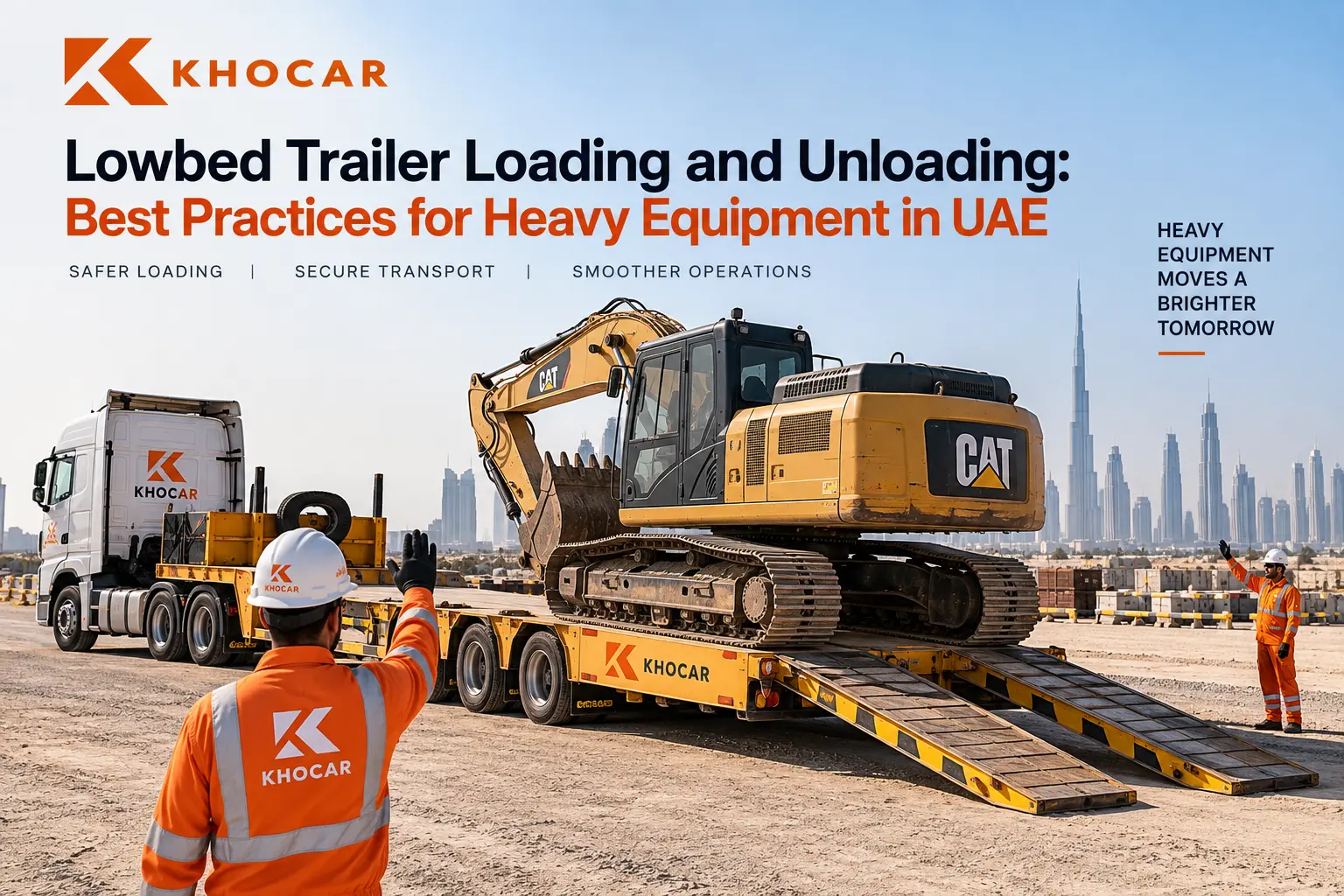
Moving a 20-ton excavator across the UAE is not simply a matter of driving it onto a trailer and tightening a few chains. The most consequential moments often happen before the vehicle leaves the site: positioning the lowbed, preparing ramps, controlling people and vehicles, distributing the machine’s weight, checking clearances, and securing the load. Unloading creates a second high-risk window because restraints are removed, the machine’s center of gravity can change as it moves down a ramp, and people may be tempted to stand in pinch points or inside the machine’s travel path.
For contractors, oilfield service companies, construction firms, plant owners, and logistics teams, a disciplined lowbed trailer loading and unloading UAE process protects people, equipment, roads, and project schedules. UAE road rules also make accurate weight and dimension planning essential. Federal requirements set maximum heavy-vehicle weights and dimensions, while loads that are not easily divisible may require special transportation permits. At site level, the loading area needs firm, level ground, sufficient maneuvering space, clear communication, and appropriate lifting or securing equipment.
This guide explains a practical lowbed trailer loading procedure from planning through final unloading, with special attention to heavy equipment loading in UAE conditions, load security, route restrictions, and the checks that prevent avoidable delays.
Key Takeaways
- Confirm the machine’s actual or manufacturer-specified weight, dimensions, center of gravity, attachment configuration, and operating condition before assigning a trailer.
- Select a lowbed based on the complete transport combination—tractor, trailer, axle configuration, deck dimensions, payload, and route—not simply the machine’s tonnage.
- Prepare a firm, level, obstruction-free loading area and keep non-essential personnel outside the loading/unloading zone.
- Inspect ramps, deck, tires, brakes, suspension, anchorage points, chains, binders, chocks, and other securing equipment before loading.
- Load slowly under a controlled plan, keeping the machine centered and maintaining a low, stable center of gravity.
- Do not rely on machine weight or parking friction to keep equipment in place; use a suitable restraint system designed for the load.
- Verify gross weight, axle distribution, total loaded dimensions, route restrictions, and any required permit before departure.
- During unloading, establish the exclusion zone first, stabilize the trailer, remove restraints only when the machine is stable, and control the machine’s movement down the ramps.
- Document the loading condition with photos and a checklist, especially for high-value or project-critical equipment.
Why Loading and Unloading Is the Highest-Risk Part of a Heavy Equipment Move
The transport journey gets most of the attention, but loading and unloading combine moving vehicles, ramps, elevated surfaces, heavy machinery, changing centers of gravity, and people working close to the equipment. UK HSE guidance on loading areas notes that heavy loads, moving or overturning vehicles, and work at height can result in serious injury or death, and recommends level, firm loading areas with pedestrians and unrelated traffic kept clear. HSE guidance on safe loading Although this is UK guidance rather than UAE law, its risk-control principles are useful when developing a site-specific safe system of work.
| Risk | What can go wrong | Primary control |
| Ramp movement | Machine slips, rolls, or leaves the intended path | Inspect ramps, confirm capacity/angle, align machine, use a controlled speed |
| Trailer movement | Trailer shifts while machine is climbing or descending | Park on firm level ground; apply brakes; use stabilisation/chocks as appropriate |
| Load shift | Machine moves during travel | Use a suitable restraint system and verify attachment points |
| Poor weight distribution | Axles become overloaded or trailer becomes unstable | Plan machine position and check axle/gross weights |
| Pedestrian exposure | Person is struck, crushed, or trapped | Establish exclusion zone and controlled communication |
| Overhead/route clearance | Machine or attachment contacts bridge, cable, pipe, sign, or structure | Measure loaded height and plan route before departure |
| Unexpected machine movement | Hydraulic/mechanical systems move or machine rolls | Follow equipment isolation/parking procedures and control the machine during loading |
| Unloading restraint removal | Machine moves as restraints are released | Confirm stable condition before removing restraints; keep people out of fall/roll paths |
UAE Weight, Dimension, Permit, and Route Considerations
The UAE’s Federal Decree-Law No. 12 of 2023 places responsibilities on heavy-vehicle operators, including not exceeding prescribed gross, axle, and dimensional limits and ensuring proper distribution and securing of loads. Read the UAE Federal Decree-Law No. 12 of 2023 The implementing Cabinet Resolution is active and took effect on 1 February 2024. See Cabinet Resolution No. 138 of 2023
| Axles | Maximum gross weight stated by MoEI |
| 2 axles | 21 tonnes |
| 3 axles | 34 tonnes |
| 4 axles | 45 tonnes |
| 5 axles | 56 tonnes |
| 6 axles | 65 tonnes |
UAE Ministry of Energy and Infrastructure guidance also gives maximum dimensions for specified heavy-vehicle configurations. For a truck head and semi-trailer, the published overall limits are 21 m length, 2.6 m width, and 4.6 m height. These figures are not a substitute for checking the exact vehicle configuration, axle limits, route conditions, or permit requirements.
Where a non-divisible load exceeds ordinary weight or dimensional limits, the UAE framework provides for special transportation permits subject to conditions. The Ministry states that such exceptions depend on factors including the absence of practical transport alternatives and protection of infrastructure and road-user safety.
Abu Dhabi route timing can also affect a lowbed move. Abu Dhabi Mobility announced restrictions on heavy-vehicle movement in Abu Dhabi city from Monday to Thursday, 6:30–9:00 AM and 3:00–7:00 PM, with Friday restrictions of 6:30–9:00 AM and 11:00 AM–1:00 PM, effective from 27 January 2025. Abu Dhabi Mobility’s heavy-vehicle movement update Because traffic rules and route restrictions can change, confirm the applicable restrictions for the planned date and route rather than treating these hours as permanent.
Pre-Loading Planning: Do Not Send the Trailer Until the Load Is Defined
The loading operation should begin on paper before it begins on the ground. A transport provider needs enough information to select the correct equipment and plan the job. KhoCAR’s lowbed trailer booking checklist recommends providing equipment type, weight, dimensions, pickup and drop-off locations, loading method, unloading method, timing, site-access details, and photos.
Information to collect
- Machine make, model, serial number, and asset ID.
- Operating weight or transport weight, including attachments and removable accessories that will travel with the machine.
- Overall length, width, height, and ground clearance.
- Whether the machine is operational and can drive onto/off the trailer.
- Attachment status: bucket, boom, counterweight, blade, forks, crane components, or other equipment.
- Center-of-gravity information if supplied by the manufacturer or known from the machine configuration.
- Pickup and delivery coordinates, site contact, gate requirements, and working hours.
- Required delivery date and whether the move is tied to a shutdown, mobilization, or project milestone.
- Any known route restrictions, low bridges, overhead utilities, narrow access roads, steep grades, or restricted industrial areas.
- Loading equipment available at each end: ramps, crane, forklift, winch, recovery equipment, or other support.
Create a simple load plan
A useful load plan should answer four questions: What is being carried? Where will it sit? How will it be restrained? What route and restrictions apply? For unusual machinery, the plan should also show approximate axle loading and the relationship between deck length, machine length, and any permitted overhang.
Lowbed Trailer Inspection Before Loading
Do not treat trailer arrival as proof that the equipment is ready. The trailer itself should be checked before the machine approaches the ramps. HSE load-securing guidance stresses that anchorage points must be suitable for the forces they receive and compatible with the securing equipment.
| Inspection area | Check |
| Deck | Clean, dry where practicable, structurally sound, no obvious damage, debris, oil, or loose material |
| Ramps | Correctly installed, secure, rated for the intended load, free of damage, and positioned correctly |
| Anchorage points | Accessible, undamaged, compatible with chains/restraints, and attached to the trailer’s structural system |
| Tires/wheels | Condition, inflation, visible damage, and suitability for the trip |
| Brakes | Operational and applied before loading/unloading |
| Suspension | No obvious damage or abnormal condition |
| Lights/reflectors | Operational and unobstructed |
| Chocks/stabilisers | Available and suitable for the loading situation |
| Securing equipment | Chains, binders, straps, edge protection, chocks/dunnage checked and rated as required |
| Clearance | No interference from gooseneck, ramps, deck fittings, or trailer accessories |
Step-by-Step Lowbed Trailer Loading Procedure
Step 1: Establish the exclusion zone
Before the machine moves, define who is allowed inside the loading area. Keep pedestrians, visitors, unrelated vehicles, and non-essential workers outside. HSE recommends separating pedestrians from loading activity and providing a safe place for drivers who are not involved in the operation. HSE workplace transport guidance
Step 2: Position and stabilise the trailer
Place the trailer on firm, level ground where practicable. Apply the parking brake and use the stabilisation/chocking arrangements appropriate to the trailer and site procedure. The objective is to prevent unintended trailer movement while the machine transfers its weight onto the deck.
Step 3: Inspect and position the ramps
Confirm that ramps are fully engaged, correctly aligned, and suitable for the machine. Consider the machine’s wheel or track width, ground clearance, approach angle, and ramp transition. Never improvise with loose materials that can shift under load.
Step 4: Align the machine
Align the machine with the center of the trailer before climbing. Minimise steering corrections on the ramps. For tracked machines, keep both tracks moving in a controlled manner and avoid abrupt turns. A spotter should communicate from a position where they cannot be trapped or run over.
Step 5: Climb slowly and under control
Use the lowest practical speed and follow the equipment manufacturer’s operating guidance. Keep attachments in a stable transport position. Avoid sudden braking, acceleration, or steering while on ramps.
Step 6: Position the machine for stability
Once on the deck, position the equipment according to the load plan. Keep the center of gravity as low as practicable and avoid unnecessary offset to one side. The final position must account for axle distribution, deck capacity, trailer geometry, and any applicable legal limits.
Step 7: Lower, isolate, and secure the machine
Place the equipment in its transport configuration. Where applicable, lower attachments to a stable position, apply the machine’s parking system, shut down/isolate it according to the manufacturer’s instructions, and prevent unintended movement. Then install the planned restraints.
Step 8: Install restraints correctly
Use suitable chains, binders, straps, chocks, or other engineered restraints appropriate to the machine. DVSA guidance on securing loads explains that a securing system must be selected for the load and vehicle combination and that load weight alone cannot be relied upon to prevent movement.
Step 9: Recheck after securing
Walk around the entire combination. Confirm restraint engagement, chain/binder condition, chock placement, attachment position, clearance, and that no component can interfere with tires, suspension, steering, brakes, or other moving parts.
How to Position Heavy Equipment on a Lowbed Trailer
Positioning is more than making the machine “fit.” A heavy machine can fit physically while creating an unacceptable axle load or stability problem. The UAE legislation specifically places responsibility on operators to ensure proper load distribution and securing.
| Positioning factor | Why it matters |
| Centerline | Reducing side-to-side imbalance supports predictable handling |
| Center of gravity | A lower and appropriately positioned center of gravity generally improves stability |
| Axle distribution | Prevents overloading individual axles and helps keep the combination within limits |
| Deck length | Controls fit, overhang, and usable restraint locations |
| Attachment position | Booms, buckets, blades, forks, and counterweights can change total dimensions and weight distribution |
| Ground clearance | Influences loading ramp angle and risk of contact |
| Access to anchor points | A good position still needs practical, safe restraint attachment |
KhoCAR’s lowbed trailer specifications guide explains that capacity depends on trailer configuration, axle count, frame design, and suspension rather than a single universal lowbed rating. Use the trailer manufacturer’s or operator’s actual rated limits for the specific unit.
Lowbed Trailer Loading Safety: How to Secure Heavy Machinery
Securing heavy machinery should be based on the equipment, trailer, restraint system, and expected forces during road travel. DVSA’s load-securing guidance notes that chains can be appropriate for heavy engineering plant and machinery, while also emphasizing that attachment points and the entire restraint system must be suitable.
Common restraint elements
- Chains and binders: commonly used for heavy plant where suitable attachment points and rated equipment are available.
- Wheel or track chocks: provide a physical barrier to movement and may complement the primary restraint system.
- High-friction materials: can increase resistance to sliding when certified and used within their intended application.
- Purpose-built cradles or blocks: useful where the equipment’s geometry or wheels/tracks require additional positive positioning.
- Dedicated trailer anchorage points: should be structurally suitable and compatible with the restraint equipment.
Do not make these assumptions
- The machine is heavy enough that it will not move.
- A single chain is enough because the machine is not going far.
- A cover or tarp is a substitute for restraint.
- Any convenient part of the machine is a suitable chain attachment point.
- Damaged or unknown-rated chains are acceptable for a high-value load.
- Side-to-side imbalance does not matter because the machine is below the trailer’s nominal payload.
DVSA guidance gives a useful benchmark for normal road travel: the securing system should withstand forces equivalent to the full weight of the load forward and half the load to the sides and rear. The exact securing design for a UAE transport operation should follow the applicable local requirements, trailer/equipment manufacturer instructions, and competent load-securing assessment rather than copying a foreign rule without review.
Final Pre-Departure Inspection
| Check | Pass condition |
| Gross weight | Within the applicable legal and vehicle limits |
| Axle loading | Within applicable axle limits and appropriately distributed |
| Overall height | Measured loaded height is compatible with the planned route/clearances |
| Overall width/length | Within applicable limits or covered by required permit arrangements |
| Restraints | All required restraints installed, tensioned, and correctly attached |
| Chocks/blocks | Installed where required and secured against movement |
| Attachments | Boom, bucket, blade, forks, counterweights, etc. secured or configured for transport |
| Trailer condition | Brakes, tires, lights, deck, ramps and visible safety systems checked |
| Route | Route and restrictions reviewed; permits/approvals available where required |
| Site paperwork | Gate passes, delivery references, contact details and required documents ready |
| Photos | Loading condition documented before departure |
Safe Unloading of Heavy Machinery From Lowbed
Unloading is not simply loading in reverse. The machine’s restraints have to be removed in a controlled sequence, the trailer must remain stable, and the route from deck to ground must be clear. Before releasing restraints, confirm that the machine cannot roll, slide, tip, or shift unexpectedly.
Step 1: Prepare the destination
- Choose firm, level ground where practicable.
- Establish a clear exclusion zone.
- Remove unrelated vehicles and pedestrians.
- Check overhead lines, pipes, structures, gates, and turning space.
- Confirm that the ground can support the machine’s weight and the unloading equipment.
Step 2: Stabilise the trailer
Apply brakes and use the trailer’s required stabilisation/chocking arrangements. HSE specifically advises that trailers should be on firm, level ground and that brakes/stabilisers should be used during loading and unloading. HSE unloading and loading checklist
Step 3: Inspect the machine before restraint removal
- Check that the machine is in the intended unloading configuration.
- Confirm it can start and move, or verify the alternative method if it is non-running.
- Confirm attachments will clear ramps and the ground.
- Make sure nobody is in the machine’s travel or fall zone.
- Confirm the operator and signal person understand the unloading sequence.
Step 4: Remove restraints systematically
Remove chains, binders, straps, chocks, or other restraints in the planned order. Do not stand in the path of a restraint under tension. Do not climb onto an unstable load simply to release a chain.
Step 5: Position and secure ramps
Confirm ramps are locked into their operating position and aligned with the machine’s tracks or wheels. Check that the transition is free of debris and that the ramp surface is suitable for the conditions.
Step 6: Descend slowly
Use controlled, low-speed movement. Avoid abrupt steering or braking. Keep the machine aligned with the ramp and maintain communication with the spotter. HSE recommends avoiding reversing where possible and, where reversing is unavoidable, controlling the area and using a trained signaller/banksman where appropriate. HSE reversing guidance
Step 7: Clear the trailer and make the area safe
- Move the machine to the designated safe position.
- Lower attachments to the manufacturer’s recommended safe position.
- Apply the machine’s parking system.
- Remove or stow ramps and securing equipment only when safe to do so.
- Inspect the trailer and site for damage, loose components, and debris.
Common Lowbed Loading and Unloading Mistakes
| Mistake | Why it causes trouble | Better practice |
| Using nominal payload as the only selection criterion | Actual axle distribution, deck geometry, and route limits can still be unsuitable | Check the full combination and actual load plan |
| Loading on soft or uneven ground | Trailer or ramps can become unstable | Use firm, level ground and assess site conditions |
| Guessing machine weight | Can cause wrong trailer selection or compliance problems | Use manufacturer data, weighbridge data, or reliable transport records |
| Ignoring attachments | Booms, buckets, blades and counterweights change dimensions/weight | Measure the actual transport configuration |
| No exclusion zone | People can enter pinch, crush, or travel paths | Segregate people and vehicles before movement |
| Improvised ramp support | Ramps can shift or fail | Use correctly fitted, rated ramps |
| Securing to weak points | Restraint may fail or damage equipment | Use suitable structural anchorage points |
| Removing restraints before stabilising the unloading area | Machine can move unexpectedly | Prepare destination and stabilise trailer first |
| Last-minute route planning | Low clearances, restrictions or permits can derail the move | Review route and restrictions before dispatch |
| Relying on a generic checklist | Different machines create different risks | Use a load-specific plan and competent supervision |
Practical Examples
Example 1: 22-ton excavator, operational
Suppose a 22-ton excavator is moving from a construction yard in Abu Dhabi to another project. The machine can self-load, but its boom and bucket create a tall transport profile. Before dispatch, the team confirms transport weight, actual dimensions with the attachment installed, trailer capacity and axle configuration, loading surface, delivery access, and route restrictions. At loading, the trailer is positioned on firm ground, ramps are inspected, the machine is aligned centrally, and the final position is selected to maintain appropriate weight distribution. The machine is then secured with a load-specific restraint arrangement and the loaded dimensions are rechecked before departure.
Example 2: Non-running wheel loader
A wheel loader has a mechanical fault and cannot climb the lowbed under its own power. The loading plan changes completely. A suitable recovery/loading method must be arranged, the lifting or winching equipment must be appropriate for the machine, and the exclusion zone becomes even more important because personnel may be working around a machine that cannot be controlled normally.
Example 3: Oversized industrial machine
A large industrial machine exceeds ordinary road dimensions. The team should not simply choose a larger trailer and depart. The UAE framework allows special transportation permits for qualifying non-divisible loads subject to specified controls. The transport plan should therefore include measured dimensions, weight data, route assessment, permit requirements, timing, and any required coordination before the trailer is dispatched.
Heavy Equipment Loading UAE: Complete Site Checklist
- Equipment make/model/serial confirmed
- Transport weight verified
- Length/width/height measured in transport configuration
- Ground clearance checked
- Attachments and accessories accounted for
- Machine operational status confirmed
- Loading/unloading method agreed
- Trailer configuration and capacity confirmed
- Deck, ramps, tires, brakes, suspension and lights inspected
- Anchorage points inspected
- Chains/straps/binders/chocks and other securing equipment available and suitable
- Firm, level loading area prepared
- Overhead clearance checked
- Pedestrian/vehicle exclusion zone established
- Competent operator and signal person assigned
- Load position planned
- Gross and axle weights checked
- Loaded dimensions checked
- Route and restrictions checked
- Required permits/approvals confirmed
- Delivery site prepared
- Loading photos taken
- Final walk-around completed before departure
How to Make Lowbed Transport More Efficient in the UAE
Book with complete information
KhoCAR’s lowbed trailer booking guide recommends sending equipment type, weight, dimensions, pickup/drop-off locations, loading/unloading arrangements, timing, and photos. This reduces the chance of dispatching a trailer that is unsuitable for the actual machine.
Plan around route restrictions
Do not build the schedule around driving distance alone. Heavy-vehicle restrictions, site working hours, traffic peaks, permits, gate passes, and delivery windows can all affect the practical travel time. Abu Dhabi Mobility’s commercial transport system also uses Asateel for commercial transport activity and permit processes. Abu Dhabi Mobility Commercial Transport / Asateel
Use the right trailer rather than the biggest trailer
A larger trailer is not automatically a safer trailer. The correct unit must suit the machine’s weight, dimensions, loading method, axle configuration, deck height, restraint points, and route. Overspecifying the trailer can add cost and may not solve a geometry or permit problem.
Build loading into the project schedule
Treat loading and unloading as planned work activities, not spare minutes around the transport window. Allow time for site access, machine inspection, ramp setup, securing, documentation, and unexpected technical issues.
How KhoCAR Supports Lowbed Trailer Transport in the UAE
KhoCAR’s Lowbed Trailer UAE service is designed for heavy equipment movement across Dubai, Abu Dhabi, Sharjah, and other UAE locations. The service page describes support for construction, industrial, and oversized equipment, with experienced drivers and logistics support.
For a transport request, KhoCAR’s published booking guidance asks customers to provide the equipment type, weight, dimensions, pickup and drop-off locations, loading/unloading method, preferred date/time, access details, and photos. Use KhoCAR’s lowbed booking information checklist Providing those details upfront gives the transport team a better basis for selecting the trailer and planning the movement.
KhoCAR’s lowbed trailer rental cost guide also explains that a transport quote can be affected by load size, weight, access difficulty, urgency, route, and other operational factors—not distance alone.
KhoCAR’s heavy equipment transport permit guide can be used as an additional planning reference when a load may require permit coordination.
Need Safe Lowbed Trailer Loading and Unloading in the UAE?
If you need to move an excavator, bulldozer, wheel loader, generator, crane component, or other heavy machinery, KhoCAR can help arrange lowbed trailer transport across the UAE. To speed up planning, provide the equipment type, weight, dimensions, pickup and delivery locations, loading/unloading method, required date, and photos. Explore KhoCAR’s Lowbed Trailer Services in the UAE or use the lowbed booking details checklist before requesting a quote.
FAQs
What is the safest way to load heavy equipment on a lowbed trailer?
Prepare a load-specific plan, use firm and level ground, stabilise the trailer, inspect ramps and restraints, establish an exclusion zone, align the machine with the trailer, climb slowly, position the machine for stability and axle distribution, and secure it with suitable rated restraints before departure.
What should I check before loading heavy equipment on a lowbed trailer?
Check the machine’s weight and dimensions, transport configuration, operating condition, loading method, trailer capacity and configuration, deck and ramp condition, anchorage points, securing equipment, ground conditions, overhead clearance, site access, and route/permit requirements.
How do I secure an excavator on a lowbed trailer?
Use a load-specific restraint plan appropriate to the excavator and trailer. Suitable systems can include rated chains and binders, chocks, and other compatible restraints attached to appropriate structural points. The exact arrangement depends on the machine, trailer, restraint equipment, and applicable requirements; do not rely on machine weight alone.
Can heavy equipment drive onto a lowbed trailer by itself?
Yes, if the equipment is operational and the trailer/ramp arrangement is suitable for its weight, dimensions, ground clearance, and approach angle. Non-running equipment may require a crane, winch, recovery system, or other specialised loading method.
Does heavy equipment weight affect lowbed trailer selection in the UAE?
Yes. Weight affects trailer selection, payload, axle distribution, road compliance, and route planning. The UAE has prescribed gross and axle limits, so the correct trailer must be selected for the complete transport combination rather than the machine’s weight alone.
Do oversized heavy equipment loads need a permit in the UAE?
Loads exceeding ordinary weight or dimensional limits may require a special transportation permit where they qualify as non-divisible loads and meet the applicable conditions. The exact requirement depends on the load and route, so confirm the current rules and permit process before dispatch.
What should the unloading area look like?
It should be firm and as level as practicable, have enough space for the trailer and machine, be clear of unrelated traffic and pedestrians, have suitable overhead clearance, and provide a controlled path for the machine to leave the trailer. The destination should be prepared before restraints are removed.
Why is load distribution important on a lowbed trailer?
Uneven distribution can overload individual axles, affect trailer handling, reduce stability, and create compliance problems. Machine position should therefore be planned using the actual trailer configuration, equipment weight, and applicable axle limits.
What are the biggest lowbed trailer loading safety mistakes?
Common mistakes include loading on uneven ground, using the wrong trailer, underestimating machine weight, ignoring attachments, allowing pedestrians into the loading zone, using unsuitable restraints, failing to check loaded dimensions, and removing restraints before the unloading area is ready.
How early should I arrange lowbed trailer transport in the UAE?
Arrange it as early as practical, particularly for oversized or project-critical equipment. Early planning allows time for trailer availability, site coordination, route restrictions, permits where applicable, loading equipment, gate access, and contingency planning.
What information should I send when requesting a lowbed trailer quote?
Send the equipment type, make/model if known, weight, length/width/height, pickup and drop-off locations, whether the machine is operational, loading and unloading method, required date/time, site access information, and clear photos. These details help the provider assess the job accurately.
Are Abu Dhabi heavy-vehicle movement restrictions relevant to lowbed trailers?
They can be. Abu Dhabi Mobility has published restricted movement hours for heavy vehicles on specified Abu Dhabi city roads. Restrictions and routes can change, so the transport schedule should be checked against the current official requirements for the planned journey.