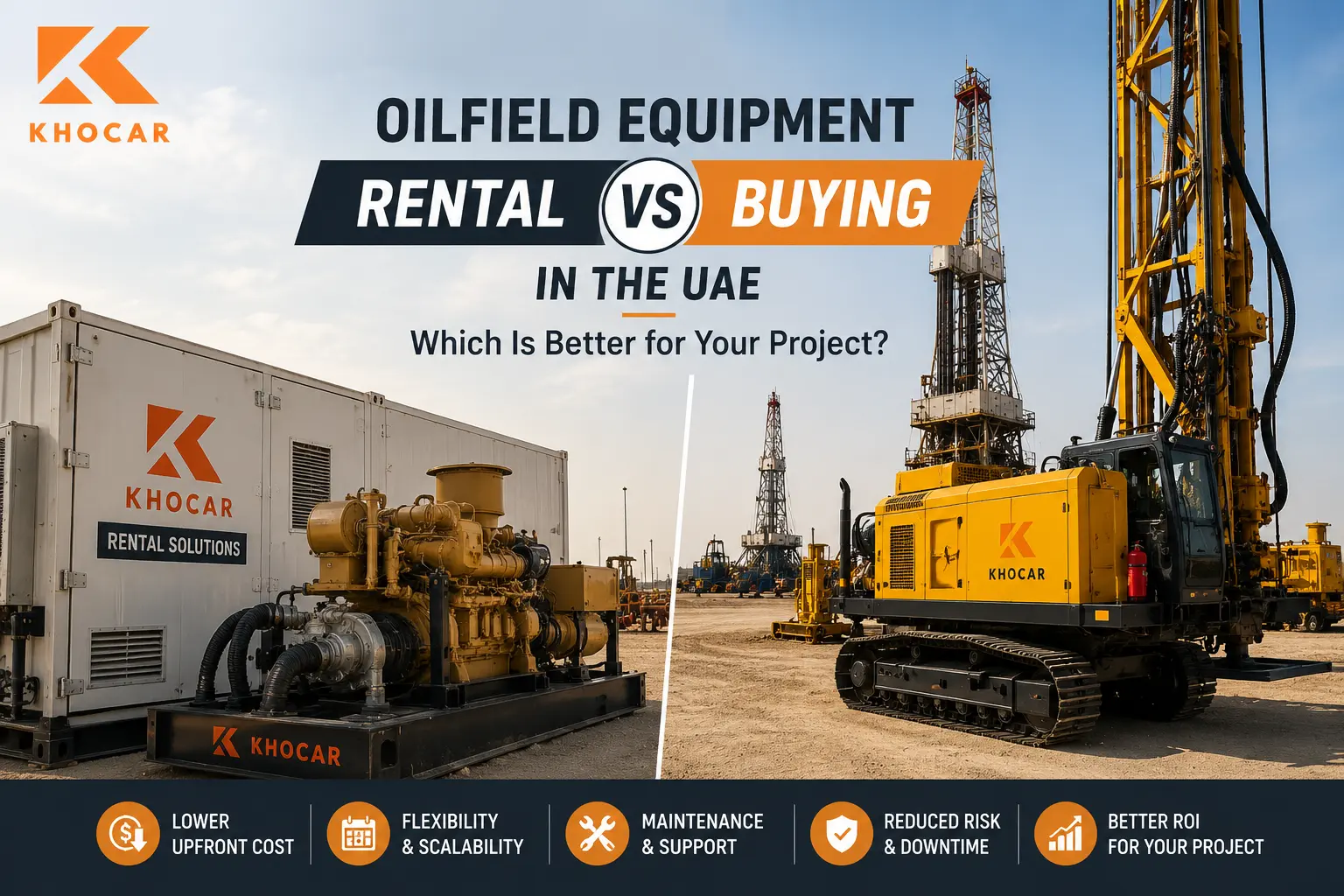
An oilfield project can look profitable on paper and still lose money because the equipment strategy was wrong. A contractor may purchase an expensive unit that sits idle between campaigns, or rent equipment for so long that cumulative rental charges exceed a sensible ownership cost. That is why Oilfield Equipment Rental vs Buying in the UAE is not simply a procurement question. It is a project-planning decision involving utilization, cash flow, mobilization, maintenance, compliance, storage, resale value, and the cost of downtime.
The UAE makes this decision especially important because oilfield work spans onshore and offshore operations, drilling and completion, well intervention, industrial maintenance, logistics and specialized support. ADNOC’s current project pipeline and upstream expansion plans indicate substantial ongoing equipment demand. Its 2025 review reported 4.85 million barrels per day of crude production capacity and a target of 5 million barrels per day by 2027, while ADNOC Drilling operates a large onshore, offshore and island rig fleet. ADNOC’s 2025 review and ADNOC Drilling’s operations overview provide useful context for the scale of activity.
So which option is better? In most cases, neither rental nor buying is universally superior. Rental is often stronger for short-duration, uncertain, specialized, or variable-demand work. Buying can win when utilization is consistently high, the equipment will be needed for years, and ownership creates strategic value. A hybrid strategy, owning core equipment while renting peak-demand or specialized assets, is often the most practical answer for UAE contractors.
Key Takeaways
- Renting usually makes the most sense when the project is short, equipment demand is uncertain, utilization is intermittent, or a contractor needs specialized equipment without committing large CAPEX.
- Buying can make more sense when equipment will be used consistently over several years, the operating configuration is stable, and the owner can manage maintenance, storage, compliance and eventual resale.
- Leasing sits between the two: it can provide longer-term access with a structured payment profile while avoiding some of the upfront capital burden of outright purchase.
- The right comparison is not daily rental rate versus purchase price. Compare the total cost of ownership—including financing, maintenance, inspections, spares, transport, storage, insurance, downtime and resale value—against the full rental cost.
- In the UAE, local availability and mobilization speed can materially change the economics. Equipment that arrives quickly can prevent project delays that cost far more than a modest rental premium.
- Safety and certification cannot be traded away for a cheaper option. Equipment intended for hazardous areas, pressure service or other controlled applications must meet the project’s technical and compliance requirements.
- For many contractors, a hybrid fleet is the strongest strategy: own high-utilization core assets and rent specialized, temporary or peak-load equipment.
Quick Answer: Should You Rent or Buy Oilfield Equipment in the UAE?
| If Your Project Looks Like This… | Usually Consider | Why |
| 2–8 week campaign | Rental | Avoids capital tied up in an asset with limited utilization. |
| 3–12 month project with uncertain scope | Rental or lease | Preserves flexibility while project requirements develop. |
| Multi-year contract with predictable demand | Buy or lease | High utilization can justify ownership economics. |
| Rarely used specialist equipment | Rental | Avoids idle asset cost, storage and depreciation. |
| Core equipment used across multiple projects | Buy | High recurring utilization can spread fixed ownership costs. |
| Temporary surge in demand | Rental | Adds capacity without permanently expanding the fleet. |
| Equipment with rapidly changing technology | Rental/lease | Reduces exposure to obsolescence. |
| Equipment that must always be available | Buy + backup rental option | Ownership provides control; rental can cover peaks or failures. |
Why the UAE Market Changes the Rental-vs-Buy Calculation
The UAE is not a small, single-site oilfield market. Abu Dhabi dominates upstream activity, while contractors also support offshore facilities, industrial zones, fabrication yards, logistics operations and projects across other Emirates. That creates different equipment-use patterns: a contractor may need a unit continuously on one project, while another may only need it for a specific intervention window.
ADNOC’s published project portfolio shows the scale of ongoing energy development, and its 2025 announcements included long-term investments and local manufacturing agreements. For example, ADNOC announced AED 6 billion in framework agreements for UAE manufacturing of cables and pressure vessels, with the stated goals of improving availability, reducing delivery times and strengthening supply-chain resilience. ADNOC’s manufacturing announcement For project managers, that is a useful reminder: procurement strategy is not only about price; availability and lead time can have operational value.
What Counts as Oilfield Equipment in the UAE?
The phrase ‘oilfield equipment’ covers a much wider range of assets than drilling rigs. Depending on the contractor and project, it can include equipment used for drilling, well intervention, completion, pressure control, wireline, cementing, production support, maintenance, transport and site logistics.
- Well intervention equipment
- Wireline and slickline tools
- Pressure control equipment, valves, BOPs and lubricators
- Cementing and well-integrity equipment
- Hydraulic power units, pumps and hydraulic components
- Compressors, generators and light towers
- Mobile workshops and service trucks
- Vacuum, flushing or fluid-handling equipment
- Forklifts, telehandlers and material-handling equipment
- Lowbed trailers, flatbeds and heavy-haul transport equipment
- Specialized tools, test equipment and safety systems
- Spare parts, seals, O-rings, lubricants and consumables
KhoCAR’s oilfield services and industrial supplies division describes a portfolio spanning seals and O-rings, lubricants, hydraulic components, pressure-control accessories, industrial supplies, oilfield equipment supply, machinery maintenance and hazardous-area installations. That breadth matters when evaluating rental versus purchase because equipment is rarely an isolated asset: availability of spares, repair capability and technical support can influence the true project cost.
Oilfield Equipment Rental vs Buying: The Core Financial Difference
Buying converts a project requirement into an owned asset. You pay the acquisition cost—whether from cash or financing—and then carry the equipment’s operating and ownership costs. Rental converts the same requirement into a service expense tied more directly to the period of use.
| Cost Component | Rental | Buying |
| Upfront capital | Usually lower | Usually high |
| Monthly/periodic cost | Rental charge | Financing or capital recovery + operating costs |
| Maintenance | Often included or shared, depending on contract | Owner responsibility |
| Depreciation | Generally not your asset | Owner bears depreciation |
| Resale value | Not applicable to renter | Potential recovery at disposal |
| Storage between projects | Usually supplier’s responsibility | Owner responsibility |
| Fleet flexibility | High | Lower unless fleet is actively redeployed |
| Availability control | Depends on supplier availability | High once asset is owned |
| Technology obsolescence | Lower exposure | Owner bears more exposure |
| Customization | May be limited by supplier | Greater control |
| Asset utilization risk | Lower | Higher |
| Long-term economics | Can become expensive at very high utilization | Can become attractive at high utilization |
Total Cost of Ownership: The Calculation Buyers Often Miss
A common procurement mistake is to compare the purchase price with the advertised rental rate and stop there. A proper rent-versus-buy analysis should calculate the total economic cost over the project’s expected period.
For a purchased asset, a simplified project-level ownership model can be written as:
Ownership Cost = Purchase Price + Financing + Maintenance + Inspections + Spares + Insurance + Storage + Transport + Downtime − Residual Value
For rental, a simplified model is:
Rental Cost = Rental Charges + Delivery/Mobilization + Optional Services + Damage/Excess Charges + Return/Off-hire Costs
These formulas are deliberately simplified. A finance team may also need to account for tax, depreciation, financing structure, working capital, opportunity cost of capital and contract-specific accounting treatment. The point is to compare the full economic picture rather than a single line item.
Caterpillar’s rent/lease/buy guidance makes a similar practical distinction: rental and leasing can help businesses adapt equipment costs to changing workloads, while outright ownership can make sense for consistent, long-term equipment needs.
A Simple Break-Even Method
Suppose a specialized unit costs AED 300,000 to purchase. If annual ownership costs beyond acquisition average AED 45,000, and the expected residual value after three years is AED 120,000, the simplified three-year ownership cost is AED 315,000 before financing and opportunity cost. If an equivalent rental package costs AED 15,000 per month, three years of continuous rental would be AED 540,000 before delivery or other charges.
In that simplified scenario, buying looks attractive for continuous use. But now change the utilization: if the unit is needed only 8 months over three years, rental is AED 120,000 plus applicable logistics and charges. Ownership could leave the contractor carrying a large idle asset for much of the period.
The lesson is more important than the example: the break-even point depends on utilization. A purchase that looks cheap at 100% utilization can be expensive at 20% utilization.
Advantages of Oilfield Equipment Rental in the UAE
1. Lower Upfront Capital Requirement
Rental avoids tying a large amount of working capital into equipment before revenue is generated. This can be especially useful for smaller contractors, newly awarded projects, or companies managing several simultaneous mobilizations.
Instead of spending AED 500,000 on a specialized unit that may sit idle, a contractor can allocate capital to labor, materials, certification, mobilization, insurance or other project-critical needs.
2. Better Flexibility for Short Projects
Oilfield scopes can change. A well intervention may be rescheduled. A maintenance shutdown may move. A contractor may win a short-term campaign and then have no equivalent requirement for the same equipment.
Rental lets the contractor align equipment access more closely with the project window. KhoCAR’s truck rental service explicitly offers short- and long-term rental options, which illustrates the broader flexibility principle.
3. Access to Specialized Equipment Without Long-Term Ownership
Some equipment is essential for a particular job but not needed frequently enough to justify ownership. Specialist tools, temporary pressure-control packages, certain lifting/transport assets and unusual support equipment can fall into this category.
This is particularly relevant when equipment requires specialist maintenance or certification. A rental arrangement may allow the contractor to obtain an inspected asset while avoiding the burden of keeping it compliant during long periods of inactivity—subject to the rental contract and supplier’s responsibilities.
4. Reduced Obsolescence Risk
Technology changes, project standards evolve and equipment can become commercially unattractive before it is physically worn out. Rental or leasing can make it easier to refresh equipment without selling an older asset.
5. Faster Capacity Expansion
If a contractor suddenly wins a second project, renting can add capacity without waiting for a new asset purchase, financing approval, manufacturing lead time or fleet expansion.
6. Potentially Simpler Maintenance Responsibility
Depending on the contract, the rental provider may handle scheduled maintenance, breakdown support, inspections or replacement. That can reduce internal workshop workload.
However, this should never be assumed. Before signing, confirm exactly who pays for preventive maintenance, wear parts, breakdowns, transport to a workshop, inspection renewals and damage.
When Buying Oilfield Equipment Makes More Sense
1. The Equipment Will Be Used Consistently
High utilization is the strongest argument for ownership. If an asset is expected to work across several projects with minimal idle time, ownership can spread the acquisition cost over many operating hours.
2. The Equipment Is Core to Your Service
If a contractor’s business model depends on having a specific unit available—rather than merely needing it occasionally—ownership can provide strategic control.
For example, a company specializing in wireline support may benefit from owning its core service unit because availability, configuration and readiness directly affect its ability to accept jobs.
3. The Project Is Long-Term and Predictable
Long-term contracts make ownership easier to justify because the contractor has better visibility into utilization and revenue. A five-year project with stable equipment requirements is a very different economic case from a six-week campaign.
4. Customization Is Critical
Some oilfield equipment needs project-specific configuration, instrumentation, storage, hazardous-area modifications or integration with existing systems. Buying can provide greater control over how the asset is configured and maintained.
For hazardous-area applications, customization should be treated carefully. Equipment changes may affect certification, inspection and site acceptance. KhoCAR’s Zone 2 installation and certification service highlights the need for appropriate hazardous-area equipment and documentation when preparing vehicles and equipment for Zone 2 environments.
5. Resale or Redeployment Has Meaningful Value
Ownership can be attractive when equipment has a healthy secondary market or can be redeployed across several projects. But residual value should be treated conservatively; oilfield-specific equipment can lose value quickly if standards, technology or market demand change.
Where Oilfield Equipment Leasing Fits
Leasing is often discussed as the middle ground between rental and buying. The terminology varies by supplier and finance structure, so the contract needs to be read carefully. In broad commercial terms, a lease provides access to equipment over a longer period with scheduled payments, while ownership may or may not transfer depending on the arrangement.
| Model | Best Fit | Main Advantage | Main Trade-Off |
| Short-term rental | Weeks to months; uncertain demand | Maximum flexibility | Higher effective cost if used continuously for years |
| Long-term rental | Months to several years; moderate flexibility | Predictable access without outright purchase | Less flexibility than short-term rental; cumulative cost |
| Lease | Longer planned use | Structured payments and newer equipment access | Contract obligations and less flexibility |
| Purchase | High utilization; long-term core asset | Control and potential long-term value | CAPEX, maintenance, depreciation and idle-asset risk |
| Hybrid | Mixed fleet and project portfolio | Balances control with flexibility | Requires stronger fleet planning |
Rental vs Buying: What Matters Most?
| Decision Factor | Renting Wins When… | Buying Wins When… |
| Project duration | Short or uncertain | Long and predictable |
| Utilization | Low/intermittent | High/continuous |
| Cash flow | Capital is constrained | Capital is available |
| Technology | Changes quickly | Stable and mature |
| Maintenance capability | Limited internal support | Strong workshop/team |
| Availability | Supplier can guarantee access | Asset must always be available |
| Customization | Standard configuration is enough | Special configuration is essential |
| Resale | Secondary market is uncertain | Asset has strong redeployment/resale value |
| Demand profile | Peaks and seasonal surges | Consistent baseline demand |
| Risk tolerance | Prefer supplier to carry more asset risk | Comfortable carrying ownership risk |
How Project Duration and Utilization Change the Answer
Project duration alone is not enough. Two contractors can both need equipment for 12 months but reach different conclusions because their utilization differs.
| Scenario | Project Length | Expected Utilization | Likely Strategy |
| Temporary well campaign | 4 months | 80% during campaign, then none | Rent |
| Long-term field support | 36 months | 85–95% | Buy or long-term lease |
| Seasonal contractor | 24 months | 30–40% | Rent or hybrid |
| Specialist intervention tool | 12 months | 10–20% | Rent |
| Core service truck | 60 months | 70–90% | Buy, with rental backup |
| Rapid project expansion | 6 months | Variable | Rent initially; review purchase if demand persists |
Maintenance, Downtime and Local Support Can Change the Economics
The cheapest equipment is not necessarily the lowest-cost equipment. In oilfield work, downtime can interrupt a crew, delay a well intervention, hold up transport, or create cascading costs.
Before comparing rental and purchase, ask how quickly the equipment can be repaired or replaced in the UAE. A supplier with local stock, technicians and spare parts may offer greater economic value than a cheaper supplier whose equipment must be shipped from overseas.
KhoCAR states that its oilfield services and industrial supplies operation focuses on responsive support, local mobilization and equipment availability, and its construction machinery service includes on-site maintenance and diagnostics. Its oilfield services page and machinery maintenance service illustrate why service support should be included in the procurement comparison.
The UAE Climate Should Be Part of the Cost Model
Heat, dust and demanding site conditions can increase wear on equipment and affect maintenance planning. An equipment package that performs well in a controlled indoor environment may need a different maintenance approach in Abu Dhabi’s desert conditions.
- Check cooling-system condition and maintenance intervals.
- Consider dust exposure and filtration requirements.
- Budget for more frequent inspections where the operating environment warrants it.
- Confirm that lubricants, seals, hoses and hydraulic components are appropriate for the operating conditions.
- Ask the supplier how the equipment is maintained between rentals.
- Do not assume a rental unit is ‘maintenance-free’ simply because you do not own it.
KhoCAR specifically positions its machinery maintenance services around Abu Dhabi’s heat and dust, including hydraulic inspection, fluid replacement, engine diagnostics and mobile service.
Safety, Certification and Compliance: The Non-Negotiable Layer
Oilfield equipment procurement cannot be reduced to financial calculations. The equipment must be technically appropriate for the job and compliant with the applicable project requirements.
For hazardous areas, that may include equipment certification, installation requirements, inspection records, gas detection, ignition-source control or other site-specific controls. The IECEx equipment certification scheme provides international context for certified equipment intended for explosive atmospheres. Project requirements may also reference ATEX or other standards.
Pressure-control equipment introduces another dimension: pressure rating, configuration, material compatibility, inspection and certification need to match the well and intervention program. KhoCAR’s cementing and well-intervention offering includes wireline valves/BOPs, lubricators, stuffing boxes, tool traps and other pressure-control accessories, with some equipment listed at pressure ratings up to 15,000 psi. See KhoCAR’s cementing and pressure-control services
The procurement decision should therefore include a technical compliance gate: if the rented or purchased asset cannot meet the project specification, the price advantage is irrelevant.
Supply Chain, Availability and Mobilization
In the UAE, project schedules can be tight. Equipment may need to move between Abu Dhabi, Dubai, offshore staging locations, industrial zones and remote sites. Transport is therefore part of the equipment economics.
If you buy an asset, you need to consider where it will be stored and how it will be moved. If you rent, you need to consider delivery, pickup, off-hire timing and standby charges.
For heavy or oversized equipment, KhoCAR’s lowbed trailer rental and transport service supports movement of heavy machinery and industrial equipment across the UAE. That kind of logistics capability can be relevant when evaluating the true landed cost of either a rental or purchased asset.
Rental Contract Terms That Can Make or Break the Deal
Two rental quotes with the same daily rate can have very different total costs. Before signing an oilfield equipment rental agreement, review the commercial details carefully.
- Minimum rental period
- Mobilization and demobilization charges
- Delivery and collection fees
- Off-hire procedure and notice period
- Standby rates
- Overtime or operating-hour limits
- Fuel responsibility
- Consumables responsibility
- Routine maintenance responsibility
- Breakdown response time
- Replacement-equipment commitment
- Damage and misuse clauses
- Inspection and certification responsibility
- Insurance requirements
- Cleaning/decontamination requirements
- Late-return charges
- Transport between sites
- Operator or technician inclusion
- Extension rates after the initial term
What to Ask an Oilfield Equipment Supplier in the UAE
- Is the equipment currently available in the UAE, or does it need to be imported?
- What is the exact make, model, capacity, pressure rating or technical configuration?
- What certifications and inspection records are included?
- Who is responsible for preventive maintenance during the rental?
- What happens if the equipment fails on site?
- How quickly can a replacement unit be mobilized?
- Are delivery, pickup and transport included in the quoted rate?
- Are there minimum rental periods or standby charges?
- Can the equipment be modified for the project, and who approves those modifications?
- What spare parts and consumables are included?
- Can you support the equipment across Abu Dhabi and other UAE locations?
- If we buy, what after-sales maintenance and spare-parts support is available?
- Can you provide a total-cost comparison between rental and purchase for our expected utilization?
Practical UAE Project Examples
Example 1: A Three-Month Well Intervention Campaign
A contractor wins a three-month intervention campaign and needs pressure-control accessories, slickline tools and a support vehicle. After the project, there is no confirmed requirement for the same package.
Rental is likely attractive because the project has a defined end date and the equipment may have low utilization afterward. The contractor should prioritize supplier availability, certification, technical suitability and breakdown support rather than simply selecting the lowest monthly rate.
KhoCAR’s slickline and pressure-control offering is an example of a supplier model where specialized tools and pressure-control equipment can be sourced for UAE operations.
Example 2: A Five-Year Oilfield Support Contract
A contractor has a five-year support contract and expects a service truck and core equipment package to operate most working days. Utilization is high, the scope is stable and the company already has maintenance capability.
Buying may be financially stronger because the equipment will generate value over a long period. The contractor should still model financing, maintenance, replacement cycles, residual value and the cost of keeping a backup asset.
Example 3: Sudden Project Expansion
A contractor owns five units but wins a project requiring eight for six months. Buying three more units may create a fleet surplus after the project. Renting the additional three is often the more flexible choice.
This is a classic hybrid-fleet situation: ownership covers baseline demand while rental covers temporary peaks.
Example 4: Specialized Equipment With Changing Specifications
A contractor needs a specialized piece of equipment, but the project scope may change after the first phase. The equipment may require different capacity or configuration later.
Rental or leasing can reduce the risk of being locked into the wrong specification. The contractor can validate the operational requirement before making a permanent investment.
A Practical 10-Point Rent-or-Buy Decision Framework
- Define the exact equipment requirement and technical specification.
- Confirm project duration and realistic utilization—not optimistic utilization.
- Confirm whether demand will continue after the current project.
- Obtain the full rental cost, including logistics and standby terms.
- Calculate ownership cost including financing, maintenance, inspections, storage and residual value.
- Estimate the financial cost of downtime under each model.
- Check supplier availability and replacement response time.
- Verify certification, compliance and project-specific HSE requirements.
- Score the strategic value of ownership, including redeployment and customization.
- Choose rental, lease, purchase or a hybrid approach based on the total economic and operational picture.
A Simple Decision Scorecard
| Factor | Weight | Rental Score 1–5 | Buy Score 1–5 |
| Project duration | 15 | ||
| Equipment utilization | 20 | ||
| Capital availability | 10 | ||
| Maintenance capability | 10 | ||
| Technology/obsolescence risk | 10 | ||
| Availability requirement | 10 | ||
| Customization need | 10 | ||
| Resale/redeployment value | 10 | ||
| Supplier support | 5 |
Multiply each score by the weight and compare the totals. This is not a substitute for a detailed financial model, but it forces the project team to consider operational factors that a simple price comparison can miss.
When a Hybrid Strategy Is Better Than Either Option
For many UAE contractors, the most efficient fleet is not 100% owned or 100% rented. It is a portfolio.
- Own high-utilization trucks and core service assets.
- Rent specialized tools required only for certain interventions.
- Rent additional capacity during project peaks.
- Lease newer equipment when long-term access is required but CAPEX needs to be controlled.
- Maintain a supplier relationship for emergency replacement equipment.
- Use local equipment supply for consumables, spares and components so owned assets remain productive.
This approach matches the principle described in Caterpillar’s rent/lease/buy guidance of combining consistently used core equipment with rented or leased equipment when workloads change.
Why the Right Supplier Matters as Much as the Right Ownership Model
Choosing rental versus purchase solves only half the problem. The supplier determines how quickly equipment can be sourced, what documentation accompanies it, how maintenance is handled and how responsive support will be when the equipment is needed.
An experienced UAE oilfield equipment supplier should be able to discuss the technical requirement, not simply quote a product name. That is particularly important for pressure-control equipment, hazardous-area applications, specialized wireline tools and equipment used in demanding field conditions.
KhoCAR’s oilfield services and industrial supplies page describes its offering as a combination of oilfield equipment supply, industrial spares, consumables, machinery repair, Zone 2 installations and field support. For a contractor, that integrated model can reduce the number of separate vendors involved in keeping equipment operational.
Oilfield Equipment Rental vs Buying in the UAE: Final Verdict
If the project is short, uncertain, specialized or subject to sudden changes in demand, oilfield equipment rental is often the safer commercial choice. You preserve capital, reduce idle-asset exposure and can scale equipment capacity up or down.
If the project is long-term, utilization is consistently high, the equipment is central to your business and you have the maintenance and compliance capability to manage it, buying can deliver better long-term economics and greater operational control.
If your workload is mixed—as it is for many contractors—the strongest answer is usually a hybrid strategy. Own the equipment you know will work continuously. Rent the assets that are temporary, specialized or needed only during peaks.
The UAE market rewards contractors who can mobilize quickly and maintain reliable equipment. So the best decision is not simply ‘rent’ or ‘buy.’ It is the option that produces the lowest risk-adjusted total cost while keeping the right equipment available, compliant and productive when the project needs it.
Get Oilfield Equipment Supply and Project Support in the UAE
Need oilfield equipment, industrial supplies, pressure-control components, specialized tools or project support in the UAE? KhoCAR’s oilfield services and industrial supplies team can help you match equipment and supply requirements to the operational need.
KhoCAR supports UAE oilfield and industrial operations with equipment supply, hydraulic components, pressure-control accessories, seals and O-rings, lubricants, industrial consumables, machinery maintenance and hazardous-area services. For projects that also require transport or fleet capacity, truck rental services and lowbed transport can support equipment movement.
Tell the team what equipment you need, how long you expect to use it, the project location, technical specifications and required mobilization date. A supplier can then help determine whether rental, supply, purchase or a combination is the most practical route.
FAQs
Is it cheaper to rent or buy oilfield equipment in the UAE?
The answer depends mainly on utilization, project duration and the full cost of ownership. Rental can be cheaper for short-term or intermittent use, while buying can be cheaper for high-utilization equipment used over several years. Compare total rental cost against purchase, financing, maintenance, storage, insurance, inspections, downtime and residual value.
When should I rent oilfield equipment in the UAE?
Consider rental when the project is short-term, equipment demand is uncertain, utilization is low, the equipment is specialized, technology may change, or you need temporary capacity. Rental is also useful when preserving working capital is more important than owning the asset.
When should I buy oilfield equipment in the UAE?
Buying is generally worth evaluating when equipment will be used consistently for several years, is central to your service offering, has a stable specification, can be maintained effectively, and has meaningful redeployment or resale value.
What is oilfield equipment leasing in the UAE?
Leasing provides longer-term access to equipment through scheduled payments rather than an immediate outright purchase. The exact ownership, maintenance and end-of-term terms depend on the lease contract, so businesses should compare the full contractual cost with both rental and ownership.
What oilfield equipment can be rented in the UAE?
Depending on the supplier, rental options can include trucks, lowbed trailers, generators, compressors, lifting and material-handling equipment, specialized tools, field support equipment and other project assets. Availability varies by equipment type and supplier.
How do I calculate rental vs buying for oilfield equipment?
Estimate the total rental cost for the exact expected utilization period, including mobilization, delivery, standby, fuel, consumables, damage and return costs. Then calculate ownership cost including purchase or financing, maintenance, inspections, insurance, storage, transport, downtime and residual value. Compare the two over the same period.
Does renting include maintenance?
Sometimes, but not automatically. The contract should specify preventive maintenance, breakdown repair, wear parts, service intervals, inspection costs and replacement-equipment obligations. Never assume these are included without confirming them in writing.
Is buying better for long-term oilfield projects?
It can be. Long-term projects with high and predictable utilization often improve the economics of ownership because the acquisition cost is spread over many operating hours. However, financing, maintenance, depreciation, downtime and residual value still need to be modeled.
What is the biggest disadvantage of buying oilfield equipment?
The biggest commercial risk is owning an expensive asset that is underutilized. Owners also carry maintenance, storage, depreciation, compliance, insurance and resale risk. If the project ends early, the asset may remain idle.
What is the biggest disadvantage of oilfield equipment rental?
The biggest risk is cumulative cost at high utilization. Rental can become more expensive than ownership if the equipment is used continuously for a long period. Availability and contract terms can also become issues if the supplier has limited fleet capacity.
Should UAE contractors use a hybrid equipment strategy?
Often, yes. A hybrid fleet can combine owned high-utilization core equipment with rented specialist equipment and temporary peak capacity. This can improve flexibility while retaining control over critical assets.
How important is local equipment availability in the UAE?
Very important. Local availability can reduce mobilization time, shipping risk and downtime. A slightly higher local rental or supply cost can be economically preferable if it gets the equipment to site when the project needs it.
Does oilfield equipment need certification before use in the UAE?
Many categories of oilfield equipment require inspection, certification or documentation depending on the equipment, service, pressure rating, hazardous-area classification and project requirements. The exact requirement should be confirmed with the operator, project HSE team and competent supplier.
Can I rent pressure-control equipment for well intervention work?
Potentially, depending on the supplier, pressure rating, configuration, certification and availability. Pressure-control equipment must be correctly selected for the well and intervention program. KhoCAR lists wireline valves/BOPs, lubricators, stuffing boxes, tool traps and related equipment as part of its UAE well-intervention support.
Does KhoCAR provide oilfield equipment supply in the UAE?
Yes. KhoCAR’s oilfield services and industrial supplies division provides oilfield equipment supply, industrial spares and consumables, hydraulic components, pressure-control accessories, machinery maintenance and hazardous-area installation support.
Does KhoCAR offer rental services in the UAE?
Yes. KhoCAR offers truck rental with short- and long-term options, including pickups, cargo trucks, flatbeds and heavy-duty trucks. It also offers lowbed trailer rental and transport for heavy and oversized equipment.
Can KhoCAR help me decide whether to rent or buy?
A supplier can help assess the technical and operational requirement, availability and support model, but the final commercial decision should consider your project duration, utilization, cash flow, maintenance capability, downtime exposure and long-term fleet strategy. Share the equipment type, expected usage and project duration to get a more relevant recommendation.