
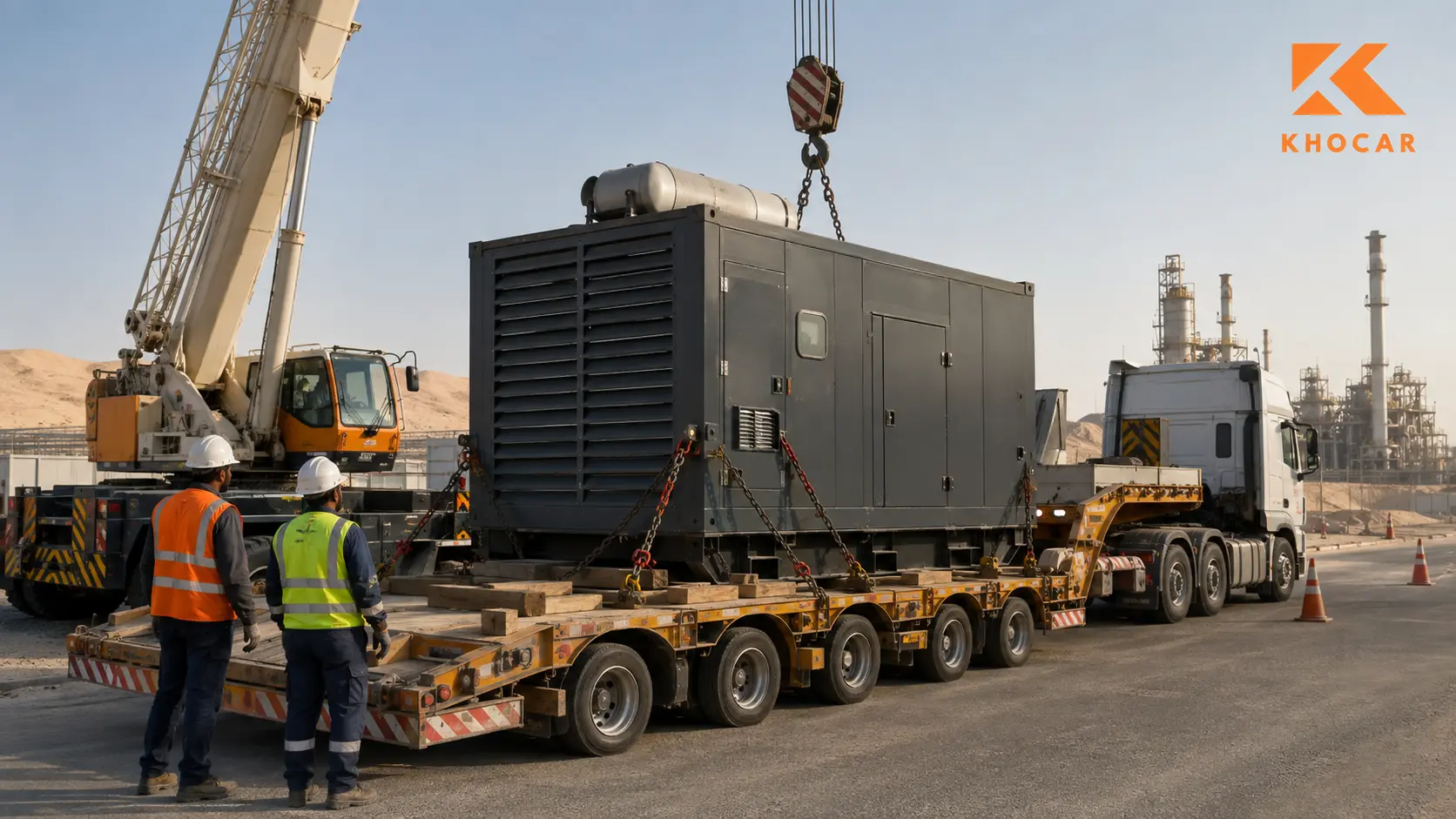
A generator move can fail before the truck travels one kilometre. The quoted weight may exclude a full base tank, batteries, exhaust components or a separate control panel. The selected trailer may carry the tonnes but put the canopy above a bridge or gate limit. The crane may be advertised as “100-tonne” yet lack capacity at the required working radius. At the destination, one missing lifting certificate or gate pass can leave the entire convoy waiting. Safe generator transport UAE projects therefore begin with verified load data, not a trailer booking.
This guide from KhoCAR explains how to select a lowbed trailer for a generator, prepare the genset, plan crane loading, secure the skid, check route and permit requirements, and arrive with the documents the site expects. It is written for facility teams, rental companies, MEP contractors, oilfield contractors and logistics coordinators moving open or acoustic diesel generators between UAE yards, construction sites, factories and remote operating locations.
Key Takeaways
Successful diesel generator transportation in the UAE depends on five linked decisions: verify the generator’s actual transport mass and dimensions; choose the trailer by loaded height, axle distribution and skid footprint as well as payload; size the crane from the load chart at the real radius, including rigging; obtain the permits and time windows required by every road authority on the route; and clear the receiving site’s gate and lifting requirements before dispatch. Never lift from canopy sheet metal, radiator frames, exhaust parts or unverified eyes. Never assume a kVA rating proves weight. Treat fuel condition, battery isolation, loose accessories, weather protection and load securement as part of the transport plan. A road-legal combination can still be refused at the gate, and a site-approved vehicle can still be illegal on the road, so both approval tracks must be completed.
How Do You Transport a Diesel Generator in the UAE?
Quick answer: Confirm the exact generator model, transport weight, dimensions, centre of gravity and OEM lifting points; survey pickup, route and delivery access; select a trailer that satisfies payload, axle-load, deck-height and bearing requirements; prepare an approved lifting plan for both ends; isolate and protect the genset; secure it to rated trailer points; obtain applicable freight, route and abnormal-load permissions; then complete a documented pre-departure and site handover inspection.
The work is easiest to control when it is divided into four packages. The equipment owner supplies accurate load and isolation information. The transport provider designs the road movement and load securement. The lifting team designs loading and unloading. The receiving site confirms its gate, HSE and work-permit requirements. One competent coordinator should reconcile all four packages so that assumptions do not conflict.
Why Industrial Generator Transport Is More Complex Than Moving a Steel Box
A diesel generator looks rigid, but it is a packaged mechanical and electrical system. The engine and alternator create a concentrated, uneven mass on the base frame. An acoustic enclosure adds height and large panels that can be damaged by slings or chains. A base fuel tank may contain hundreds or thousands of litres, changing weight and centre of gravity. Radiators, silencers, cable boxes, louvers, external fuel lines and control panels project beyond the structural skid. Anti-vibration mounts that work during operation may not be intended to carry transport or lifting forces.
The same nominal rating can hide very different packages. An open 500 kVA set, a weatherproof 500 kVA canopy and a containerised 500 kVA power module do not have the same dimensions, weight, lifting points or deck-load pattern. “Move one 500 kVA generator” is therefore not enough information for a safe quotation.
The five generator-specific risks to control
Incorrect mass: the dry weight may omit fuel, coolant, batteries, loose accessories, cable reels or a separate day tank.
Unverified lifting structure: canopy eyes may be for the empty enclosure, while the base-frame eyes may require a spreader beam or a defined sling angle.
Concentrated deck loading: narrow skid rails can overload a local deck area even when total trailer payload is adequate.
Sensitive components: control electronics, radiator cores, batteries, exhaust flex sections and mounts can be damaged by impact, vibration or badly placed restraints.
Fuel and leak exposure: a loose cap, damaged drain, full base tank or unsealed hose can create fire, environmental and gate-access problems.
Information Required Before You Book a Lowbed or Crane
The first deliverable should be a verified generator transport data pack. If the OEM drawing is unavailable, measure the unit and have the equipment owner confirm the weight basis in writing. Photographs should show all four sides, the skid underside, lifting points, fuel connections, exhaust, control panel, pickup path and delivery position. Include a scale reference where dimensions are not obvious.
| Information to provide | Why it changes the plan | Best evidence |
| Exact generator identity | A kVA rating does not establish transport weight, dimensions or lifting method. | OEM model, serial number, nameplate and general-arrangement drawing |
| Transport mass | Controls trailer payload, axle distribution, crane load and rigging capacity. | OEM shipping weight or recent certified weight; state fuel and accessories included |
| Overall transport dimensions | Determines deck fit, loaded height, route clearance and permit category. | Measured L × W × H at the widest and highest fixed points |
| Skid footprint and centre of gravity | Controls deck loading, blocking, axle reactions and lift stability. | OEM drawing showing skid rails, lifting points and centre-of-gravity mark |
| Pickup and delivery conditions | A suitable road trailer can still be impossible to load or unload at the site. | Gate width, surface, crane set-up area, overhead lines, slopes and photos/video |
| Route and schedule | Authority, timing and escort requirements depend on the actual roads and emirates. | Exact pins, approved gate, required arrival window and route constraints |
Do not estimate from kVA: Electrical output is not a transport-weight category. Two generators with the same kVA can use different engines, alternators, tanks, enclosures and cooling systems. Trailer and crane selection must use a verified mass and configuration.
How to Select a Lowbed Trailer for a Generator
A lowbed is often the best starting point for a tall or heavy generator because its lower deck reduces total travelling height and improves stability. It is not automatically necessary for every genset, and it is not automatically sufficient. The correct platform is the one that satisfies total loaded dimensions, legal and permitted axle loads, structural deck capacity, turning access, loading method and the route’s physical constraints.
KhoCAR’s lowbed trailer services in the UAE cover generator and industrial-equipment movements across Abu Dhabi, Dubai, Sharjah and inter-emirate routes. For a general platform comparison before reading the generator-specific checks below, see Lowbed vs Flatbed Trailer in the UAE.
| Load condition | Likely starting option | Decision checks before dispatch |
| Compact generator; within normal height and payload | Flatbed or step-deck may be possible | Crane access, tie-down geometry, skid bearing, legal dimensions and route |
| Tall acoustic canopy or containerised genset | Lowbed / low-loader | Total loaded height, exhaust or lifting-frame projections, bridge and gate clearance |
| Heavy skid with concentrated rail loads | Multi-axle lowbed selected by calculation | Deck point-load capacity, rail spacing, load position, axle reactions and tractor limits |
| Non-running unit with no safe ramp method | Crane-loaded lowbed | Approved lifting points, crane radius at both ends, certified rigging and set-up ground |
| Oversize or overweight configuration | Engineered heavy-haul combination | Authority permit, approved route/time, escorts, swept path, bridge and utility constraints |
1. Calculate total loaded height
Use the generator’s highest fixed transport point, not only the canopy catalogue height. Add the trailer deck height and any timber, rubber mat, steel spreader plate or cribbing beneath the skid. Also include exhaust cowls, lifting frames, cable boxes and protective covers that remain installed. The result must be compared with the surveyed route and permit conditions.
Planning formula: Total loaded height = trailer deck height + generator transport height + dunnage or load-spreading allowance. Use measured values and retain clearance margin for route control; do not work exactly to a mapped obstruction height.
2. Check payload and axle reactions—not just the trailer nameplate
The transport mass should include the generator, retained fuel and fluids, batteries, fitted accessories, transport frame and anything carried as part of the load. The provider must then position that mass so the tractor and trailer axles remain within their allowable and permitted limits. A heavy engine end placed too far forward or rearward can overload an axle group even though the combined payload appears acceptable.
3. Check the skid footprint and local deck strength
Generators commonly sit on two narrow longitudinal rails. That concentrates force into strips rather than spreading it over the deck. Confirm the rail spacing, contact length, structural cross-members and any base-tank projections. Use engineered dunnage or load-spreading plates where required, while keeping drains, tank seams and flexible components free from crushing loads.
4. Confirm usable deck length, width and tie-down geometry
Allow space for blocking, chains or webbing, edge protection and safe access for the crew. A generator that physically fits between trailer edges may still leave poor restraint angles or place chains against canopy panels. Any over-width projection changes route, marking and permit requirements. Confirm detachable exhausts, stairs, cable trays and auxiliary tanks separately rather than hiding them inside the main dimensions.
5. Decide how the unit will get on and off
Most fixed-skid generators are crane loaded. A rental generator mounted on a roadworthy chassis may be towable, and some equipment can be winched onto a suitable trailer using an OEM-approved frame method, but improvised dragging or pulling from lifting eyes can distort the base. The loading and unloading method must be agreed before the trailer leaves the depot.
Crane Loading: Build the Lift Around the Real Radius
Crane selection is not made from the largest number painted on the boom. Rated capacity falls as working radius increases and changes with boom length, counterweight, outrigger configuration and pick geometry. The lifting team needs the generator’s verified gross lift weight, the weight of the hook block, spreader beam, slings and shackles, and the maximum radius at every critical point: initial pick, swing over the trailer, set-down and final placement.
For Abu Dhabi work, the February 2026 ADOSH-SF Code of Practice 34.0 for lifting equipment requires lifting operations to be planned, risk assessed and carried out by trained, competent personnel. Its lifting-plan requirements include roles, crane capacities at radius, a lift sketch, operator and slinger competency records, test certificates and risk assessments. The code also requires an appointed person when a crane is used.
Use only verified generator lifting points
The preferred evidence is the OEM lifting drawing for the exact packaged unit. It should identify which points carry the full assembled generator, the required lifting arrangement and any angle or spreader restriction. Never assume that a canopy eye, roof rail, radiator frame, exhaust bracket or container corner casting is rated for the entire genset unless the manufacturer says so.
The principle is visible even in manufacturer instructions for smaller sets: a current Cummins generator service manual identifies dedicated lift-hook slots and says the lifting rig must spread the straps so they do not crush or bend the control box, air filter or fuel lines. Industrial packages differ, so use the manual for the actual unit rather than copying another model’s arrangement.
Understand why sling angle matters
A flatter bridle creates more tension in each sling leg. In an idealised, symmetric two-leg lift, leg tension equals W ÷ (2 × sin θ), where θ is each leg’s angle above the horizontal. A 10,000 kg load at 60° produces about 5,774 kg of ideal tension per leg; at 30°, each leg carries about 10,000 kg before allowance for centre-of-gravity offset, hitch efficiency, dynamics or unequal sharing. This example is educational, not a rigging design.
The OSHA safe-sling tables show rated capacities changing with horizontal angle, and the ADOSH code requires sling-angle effects on safe working load to be understood. The appointed lifting person must use certified rigging data and the approved lift plan.
Crane set-up checks that stop bad lifts
Ground bearing: confirm soil, pavement, underground services, basements, trenches and outrigger-mat design.
Maximum working radius: measure the worst pick-and-place radius, including walls, fences, live plant and the trailer position.
Overhead and side clearance: identify power lines, pipe racks, structures, lighting and adjacent traffic.
Wind and weather: large acoustic canopies present wind area; follow the crane and lift-plan limits. The ADOSH code states lifting must cease at 38 km/h gusts or recorded wind, while a manufacturer may impose a lower limit.
Control of the area: set an exclusion zone, nominate one signaller, agree communications and keep people out from under the suspended load.
Trial lift: raise only enough to prove balance, brakes, rigging seating and clearance before committing to the swing.
How to Prepare a Diesel Generator for Transportation
Preparation protects people, the road, the generator and the receiving site. The equipment owner should lead the shutdown and isolation because the transport crew may not know the control sequence, auto-start circuit, remote cables or stored electrical energy. Record the pre-move condition with time-stamped photographs and note existing leaks, dents, alarms and missing parts.
Shutdown and electrical isolation
- Remove the electrical load and complete the OEM cooldown. Do not stop a hot loaded set and immediately begin handling.
- Disable automatic and remote starting. Place controls in the required safe mode and isolate external start signals.
- Isolate output and auxiliary supplies. Disconnect and label power, earthing, charger, heater, control and communication cables using the project procedure.
- Isolate the starting batteries. Follow the OEM sequence; many manuals specify disconnecting the negative cable first and reconnecting it last. Protect terminals from accidental contact.
- Verify zero-energy and release stored pressure. Check external fuel pumps, day-tank transfer, jacket-water heaters, air-start systems and connected pipework.
Fuel, oil, coolant and environmental controls
Do not apply a universal “transport with a full tank” or “drain everything” rule. The correct fluid condition depends on OEM guidance, route and site rules, tank construction, leak condition, dangerous-goods requirements and the need to control weight. Confirm and document the fuel level used in the transport mass. Close and secure fill caps, drains, vents and isolation valves as designed. Cap disconnected hoses and provide suitable spill controls without blocking required tank ventilation.
Inspect the base tank, flexible connections, coolant hoses, oil pan, filters and drain points. Any active leak should be repaired before movement. If a fluid must be drained, use an approved container and waste-handling process; never drain onto the ground. At delivery, record which fluids were removed so the commissioning team does not attempt to start an unready unit.
Protect vulnerable components
Remove or independently pack loose items: silencers, rain caps, cable glands, ladders, tools, manuals and spare filters.
Secure doors and panels: use their designed latches; do not overtighten chains across thin acoustic sheet metal.
Protect openings: fit weather-resistant covers to exhaust, intake and cable entries while avoiding moisture traps.
Support external assemblies: remove tall exhaust stacks or braces only under the approved disassembly method.
Preserve control settings and evidence: photograph the controller state, hour meter, alarm history and cable labels before isolation.
Load Positioning and Securement on the Trailer
The generator should bear on structural skid rails or manufacturer-approved support points. Use clean, sound dunnage that spreads load and resists movement without contacting tanks, valves, drains or flexible mounts. Align the heavy end according to the axle-load calculation, then verify actual position before final tensioning. The driver should not adjust the position by guesswork after the crane has left.
Restraints must prevent forward, rearward, lateral and vertical movement under transport forces. Use rated trailer anchor points and rated chains, binders or webbing selected for the load and edge conditions. Keep restraints off radiator cores, doors, louvers, exhausts, control boxes and unverified lifting eyes. Add blocking or chocks where engineered into the securement plan; friction mats can assist but do not replace positive restraint.
KhoCAR’s heavy-equipment securement checklist for UAE lowbed moves explains working-load-limit checks, tie-down geometry and pre-trip inspection in more detail. For a generator, the securement plan should also protect the enclosure and allow inspection of tank drains, straps, chains and dunnage during rest stops.
Pre-departure securement check
Load position matches the axle and route plan.
All restraints and anchor points are identifiable and rated.
No restraint bears on sheet metal, cables, hoses or sharp unprotected edges.
Dunnage is stable, captured and clear of fragile components.
Doors, caps, batteries, accessories and covers are secure.
Overall length, width, height and mass match the permit application.
Photographs show the final load from every side before departure.
A planned early stop is available to recheck tension after the load settles.
Generator Transport UAE Permits and Route Planning
There is no single document called a “UAE generator transport permit” that replaces every other approval. Requirements depend on the registered vehicle, operator activity, total loaded mass and dimensions, roads used, time of movement, escort need, and the emirates crossed. The transport provider should screen the complete route against current authority requirements and secure written approvals before mobilising an over-weight, over-dimension or restricted-road combination.
| Jurisdiction / control | What the current official source establishes | Planning implication |
| Abu Dhabi commercial freight | Abu Dhabi Mobility lists operator, freight-vehicle and driver permits through Asateel; activated vehicles use approved tracking devices. | Use a properly permitted operator, vehicle and driver. This is separate from a route or abnormal-load approval. |
| Abu Dhabi restricted-road movement | TAMM provides a heavy-vehicle mobility-permit service for roads and prohibited areas. | Confirm whether the selected route or time needs a mobility permit before dispatch. |
| Abu Dhabi city timing restrictions | The published schedule effective 27 January 2025 restricts heavy vehicles Mon–Thu 06:30–09:00 and 15:00–19:00; Friday 06:30–09:00 and 11:00–13:00. | Build the slot into pickup, crane and gate bookings, then re-check the live rule for the move date. |
| Dubai over-weight / over-dimension | Dubai RTA provides a mobility permit and currently states a three-working-day service time. Its page lists special-load characteristics including weight over 60 t, width over 3.5 m, height over 4 m or length over 20 m. | Do not promise immediate movement. Submit accurate vehicle-and-load dimensions and leave time for review or route conditions. |
| Client or industrial site | Gate, HSE, lifting and work-permit controls are set by the receiving organisation and project. | Obtain the current project checklist; a road permit does not grant site entry or permission to lift. |
Abu Dhabi Mobility’s commercial transport information explains the Asateel operator, vehicle and driver permit structure. Its published heavy-vehicle restriction update provides the current public timing reference used above. For restricted roads and prohibited areas, check the TAMM heavy-vehicle mobility permit service. Because notices can change, verify all three on the actual move date.
For Dubai, the RTA over-weight and over-dimension mobility-permit service states the current application route, typical service time and special-load characteristics. An inter-emirate movement may need coordination beyond one portal, especially if the approved route, escort or time conditions change at an emirate boundary.
Permit rule: Apply using the final tractor, trailer, axle arrangement, load mass, dimensions and route. Changing the trailer, adding an exhaust frame or repositioning the generator after approval can invalidate the assumptions behind the permit.
What a Generator Route Survey Should Check
Vertical clearance: bridges, gantries, power or telecom lines, pipe racks, canopies and the final gate.
Horizontal clearance: lane width, barriers, parked vehicles, toll gates, security chicanes and narrow industrial roads.
Swept path: roundabouts, U-turns, slip roads, yard corners and the crane/trailer reversing path.
Structural limits: bridges, culverts, weigh stations, soft shoulders and temporary site roads.
Traffic controls: heavy-vehicle bans, permitted time window, road works, events and escort staging.
Emergency holding points: safe places to stop if the gate, crane or escort is not ready.
Site interface: gate dimensions, wheel-wash, security search, induction location, unloading area and exit route.
For a more detailed local scheduling reference, use KhoCAR’s 2026 guide to Abu Dhabi heavy-vehicle timings and restricted roads together with the current authority notice rather than treating any blog or saved screenshot as a permanent rule.
Generator Relocation Abu Dhabi: A Practical Planning Example
Consider a hypothetical acoustic diesel generator moving from a Musaffah yard to a remote industrial site. The owner initially supplies a model and an 11,800 kg dry weight. The drawing later shows a 1,500-litre base tank, external silencer frame and a heavy engine end offset from the geometric centre. The destination can accept the trailer but has no permanent crane, and the set-down point is behind a fence at a longer radius than the pickup.
The correct plan does not merely add a lowbed and two cranes. The owner confirms the actual fuel level and transport mass; the provider calculates loaded height and axle reactions; the lifting team sizes each crane independently using the worst radius and total suspended load; the exhaust frame is either included in the measured envelope or removed and packed under an approved method; the route is checked against Abu Dhabi timings and any mobility permit; and the site approves the lift plan, crew and equipment certificates before dispatch.
Suppose the loaded combination fits the road route but the final gate canopy is lower than the road clearance. That is not solved by a road permit. The generator may need a different entrance, a lower trailer, removal of an approved detachable component, or a change to the set-down strategy. This is why pickup and delivery surveys belong in the same plan as the highway route.
Site-Access Checklist for Industrial and Oilfield Locations
Site-access requirements vary by operator, project and risk level. Request the live checklist from the receiving organisation and confirm who submits each item. Do not assume that requirements used on a previous ADNOC, utility, construction or factory job remain valid. A generator arriving at a classified hazardous area may also create vehicle and equipment restrictions that do not apply at a general industrial yard.
Transport and identity documents
Driver licence, Emirates ID and any commercial freight-driver permit required for the operation.
Tractor and trailer registration, insurance, inspection and freight-vehicle permit records.
Approved route, mobility or abnormal-load permit and escort details where applicable.
Delivery note, gate pass, purchase order or equipment-transfer authorisation.
Generator model, serial number, owner, dimensions, declared transport mass and condition report.
Lifting and HSE documents
Approved method statement, task risk assessment / JSA and lift plan for loading and unloading.
Crane registration, inspection and test certificates plus the applicable load chart and configuration.
Valid certificates for slings, shackles, spreader beams and other lifting accessories.
Operator, appointed person, lifting supervisor and rigger / signaller competency evidence.
Site induction, toolbox talk, work permit, lifting permit and exclusion-zone arrangements.
Ground-bearing confirmation, outrigger-mat plan and underground-service clearance when the crane sets up onsite.
Generator and hazardous-area checks
Fuel level, leak-free condition, spill kit and site acceptance of the planned fluid condition.
Battery and auto-start isolation status, lockout/tagout ownership and handover method.
Loose exhaust, cable, ladder and accessory packing list.
Zone classification and site-specific vehicle/equipment requirements if the truck or crane will enter a hazardous area.
Emergency contacts, gas testing, fire-watch or other controls required by the receiving site.
Important distinction: A Zone 2 requirement is driven by where the transport vehicle or lifting equipment will operate, not by the fact that the cargo is a generator. Confirm the classified-area boundary and current site rule before promising access.
Day-of-Move Generator Transportation Sequence
- Hold a pre-start coordination meeting. Confirm owner, transport, lifting and site representatives; latest drawings; permit conditions; weather; route; gate slot and emergency contacts.
- Inspect and isolate the generator. Record condition, verify shutdown and auto-start isolation, confirm fluid level and mass basis, cap connections and secure accessories.
- Inspect the trailer and lifting equipment. Check configuration, deck, dunnage, anchor points, crane set-up, certificates, rigging tags and load chart.
- Barricade and conduct the lift. Follow the approved plan, use one appointed signaller, make a trial lift, protect the enclosure and place the skid at the calculated trailer position.
- Secure and measure the loaded combination. Install restraints and blocking, verify axle/load position, measure overall dimensions and photograph all sides.
- Complete the departure check. Confirm permits, timing window, route, escort, lights, markings, tyre condition, load security and driver documents.
- Recheck after initial travel. Stop at the planned safe location and inspect chains, binders, webbing, dunnage, covers and any sign of leakage or movement.
- Control arrival and unloading. Do not break restraints until the trailer is parked in the approved area and the crane, lift supervisor and exclusion zone are ready.
- Handover before commissioning. Record delivery condition, isolation state, removed fluids or accessories, damage observations and responsibility for reconnection and testing.
Common Generator Transport Mistakes
- Quoting from kVA alone. It hides the package weight, tank, enclosure, cooling and accessories.
- Using dry weight after leaving fuel in the base tank. The crane, trailer and permit can all be based on the wrong number.
- Selecting the crane by headline tonnage. Capacity at the real radius and configuration is what matters.
- Lifting from canopy or unverified eyes. Sheet metal and enclosure points may not carry the complete generator.
- Forgetting the unloading plan. The destination often has the longer radius, poorer ground and tighter access.
- Ignoring skid rail point loads. Adequate total payload does not prove the deck can accept concentrated bearing.
- Applying for permits before finalising the combination. A later change in trailer, position or accessory envelope can change the approved data.
- Arriving without site-approved documents. The public-road journey can be complete while unloading remains prohibited.
- Restarting immediately after delivery. Fluids, batteries, cables, exhaust and cooling systems may still be isolated or disturbed.
Plan Your Generator Transport in the UAE with KhoCAR
A reliable industrial generator move starts with the right questions: exact mass, true dimensions, skid footprint, route, crane radius and site rules. KhoCAR can coordinate a suitable lowbed trailer for generator transport across the UAE and help plan the movement around access, loading and delivery constraints. Send the model, weight evidence, L × W × H, photos, pickup and delivery pins, required date, fuel condition and site-contact details. To arrange a generator relocation in Abu Dhabi or an inter-emirate move, contact KhoCAR for a project-specific transport plan and quotation.
FAQs
Do I need a lowbed trailer to transport a diesel generator in the UAE?
Not always. A compact generator may fit a flatbed or step-deck if payload, deck loading, loaded height, securement and route limits are satisfied. A lowbed is usually preferred for taller, heavier or containerised sets because the lower deck improves height clearance and stability. Select by verified dimensions, mass, skid footprint and route—not by equipment name alone.
What information is needed for a generator transport UAE quotation?
Provide the exact model and serial number, verified transport weight, overall length, width and height, fuel level, skid and lifting drawing, centre of gravity if available, photographs, pickup and delivery pins, access restrictions, required date, crane need and site-document requirements. State whether exhausts, tanks, panels or cable equipment travel with the set.
Can a diesel generator be transported with fuel in the tank?
It depends on the generator, tank condition, transport weight, route rules and receiving-site requirements. Do not assume a full or empty tank is always acceptable. Confirm the permitted fuel condition, include retained fuel in the declared mass, secure caps and valves, repair leaks and document the condition for handover.
How do you lift a generator onto a lowbed?
Use an approved lifting plan, a crane with adequate capacity at the real working radius, certified rigging and the OEM-approved lifting points for the exact assembled unit. A spreader beam may be required to maintain sling geometry and protect the canopy. Conduct a trial lift and keep everyone outside the exclusion zone.
Can you lift a generator by the canopy lifting eyes?
Only if the manufacturer’s document for that exact package confirms those eyes are rated for the complete generator and specifies the lifting arrangement. Some roof or canopy points are only for enclosure handling. When evidence is missing, use verified structural base-frame points under an engineered lift plan.
What size crane is needed to load a generator?
There is no safe answer from generator weight alone. Crane capacity depends on total suspended load, working radius, boom length, counterweight, outrigger configuration, ground conditions and pick path. The lifting appointed person must select the crane from its load chart using the worst point of the lift at both pickup and delivery.
Does generator transport in the UAE require a special permit?
A standard within-limit movement may not need an abnormal-load permit, but the freight operator, vehicle and driver still need applicable operating permissions. Over-weight, over-dimension or restricted-road movements require the relevant authority approvals for the actual route. Requirements differ by emirate, vehicle, dimensions, mass, time and road.
How long does an oversized-load permit take in Dubai?
Dubai RTA’s current mobility-permit page states a service time of three working days. Complex or incomplete applications can take longer, and the move may have route, time or escort conditions. Apply only after finalising the vehicle, trailer, load dimensions, mass and route.
What are the Abu Dhabi heavy-vehicle restricted times?
Abu Dhabi Mobility’s published schedule effective 27 January 2025 restricts heavy vehicles on Abu Dhabi city roads Monday to Thursday from 06:30 to 09:00 and 15:00 to 19:00, and Friday from 06:30 to 09:00 and 11:00 to 13:00. Always check the live authority notice because temporary or permanent updates can change the plan.
What documents are usually required to enter an industrial or oilfield site?
Common requirements include driver and vehicle documents, gate pass, delivery note, approved route or load permit, method statement, JSA, lift plan, crane and rigging certificates, operator and rigger competency, induction and work/lifting permits. Hazardous-area requirements are project-specific. Obtain the receiving site’s current checklist before dispatch.
How should a generator be secured to a lowbed trailer?
Support it on approved structural skid points and restrain it against forward, rearward, lateral and vertical movement using rated equipment and trailer anchors. Keep chains and straps off sheet metal, controls, radiator cores, hoses and sharp unprotected edges. Verify load position, tension and dunnage before departure and at a planned early inspection stop.
How much does diesel generator transportation in the UAE cost?
Cost depends on generator mass and dimensions, trailer and axle configuration, cranes at one or both ends, distance, permit and escort requirements, route survey, waiting time, site induction and mobilisation timing. Accurate drawings, photos, pins and schedule information produce a faster and more reliable quotation than a kVA rating alone.
Can a generator be started immediately after relocation?
Not automatically. Confirm that fluids, batteries, output cables, earthing, fuel lines, exhaust, cooling components and remote-start circuits have been restored and inspected. Check for transport damage or leaks, follow the OEM commissioning procedure, and complete any required insulation, phase, functional and load tests before service.