
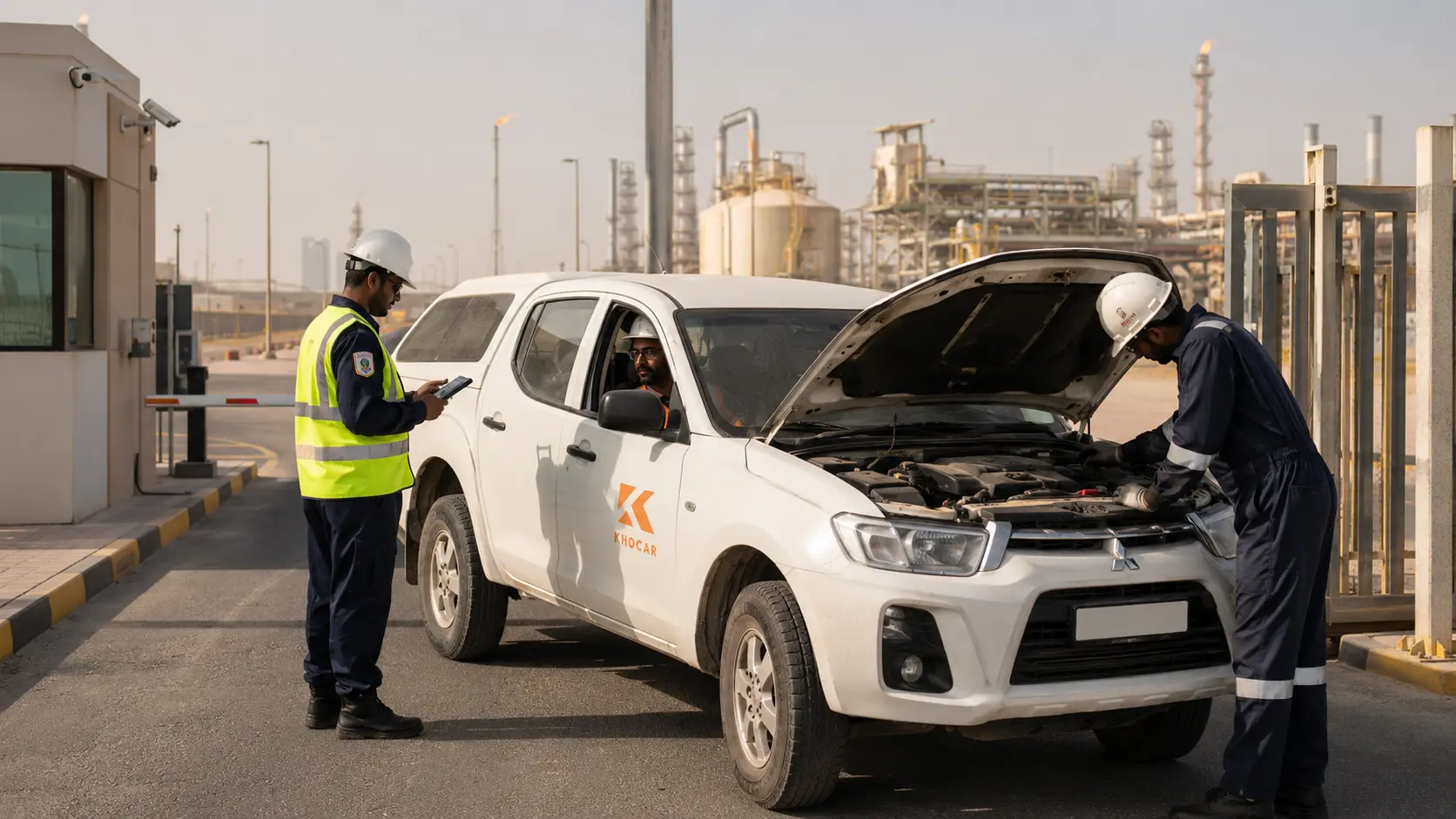
A vehicle can arrive at an Abu Dhabi oilfield gate fully serviced, insured, and carrying the correct cargo, and still be refused entry. The reason is often a mismatch between two requirements that contractors regularly treat as interchangeable: the CICPA pass Abu Dhabi security process and Zone 2 vehicle certification. One answers “Is this approved vehicle authorized to access a controlled location?” The other answers “Is this vehicle technically prepared to operate where a flammable atmosphere may occur briefly?” Passing one test does not automatically pass the other.
That distinction matters more as project activity accelerates. ADNOC has announced AED 200 billion in new project awards for 2026–2028, creating a large pipeline in which contractor mobilization, fleet readiness and disciplined documentation can directly affect delivery. This guide from KhoCAR Services explains CICPA vs Zone 2 in plain language, shows how they fit into broader ADNOC vehicle site access requirements, and gives contractors a practical workflow to reduce last-minute rejections. Requirements vary by asset, operator, location, and work scope, so use the guide to organize your questions—not as a substitute for the latest project-specific instruction.
Key Takeaways
A CICPA vehicle pass is fundamentally an access-and-security authorization. Zone 2 certification is a technical hazardous-area readiness process intended to control vehicle ignition risks. They solve different problems, are normally reviewed by different stakeholders, and should be managed as separate workstreams.
Not every ADNOC-related trip requires the same combination of approvals. A vehicle’s route, destination, operating area, task, sponsor and site classification determine what applies. Contractors should ask for a written access matrix early, then run security permits, Zone 2 preparation, legal roadworthiness, driver approval and route permits in parallel where possible.
A component marked ATEX or IECEx does not, by itself, prove that an entire converted vehicle is acceptable. The installation, interfaces, wiring, shutdown logic, documentation and inspection evidence must be evaluated as a system against the project’s current acceptance criteria.
CICPA Pass Abu Dhabi vs Zone 2 Certification: Quick Answer
The short answer is simple: a CICPA pass controls who and what may enter a protected site, while Zone 2 certification addresses whether a vehicle is suitably prepared for a specified hazardous operating area. A contractor may need one, both, or neither depending on the exact movement. If both are required, neither replaces the other.
| Question | CICPA / security pass | Zone 2 vehicle certification |
| Primary purpose | Security and controlled-site access | Technical control of ignition risks in a hazardous area |
| Main question | May this identified vehicle enter this location under the approved sponsor or project? | Is this vehicle configured and documented for the specified Zone 2 operating conditions? |
| Typical reviewers | Security authority, sponsor and site-access team | Project HSE/technical team, inspector and qualified conversion provider |
| Typical evidence | Current application and identity, ownership, sponsor and vehicle records requested by the live process | Scope, component certificates, installation records, test results, labels and inspection evidence requested by the project |
| Transferable? | Do not assume; treat authorization as vehicle-, sponsor-, location- and validity-specific | Do not assume; vehicle configuration and post-approval modifications matter |
| Does it replace the other? | No | No |
What Is a CICPA Pass Abu Dhabi?
In contractor language, “CICPA pass” is still widely used to describe a security permit associated with access to protected petroleum, industrial, critical-infrastructure or other controlled locations in Abu Dhabi. The public-facing government structure and service labels can change, so applicants should follow the current National Guard security-permit channel, the relevant official portal and the project sponsor’s latest instructions rather than relying on an old screenshot, checklist or agency name.
For vehicles, the practical objective is to connect an identifiable vehicle and its supporting records to an authorized access purpose. Abu Dhabi’s official digital services also publish a Security Pass for Vehicles entry. Availability, authentication requirements, fields, and supporting documents may change, which is why the live service and sponsor instructions must be checked at the time of application.
What a CICPA vehicle pass usually establishes
At a high level, the security review establishes an access relationship: a known organization or sponsor, a defined operational need, an identified vehicle, a controlled destination, and a permitted period. It may also link the vehicle to named personnel or other project records. The exact structure depends on the relevant authority and site.
The vehicle identity in the application matches the registration and the vehicle presented.
The access request has an approved business or project purpose.
The sponsor, contractor and location information is consistent across supporting records.
The authorization is current for the intended visit, route and controlled area.
What a CICPA pass does not prove
A security pass does not certify that the engine, exhaust, electrical circuits or accessories are safe for a hazardous atmosphere. It also does not automatically replace ordinary registration, insurance, road permits, driver credentials, inductions, journey management or a site-specific vehicle inspection. Think of it as one locked door in a corridor of approvals: opening it does not open every door that follows.
| Practical rule: Never tell a dispatcher that a vehicle is “ADNOC approved” based only on a CICPA sticker, a Zone 2 label or a component certificate. Record exactly what was approved, by whom, for which vehicle, site, scope and validity period. |
Common CICPA pass document categories
Contractors often ask for one universal CICPA pass document list. There is no safe static list for every location and sponsor. However, applications commonly draw from the following categories. Treat them as a preparation framework and confirm the live checklist before submission.
Company and sponsor records: trade or establishment information, project relationship, and the current support or authorization requested by the portal.
Vehicle records: registration details, plate and chassis identifiers, ownership or authorized-use evidence, and insurance where requested.
Purpose and location: destination, work scope, contract or task reference, requested access period and the site or facility involved.
People and accountability: authorized signatory, applicant details, driver information or linked personnel permits where required.
Additional controls: any site-specific security, HSE, technical or operational evidence requested for the vehicle class and task.
What Is Zone 2 Vehicle Certification in Abu Dhabi?
Zone 2 is a hazardous-area classification, not a security zone. The UK Health and Safety Executive’s hazardous-area definitions describe Zone 2 as a place where an explosive gas, vapour or mist atmosphere is not likely during normal operation, but—if it occurs—will persist only briefly. That does not mean the risk is negligible. It means equipment and operating controls must be chosen for a lower-frequency but still credible ignition hazard.
A standard road vehicle contains multiple potential ignition sources: hot exhaust surfaces, sparks from electrical switching or damaged wiring, static discharge, non-protected accessories, and—in some diesel scenarios—engine overspeed caused by ingesting a combustible vapour. Zone 2 vehicle preparation aims to reduce those risks in the context defined by the project. The required scope can vary substantially by vehicle type, engine, equipment package, operating area and client specification.
For procurement and fleet teams, the phrase “Zone 2 certification Abu Dhabi” usually describes a combined process of vehicle assessment, agreed modifications, installation control, functional testing, technical documentation and project acceptance. It should not be reduced to buying a kit or applying a generic sticker.
Typical Zone 2 vehicle controls
A project may require some or all of the following systems, but a generic shopping list is not a certification plan. The design must be based on the vehicle and the acceptance criteria provided for the job.
| Control area | Typical function | What should be checked |
| Exhaust | Reduce the chance of hot particles or unsafe exhaust conditions becoming an ignition source | Component suitability, condition, mounting, leakage and maintenance access |
| Engine shutdown | Stop the engine when a defined hazardous condition or emergency command occurs | Shutdown logic, response, reset, fail-safe behavior and test record |
| Air intake protection | Help control diesel-engine runaway or vapour ingestion risk where specified | Sizing, actuation, installation position and functional test |
| Gas detection | Detect the specified gas or vapour condition and activate warnings or shutdown actions | Sensor type, location, calibration, alarm thresholds, outputs and records |
| Electrical system | Reduce arcing, sparking and unsafe energized accessories | Wiring, terminations, isolation, fusing, enclosures, accessories and modifications |
| Static control and marking | Support energy dissipation, inspection and correct operating limits | Bonding/earthing provisions, labels, zone designation and documentation match |
Contractors planning a conversion can review KhoCAR’s Zone 2 installation and certification service in Abu Dhabi to understand the workshop support available for assessment, installation, testing and documentation.
ATEX and IECEx: Important Evidence, but Not a Whole-Vehicle Shortcut
ATEX and IECEx frequently appear in Zone 2 discussions because they provide recognized frameworks for equipment used in explosive atmospheres. The European Commission explains that ATEX Directive 2014/34/EU applies to equipment and protective systems intended for potentially explosive atmospheres. The IECEx Certified Equipment Scheme uses independent conformity assessment for electrical and mechanical equipment designed for hazardous areas.
The important limitation is scope. A certificate may cover a gas detector, switch, valve or enclosure under stated conditions. It does not automatically validate the complete vehicle, the installer’s wiring, the interface between devices, the shutdown sequence, or modifications added later. Contractors who need a deeper explanation can read ATEX vs IECEx for Zone 2 vehicles in the UAE, then confirm which evidence the specific project accepts.
CICPA vs Zone 2: Why Contractors Confuse Them
The confusion is understandable because both requirements often surface during the same mobilization. A project coordinator says, “The pickup needs approval for the field,” and the fleet team starts collecting everything under one folder called “ADNOC pass.” Security, transport, HSE and operations may each use different words for their part of the process. By the time the vehicle reaches the gate, the team may know it has “a certificate” without knowing what that certificate covers.
The cleanest way to separate them is by risk. CICPA/security authorization manages the risk of unauthorized access to a controlled location. Zone 2 preparation manages the risk that the vehicle could ignite a flammable atmosphere in a classified operating area. A valid security pass can therefore coexist with a technical rejection, and a technically prepared vehicle can still lack permission to enter.
A simple example
Imagine two identical diesel pickups assigned to an Abu Dhabi project. Vehicle A is listed under the sponsor’s current access authorization but still has an unapproved auxiliary light circuit and no evidence that its shutdown system was function-tested. Vehicle B has a documented Zone 2 conversion and passed its technical inspection, but its plate number was never included in the current security application. Vehicle A may be stopped by HSE or technical inspection; Vehicle B may be stopped by security. Neither is fully mobilization-ready.
Which Requirement Comes First?
In most real projects, the better question is not “Which comes first?” but “Which workstreams can start now, and what information does each one need?” Security applications may depend on sponsor and contract details. Zone 2 preparation may depend on the vehicle, location classification and technical specification. Waiting for one stream to finish before opening the other can create avoidable idle time.
A practical six-step mobilization sequence
Define the movement. Record the vehicle, driver, cargo or equipment, destination, route, task, operating area and expected dates.
Request the access matrix. Ask the sponsor or site to state the required security pass, personnel pass, inductions, technical approvals, inspections and route permissions.
Classify the operating exposure. Confirm whether the vehicle only reaches a non-hazardous laydown area or must enter and operate within a defined hazardous area.
Open parallel folders. Track security, Zone 2/technical, roadworthiness, route/mobility and driver/site records separately, with one accountable owner for each.
Freeze vehicle configuration. Avoid accessory, wiring, engine, exhaust or body modifications after technical review unless the change is assessed and the evidence updated.
Run a final document-to-vehicle check. Match plate, chassis, company, sponsor, dates, labels, installed components and driver records before dispatch.
ADNOC Vehicle Site Access Requirements: A Layered Model
ADNOC vehicle site access requirements are better understood as overlapping layers than as a single pass. ADNOC’s group-wide HSE policy places strong emphasis on legal compliance, risk controls, process safety, asset integrity and contractor participation. In practice, the exact evidence used to implement those principles is set by the relevant company, project and site.
| Layer | Core question | Possible evidence | Who confirms it? |
| Security access | May this person and vehicle enter the controlled location? | Current security permit, sponsor relationship and matching identity records | Authority, sponsor and site security |
| Hazardous-area technical | Can the vehicle safely perform the intended task in the specified classified area? | Approved scope, equipment certificates, installation and test records, inspection status | Project HSE/technical team and accepted inspector |
| Legal roadworthiness | May it lawfully operate on public roads? | Registration, insurance, inspection status and vehicle-class documents | Relevant transport and licensing authorities |
| Route and mobility | May this vehicle class use the planned roads, times and restricted areas? | Heavy-vehicle, route, load or movement permit where applicable | Relevant mobility/transport authority |
| Driver and personnel | Is the operator licensed, trained, inducted and permitted? | Licence, training, inductions, medical or personnel pass as applicable | Employer, sponsor, site and authority |
| Project and task | Is the vehicle accepted for this contract, load and operating method? | Asset register, journey plan, lifting/loading documents, work permit or task approval | Contractor and project management |
For example, Abu Dhabi publishes a separate truck road and prohibited-area permit service. A mobility permit addresses where and when a truck may travel; it does not prove security authorization for a protected facility or Zone 2 readiness inside a hazardous operating area.
Document Checklist for a CICPA Vehicle Pass and Zone 2 Review
The following checklist is designed to expose gaps before submission. It deliberately avoids presenting a fixed government or ADNOC checklist, because the exact documents, names, validity and portal steps can change. Mark each item as required, not required or awaiting written confirmation for the specific job.
Folder 1: CICPA / security-access preparation
Current sponsor or project instruction showing the relevant permit route and controlled location.
Company, contract, authorization or support records requested by the live application process.
Vehicle registration data with plate, chassis/VIN, vehicle class and ownership or authorized-use details matching the physical vehicle.
Insurance and other statutory records requested for the vehicle and intended period.
Applicant, authorized signatory, driver or linked personnel information requested by the site or portal.
Requested dates, business purpose, destination and any recurring or temporary access details.
A final record of approval, expiry/validity, location and any limitations—not just a screenshot saying “submitted.”
Folder 2: Zone 2 technical preparation
Written project specification or acceptance criteria for the vehicle type and intended operating area.
Vehicle baseline inspection covering the engine, exhaust, intake, electrical system, battery, accessories and existing modifications.
Approved conversion scope listing every required control, interface and operating limitation.
Component identification, rating, ATEX/IECEx or other conformity evidence where specified, plus traceability to what is installed.
Installation drawings or records, cable and terminal details, protection devices, labels and shutdown logic.
Calibration and functional-test records for gas detection, alarms, shutdowns, intake protection and other active systems.
Inspection report, punch-list closure, certificate or acceptance record required by the project.
Maintenance, periodic-test and change-control plan so the vehicle remains in the approved configuration.
Folder 3: road, driver and site readiness
Driving licence and any vehicle-class, defensive-driving or project training requirements.
Public-road, heavy-vehicle, restricted-road, load or route permissions that apply to the movement.
Site induction, journey-management plan, emergency contacts and arrival instructions.
Cargo, lifting, loading, restraint or equipment documents required for the task.
Vehicle housekeeping, safety kit, inspection tags and other gate-check items required by the destination.
Three Practical Mobilization Examples
Example 1: Security pass valid, Zone 2 inspection fails
A maintenance contractor assigns a pickup to a field support task. The CICPA vehicle pass is current and the plate matches, but the pre-mobilization technical check finds an accessory wired directly to the battery outside the documented isolation arrangement. The correct response is not to rely on the pass. The circuit must be assessed, corrected if required, documented and rechecked before the vehicle enters the classified operating area. A useful companion checklist is KhoCAR’s guide to common Zone 2 vehicle inspection failures in Abu Dhabi.
Example 2: Zone 2 conversion complete, security access missing
A diesel service vehicle has the specified shutdown and detection systems, complete installation records and an accepted technical inspection. The dispatcher substitutes it for another fleet unit after a breakdown, assuming the Zone 2 certificate is enough. At the gate, the vehicle is not linked to the current access authorization. The project loses the mobilization slot. The lesson is that technical equivalence does not make access authorization transferable.
Example 3: Road permit required, Zone 2 may not be
A heavy truck transports equipment to a non-hazardous logistics area outside the classified process zone. Its route includes roads or times subject to heavy-vehicle controls. The movement may require a mobility or route permit and site security authorization, while the project may determine that Zone 2 preparation is not required because the truck will not enter or operate in a classified area. The conclusion must come from the written movement and access plan—not from the fact that the destination is generally described as an ADNOC site.
Common Mistakes That Delay ADNOC Site Access
1. Using “ADNOC approved” as a vague status
This phrase hides critical details. Replace it with a status such as: “security pass approved for Vehicle X and Location Y until Date Z; Zone 2 inspection accepted to Specification A; driver induction pending.” Precision makes gaps visible.
2. Treating an ATEX or IECEx component certificate as vehicle approval
The certificate may be excellent evidence for that component, but only within its stated scope. The vehicle installation, system interfaces and project acceptance remain separate questions.
3. Starting security and technical work sequentially
If the project allows parallel preparation, waiting for the security application to finish before assessing the vehicle wastes time. Begin with the access matrix and assign owners to both streams.
4. Mismatched vehicle details
A single transposed plate digit, outdated registration copy, wrong chassis number, changed company name or inconsistent sponsor reference can interrupt a review. Perform a line-by-line data match against the physical vehicle.
5. Modifying the vehicle after approval
Adding a beacon, radio, inverter, tracking device, compressor, auxiliary battery or body accessory can alter the electrical or mechanical configuration. Route changes through technical change control and update records before operation.
6. Ignoring expiry, calibration and maintenance dates
A pass can expire, a gas detector can fall outside calibration, and a shutdown system can fail after months of service. Readiness is a maintained condition, not a one-time sticker.
7. Assuming every ADNOC location has identical rules
Different operating companies, facilities, project phases, contractors and work scopes can use different acceptance paths. The most recent written instruction for the actual destination controls.
How to Avoid Delays Before Mobilization
A reliable process starts before a workshop appointment or portal submission. The following timeline is a planning example, not a promised government or inspection turnaround. Move it earlier when the project, fleet size or vehicle condition is complex.
| Planning point | Actions | Decision to close |
| T–30 or earlier | Confirm destination, operating area, task, vehicle and sponsor. Request current access and technical requirements. | Do we know exactly which approvals apply? |
| T–21 | Open security application; inspect vehicle baseline; approve conversion and documentation scope. | Are both security and technical workstreams moving? |
| T–14 | Complete installation, component traceability, calibration and functional tests. Review application status. | Are defects and missing documents owned and dated? |
| T–7 | Complete project inspection or verification, close punch items and match records to the vehicle. | Is there objective evidence for every claimed approval? |
| T–1 | Run dispatch audit: identifiers, validity, calibration, driver, route, cargo and arrival instructions. | Can the driver explain where the vehicle may and may not operate? |
Build a one-page vehicle readiness record
For each mobilized unit, maintain one summary page with the plate, chassis/VIN, make/model, project, destination, security-pass status, Zone 2 status, inspection reference, calibration dates, road-permit status, assigned driver and open actions. Link or attach the supporting evidence, but do not replace it. This simple index helps a gate coordinator, fleet manager and HSE reviewer discuss the same vehicle without searching through multiple chat threads.
Use an approval matrix, not a single green tick
A green tick labelled “approved” encourages assumptions. A matrix should show each layer separately: security, hazardous-area technical, legal roadworthiness, route/mobility, driver/personnel and project/task acceptance. Use statuses such as not applicable, awaiting confirmation, submitted, accepted, expired and blocked. Record the approving party and evidence reference beside every status.
Can One Workshop Handle Both Processes?
A Zone 2 workshop can assess and modify the vehicle, install the required controls, test the system and assemble technical evidence within its service scope. It should not imply that workshop work automatically grants a government security pass. The CICPA/security application is managed through the relevant authority and sponsor process; the project’s own security and HSE teams retain their roles.
The most efficient arrangement is coordination with clear boundaries. The contractor or sponsor owns access authorization and project information. The workshop owns the agreed technical scope and records. The accepted inspector or project reviewer confirms technical acceptance. The fleet team preserves the approved configuration and schedules maintenance. When those responsibilities are explicit, missing evidence is easier to catch before dispatch.
Final Takeaway
The practical answer to CICPA vs Zone 2 is not “choose one.” A CICPA pass in Abu Dhabi is an access-and-security requirement; Zone 2 vehicle certification is a hazardous-area technical requirement. They may intersect during ADNOC contractor mobilization, but they are not interchangeable. Start with the actual task and location, obtain the current written access matrix, prepare each compliance layer separately, and verify the final records against the physical vehicle. That is how contractors turn a folder full of certificates into genuine site readiness.
Need Zone 2 Vehicle Preparation for Abu Dhabi Site Access?
If your project has confirmed that a pickup, truck or specialist vehicle must be prepared for Zone 2 operation, KhoCAR can support the technical workstream—from vehicle assessment and conversion planning to installation, functional testing and documentation. Explore our Zone 2 installation and certification services or contact the KhoCAR team in Musaffah, Abu Dhabi with the vehicle details and project specification. We will help you identify the technical scope while your sponsor or access team manages the applicable security-permit process.
FAQs
Is a CICPA pass the same as Zone 2 certification?
No. A CICPA or security pass deals with authorization to access a controlled location. Zone 2 certification or preparation deals with the vehicle’s ignition risks in a classified hazardous area. A project may require both, but approval under one process does not automatically satisfy the other.
Does every vehicle entering an ADNOC site need Zone 2 certification?
Not necessarily. The requirement depends on the destination, operating area, task, vehicle and project rules. A delivery vehicle that remains in a non-classified logistics area may have different technical requirements from a maintenance pickup that must operate in a Zone 2 area. Obtain written confirmation from the sponsor or site HSE team.
Can a Zone 2-certified vehicle enter an ADNOC site without a CICPA vehicle pass?
Not if the destination requires the relevant security authorization. Zone 2 readiness demonstrates technical controls within its approved scope; it does not grant access to a protected facility. The vehicle, sponsor, driver and visit must still satisfy the applicable security and site-entry process.
Can a vehicle with a CICPA pass operate in a Zone 2 area?
Only if the project also accepts that vehicle for the hazardous operating area and all other requirements are met. A security pass alone does not assess the exhaust, intake, electrical system, gas detection, shutdown functions or other ignition controls.
Who issues a CICPA pass in Abu Dhabi now?
“CICPA pass” remains common industry language, but contractors should use the current official security-permit channel and follow their sponsor’s latest instructions. Government structures, portal names and service workflows can change, so avoid copying an old procedure without checking the live official source.
What documents are required for a CICPA vehicle pass?
The exact list varies by service, sponsor, location, vehicle and application type. Prepare current company/sponsor records, vehicle registration and identity details, ownership or authorized-use evidence, insurance where requested, access purpose and dates, and applicant or driver information. Then compare them with the live official checklist before submission.
How long does a CICPA pass take and how long is it valid?
There is no reliable universal answer. Processing and validity can depend on the authority, sponsor, access category, completeness of the application, project period and security review. Plan early, track the official application, and do not schedule a critical mobilization based on an unofficial promised turnaround.
Can a CICPA vehicle pass be transferred to another vehicle?
Do not assume it can. Security authorization normally depends on the identified vehicle and its records, while Zone 2 acceptance depends on the actual installed configuration. A replacement vehicle should be checked through the applicable access and technical processes before dispatch.
Does an ATEX or IECEx certificate make a vehicle Zone 2 certified?
Not by itself. The certificate may establish conformity for a particular component or product under stated conditions. Whole-vehicle readiness also depends on installation, wiring, system interfaces, shutdown logic, tests, documentation, maintenance and the project’s acceptance criteria.
What happens if a vehicle is modified after Zone 2 approval?
The change may invalidate assumptions behind the earlier inspection or documentation. New lighting, radios, trackers, inverters, batteries, exhaust work or body equipment should be technically assessed, documented and, where required, reinspected before the vehicle returns to a classified area.