
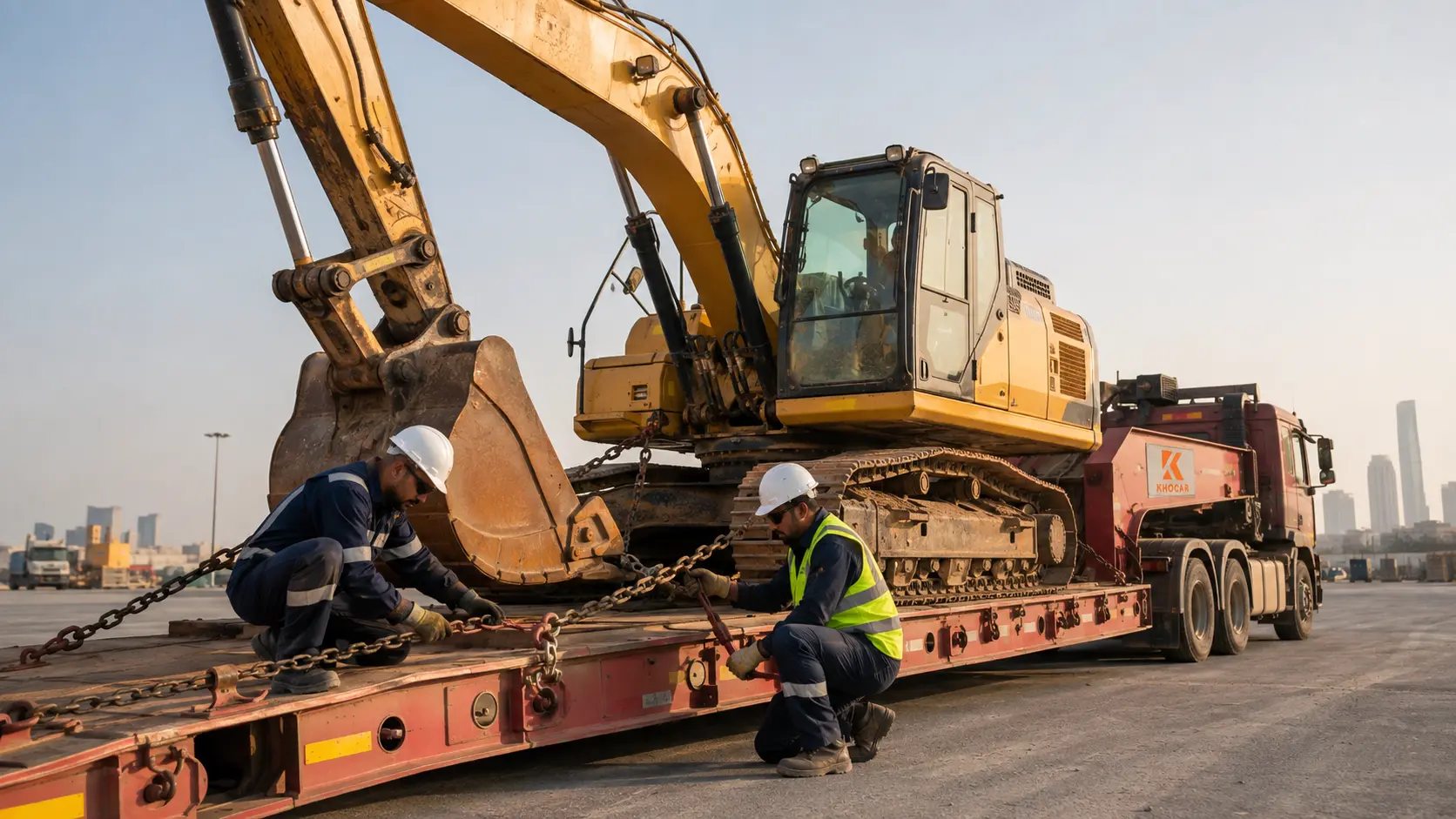
Knowing how to secure heavy equipment on a trailer is not the same as making a machine look tight on the deck. An excavator weighing tens of tonnes can still creep under vibration, rotate at an articulation joint, release pressure in a hydraulic attachment, or load one chain far more heavily than the others. A restraint that appears solid in a Musaffah yard may behave very differently during emergency braking, a roundabout, a rough site road or a long inter-emirate move. The result can be damaged machinery, a shifted centre of gravity, an over-stressed anchor point or a load that no longer matches its approved transport profile.
This guide gives UAE fleet teams, dispatchers, HSE staff and contractors a practical framework for planning lowbed trailer tie-downs. It explains direct and indirect restraint, chains and binders, working load limits, designated attachment points, separate restraint of booms and buckets, and the checks required before and after departure. It also shows where securement fits within the wider route, axle-load and permit process. The aim is to help teams send accurate job details to KhoCAR Services, challenge unsafe shortcuts and arrive at site with a transport system, not simply a collection of chains.
Key Takeaways
Heavy-equipment securement is a complete system: the machine, trailer, deck, anchor points, blocking, chains or lashings, binders and inspection process must work together. Position the machine to keep the loaded combination stable and within axle and coupling limits; use only rated, identifiable hardware attached to approved points; protect restraints from sharp edges; and immobilise articulating or hydraulic attachments in their manufacturer-specified transport position. Friction and parking brakes are helpful but cannot be treated as the only restraint. There is no safe universal answer to “how many chains?” because weight, geometry, anchor angles, restraint ratings, attachments, route and governing requirements change the calculation. The driver or competent transport team should complete a documented pre-trip check, verify the load after departure and at planned stops, and stop if any chain, binder, anchor, blocking or machine position has changed. Securement also does not replace UAE weight, dimension, route, timing or permit compliance.
How Do You Secure Heavy Equipment on a Trailer?
Secure heavy equipment by selecting a suitable trailer, placing the machine for stable weight distribution, immobilising its moving parts, and connecting an engineered combination of rated direct restraints, blocking or chocking and other approved controls to designated machine and trailer anchor points. Inspect the entire system before departure and recheck it during the journey. The exact arrangement must come from the load plan, manufacturer instructions, hardware ratings and applicable UAE requirements—not from habit or machine weight alone.
Dubai RTA’s Heavy Truck and Bus Handbook describes both indirect restraint, such as tie-down lashing that clamps a load to the deck, and direct restraint, such as containing the load or attaching it with lashings or mechanical locking. It also warns that friction alone is not enough to control movement forward during braking, backward, sideways in corners or vertically. Although the handbook is written for Dubai heavy-vehicle drivers, those principles are a valuable UAE reference for any lowbed load plan.
Think in Systems, Not in Chain Counts
A securement system has to manage forces in multiple directions while the trailer bends, vibrates and changes attitude. One chain may resist forward movement but contribute little to lateral restraint because of its angle. Another may appear tight but connect to an anchor that is not rated for cargo securement. A bucket resting on timber may still rotate if the boom circuit settles. The question is therefore not “Are four chains fitted?” but “Does the complete, rated arrangement restrain every credible movement of this exact machine on this exact trailer?”
| System element | What must be verified |
| Machine | Verified transport weight, dimensions, centre of gravity, approved tie-down points and transport position |
| Trailer | Payload, deck geometry, ramp rating, axle configuration, anchor-point ratings and condition |
| Primary restraints | Rated chains, wire rope or other equipment suitable for the load and approved plan |
| Tensioning devices | Compatible binders or tensioners with legible ratings and positive security against release |
| Supplementary controls | Blocking, chocks, cradles, friction mats, edge protection and mechanical locks where designed |
| People and process | Competent loader/driver, exclusion zone, documented inspection, en-route checks and stop-work criteria |
Step 1: Build the Load Profile Before the Lowbed Arrives
The safest chain layout cannot compensate for a trailer selected from incomplete information. Obtain the machine data in its actual transport configuration, including fuel, attachments, counterweights, tools and anything stored in the cab or on the chassis. Model names are not enough: options such as long-reach booms, LGP tracks, blades, rippers, quick couplers and guarding can change weight and dimensions significantly.
- Identification: make, model, serial or fleet number and clear current photos;
- Mass: verified operating or transport weight, plus each removed or separately carried attachment;
- Transport dimensions: length, width and height in the exact stowed position;
- Geometry: track width, wheelbase, ground clearance, overhangs and centre-of-gravity information where available;
- Condition: running or non-running, steering and brake condition, leaks, damaged tyres/tracks and isolation requirements;
- Attachment status: boom, stick, bucket, blade, ripper, forks, outriggers, counterweight and loose accessories;
- Manufacturer instructions: designated tie-down/lifting points, articulation locks, transport pins, hydraulic positions and prohibited attachment points;
- Journey data: collection/delivery locations, surface condition, ramps or crane availability, route, timing and access constraints.
| Dispatch rule: If the transport team has only a machine name and an estimated weight, the load plan is not ready. Ask for the actual transport configuration and current photos before confirming the trailer. |
Step 2: Select a Trailer That Supports the Securement Plan
Trailer selection affects more than payload. The deck must have enough usable length and width, suitable anchor locations, a loading angle the machine can safely negotiate, adequate ground clearance for the route and an axle layout capable of carrying the planned distribution. The tractor, coupling and trailer must be evaluated as one combination.
If the team is still deciding which deck profile suits the cargo, KhoCAR’s guide to choosing a lowbed vs flatbed trailer in the UAE explains how height, loading method, stability, axle distribution and site access change the decision. Whichever trailer is chosen, confirm that anchor points are designed and rated for cargo restraint. Side rails, stake pockets, ramps, hydraulic pipes and convenient chassis openings are not automatically approved anchors.
Step 3: Control the Loading Area and Roles
Use a firm, level area separated from passing vehicles and people. Check overhead hazards, soft shoulders, drainage channels and the space needed for ramps, detachable gooseneck operation, recovery equipment or a crane. Agree one person to direct the machine and define clear hand signals or radio communication. Anyone not required for the operation should remain outside the exclusion zone.
Before driving on, verify ramp locking, ramp capacity, deck cleanliness and traction. Mud, oil, hydraulic fluid and sand can reduce friction and make the loading path unpredictable. A non-running machine needs an engineered recovery method with suitable winches, sheaves, anchorages and controls; improvising with transport chains or driving another machine behind it creates new hazards.
Step 4: Position the Machine for Stability and Axle Distribution
Place the machine according to a documented load-distribution plan, not simply where its tracks fit. The objective is to keep the combined centre of gravity stable, maintain required coupling load and stay within the limits for the tractor, trailer, axles, axle groups, tyres and route. The RTA handbook advises that weight distribution remain within vehicle, wheel and axle limits, that the centre of gravity remain near the vehicle centreline, and that heavy items be placed near the centreline and axles where practicable.
- Machine centred laterally unless an engineered plan specifies an offset;
- Track, tyre or support footprint fully supported by the designed deck area;
- Axle and coupling loads checked against the complete loaded combination;
- Boom, counterweight, blade or other heavy projection accounted for in the centre-of-gravity estimate;
- Ground clearance checked at the trailer belly, ramps and route breakover points;
- Overall loaded height, width, length and overhang measured in transport position;
- Machine isolated, parking brake applied where appropriate, transmission secured and keys controlled;
- Articulation lock, slew lock, transport pin or other manufacturer device fitted when required.
Direct vs Indirect Restraint: What Is the Difference?
| Method | How it works | Heavy-haul example |
| Direct restraint | The restraint connects the machine to the trailer or the load is positively contained/blocked | Chains from designated machine tie-downs to rated trailer anchors; engineered cradle; mechanical locking system |
| Indirect restraint | A lashing passes over or around the load and increases clamping force against the deck | Top-over lashing on suitable packaged or rigid cargo, with edge protection and verified pre-tension |
| Blocking or chocking | A fitted physical barrier limits rolling, sliding or local movement | Rated wheel chocks, timber or steel blocking designed for the load and secured against displacement |
| Friction enhancement | A clean deck or approved mat increases resistance to sliding | Friction mat with known condition and use limits; never treated as the only restraint |
For tracked or wheeled plant, direct restraint to designated points is often the core of the plan. Indirect lashings may be unsuitable where they can crush bodywork, damage hoses or slide off irregular shapes. Blocking and friction can strengthen a system, but they need a defined role and must be able to stay in place through the full journey.
The official UK load-securing basics guidance notes that no single solution works for every load or vehicle and that a system may combine vehicle structure, barriers, lashings and friction mats. This is international guidance, not UAE law, but it supports the same system-based approach.
Chains, Straps, Binders and Blocking: Choosing the Right Tool
| Device | Typical role | Inspect and verify |
| Transport chain | High-load direct restraint where specified | Grade, size, WLL, tags/markings, elongation, bent links, gouges, corrosion, heat or weld damage |
| Ratchet or lever binder | Applies and maintains chain tension | WLL compatibility, hooks, threads, handle/ratchet condition, locking against release and safe operating clearance |
| Web lashing | Suitable loads or supplementary restraint when approved | Label/WLL, cuts, abrasion, chemical/heat damage, knots, edge protection and compatibility with machinery surfaces |
| Wheel chock / blocking | Limits rolling or sliding | Material, fit, strength, deck attachment and resistance to vibration or displacement |
| Friction mat | Increases sliding resistance | Known rating/use conditions, contamination, crushing, coverage and manufacturer limits |
| Edge protector / sleeve | Protects the restraint and load at contact points | Correct fit, no migration, no reduction of securement geometry and no sharp uncovered edge |
Chains are commonly used for excavators, dozers and other heavy machines because they can provide robust direct restraint, but “chain” is not a specification. The grade, diameter, WLL, end fittings and condition must be known. Web straps may be appropriate for some guards, lightweight accessories or purpose-approved applications, but they should not replace the rated primary restraint for heavy plant merely because they are easier to tension. Never knot webbing or use an unmarked strap whose capacity cannot be verified.
Working Load Limit and the Weakest-Component Rule
Working load limit (WLL) is the maximum load that a restraint component is rated to carry under specified service conditions; it is not the machine weight and it is not a breaking-strength target. The usable capacity of a securement path is governed by its weakest component and by the way that path is installed. Chain, hooks, shortening devices, binder, connecting hardware, machine point and trailer anchor all matter.
Angles matter because a chain running nearly parallel to the deck behaves differently from one arranged to provide strong lateral or longitudinal components. Slack, crossed paths, contact with sharp edges and anchors that allow hooks to side-load can reduce performance. Only a competent person with the hardware data and governing design criteria should calculate the required arrangement. Do not divide machine weight by a chain label and call the answer a securement plan.
How Many Chains Are Needed?
There is no universal UAE chain count for every excavator, bulldozer or loader. The correct number depends on machine mass and geometry, restraint directions, WLLs, anchor ratings, chain angles, attachments, trailer design, route and applicable authority or client rules. As an international comparison only, the U.S. 49 CFR 393.130 heavy-equipment rule specifies at least four tie-downs for certain wheeled or tracked equipment weighing 4,536 kg (10,000 lb) or more, attached at the front and rear or designated mounting points. That U.S. minimum is not UAE law and must not be copied as a complete UAE load plan.
Use Designated Tie-Down Points—Not Convenient Metal
Machine manufacturers may provide labeled or documented tie-down points that transfer restraint forces into the structure. Confirm their location in the current operator or transport manual and inspect them for deformation, cracks, corrosion, blocked access or previous misuse. A lifting eye is not automatically a tie-down point, and a tie-down point is not automatically approved for lifting.
Avoid connecting to hydraulic cylinders, hoses, steps, handrails, guards, track pads, steering linkages or sheet-metal apertures unless the manufacturer specifically approves the arrangement. On the trailer, use rated cargo anchors that match the direction and hook geometry. If the only usable path produces side-loading, sharp-edge contact or interference with a tyre or track, stop and revise the plan.
Secure Attachments and Articulating Parts Separately
The base machine may be restrained while its attachment remains free to move. Booms, sticks, buckets, blades, rippers, forks, outriggers, counterweights and loose tools can rotate, settle or bounce because of road movement and hydraulic leakage. Lower them into the manufacturer-approved transport position, install mechanical locks or pins where specified, release or isolate stored energy as instructed and use separate restraint when the governing guidance requires it.
| Part | Movement risk | Planning response |
| Excavator boom, stick and bucket | Hydraulic settlement, slew movement, bucket bounce or projection beyond the approved profile | Stow in documented transport position; engage slew/transport lock; support and separately restrain attachment as required |
| Bulldozer blade and ripper | Width/overhang, vertical movement, concentrated contact and unplanned articulation | Confirm blade/ripper position, transport locks/support and independent restraint where specified |
| Wheel loader articulation and bucket | Centre joint movement, steering articulation and raised-loader-arm hazard | Fit articulation lock; lower bucket/arms to transport position; secure per manufacturer |
| Forklift or telehandler forks/boom | Sliding forks, telescopic movement or raised boom | Retract and lower; secure forks/carriage and use transport pins/locks as specified |
| Detached bucket, breaker or tool | A separate cargo item can slide, roll or strike the machine | Place in a suitable cradle/blocking system and secure as its own load |
Inspect Every Chain, Binder and Anchor Before Use
Cleaning is part of inspection: grease and packed sand can conceal link damage, prevent hooks from seating and reduce deck friction. Follow the component manufacturer’s removal criteria and the company inspection system. When a defect or missing identification makes capacity uncertain, quarantine the item rather than assigning it an assumed rating.
- missing or illegible grade, size, WLL or traceability markings where required;
- stretched, twisted, bent, cracked, gouged or severely worn chain links;
- heat damage, arc strikes, welded repairs or unauthorized modifications;
- hooks with opened throats, damaged tips, twisting or poor seating;
- binder threads that are damaged, contaminated or at the end of adjustment;
- ratchet, pawl, handle or locking device that does not positively hold;
- anchor points with cracks, torn welds, distortion, severe corrosion or deck separation;
- contact with sharp edges, exhaust heat, tyres, track movement, steering or hydraulic components;
- blocking, chocks or mats that are split, contaminated, crushed or able to migrate;
- any arrangement that requires striking, welding, knotting or improvised extension to achieve tension.
Lowbed Pre-Departure Securement Checklist
A competent person should inspect the loaded combination from all sides before release. The driver retains responsibility for deciding whether the vehicle can move safely under the applicable system. Dubai RTA’s handbook specifically calls for daily pre-trip checks, including lashings and even load distribution, and states that the driver has final responsibility for the vehicle check.
| Check | Release criterion |
| Load identity | Machine, attachment and job details match the dispatch order and permit/route documents. |
| Position | Machine remains in the planned location; centreline, deck support and axle/coupling distribution are verified. |
| Machine state | Engine off, key controlled, brake/transmission/isolation set, articulation/slew/transport locks engaged as required. |
| Attachments | Boom, bucket, blade, ripper, forks, outriggers and detached tools are stowed, supported and restrained. |
| Restraint paths | Correct number and arrangement under the approved plan; direct restraint controls forward, rearward, lateral and vertical movement. |
| Hardware | Chains, binders, hooks, connectors, straps, edge protectors and anchors are rated, compatible, undamaged and correctly seated. |
| Tension | Slack removed without over-tensioning; binders secured against release; no unsafe handle extension or improvised device. |
| Deck and blocking | Deck is clean; blocking/chocks/mats are fitted, retained and performing their intended role. |
| Clearances | Restraints cannot contact sharp edges, heat, tyres, tracks, steering, hoses or moving parts. |
| Loaded profile | Overall height, width, length, overhang, axle loads and required signs/lighting/escort controls are confirmed. |
| Walkaround | Ramps/gooseneck, suspension, tyres, coupling, lights, mirrors and visible leaks checked; photos and sign-off recorded. |
Recheck the Load After Departure and During the Journey
Restraints can settle as tyres compress, track pads seat, hydraulic attachments move and blocking beds in. The RTA handbook tells drivers to check the load regularly after departure, use mirrors for visual monitoring and conduct a quick walkaround at the next stop. A company journey plan should define more precise intervals and event-based checks for the load, route and permit.
- at the first safe planned stop after the load has settled;
- at each journey-plan inspection point or driver change;
- after heavy braking, sudden steering, impact, severe road vibration or suspected contact;
- after leaving a rough worksite, ramp, ferry, weighbridge or loading area;
- after significant weather, temperature or road-surface change when relevant;
- whenever a mirror view, sound, handling change or dashboard/escort report suggests movement.
Stop in a safe location before approaching the load. Look for slack chains, migrated blocking, rotated hooks, binder movement, fluid leakage, settling attachments, tyre or suspension changes and contact marks. Never climb onto an unstable load or retension from a traffic lane. If the machine has moved or a component is damaged, hold the journey until a competent team reassesses the entire plan.
UAE Compliance: Securement Is Only One Layer
A well-secured machine can still be non-compliant if the combination exceeds permitted weights or dimensions, uses a restricted route or travels without the required authorization. The current federal framework includes the UAE Traffic Regulation Decree-Law, the active federal law regulating heavy-vehicle weights and dimensions and the related Cabinet Resolution on limits and penalties. The competent authority, route and load determine the approvals and operational conditions that apply.
For Abu Dhabi movements, the official TAMM service allows operators to request a heavy-vehicle mobility permit for passage through prohibited locations or unauthorized times. Requirements and restrictions can change, so verify current authority guidance, permit conditions, restricted-road timings, escort needs and site access shortly before dispatch. Never assume that a permit for size, route or timing approves an unsafe securement arrangement.
| Compliance layer | Questions to close before dispatch |
| Weight | Tractor/trailer tare, machine and attachments; gross, axle, axle-group, coupling, tyre and equipment ratings |
| Dimensions | Measured loaded height, width, length, overhang and any removable or separately carried attachment |
| Route | Bridge/gantry clearances, road/bridge limits, turns, gradients, humps, roadworks, gates and site surfaces |
| Timing/access | Emirate and municipal restrictions, prohibited roads/areas, project gates and loading/unloading windows |
| Permit/escort | Competent authority, validity, approved route/times, signage, lighting, escort and communication conditions |
| Documents | Registration, driver/vehicle approvals, load plan, permits, equipment details, inspection records and contact chain |
Common Heavy-Equipment Tie-Down Mistakes
| Mistake | Why it fails | Better control |
| Counting chains without checking ratings or angles | A visible chain does not prove capacity or directional restraint | Calculate and document the full system using rated components and approved criteria |
| Attaching to steps, guards or hydraulic parts | Convenient metal may deform or damage critical systems | Use manufacturer-designated machine points and rated trailer anchors |
| Using parking brake and machine weight as restraint | Vibration and dynamic forces can overcome friction or brake holding | Apply the approved positive-restraint and blocking system |
| Leaving the boom, bucket or blade “resting” | Hydraulics can settle and attachments can bounce or rotate | Use transport position, locks/supports and separate restraint where required |
| Mixing unknown chain, hooks and binders | The weakest or untraceable component governs the path | Use compatible, identified hardware with verified WLLs |
| Routing over sharp edges or hot surfaces | Abrasion, cutting and heat can reduce restraint capacity | Reroute or use approved edge/heat protection without compromising geometry |
| No first-stop inspection | Initial tension can change as the load settles | Plan a safe early recheck and document subsequent checks |
| Copying the previous machine’s plan | Same model family can have different weight, attachments and centre of gravity | Create the plan from the actual machine and current transport configuration |
Three Realistic UAE Load-Securement Examples
Example 1: Excavator With Bucket Attached
A crawler excavator is centred on the lowbed and the undercarriage has a four-corner direct-restraint arrangement under the approved plan. During the final walkaround, the supervisor notices that the boom is lowered but the bucket can still pivot and the chain path touches a sharp edge near the track frame. The team does not accept the base-machine chains as proof that the attachment is safe. It repositions the boom/bucket using the manufacturer transport guidance, installs the specified attachment restraint and reroutes the affected chain with an approved connection and protection method. The lesson: restrain both the carrier and every independent movement mode.
Example 2: Bulldozer With Wide Blade and Ripper
A dozer’s published base weight fits the trailer, but current photos show a wide blade and rear ripper. Measured transport width and rear overhang change the approved profile, while the concentrated track loads affect deck and axle distribution. The dispatcher pauses confirmation, obtains the actual weight and dimensions, verifies blade/ripper positions and tie-down instructions, and updates the route and permit review. The securement plan is rebuilt around the complete machine—not the brochure weight.
Example 3: Non-Running Wheel Loader
A wheel loader cannot start and its steering condition is uncertain. Driving or towing it onto ramps would not provide controlled alignment, and the articulation joint could move in transport. The team develops a rated winching/recovery method, establishes an exclusion zone, positions the loader to the load plan, installs the articulation lock and lowers the bucket. Only then does it connect the approved restraint system. “Non-running” was not a small note; it changed loading, positioning, isolation and securement.
What to Send a UAE Lowbed Transporter Before Requesting a Quote
Good information shortens the quote cycle and helps the transport provider identify problems before the machine reaches the ramp. Send one controlled package rather than scattered messages.
- machine make, model, fleet/serial identifier and current photos from all sides;
- verified transport weight and dimensions with every attachment listed;
- manufacturer transport/tie-down instructions and available designated anchor-point details;
- running condition, brakes/steering status, leaks and any recovery requirement;
- collection and delivery pins, access contacts, surfaces, gradients, gates and loading/unloading equipment;
- required date/time, route restrictions, permit status and site induction or PPE requirements;
- whether attachments will remain fitted, be repositioned or travel as separate cargo;
- required evidence: trailer/driver documents, load plan, restraint inspection, photos, permit and delivery sign-off.
Final Takeaway
The safest answer to how to secure heavy equipment on a trailer begins before the first chain is connected. Verify the exact machine, select the right lowbed, control the loading area, position the mass correctly, immobilise attachments and build a rated restraint system from compatible components and approved anchor points. Then inspect it as a complete system—before departure, after settling and whenever the journey creates a reason to doubt it.
Do not treat machine weight, parking brakes, friction, a familiar chain count or a previous transport photo as engineering evidence. If the machine data, loading method, securement points, route or permit conditions are uncertain, contact KhoCAR before the collection window. Early technical clarification is usually faster and safer than rebuilding a load at the roadside or site gate.
Need a Lowbed Trailer for Heavy Equipment in the UAE?
KhoCAR supports contractors with lowbed transport planning for excavators, bulldozers, loaders, generators, oilfield skids and other heavy or oversized equipment across the UAE. Share the machine’s actual weight and transport dimensions, attachments, condition, photos, pickup/delivery access, target timing and permit status. Explore KhoCAR’s Lowbed Trailers UAE service to request a job-specific assessment and suitable transport solution.
FAQs
How do you secure heavy equipment on a lowbed trailer?
Select a trailer suitable for the machine and route, position the machine to the approved weight-distribution plan, place it in the manufacturer-specified transport state, and connect a calculated system of rated chains or other restraints to designated machine and trailer anchor points. Add blocking, chocks, locks or attachment restraint where required, inspect before departure and recheck during the journey.
How many chains are needed to secure an excavator?
There is no universal UAE number. The correct chain count and arrangement depend on excavator weight and geometry, chain and anchor working load limits, restraint angles, attachments, trailer design, route, manufacturer instructions and applicable authority or client rules. A competent person must design the system. Do not copy a foreign minimum or a previous load without verifying its applicability.
Can ratchet straps secure an excavator or bulldozer?
Web lashings may be useful for suitable lightweight items or supplementary controls when the approved plan allows them, but ordinary ratchet straps should not be assumed suitable as the primary restraint for heavy tracked machinery. Use identifiable, rated equipment selected for the actual forces and protect webbing from cuts, heat and abrasion.
What does working load limit mean on a transport chain?
Working load limit is the maximum load the component is rated to carry under specified service conditions. It is not the chain breaking strength and is not the same as machine weight. The usable capacity of a restraint path is limited by the weakest chain, hook, connector, binder, machine tie-down point or trailer anchor and is affected by installation geometry.
Where should chains attach to an excavator?
Attach chains only to the excavator manufacturer’s designated transport tie-down points and to rated trailer cargo anchors, using compatible hooks or connectors. Do not assume that a lifting eye, track opening, step, handrail, hydraulic cylinder or convenient chassis hole is approved. Check the current machine manual and inspect each point before use.
Does an excavator bucket need a separate tie-down?
It may. The boom, stick, bucket and other attachments can settle, rotate or bounce independently of the undercarriage. Stow them in the manufacturer-approved transport position, engage transport or slew locks, provide support and apply separate restraint when required by the manufacturer, load plan or governing rule.
Should a wheel loader articulation lock be fitted during transport?
Follow the specific manufacturer transport instructions. For articulated loaders, the articulation lock commonly prevents unintended centre-joint movement during servicing, lifting or transport. The loader should also have its bucket and lift arms in the specified transport position and be restrained at approved points.
When should lowbed trailer chains be rechecked?
Complete a full pre-trip inspection, then recheck at the first safe planned stop after the load has settled and at the intervals defined by the journey plan. Inspect again after hard braking, severe road vibration, impact, a rough worksite exit or any sign of movement. Stop safely before approaching or retensioning the load.
Can friction mats or the parking brake replace chains?
No. Friction mats, clean decks, parking brakes and transmission settings can support a securement system, but they should not be treated as the only restraint for heavy machinery. Dubai RTA guidance warns that friction alone does not control all forward, backward, lateral and vertical movement created in transport.
What if the heavy machine is non-running?
Tell the transporter before booking. A non-running machine can require a rated winch or crane, different ramp controls, steering or brake isolation, recovery anchorages and additional personnel. The loading method must control the machine without exposing people to a runaway, crush or line-of-fire hazard, and the final position and securement plan may change.
Does a securely tied machine still need a UAE transport permit?
Possibly. Securement does not replace compliance with gross and axle weights, loaded dimensions, restricted roads, travel timings, escort requirements or site-access rules. Permit needs depend on the exact loaded combination, route and competent authority. Verify current federal and emirate requirements before dispatch.
What details are needed to book a lowbed trailer in the UAE?
Provide the machine make/model, verified transport weight and dimensions, attachments, current photos, manufacturer transport information, running condition, pickup and delivery locations, access conditions, loading method, required date and permit or escort status. Better inputs allow the transporter to select the trailer, prepare the load plan and identify route issues earlier.