
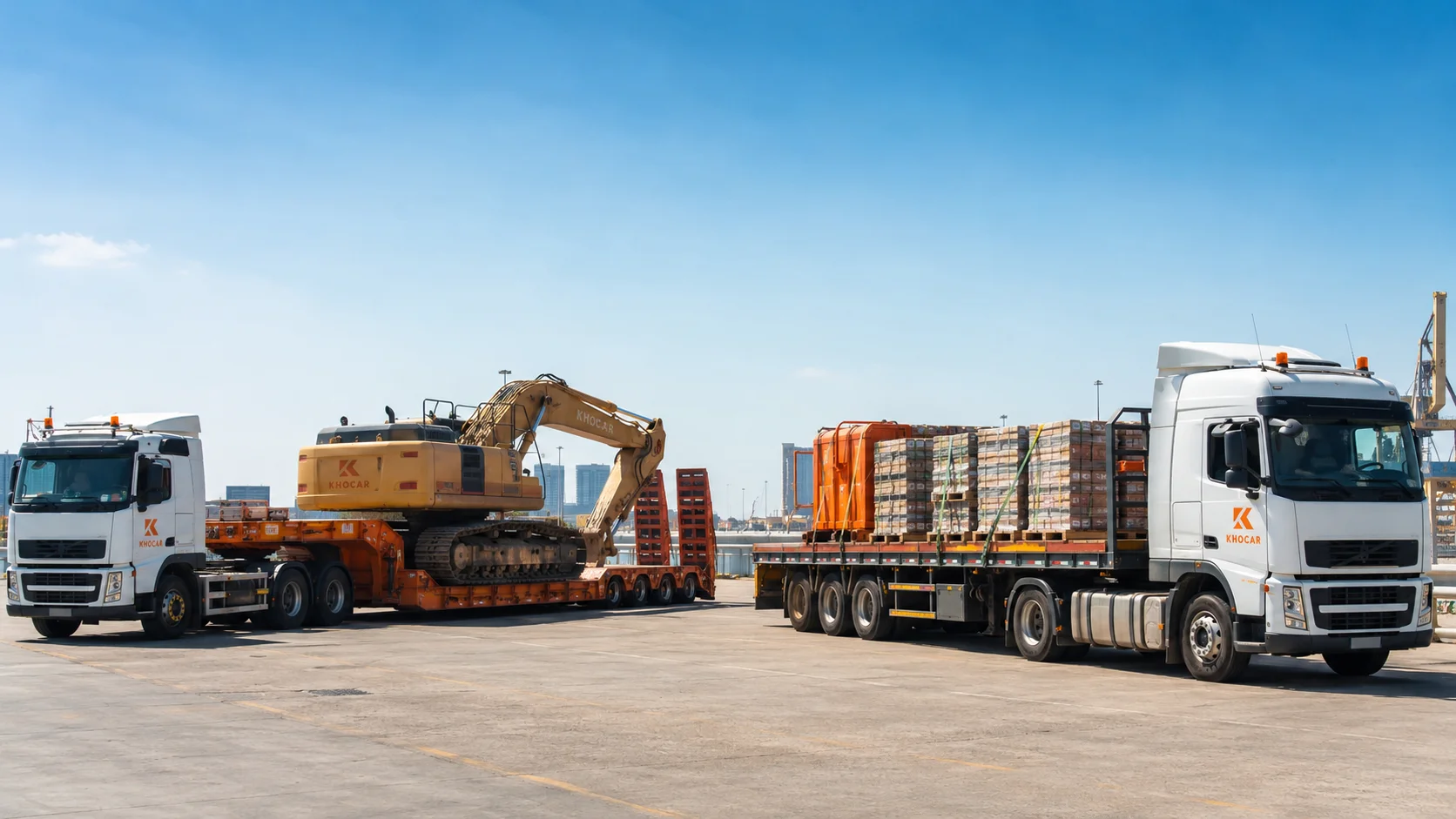
Choosing between a lowbed and a flatbed is not simply a question of which trailer can carry the stated weight. The wrong choice can leave an excavator too high for the planned route, a generator without a safe loading method, or a project team waiting at the gate while the transport provider changes equipment.
For contractors comparing a lowbed vs flatbed trailer UAE solution, the decision should be based on the complete transport profile: cargo dimensions, operating weight, center of gravity, loading method, ground clearance, axle distribution, route restrictions, and site access.
A standard flatbed is efficient for many general and crane-loaded items. A lowbed is normally the stronger option for tall, heavy, tracked, self-propelled, or oversized machinery because its lower deck reduces total transport height and improves loading practicality.
This guide explains the difference between lowbed and flatbed trailers in clear operational terms. It also shows which option is more suitable for excavators, loaders, generators, steel, containers, and industrial equipment, while highlighting the UAE compliance questions that should be checked before dispatch.
Key Takeaways
- Use a lowbed when the equipment is tall, heavy, tracked, self-propelled, difficult to lift, or likely to exceed route height on a standard deck.
- Use a flatbed when the cargo is within legal and equipment limits, can be loaded safely by crane or forklift, and does not require a low loading angle.
- A low deck can reduce total loaded height, but it does not automatically remove permit, axle-load, width, escort, or route-approval requirements.
- The trailer payload rating is only one number. Gross combination weight, axle distribution, deck dimensions, tie-down capacity, tractor suitability, and route limits must also be checked.
- For a fast UAE transport assessment, provide the equipment make and model, operating weight, transport dimensions, attachments, photos, collection and delivery locations, required timing, and loading conditions.
Quick Answer: Should You Use a Lowbed or a Flatbed Trailer?
| Choose a lowbed trailer for tall, heavy, tracked, self-propelled, or oversized equipment such as excavators, bulldozers, large wheel loaders, cranes, and industrial machinery. Choose a flatbed for general freight and equipment that can be safely crane-loaded or forklift-loaded, remains within permitted dimensions, and does not need a low loading angle. The final decision must be based on the loaded combination, route, axle distribution, and site conditions – not the cargo name alone. |
In practical terms, ask one question first: what problem must the trailer solve? If the main problem is cargo height, extreme weight, tracked loading, or stability, a lowbed usually solves it better. If the main problem is flexible deck space for ordinary freight, steel, pallets, packaged machinery, or containers, a flatbed may be the more efficient choice.
What Is a Flatbed Trailer?
A flatbed trailer is an open-deck trailer with a relatively level, higher deck and no fixed roof or enclosed sides. It is valued for flexibility because cargo can be loaded from the side, rear, or above. Cranes and forklifts can access the deck easily, and the same trailer can serve many general freight categories.
Typical Flatbed Trailer Uses
- Steel beams, pipes, structural sections, and fabricated components
- Palletized construction materials and packaged industrial goods
- Containers or modular units when the trailer and securing arrangement are suitable
- Smaller machines that can be lifted safely and stay within height and weight limits
- Generators, compressors, skids, tanks, and workshop equipment that have engineered lifting points
- Long but not exceptionally tall cargo, subject to deck length and overhang rules
Main Advantages of a Flatbed
- Versatile deck for many cargo types
- Easy side and overhead loading with cranes or forklifts
- Often easier to source for routine freight
- Can be more economical when a specialist low deck is unnecessary
- Useful for multiple smaller items when the load plan and securement system are approved
Main Flatbed Limitations
- The higher deck increases total loaded height
- Self-propelled equipment may need separate ramps or lifting equipment
- Tracked machines can be difficult to load without a suitable ramp angle and load-rated system
- Tall cargo may trigger route, clearance, escort, or permit problems
- A higher cargo position can raise the combined center of gravity
What Is a Lowbed Trailer?
A lowbed trailer is an open heavy-haul trailer designed with a main deck positioned lower to the road than a conventional flatbed. Depending on configuration, it may use rear loading ramps, a fixed or detachable gooseneck, multiple axles, extendable sections, or specialized suspension. In everyday UAE logistics, the term “lowbed” is often used broadly for trailers intended to move construction machinery and oversized equipment.
The core advantage is not simply high payload. It is the combination of lower deck height, better access for mobile machinery, improved height management, and heavy-duty axle configurations.
Typical Lowbed Trailer Uses
- Excavators, bulldozers, wheel loaders, graders, pavers, and rollers
- Cranes, drilling support equipment, and oilfield machinery
- Large generators, transformers, compressors, and industrial skids
- Tall equipment that would sit too high on a standard flatbed
- Heavy tracked or wheeled machines that need to drive onto the trailer
- Oversized project cargo that requires engineered route and load planning
Main Advantages of a Lowbed
- Lower total loaded height for tall machinery
- More practical loading for self-propelled equipment
- Lower cargo position and potentially improved transport stability
- Heavy-duty axle and suspension options for demanding loads
- Better fit for excavators, bulldozers, loaders, and project machinery
Main Lowbed Limitations
- Specialist equipment may cost more than an ordinary flatbed movement
- Low ground clearance can require careful planning at ramps, speed humps, uneven yards, and site entrances
- The trailer may need more space for turning and loading
- A lowbed does not remove legal gross-weight, axle-load, width, length, or route restrictions
- Not every lowbed has the same capacity, deck height, ramp angle, or axle configuration
Lowbed vs Flatbed Trailer UAE: Side-by-Side Comparison
| Decision Factor | Flatbed Trailer | Lowbed Trailer |
| Deck profile | Higher, mostly level open deck | Lower main deck designed to reduce loaded height |
| Best suited to | General freight, steel, packaged cargo, crane-loaded machinery | Tall, heavy, tracked, self-propelled, or oversized machinery |
| Loading method | Usually crane, forklift, side loader, or separate ramps | Often rear ramps or detachable gooseneck; machine may drive on |
| Height management | Less vertical allowance because cargo starts higher | More vertical allowance because cargo sits closer to the road |
| Stability considerations | Suitable when weight and center of gravity are controlled | Lower cargo position can help with high or heavy machinery |
| Axle configurations | Common freight configurations | Often available with additional axles for heavier load distribution |
| Route and site access | Usually simpler for routine cargo | May require more turning space and ground-clearance planning |
| Typical cost profile | Often more economical for standard freight | Often higher because it is specialist heavy-haul equipment |
| Permit outcome | Depends on loaded dimensions and weight | Depends on loaded dimensions and weight; low deck may reduce height-related issues |
The 7 Most Important Differences Between Lowbed and Flatbed Trailers
1. Deck Height and Total Loaded Height
Deck height is often the deciding factor. Total transport height is calculated from the road surface to the highest point of the loaded equipment. A tall excavator on a higher flatbed deck may create a route-clearance problem even when its weight is acceptable. Moving the same machine onto a suitable lowbed can lower the total combination height because the machine begins closer to the road.
Simple planning formula: total loaded height = trailer deck height + cargo height in transport position + supports, packing, or attachments.
KhoCAR’s detailed guide to lowbed trailer specifications, dimensions, capacity, and legal limits explains why deck height should be evaluated together with usable deck length, trailer width, ground clearance, payload, axle configuration, and route limits.
2. Loading Method and Ramp Angle
A flatbed is highly efficient when the cargo can be lifted. Steel, skids, generators, packaged machinery, and modular units can often be placed by crane or forklift. The operation still needs verified lifting points, suitable lifting equipment, a controlled loading zone, and a securement plan.
A lowbed becomes more practical when the machine is self-propelled. Excavators, bulldozers, loaders, and rollers can often drive onto a lowbed using designed ramps or a detachable gooseneck. Ramp angle matters because a steep transition can cause the machine to ground, slip, strike the trailer, or overload a ramp. Ground condition matters too: sand, mud, broken concrete, or a sloped yard can turn an ordinary loading operation into a recovery job.
The UK Health and Safety Executive advises that loading and unloading should be planned in advance and carried out in an area clear of passing traffic and uninvolved people. This is not UAE law, but it is a useful international safety principle for yard planning.
3. Cargo Type and Equipment Geometry
The cargo name alone is not enough. Two excavators can require different trailers because one has a long boom, wide tracks, a heavy counterweight, or a larger transport height. Likewise, one generator may fit a flatbed while another needs a lowbed because its enclosure is taller, its weight is concentrated over a small footprint, or lifting points are unavailable.
For each item, confirm:
- Make, model, and serial or equipment identification where relevant
- Operating weight and transport weight, including attachments and fuel if applicable
- Length, width, and height in the actual transport position
- Track width, wheelbase, ground clearance, and overhang
- Center-of-gravity information when supplied by the manufacturer
- Lifting points, tie-down points, and any manufacturer transport instructions
- Whether the machine can move under its own power and whether it has faults
4. Stability and Center of Gravity
A lower deck can place the equipment closer to the road, which may help reduce the combined center of gravity. That is valuable for tall machinery and heavy equipment. However, “lowbed” does not automatically mean “safe.” Poor cargo position, unequal axle loading, loose attachments, unsuitable tie-downs, excessive speed, abrupt steering, or an incorrect tractor-trailer match can still create serious risk.
The transport planner must consider lateral stability, longitudinal movement, braking forces, turning behavior, road camber, wind exposure, and the machine’s own center of gravity. The lowest deck is not always the only objective; adequate ground clearance and correct weight transfer are also essential.
5. Payload Rating, Gross Combination Weight, and Axle Distribution
A trailer advertised with a high payload capacity cannot be selected from the payload figure alone. The entire movement must account for the tractor, trailer tare weight, cargo, accessories, fuel, and any additional equipment. Equally important, the weight must be distributed within the approved axle and coupling limits.
As of July 2026, the UAE Legislation platform lists Cabinet Resolution No. 138 of 2023 as active and effective from 1 February 2024.
The Ministry of Energy and Infrastructure stated that the maximum gross weight for a heavy vehicle with six axles or more is 65 tonnes, while a vehicle exceeding the applicable gross, axle, or dimensional limits with an indivisible load requires a prior transport permit from the competent authority.
| Important compliance note:
A trailer manufacturer rating is an engineering limit for that trailer configuration; it is not permission to operate at that weight on every UAE road. The legal movement depends on the complete registered combination, axle loads, local route, authority requirements, permit conditions, and current restrictions. |
6. Route Access, Ground Clearance, and Site Conditions
A low deck helps with overhead clearance, but it reduces ground clearance. Route planning must therefore look both up and down. Bridges, gantries, utilities, and gate structures are overhead concerns. Speed humps, ramp crests, drainage channels, uneven yards, and temporary access roads are underside concerns.
The route plan should review:
- Bridge and overhead structure clearances
- Road width, turning radius, roundabouts, and tight industrial gates
- Road or bridge weight classifications
- Heavy-vehicle restrictions and permitted travel windows
- Construction diversions, temporary closures, and access permits
- Pickup and delivery surface condition
- Space for ramps, crane outriggers, turning, and safe unloading
Abu Dhabi Mobility announced in January 2025 that heavy vehicles were restricted on Abu Dhabi city roads from Monday to Thursday between 6:30 a.m. and 9:00 a.m., and between 3:00 p.m. and 7:00 p.m. Transport teams should verify the latest applicable restrictions before dispatch because routes and timings can change.
For a deeper UAE-specific overview, see KhoCAR’s guide to heavy equipment transport permits and lowbed route approval.
7. Cost, Availability, and Operational Efficiency
A flatbed may cost less when the load is routine and can be lifted safely. Booking a specialist lowbed for ordinary palletized cargo can add unnecessary cost and complexity. The reverse is also true: choosing a cheaper flatbed for tall or self-propelled machinery may create crane hire, ramp hire, rebooking, permit, or delay costs that exceed the original saving.
The correct cost comparison should include:
- Trailer and tractor requirement
- Loading and unloading equipment
- Permit, route survey, or escort requirements
- Waiting time and site access delays
- Attachment removal or separate transport
- Risk of re-dispatch if the original trailer is unsuitable
- Project downtime if the machine misses its delivery window
Which Trailer Is Best for Different Equipment?
| Equipment or Cargo | Usually Better Starting Point | Reason and Checks |
| Medium or large excavator | Lowbed | Tracked, heavy, tall, and normally driven on. Verify operating weight, track width, boom position, attachments, and loaded height. |
| Bulldozer or crawler tractor | Lowbed | Very heavy tracked machine with concentrated loads. Confirm blade position, track width, ramp capacity, and securement points. |
| Wheel loader | Lowbed in many cases | Self-propelled and often tall. Smaller units may fit another trailer if weight, dimensions, and loading method are approved. |
| Forklift or telehandler | Depends on size | Small units may use a suitable flatbed with safe ramps or lifting. Larger or taller units often benefit from a lowbed. |
| Generator or compressor skid | Flatbed or lowbed | Flatbed can work when crane loading and total height are acceptable. Use lowbed for tall, heavy, high-value, or difficult-to-lift units. |
| Crane components or boom sections | Often flatbed | Long components can be crane-loaded. Complete mobile cranes or large crane bodies may require specialist lowbeds or modular systems. |
| Steel beams, pipes, and fabricated sections | Flatbed | Open side loading and flexible deck access are usually more efficient. |
| Container or modular cabin | Flatbed or skeletal trailer | Depends on approved corner fittings, lifting method, dimensions, and route. A lowbed may be needed for unusually tall modules. |
| Transformer or dense industrial machinery | Engineered heavy-haul solution | Weight concentration, center of gravity, lifting plan, and axle distribution determine the trailer. It may require a multi-axle lowbed or modular platform. |
| Palletized building materials | Flatbed | Routine freight when load distribution, packaging, weather protection, and securement are suitable. |
Do Excavators Always Need a Lowbed Trailer?
| Concise answer:
Most medium and large excavators are transported on lowbed trailers because they are heavy, tracked, tall when loaded, and designed to drive onto the deck. A very small excavator may sometimes use another suitable trailer, but only after confirming weight, loaded height, deck capacity, ramp system, tie-down points, axle distribution, and route requirements. |
KhoCAR’s article on excavator transport in the UAE explains the information contractors should prepare to avoid rebooking and site delays.
UAE Legal and Compliance Factors That Affect the Choice
The lowbed-versus-flatbed decision is an engineering and logistics decision, but it must be checked against the applicable legal movement. A trailer can be technically capable of carrying a machine while the loaded combination still requires a permit, alternate route, movement window, or different axle arrangement.
1. Maximum Weight and Axle Limits
UAE federal rules regulate gross and axle weights. The MoEI announcement on the 2024 framework identifies 65 tonnes as the maximum gross weight for a heavy vehicle with six axles or more, subject to the detailed tables and vehicle configuration. Never treat that figure as a universal payload allowance. The tractor, trailer, cargo, and load distribution all form part of the legal assessment.
2. Over-Dimension and Overweight Permits
An indivisible load that exceeds applicable gross, axle, or dimensional limits may need prior approval from the competent authority. In Dubai, the Roads and Transport Authority provides a service for mobility permits for overweight and over-dimension vehicles and states that circulating such vehicles without the required permission is a traffic violation.
3. Emirate and Route-Specific Requirements
Federal limits are only part of the plan. Local authority requirements, industrial-zone access rules, port or facility procedures, restricted roads, time restrictions, and project-specific gate approvals can all affect the movement. Inter-emirate transport may involve more than one authority or operating condition. Confirm requirements for the actual route rather than relying on a previous job.
4. Load Securement and Safe Loading
The trailer choice must support an effective securement plan. Chains, binders, straps, blocks, chocks, locking devices, and attachment restraints must be selected for the specific machine and approved tie-down points. Hydraulic booms, buckets, blades, forks, ramps, and loose accessories must be placed and secured so they cannot move during braking, cornering, or road vibration.
The European Commission reports that up to 25% of truck accidents are linked to poorly secured cargo. This is a European statistic rather than UAE crash data, but it illustrates why load securement should be treated as an engineering control, not a last-minute chain count.
Three Practical UAE Transport Examples
Example 1: A 22-Tonne Excavator Moving from Musaffah to a Construction Site
The excavator is tracked, self-propelled, and tall. A flatbed would require a suitable ramp or crane arrangement and would place the machine higher. A lowbed is the stronger starting point because it provides a lower deck and practical drive-on loading. The final plan still needs the exact model, operating weight, track width, height with the boom and bucket in transport position, attachment plan, route, gate dimensions, and unloading surface.
Likely decision: lowbed trailer, subject to configuration, axle, route, and permit checks.
Example 2: A Packaged Generator with Engineered Lifting Points
The generator is compact, within the proposed trailer payload, and can be lifted at both locations by certified cranes. Its loaded height on a flatbed remains acceptable for the route. A flatbed may be more efficient because drive-on loading is unnecessary. If the enclosure is unusually tall, the weight is concentrated, or the destination lacks lifting equipment, a lowbed or different handling plan may be required.
Likely decision: flatbed when lifting, height, weight distribution, and securement are confirmed; otherwise reassess lowbed or specialist options.
Example 3: Long Steel Beams for an Industrial Project
The load is long but not exceptionally tall, and cranes are available at both ends. Open side access and a level deck make a flatbed efficient. The planner must still review deck length, legal overhang, support points, dunnage, load distribution, edge protection, markings, and route turning space.
Likely decision: flatbed or extendable flatbed, depending on beam length and the approved transport plan.
How to Choose the Right Trailer: A 7-Step Decision Framework
- Identify the exact equipment: Use the make and model rather than a generic description such as “excavator” or “generator.” Obtain the manufacturer data sheet when possible.
- Confirm transport weight: Include attachments, tools, fluids, counterweights, packaging, and any items travelling on the same trailer.
- Measure transport dimensions: Record length, width, and height in the actual travel position. Do not use operating dimensions when booms, masts, buckets, forks, or outriggers will be repositioned.
- Choose the loading method: Decide whether the cargo will drive on, use ramps, or be lifted by crane or forklift. Confirm the capacity and availability of loading equipment at both locations.
- Evaluate deck height and geometry: Calculate total loaded height, check track or wheel fit, confirm support points, and assess ground clearance and ramp angle.
- Check weight distribution and securement: Match the cargo footprint and center of gravity to the deck, tractor, coupling, axles, suspension, and approved tie-down system.
- Review route, permits, and timing: Confirm authority limits, movement windows, clearances, gate access, route restrictions, permits, escorts, and loading/unloading appointments before dispatch.
Information to Send Before Requesting a Trailer Quote
The fastest way to receive an accurate recommendation is to send complete cargo and site information at the beginning. KhoCAR’s lowbed booking details guide provides a full checklist. At minimum, prepare:
- Equipment or cargo description, make, and model
- Verified weight and source of the weight figure
- Transport length, width, and height
- Attachments and whether they will remain installed
- Photos from multiple angles and a photo of the data plate where available
- Pickup and delivery map pins
- Site contact names and access instructions
- Loading and unloading method
- Ground condition and available maneuvering space
- Required date, delivery window, and project urgency
- Any known permit, gate-pass, escort, or facility requirements
Loading and Securement Checklist
| Before Loading | Before Departure |
| • Verify trailer, tractor, ramp, and lifting-equipment capacity | • Confirm cargo position and axle-weight distribution |
| • Inspect deck, ramps, hydraulic systems, tires, lights, brakes, and tie-down points | • Secure the main machine and all booms, buckets, blades, forks, ramps, and accessories |
| • Confirm the loading area is firm, level, controlled, and clear of pedestrians | • Check chain, binder, strap, blocking, and chock condition and ratings |
| • Check equipment condition, leaks, loose parts, and transport configuration | • Measure final loaded dimensions and verify route/permit conditions |
| • Agree hand signals, radio communication, and stop-work authority | • Complete a documented walk-around and recheck securement as required during the journey |
Common Mistakes When Choosing Between a Lowbed and Flatbed
Booking from the cargo name alone: “Excavator” or “generator” is not enough. The model and transport configuration determine the real requirement.
Using estimated weight: A guessed weight can lead to an unsuitable trailer, illegal axle loading, or failed collection.
Ignoring loaded height: The machine may physically fit on the deck but still be too high for the route or permit conditions.
Assuming every lowbed is the same: Deck height, usable length, axle count, ramp angle, payload, suspension, and ground clearance vary.
Forgetting loading equipment: A flatbed may look economical until the team discovers that no crane or forklift is available at the destination.
Treating permits as an afterthought: Authority and route checks should happen before the trailer reaches the pickup point.
Failing to inspect the destination: A suitable trailer can still be unable to enter, turn, deploy ramps, or unload on the proposed site.
Choosing only by price: A cheaper but unsuitable trailer can create rebooking, waiting, crane, permit, and project-delay costs.
Lowbed or Flatbed: Final Decision Summary
A flatbed is the practical choice for general cargo and liftable equipment that remains within the approved weight and dimensional envelope. A lowbed is normally the better choice for tall, heavy, tracked, self-propelled, or oversized equipment that benefits from a lower deck and drive-on loading. Neither option should be chosen by habit. The correct trailer is the one that carries the actual load safely, distributes weight correctly, fits the route and sites, supports the required loading method, and complies with current authority conditions.
Need the Right Lowbed Trailer for Heavy Equipment Transport in the UAE?
KhoCAR supports contractors, industrial companies, oilfield operators, logistics teams, and project coordinators with lowbed trailer hire and heavy equipment transport across the UAE. Services include experienced drivers, transport coordination, route planning, permit support, and solutions for excavators, bulldozers, loaders, cranes, generators, industrial machinery, and oversized project cargo across Abu Dhabi, Dubai, Sharjah, and other Emirates.
For the fastest recommendation, send: the equipment make and model, verified weight, transport dimensions, attachment details, photos, pickup and delivery locations, required timing, and site access information. Contact KhoCAR for a transport assessment and quote.
FAQs
What is the difference between a lowbed and a flatbed trailer?
A flatbed has a higher, mostly level open deck and is commonly used for general freight and crane-loaded cargo. A lowbed has a lower main deck designed for tall, heavy, tracked, or self-propelled equipment. The lower deck helps manage total transport height and often supports drive-on loading.
Which is the best trailer for heavy equipment in the UAE?
A lowbed is usually the best starting point for excavators, bulldozers, large loaders, cranes, and tall industrial machinery. The correct configuration still depends on verified weight, dimensions, center of gravity, axle distribution, route, loading method, and permit requirements.
Can an excavator be transported on a flatbed trailer?
A small excavator may sometimes be transported on a suitable flatbed if the trailer, ramps or lifting method, loaded height, weight distribution, tie-down system, and route are approved. Medium and large excavators generally use lowbeds because the lower deck and drive-on loading are more practical.
Does using a lowbed trailer avoid UAE oversized-load permits?
No. A lowbed can reduce total loaded height, but permits may still be required when the combination exceeds applicable weight, axle, width, length, or height limits. Permit requirements depend on the actual load, route, emirate, and competent authority.
Is a lowbed trailer safer than a flatbed?
A lowbed can provide advantages for tall or heavy machinery because the cargo sits lower and can often drive onto the deck. Safety still depends on correct trailer selection, loading, axle distribution, securement, driver competence, route planning, speed, and site conditions.
Can a generator be transported on a flatbed?
Yes, many generators can travel on a flatbed when their weight and dimensions are within limits, approved lifting equipment is available at both ends, and the unit can be secured properly. Tall, heavy, or difficult-to-lift generators may require a lowbed.
Do flatbed trailers have ramps?
Some flatbeds can use compatible ramps, but ramps are not automatically suitable for every machine. The ramp capacity, width, angle, surface, attachment method, and ground condition must be verified. Lowbeds are generally designed more specifically for mobile heavy-equipment loading.
How is total loaded height calculated?
Measure from the road surface to the highest point of the cargo after it is placed in its transport position. Include trailer deck height, cargo height, supports or dunnage, and any attachment that remains installed.
What details are needed to choose between a lowbed and flatbed?
Provide the cargo make and model, verified weight, transport length, width and height, attachments, photos, loading method, pickup and delivery locations, site access, required timing, and any known route or permit conditions.
How much does lowbed trailer transport cost in the UAE?
Cost depends on the trailer and tractor configuration, cargo weight and dimensions, distance, loading conditions, waiting time, route, permits, escorts, delivery window, and site access. A reliable quote requires complete equipment and location details.
Can a lowbed carry steel, pipes, or general freight?
It may be physically possible, but a flatbed is often more efficient for ordinary steel, pipes, pallets, and crane-loaded freight. A lowbed should be used when its lower deck, specialist capacity, or loading design solves a real transport requirement.
What is the most common reason the wrong trailer is sent?
Incomplete or inaccurate cargo information is a common cause. Missing weight, dimensions, attachment details, photos, loading method, or gate-access information can result in the wrong deck height, axle configuration, ramp system, or overall trailer type.