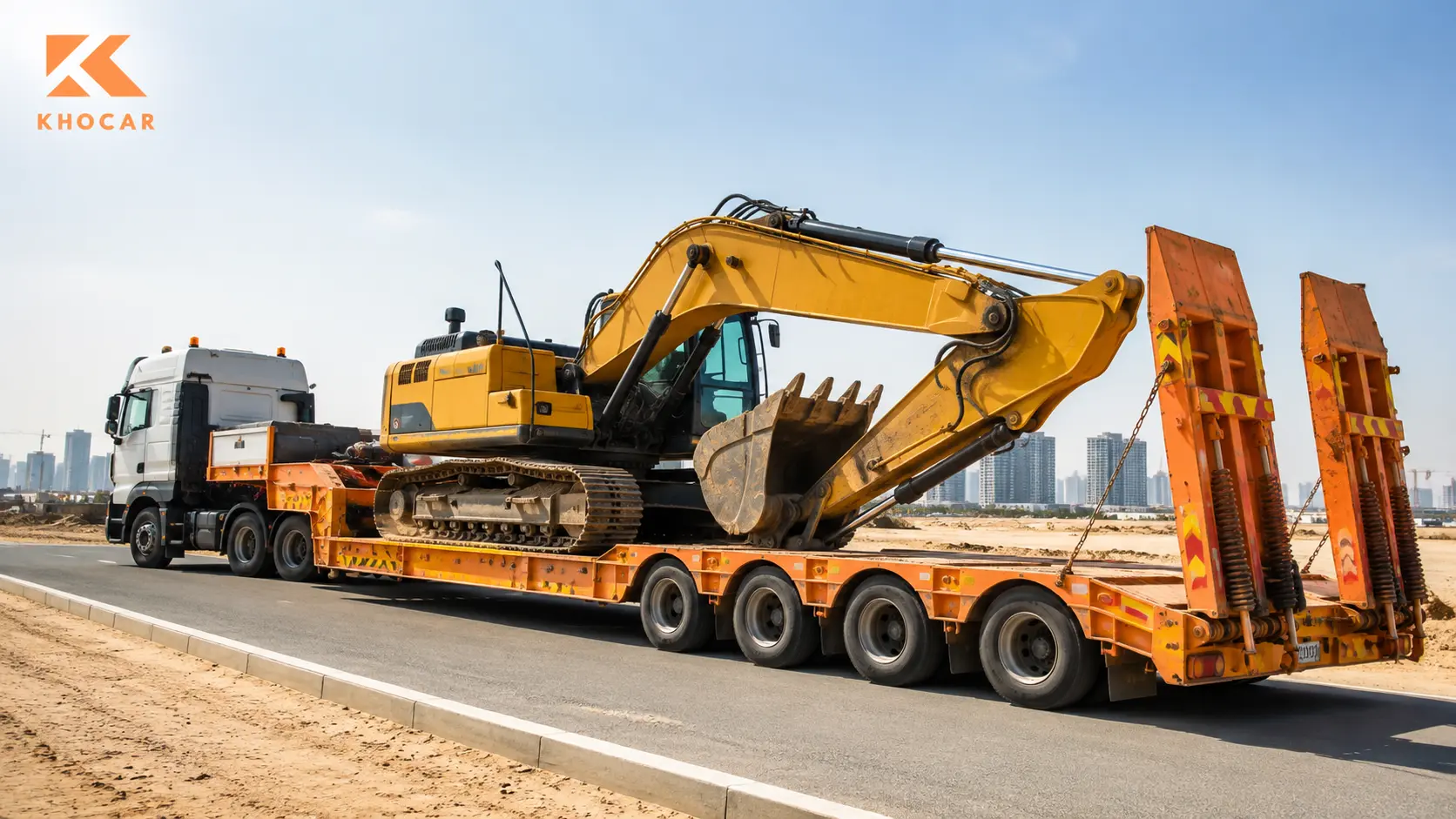
Lowbed trailer rental cost in the UAE is one of the first questions contractors ask when they need to move an excavator, bulldozer, generator, crane, transformer, or oversized industrial machine. The challenge is that a reliable quote is rarely based on distance alone. A 20-kilometre move inside Dubai can cost more than a longer inter-emirate job if the load is wide, heavy, urgent, difficult to access, or likely to need route coordination. The trailer provider must understand what is being moved, how heavy it is, how tall it becomes on the trailer, whether loading equipment is ready, and whether the route is suitable for the combined vehicle.
This guide explains the seven biggest factors that determine a lowbed trailer quote in the UAE. It is written for procurement teams, site engineers, logistics coordinators, fleet managers, workshop supervisors, and business owners who want a faster, clearer, and more accurate heavy equipment transport quote. Instead of guessing a generic AED price, use this guide to understand what drives the cost and what details to send before booking.
| Key Takeaways
Lowbed trailer rental prices in the UAE depend on equipment weight, dimensions, trailer type, route, permits, loading conditions, urgency, waiting time, and whether the job is one-way or recurring. The fastest way to get an accurate lowbed trailer quote is to send the equipment type, operating weight, length, width, height, pickup location, delivery location, loading method, required date, and site access details. Do not choose a lowbed provider only by the cheapest number. Heavy equipment transport needs proper trailer selection, experienced drivers, route planning, and compliance support. If the load is unusually tall, wide, heavy, or time-sensitive, route approval, restricted movement hours, or escort planning may affect both price and schedule. For UAE contractors, a transparent quote can prevent downtime, site delays, surprise waiting charges, and unsafe equipment movement. |
Why Lowbed Trailer Rental Cost in the UAE Is Usually Custom-Quoted
Lowbed trailer rental is different from renting a small vehicle or booking a standard delivery truck. The load is often expensive, oversized, heavy, difficult to load, and tied to project deadlines. That is why many UAE lowbed trailer providers give custom quotes instead of fixed public prices. The cost is calculated around risk, time, equipment suitability, road restrictions, and operational complexity.
For example, two jobs may look similar at first: both involve transporting an excavator from a yard to a construction site. But the final quote can change if one excavator has a wider undercarriage, a higher boom position, poor ground clearance, missing loading ramps, or a destination site with narrow access. Even the same machine can require different planning when it moves from an industrial yard, a port area, a congested city road, or a remote oilfield location.
KhoCAR’s lowbed trailer rental and transport service in the UAE is built around this kind of project-specific planning. The goal is not only to move the machine from point A to point B, but to match the correct trailer, driver, route, timing, and loading plan to the job.
| Cost Factor | Why It Affects the Quote | Common Example |
| Equipment weight | Affects trailer capacity, axle load, braking, fuel use, and road compliance. | A 12-ton loader is not priced like a 45-ton crawler excavator. |
| Equipment dimensions | Affects deck fit, legal height, width, route choice, and permit risk. | A tall boom lift may need a lower deck or special route planning. |
| Trailer configuration | Different axles, deck heights, ramps, and trailer types have different operating costs. | A heavier machine may need a multi-axle lowbed. |
| Distance and route | Longer or more complex routes increase driver time, fuel, tolls, coordination, and scheduling. | A port-to-site move may need access coordination. |
| Permits and escorts | Oversized or heavy loads may require approval, restricted movement windows, or escort support. | A wide industrial machine may not move like a standard load. |
| Loading conditions | Poor access or missing loading equipment can increase time and risk. | A dead machine may need winching or additional equipment. |
| Urgency and waiting | Same-day dispatch, night movement, idle time, or delayed site readiness can affect total cost. | A trailer waiting at a site gate for hours may create extra charges. |
1. Equipment Type, Weight, and Dimensions
The first cost factor is the equipment itself. A lowbed provider cannot price a job accurately without knowing what will sit on the trailer. Equipment type tells the transport team how the machine is loaded, where the weight is concentrated, whether it has tracks or tyres, whether it can drive onto the trailer, and whether any attachments need to be removed before movement.
Weight is especially important because it affects payload capacity, axle loading, braking distance, fuel consumption, and safety margins. A lowbed trailer may be physically large enough to carry a machine, but that does not mean it is the correct trailer for the machine’s weight distribution. UAE heavy vehicle rules also make weight and dimensions part of compliance planning. The UAE legislation portal lists the national cabinet resolution that regulates heavy vehicle weights and dimensions, which is why transport planning should begin before the lowbed arrives at site.
UAE heavy vehicle weights and dimensions regulation.
Why the machine model matters before pricing
A machine name alone is not always enough. Saying ‘excavator’ gives a category, but not the exact operating weight, track width, counterweight size, boom position, attachment configuration, or travel height. A 5-ton mini excavator and a 50-ton crawler excavator both belong to the same broad equipment family, but they create completely different transport requirements.
- Equipment type: excavator, wheel loader, bulldozer, crane, generator, compressor, tank, transformer, drilling support unit, or industrial machine.
- Operating weight: the working weight of the machine, not only the shipping weight in a brochure.
- Length, width, and height: measured in transport position, including attachments where relevant.
- Ground clearance and loading angle: important for deciding whether ramps, blocks, or special loading support are needed.
- Attachments: buckets, forks, booms, blades, counterweights, and hydraulic tools may change transport dimensions.
Example: compact loader vs crawler excavator
Imagine two customers request a lowbed trailer from a yard in Sharjah to a site in Dubai. The first needs to move a compact wheel loader that can drive onto the trailer, fits within standard dimensions, and is ready at the pickup point. The second needs to move a crawler excavator with a wide track base, heavy counterweight, and limited access at the destination. The distance may be similar, but the second quote will likely require more planning because the equipment creates higher risk and may need a different trailer configuration.
For equipment-specific planning, KhoCAR also has a guide on excavator transport in the UAE, which is useful when the machine is time-sensitive or tied to a project deadline.
2. Required Trailer Type, Axle Configuration, and Deck Height
The second factor is the trailer configuration. Not every lowbed is the same. The required trailer depends on the load’s weight, height, width, length, ground clearance, and loading method. A lower deck may help a tall machine stay within acceptable height limits. More axles may be needed to distribute heavy loads safely. Hydraulic ramps may be important for equipment that can drive on and off the trailer.
This is one reason a price-only comparison can be misleading. One quote may be cheaper because it assumes a simpler trailer, while another quote includes a trailer configuration that is more suitable for the machine and the route. The real question is not ‘what is the cheapest lowbed?’ It is ‘what is the correct lowbed for this load, route, and deadline?’
For more technical context, see KhoCAR’s guide to lowbed trailer specifications, dimensions, capacity, and legal limits.
| Trailer/Setup Consideration | What It Means | How It Can Affect Cost |
| Deck height | Distance from the ground to the trailer deck. | Lower decks can help tall loads but may require specific equipment availability. |
| Axle configuration | Number and arrangement of axles used to distribute weight. | Heavier loads may need more capable trailers and careful route planning. |
| Ramp type | Mechanical or hydraulic loading ramps, depending on equipment access. | Special loading needs may increase setup time or require a specific trailer. |
| Payload capacity | Maximum safe load the trailer can carry. | Underestimating weight can lead to rebooking or delays. |
| Deck length | Usable space for the machine or cargo. | Long machines may need a longer or extendable setup. |
Why low deck height can reduce route and permit issues
Deck height matters because the machine’s height is added to the trailer deck height. If the combined loaded height becomes too tall for the planned route, the move may need special review, a different trailer, restricted routes, or additional clearance checks. A lowbed trailer earns its name because the deck sits lower than many standard transport options, which can help with taller machinery.
For example, if a generator housing or excavator cab is already tall, saving several centimetres through a lower deck can reduce the chance of bridge, gantry, signboard, or overhead service conflicts. This does not remove the need for route checking, but it can make the transport plan more practical.
3. Pickup Location, Destination, and Total Route Complexity
Distance matters, but route complexity matters just as much. A simple yard-to-yard move on accessible roads is different from a pickup inside a congested industrial zone, a port, a remote desert site, an oilfield access road, or a construction site with narrow gates. The quote may need to account for driver time, travel restrictions, fuel, tolls, road access, waiting points, site entry requirements, and whether the same vehicle can safely reach both ends of the job.
This is why a short job is not always cheap and a longer job is not always expensive. The cleanest routes are often easier to plan. Complex routes may require more communication, earlier scheduling, special timing, or site coordination.
Why short distance does not always mean low cost
A 15-kilometre city movement can be complicated if the trailer has to pass through tight turns, peak-hour restrictions, roadworks, access gates, security checks, or areas where heavy vehicles are controlled. A 100-kilometre inter-emirate route may be more straightforward if the load is standard, the route is clear, and both sites are ready. For lowbed transport, the quality of the route often matters as much as the number of kilometres.
- Is the pickup point inside a port, free zone, oilfield, construction site, workshop, or industrial yard?
- Does the destination have enough space for a long articulated vehicle to enter, turn, and unload?
- Are there restricted movement hours or heavy vehicle bans along the route?
- Are there bridges, overhead signs, tight roundabouts, narrow internal roads, or weak access roads?
- Will site security, gate passes, or delivery windows delay the vehicle?
4. Oversized Load Permits, Route Approval, and Escort Requirements
Permit and route requirements can significantly affect lowbed trailer rental cost in the UAE. If the load is unusually heavy, tall, wide, or long, the provider may need to check whether a normal movement is allowed or whether special approval, route planning, or escort coordination is required. These steps take time and may add administrative or operational costs, but they also reduce the risk of delays, fines, road safety issues, and last-minute cancellation.
In Abu Dhabi, commercial transport regulation and permitting are managed through the Asateel ecosystem. Abu Dhabi Mobility explains that Asateel is designed to support accountability, productivity, and safety for commercial transport activities, including freight operations. For heavy vehicles, this means compliance planning should be treated as part of the job, not an afterthought.
Abu Dhabi Mobility commercial transport and Asateel information.
KhoCAR has also covered this topic in detail in its guide to heavy equipment transport permits and lowbed route approval in the UAE.
| Permit/Route Issue | Why It Matters | Possible Quote Impact |
| Over-width load | May affect lane use, route choice, escorts, or travel timing. | More planning time and possible escort coordination. |
| Over-height load | May conflict with bridges, signs, gantries, or overhead services. | Route survey or lower deck selection may be needed. |
| Heavy axle load | Can affect road eligibility and compliance. | Specific axle configuration or route review may be required. |
| Restricted roads | Some routes may limit heavy vehicle movement at certain times. | Schedule may shift to approved windows. |
| Inter-emirate movement | Requirements can vary depending on route and authorities. | More coordination before final confirmation. |
5. Loading and Unloading Conditions at Both Sites
Loading and unloading conditions are a major reason lowbed quotes change. A machine that can drive onto the trailer on firm, level ground is usually easier to handle than a dead machine, dismantled unit, or heavy cargo that requires a crane or forklift. The transport team also needs to know whether the loading area is wide enough, flat enough, and safe enough for the trailer to position correctly.
Many delays happen because the trailer reaches the site, but the machine is not ready. The operator is missing, the access road is blocked, the site gate is too narrow, the crane is delayed, or the machine cannot start. These delays affect driver time and may create waiting charges. More importantly, rushed loading can create safety risk.
Questions to answer before booking
- Can the equipment start, move, steer, and brake under its own power?
- Is an operator available at the pickup point and delivery point?
- Are ramps, cranes, forklifts, or lifting gear required?
- Is the ground level, compact, and safe for loading?
- Is there enough space for the truck and trailer to align with the machine?
- Are there overhead cables, low canopies, tight corners, or weak ground near the loading area?
- Does the destination have a clear unloading plan and site contact?
Example: working machine vs non-running machine
A working wheel loader can usually drive onto the trailer if the ramps and deck are suitable. A non-running loader may need towing, winching, a crane, or additional lifting equipment. The transport distance might be the same, but the second job is more complex because the lowbed service becomes part of a recovery and handling operation, not just transport. That difference can affect both cost and schedule.
6. Urgency, Waiting Time, and Restricted Movement Hours
Urgency can increase lowbed trailer rental cost because it affects availability and scheduling. A planned job can be matched to the right trailer, driver, route, and movement window. A same-day or emergency job may require fast dispatch, schedule reshuffling, overtime coordination, or a trailer that is already near the pickup location.
Waiting time is another hidden cost driver. If the lowbed arrives and the machine is not ready, the site is closed, the gate pass is missing, the operator is not available, or the unloading team is delayed, the provider may charge for idle time. Even when waiting is not charged separately, it can reduce availability for the next job and affect overall planning.
| Situation | Why It Can Increase Cost | How to Avoid It |
| Same-day dispatch | Requires urgent scheduling and available equipment. | Send complete details early and confirm readiness. |
| Night or restricted-hour movement | May require special driver scheduling or approvals. | Plan ahead when load size or route may restrict timing. |
| Site waiting | Driver and trailer are blocked while the machine or site is not ready. | Confirm operator, access, gate pass, and loading area. |
| Last-minute route change | May require re-planning and extra travel time. | Finalize pickup and drop-off addresses before dispatch. |
| Delayed unloading | The trailer cannot leave for the next job. | Prepare unloading crew, crane, forklift, or machine operator. |
7. One-Way Moves, Return Trips, and Recurring Project Transport
The final factor is job structure. A single one-way movement is priced differently from a return movement, multiple machines on a project schedule, weekly transfers, or ongoing site-to-site equipment rotation. In many cases, recurring work is easier to plan because the provider can understand the customer’s equipment, site layout, preferred routes, and timing patterns.
A one-way move may include empty return travel in the provider’s planning. A return trip may be more efficient if the trailer can carry equipment both ways or if the timing is predictable. A long-term project may allow better scheduling, fewer urgent calls, and clearer coordination with site teams.
Example: one excavator move vs weekly project movement
A contractor who needs one excavator moved from Abu Dhabi to Dubai may only need a single quote. A contractor rotating excavators, generators, loaders, and compressors between multiple sites each week needs a different logistics approach. The second customer may benefit from a planned transport calendar, clearer documentation, repeated route familiarity, and improved availability. That does not automatically mean every move is cheaper, but it can reduce confusion, delays, and emergency dispatch needs.
What Information Should You Send for a Faster Lowbed Trailer Quote?
The fastest way to get a clear lowbed trailer quote is to send complete information in the first message. Many quote delays happen because the transport provider has to ask basic follow-up questions: What is the equipment weight? How tall is it? Can it drive? Where exactly is it located? When does it need to move? Are there site restrictions?
KhoCAR’s existing guide on what details you need to book a lowbed trailer in the UAE covers the booking information in more detail. For pricing, the following checklist is especially useful.
| Detail to Send | Why It Matters for Price | Best Format |
| Equipment type and model | Helps identify weight, size, loading method, and handling risk. | Machine name, model number, or equipment plate photo. |
| Operating weight | Determines trailer capacity, axle load, and compliance planning. | Weight in tonnes or kg; include manual/spec sheet if available. |
| Length, width, height | Determines fit, route, clearance, and permit risk. | Measurements in transport position. |
| Pickup and delivery locations | Affects distance, route, access, and scheduling. | Google Maps pin, site name, or full address. |
| Loading/unloading method | Identifies whether the machine drives, is lifted, or requires special help. | Self-drive, crane, forklift, winch, ramps, or operator support. |
| Required date and time | Affects trailer availability and movement windows. | Exact date, preferred time, and urgency level. |
| Site access details | Prevents delays from gates, roads, permits, or space limitations. | Gate pass, contact person, access road notes, photos. |
| Equipment photos | Helps identify attachments, ground clearance, condition, and loading risks. | Front, side, rear, nameplate, and any damaged/non-running areas. |
| Copy-and-paste quote request template
Hello KhoCAR, I need a lowbed trailer quote in the UAE. Equipment: [type/model] Weight: [tonnes/kg] Dimensions: [L x W x H] Pickup: [location/pin] Delivery: [location/pin] Date/time required: [date/time] Loading method: [self-drive/crane/forklift/winch/other] Unloading method: [self-drive/crane/forklift/winch/other] Site access notes: [gate, restrictions, contact, road condition] Photos/documents attached: [yes/no] |
How to Reduce Lowbed Trailer Rental Cost Without Risking Safety
The best way to reduce cost is not to choose the cheapest quote blindly. It is to remove uncertainty. A provider prices risk, time, and complexity. When the job details are clear, the route is understood, the machine is ready, and the site is prepared, the quote can be more accurate and the job is less likely to suffer delays.
- Send complete details early. Incomplete requests create back-and-forth, delay availability checks, and may lead to conservative pricing.
- Measure the machine in transport position. Height and width can change when booms, buckets, blades, forks, or counterweights are positioned differently.
- Prepare the equipment before the trailer arrives. Make sure the machine starts, moves, has an operator, and is parked in an accessible loading area.
- Avoid last-minute schedule changes. Urgency can affect availability, driver scheduling, and route planning.
- Share photos. Photos help the transport team identify loading risks that are hard to explain by text.
- Plan recurring moves together. If you have several machines to move over a project schedule, share the whole plan instead of booking each job as an emergency.
- Do not hide oversize details. A low quote based on missing dimensions can become expensive if the job must be re-planned on pickup day.
| Mistake | What Can Happen | Better Approach |
| Asking only for price by distance | Quote may be inaccurate or incomplete. | Share weight, dimensions, route, loading method, and timing. |
| Understating equipment weight | Wrong trailer selection or unsafe loading risk. | Use actual operating weight and spec sheet where possible. |
| Ignoring height/width | Route restrictions, delays, or permit issues. | Measure transport height and width before booking. |
| Booking before site is ready | Waiting time and schedule delays. | Confirm gate access, operator, loading area, and site contact. |
| Choosing only the lowest quote | Service may not include proper planning or compliance support. | Compare what is included, not only the number. |
What Should Be Included in a Good Lowbed Trailer Quote?
A professional quote should make the scope clear. Even if the final price is customized, the customer should understand what is included and what may change the price. This is especially important for procurement teams that need to compare quotations fairly. A lowbed trailer quote that looks cheaper may exclude driver support, permit coordination, waiting time, loading assumptions, or route complexity.
- Trailer type or capacity assumed for the move
- Whether the quote includes an experienced driver
- Pickup and delivery locations covered
- Expected movement date or validity period
- Assumptions about loading and unloading
- Whether permit or route coordination is included or quoted separately
- Waiting-time policy if the site or machine is not ready
- Any extra charges for changes in weight, dimensions, route, timing, or access conditions
This does not mean every quote needs to be complicated. It means the customer should know the assumptions behind the price. When the scope is clear, both sides can avoid misunderstanding on the day of transport.
When a Higher Lowbed Quote May Actually Save Money
A higher quote is not always better, but the cheapest quote is not always the cheapest job. If a low quote leads to the wrong trailer, missing permit review, unsafe loading, delayed dispatch, or extra waiting charges, the total project cost can become much higher than the original saving. Heavy equipment downtime is often more expensive than the transport difference.
For example, if an excavator is needed on site before a concrete pour, foundation job, roadwork shift, or oilfield maintenance window, a transport delay can affect crews, subcontractors, machinery rental, and project milestones. Paying for proper planning, correct trailer selection, and reliable communication can be cheaper than losing a workday.
| Simple rule for procurement teams
Do not compare only AED totals. Compare scope, trailer suitability, driver experience, route planning, permit support, availability, and waiting-time terms. The lowest number is only useful if it covers the real job. |
Need a Lowbed Trailer Quote in the UAE?
If you need to move heavy construction equipment, oversized machinery, generators, cranes, industrial cargo, or project equipment, KhoCAR can help arrange reliable lowbed trailer rental and transport support across the UAE. The team can assist with trailer selection, experienced drivers, route coordination, and practical planning for Dubai, Abu Dhabi, Sharjah, and inter-emirate heavy equipment movement.
For a faster quote, send your equipment type, operating weight, full dimensions, pickup location, delivery location, loading method, required transport date, and site access notes. Then visit KhoCAR’s Lowbed Trailers UAE service page to request support for your transport requirement.
FAQs
How much does lowbed trailer rental cost in the UAE?
Lowbed trailer rental cost in the UAE depends on the equipment type, weight, dimensions, pickup location, destination, trailer configuration, permits, loading conditions, urgency, and waiting time. A custom quote is usually more accurate than a fixed public price because heavy equipment jobs vary widely.
Why do lowbed trailer quotes vary so much?
Quotes vary because one job may involve a standard machine and simple route, while another may require a heavier trailer, route approval, restricted movement hours, escort planning, difficult loading, or urgent dispatch. Distance is only one part of the price.
What information do I need to get a lowbed trailer quote?
You should send the equipment type, model, operating weight, length, width, height, pickup location, delivery location, loading and unloading method, required date, site contact, access notes, and photos. Complete information helps the provider quote faster and more accurately.
Does lowbed trailer rental in the UAE include a driver?
Many lowbed trailer rental jobs include an experienced driver, especially for heavy machinery and oversized equipment transport. Always confirm whether the quote includes driver support, route coordination, waiting time, and any permit-related planning.
Do oversized loads in the UAE need permits?
Oversized or unusually heavy loads may need permit support, route approval, restricted movement windows, or escort coordination depending on the load size, weight, route, and emirate-level requirements. Share dimensions and route details early so the provider can advise properly.
Is lowbed transport cheaper than flatbed transport?
Not always. Flatbed transport may be suitable for smaller or lower cargo, but lowbed trailers are often needed for taller, heavier, or oversized machinery. If the machine needs the lower deck height or heavier payload capacity, a lowbed trailer can be the safer and more practical choice even if the quote is higher.
Can I book a lowbed trailer in the UAE on the same day?
Same-day lowbed trailer booking may be possible when a suitable trailer and driver are available, and the load does not need complex route planning. For urgent jobs, send complete equipment details and site information immediately to reduce delays.
Why does equipment weight affect lowbed trailer cost?
Weight affects the trailer required, axle load, braking performance, route planning, fuel consumption, and legal compliance. An incorrect or missing weight can lead to the wrong trailer being assigned, which may delay the job or create safety risks.
Can I reduce lowbed trailer rental cost?
Yes. You can reduce avoidable costs by planning early, sending complete details, measuring the machine correctly, preparing the site, avoiding waiting time, and grouping recurring equipment movements where possible. Do not reduce cost by using the wrong trailer or hiding load details.
What types of equipment can be moved by a lowbed trailer?
Lowbed trailers commonly move excavators, bulldozers, loaders, cranes, generators, compressors, transformers, drilling equipment, tanks, industrial machinery, and other heavy or oversized cargo. The correct trailer depends on weight, dimensions, loading method, and route.