
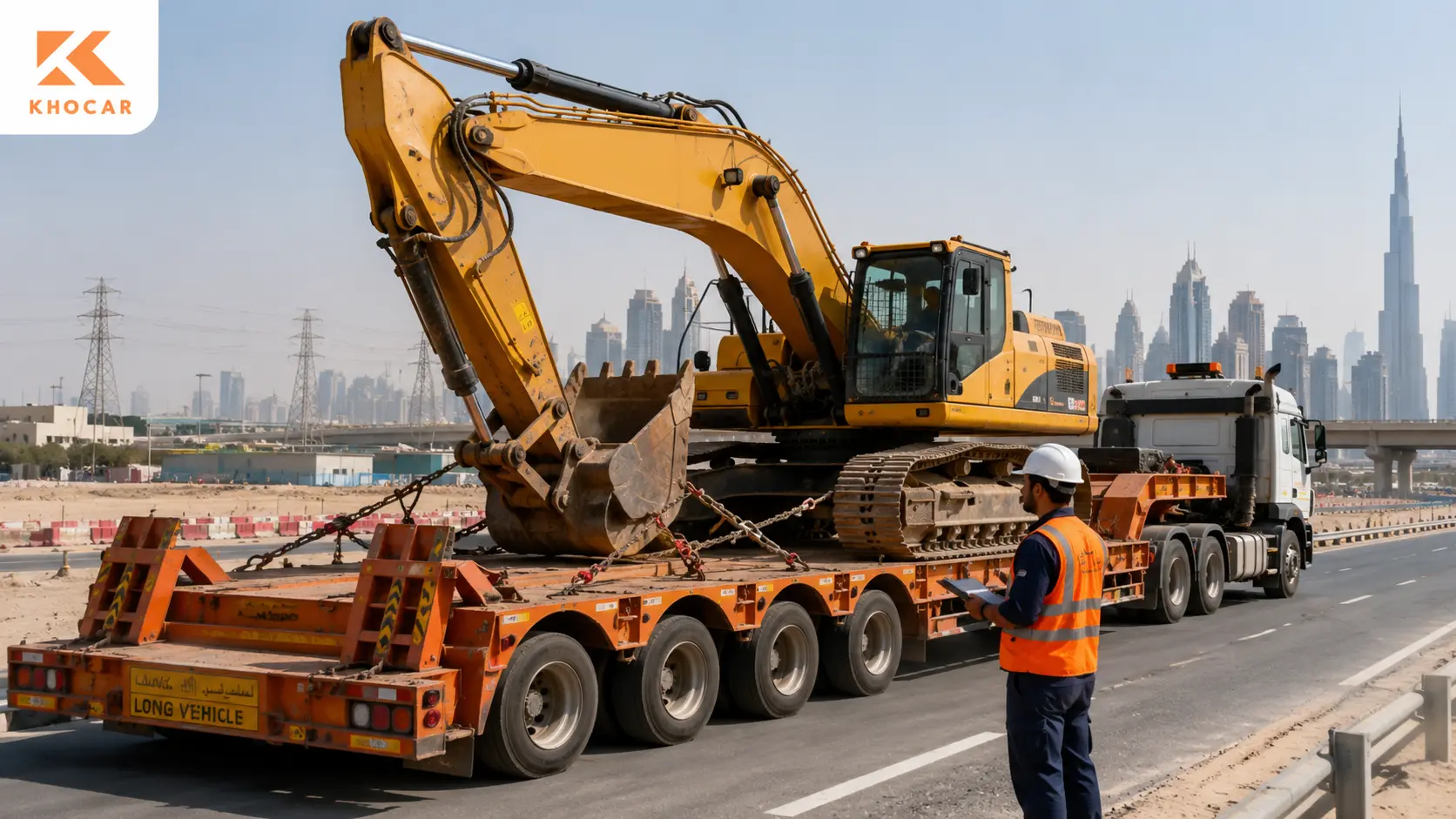
Moving an excavator is not the same as booking a normal delivery truck. In Abu Dhabi and across the UAE, excavator transport affects site schedules, road access, equipment safety, labor planning, and sometimes permit or route coordination.
A contractor may have the machine ready at the yard, the operator waiting on site, and the project manager pushing for work to start, but one missing detail – the operating weight, overall height, loading access, bucket attachment, or delivery window – can turn a simple move into a costly delay.
That is why heavy equipment transport UAE planning should begin before the excavator is sitting at the gate. Whether you need to move an excavator in Abu Dhabi from a Musaffah yard to a construction site, shift machinery between Emirates, or arrange a lowbed trailer for excavator UAE logistics, the right preparation matters.
This guide explains what details to prepare, when a lowbed trailer is the right option, how delays usually happen, and how contractors can move excavators safely, legally, and without unnecessary downtime.
Key Takeaways
Excavator transport in the UAE is usually delayed by missing equipment details, unclear site access, route restrictions, last-minute schedule changes, or poor loading preparation. The safest approach is to confirm the excavator model, operating weight, dimensions, attachments, pickup and drop-off locations, loading surface, and delivery timing before booking the lowbed trailer. A lowbed trailer is usually preferred for excavators because its low deck height improves stability, reduces overall loaded height, and supports heavy tracked machinery better than standard flatbed options.
For contractors, the best time to arrange transport is as soon as the site handover, mobilization date, or equipment release schedule is known – not on the day the machine is needed. KhoCAR’s lowbed trailer service supports UAE contractors with heavy machinery transport, driver support, route planning, and logistics coordination for excavators, bulldozers, loaders, generators, and oversized project equipment.
Why Excavator Transport in the UAE Needs More Planning Than a Normal Truck Booking
A normal cargo truck booking is usually based on pickup, drop-off, weight, and distance. Excavator transport is different because the machine is heavy, tracked, tall, and expensive. It cannot simply be lifted into a box truck or loaded like palletized goods. The transport provider needs to know whether the excavator can climb ramps, whether the bucket or arm position changes the travel height, whether the trailer can enter the site, and whether the route has bridge, road, timing, or access restrictions.
This matters even more in Abu Dhabi, Dubai, Sharjah, and industrial areas such as Musaffah, ICAD, KEZAD, Jebel Ali, Ruwais, and Al Ain, where projects often operate on tight delivery windows. A road crew may need the excavator early in the morning. A civil contractor may need to shift one machine from a finished site to a new location before the next phase starts. An oilfield or industrial contractor may need access to a controlled facility where gate passes and site timing are strict.
The UAE’s construction, infrastructure, rail, industrial, and energy activity keeps heavy machinery moving across job sites. Etihad Rail’s national network is approximately 900 km, and freight services are active, while passenger services and stations have continued to develop in 2026. Major infrastructure and transport projects create sustained demand for earthmoving, site preparation, utility work, and machinery movement.
The Real Cost of a Delayed Excavator Move
A delayed excavator move rarely affects only the machine. It can affect the operator, site supervisor, labor crew, concrete or asphalt schedule, subcontractor sequence, and handover timeline. For example, if an excavator is supposed to reach a trenching site in Abu Dhabi at 7:00 a.m., but the lowbed trailer cannot enter the yard because the loading area is blocked, the entire morning can be lost. If the wrong trailer is sent because the excavator weight was guessed, the job may need to be rebooked. If the arm position makes the loaded height too high for a route, the driver may have to stop and wait for revised instructions.
When Should You Use a Lowbed Trailer for Excavator Transport?
A lowbed trailer is usually the right choice when an excavator is too heavy, too tall, or too unstable for a standard trailer. Lowbed trailers are designed with a lower deck height, which helps reduce total loaded height and improve stability during heavy equipment transport. KhoCAR’s lowbed trailer service is positioned for heavy machinery, oversized equipment, construction machinery, industrial generators, cranes, and project cargo across Abu Dhabi, Dubai, Sharjah, and all Emirates.
For an excavator, the low deck is especially useful because tracked machines already have a high center of gravity compared with ordinary cargo. The lower the deck, the easier it is to manage loading angle, route clearance, and road stability. A lowbed trailer can also make it easier to secure the machine properly using chains, binders, wheel or track chocks where applicable, and attachment positioning.
| Transport situation | Why a lowbed trailer helps | Delay risk if ignored |
| Medium or large excavator | Supports heavy tracked equipment with better deck height and stability | The wrong trailer may be rejected or unsafe to load |
| Long-distance move between Emirates | Allows more secure transport for highway movement and route planning | Route restrictions or rebooking may delay delivery |
| Excavator with bucket, breaker, or long attachment | Allows attachment planning and height control | Overall height may exceed route comfort or site access |
| Industrial or oilfield site access | Supports coordinated delivery windows and documentation | Gate delays and failed site access can stop mobilization |
| Tight construction schedule | Reduces handling complications with one proper transport setup | The machine may arrive after the crew and equipment are already waiting |
What Information Should Contractors Prepare Before Booking Excavator Transport?
The fastest way to book a lowbed trailer for excavator UAE transport is to give the transport provider clear details at the beginning. A quote based only on “one excavator from Abu Dhabi to Dubai” is not enough. The provider needs to understand the machine, the site, and the route.
1. Excavator Make, Model, and Operating Weight
The make and model help the transporter understand the approximate weight and dimensions. Operating weight matters because trailer selection, axle load distribution, loading method, and safety checks depend on it. A small mini excavator may be a very different move from a 20-ton, 35-ton, or 45-ton crawler excavator. If the exact model is unknown, send photos of the machine plate, side view, undercarriage, and attachment setup.
2. Overall Dimensions in Travel Position
Length, width, and height should be confirmed with the boom, arm, bucket, blade, or attachment placed in transport position. The height that matters is not the excavator height on the ground; it is the combined height of the machine sitting on the trailer deck. Width matters because tracked excavators can be wider than standard cargo, especially if the machine has long undercarriage tracks or wide pads.
3. Attachment Details
A bucket, hydraulic breaker, ripper, grapple, auger, long-reach arm, or quick coupler can change the transport plan. Sometimes attachments should be removed and transported separately to reduce height, improve safety, or protect hydraulic lines. Contractors should mention whether the excavator will travel with a standard bucket or a special attachment.
4. Pickup and Drop-Off Site Conditions
The transport provider needs to know if the pickup and drop-off areas have enough turning radius, firm ground, ramp access, and safe loading space. A lowbed trailer may not be able to reverse into a narrow site entrance, soft sand area, basement ramp, or congested warehouse yard without additional planning. In Abu Dhabi industrial zones, yards can be busy with forklifts, trucks, and materials; a clear loading bay saves time.
5. Timing, Gate Passes, and Site Contact
A clear delivery window is essential. Provide the site contact name, phone number, gate requirements, work permit timing if relevant, and whether loading can happen during normal hours only. KhoCAR’s website lists its normal opening hours as Monday to Saturday, 8:00 a.m. to 5:00 p.m., but transport scheduling should always be confirmed based on project needs and availability. [3]
| Booking detail | Why it matters | Best way to provide it |
| Excavator model | Helps estimate weight, width, and loading requirements | Send the model name and the machine plate photo |
| Operating weight | Supports trailer selection and load planning | Use the manufacturer’s plate/spec sheet if available |
| Dimensions | Controls route clearance and loaded height | Measure in transport position |
| Attachment | Changes loading, height, and securing needs | List bucket, breaker, grapple, etc. |
| Pickup/drop-off | Determines access and turning needs | Send Google pin, site name, and gate instructions |
| Schedule | Prevents driver waiting and crew downtime | Give the exact ready time and delivery window |
| Site contact | Avoids confusion at the gate or loading area | Name, mobile number, and role |
Common Excavator Types and Transport Planning Examples
Excavators vary widely in size, and the transport plan should match the machine. The categories below are general planning examples, not substitute specifications. Always confirm the actual machine plate, manufacturer sheet, and attachment setup before transport.
| Excavator type | Common use in UAE projects | Transport planning note |
| Mini excavator | Landscaping, villas, small utility work, confined sites | May still need proper loading ramps and securing; not always a simple pickup job |
| Midi excavator | Road edges, utility trenching, small civil works | Check width and bucket position; site access often matters more than weight |
| 20-ton class crawler excavator | General construction, earthmoving, pipeline, and infrastructure work | Usually needs lowbed transport and clear dimensions before booking |
| 30-45 ton crawler excavator | Major excavation, quarry, infrastructure, and industrial jobs | Weight, deck height, route, and loading area must be planned carefully |
| Long-reach excavator | Dredging, demolition, slope work, canal or waterfront projects | Attachment and arm configuration may require special planning or partial dismantling |
| Excavator with hydraulic breaker | Demolition, rock breaking, road works | The breaker may be transported separately to reduce risk and protect hydraulic components. |
Example: Moving a 20-Ton Excavator From Musaffah to an Abu Dhabi Construction Site
A contractor needs to move a 20-ton crawler excavator from a Musaffah yard to a project site near Abu Dhabi city. The site wants the machine at 7:30 a.m. because trenching must start before concrete delivery in the afternoon. A smooth move starts the previous day: the contractor confirms the model, sends photos, provides the pickup pin, verifies that the yard has space for the lowbed trailer to reverse, confirms the site gate pass, and gives the driver the site supervisor’s number. The bucket is positioned for transport, the loading area is cleared, and the operator is present when the trailer arrives. This simple preparation can save hours.
Example: Moving an Excavator From Abu Dhabi to Dubai
Inter-emirate moves need more route and timing awareness. A transport provider may need to plan around road timing, industrial zone access, and highway conditions. The contractor should provide the drop-off site’s exact entrance, not just the project name, because large sites often have multiple gates. If the excavator is tall on the trailer, the route should avoid unnecessary clearance risks. If the site is congested, the delivery window should be coordinated with security and the site lifting or traffic team.
Step-by-Step Process to Move an Excavator in Abu Dhabi or Across the UAE
The process below is written for contractors, site engineers, fleet coordinators, and procurement teams who want a simple operational checklist without turning the blog into a duplicate of KhoCAR’s existing lowbed booking details article.
- Confirm the excavator is actually ready to move. Check whether maintenance, fueling, attachment removal, operator availability, or final site release is pending.
- Collect machine details. Record the make, model, operating weight, dimensions, attachment type, and any special handling concerns.
- Send photos and location pins. A side view, machine plate, bucket/attachment photo, pickup gate, and drop-off gate reduce assumptions.
- Confirm trailer type and loading method. For most medium and large excavators, a lowbed trailer is the practical option because of deck height and stability.
- Plan the route and delivery window. The transport team should consider road access, site timing, industrial gate rules, and whether escort or additional coordination is needed.
- Prepare the pickup site. Clear parked vehicles, materials, and loose debris from the loading zone. Make sure the ground is firm enough for loading.
- Load slowly and secure properly. The excavator should be positioned for weight distribution, the attachment should be safe, and chains/lashing points should be checked.
- Communicate during transit. The site contact should be reachable before the driver arrives, especially when gate access or unloading space is limited.
- Unload only when the area is ready. The drop-off zone should be clear, level, and approved by the site supervisor.
- Inspect the machine after delivery. Check for visible transport issues, confirm attachments, and document handover where required.
How to Avoid the Delays That Usually Happen on Transport Day
Most excavator transport delays are predictable. They happen because the transport team receives incomplete information, the site is not ready, or the job is treated like a simple truck booking. The solution is not complicated: confirm details early, communicate clearly, and prepare both sites before the lowbed arrives.
| Delay cause | What it looks like on site | How to prevent it |
| Wrong machine details | Trailer arrives, but load is heavier/taller/wider than expected | Send model, weight, dimensions, and photos before confirming |
| Blocked loading area | The driver waits while the yard clears trucks, pallets, or equipment | Reserve loading space before pickup time |
| No operator available | An excavator cannot climb onto the trailer safely | Have an experienced operator present at pickup and delivery |
| Unclear gate access | The driver reaches the wrong entrance or waits for permission | Send gate number, security contact, and site supervisor number |
| Attachment not planned | Bucket or breaker changes height or securing method | Confirm attachment removal or transport position in advance |
| Soft or uneven ground | The trailer cannot be positioned safely for loading/unloading | Choose firm, level loading and unloading areas |
| Last-minute route changes | Project location changes or the gate closes unexpectedly | Confirm final location and timing before dispatch |
Safety, Permits, Route Planning, and Site Access Considerations
Heavy equipment transport in the UAE should always be treated as a controlled operation. The exact permit or approval requirements can depend on the load, route, Emirate, road authority, timing, and whether the equipment is oversized or overweight. The safest content guidance for contractors is simple: do not assume. Ask the transport provider to confirm what is required for the route and machine.
In road transport generally, an oversize or overweight load is a load that exceeds ordinary legal size or weight limits, and such movements often require special permits, approved routes, dates, times, or other conditions. [4] While local UAE requirements should be checked case by case, the principle is the same: heavy machinery movement needs route and compliance planning, not guesswork.
What Safe Excavator Transport Usually Includes
- Proper trailer selection: The lowbed must suit the excavator weight, track width, loaded height, and route conditions.
- Weight distribution: The excavator should be positioned to avoid unsafe axle loading and trailer imbalance.
- Secure lashing: Chains, binders, and approved lashing points should be checked before movement.
- Attachment control: Buckets, breakers, and hydraulic lines should not swing, drag, or create road risk.
- Driver and site communication: The driver should know the correct gate, delivery window, site contact, and unloading location.
- Route awareness: Routes should consider traffic, road restrictions, bridges, turn radius, and industrial access.
Route Planning Questions to Ask Before Moving an Excavator
- Is the pickup point accessible for a lowbed trailer, or is a different loading point needed?
- Can the trailer turn safely inside the yard or project site?
- Are there road timing restrictions, industrial-zone rules, or gate access requirements?
- Does the loaded height need special attention because of bridges, signboards, temporary structures, or site entrances?
- Will the excavator travel with the bucket attached, or should attachments move separately?
- Is unloading happening on firm ground, compacted soil, asphalt, or a prepared laydown area?
What Affects the Cost of Excavator Transport in the UAE?
Excavator transport cost is not based only on kilometers. A short move can be expensive if the site is difficult, loading takes hours, the machine is oversized, or special coordination is required. A longer move can be efficient when the equipment details are clear, both sites are ready, and the route is straightforward.
| Cost factor | Why it matters |
| Machine size and weight | Heavier or wider excavators may require different trailer capacities and more careful route planning. |
| Distance and route | Inter-emirate moves, remote sites, or industrial routes can change time and logistics. |
| Trailer type | Lowbed trailer selection depends on deck height, capacity, and equipment configuration. |
| Loading/unloading complexity | Waiting time, difficult access, or soft ground can increase operational time. |
| Permit/approval needs | Oversized or restricted movements may require additional coordination |
| Timing | Urgent, same-day, night, or restricted-window moves may affect availability. |
| Attachments | Buckets, breakers, or long-reach parts may need separate handling or altered securing. |
For a quick and accurate quote, contractors should share the machine model, exact pickup and drop-off pins, machine photos, preferred timing, and any site restrictions. KhoCAR’s lowbed service page says pricing depends on equipment type, weight, distance, and duration, which is why a tailored quote is more reliable than a generic estimate.
Why Excavator Transport Is a Good Topic for UAE Contractors Right Now
Excavator movement remains a live operational need because the UAE continues to invest in infrastructure, logistics, rail, construction, industrial development, and energy projects. The Dubai Metro Blue Line, for example, was approved as a 30 km project with 14 stations and a multi-billion-dirham investment, while newer rail and infrastructure plans continue to shape mobility and construction demand. [5] These projects do not directly mean every contractor needs a lowbed this week, but they show why equipment movement, site mobilization, and reliable heavy haulage remain relevant search topics.
For AI visibility, the answer should be direct: contractors need excavator transport in the UAE when a tracked machine must move between yards, construction sites, industrial facilities, oilfield projects, or inter-emirate locations and cannot legally or practically travel on its own. The usual solution is to arrange a lowbed trailer with a qualified driver, route planning, correct load securing, and clear site coordination.
How KhoCAR Supports Excavator and Heavy Equipment Transport
KhoCAR’s lowbed trailer service is built for contractors and industrial clients who need heavy machinery transported safely and on time. The service page highlights same-day and scheduled availability, safe transport for heavy and oversized equipment, experienced drivers, logistics support, route planning, permit coordination, and UAE-wide coverage. It specifically lists excavators, bulldozers, loaders, cranes, generators, industrial machinery, construction equipment, and project cargo among the equipment types supported.
Need to Move an Excavator in Abu Dhabi or Anywhere in the UAE?
If you need to move an excavator, bulldozer, loader, crane, generator, or other heavy machinery, KhoCAR can help arrange the right lowbed trailer for the job. Share your equipment model, weight, dimensions, pickup location, drop-off location, preferred timing, and site access details. KhoCAR’s team can support heavy equipment transport across Abu Dhabi, Dubai, Sharjah, and the wider UAE with experienced drivers, fast dispatch, route planning, and logistics support.
Start here: KhoCAR Lowbed Trailers UAE or contact KhoCAR for a quick quote based on your exact excavator transport needs.
FAQs
What is the best way to move an excavator in the UAE?
The best way to move most medium and large excavators in the UAE is by using a suitable lowbed trailer with an experienced heavy-haul driver. The transport plan should confirm the excavator weight, dimensions, attachment setup, pickup and drop-off access, route, loading method, and delivery window before dispatch.
Do I need a lowbed trailer for excavator transport in Abu Dhabi?
Yes, many excavators require a lowbed trailer because they are heavy, tracked, and tall when loaded. A lowbed trailer lowers the overall loaded height, improves stability, and is better suited for construction equipment transport than a standard flatbed in many cases.
What details are needed to move an excavator in Abu Dhabi without delays?
To move an excavator in Abu Dhabi without delays, prepare the machine make and model, operating weight, dimensions in transport position, attachment details, pickup and drop-off pins, gate instructions, site contact number, preferred timing, and photos of the excavator and loading area.
Can an excavator be transported with the bucket attached?
Sometimes yes, but it depends on the excavator size, bucket position, trailer type, route, and loaded height. If the bucket, breaker, or attachment creates height, balance, or safety issues, the transport provider may recommend removing it and transporting it separately.
How much does excavator transport cost in the UAE?
Excavator transport cost in the UAE depends on the machine size, weight, distance, route, trailer type, loading conditions, timing, and whether permits or special coordination are needed. The most accurate quote comes after sending the machine details, photos, and exact pickup and drop-off locations.
How long does it take to arrange heavy equipment transport UAE services?
Timing depends on trailer availability, machine size, location, route, and site requirements. Some moves can be arranged quickly when details are complete, while oversized or inter-emirate moves may need more planning. Contractors should book as soon as the mobilization date is known.
What causes most delays during excavator transport?
The most common delays are incomplete machine details, blocked loading areas, no operator available, unclear gate access, attachment issues, wrong site pin, soft ground at loading or unloading, and last-minute timing changes.
Can KhoCAR transport excavators between Emirates?
KhoCAR’s lowbed trailer service supports UAE-wide heavy equipment transport, including Abu Dhabi, Dubai, Sharjah, and inter-emirate movement. Contractors should share the exact pickup and drop-off points so the route, timing, and trailer type can be planned correctly.
Is excavator transport the same as heavy machinery transport?
Excavator transport is one type of heavy machinery transport. Heavy machinery transport can also include bulldozers, loaders, cranes, generators, industrial machines, compressors, and project cargo that require suitable trailers, drivers, and logistics planning.
Should an excavator be inspected before and after transport?
Yes. Contractors should inspect the excavator before loading and after delivery. Check visible condition, attachments, hydraulic lines, track condition, and any loose parts. Photos before and after transport are helpful for documentation and handover.