
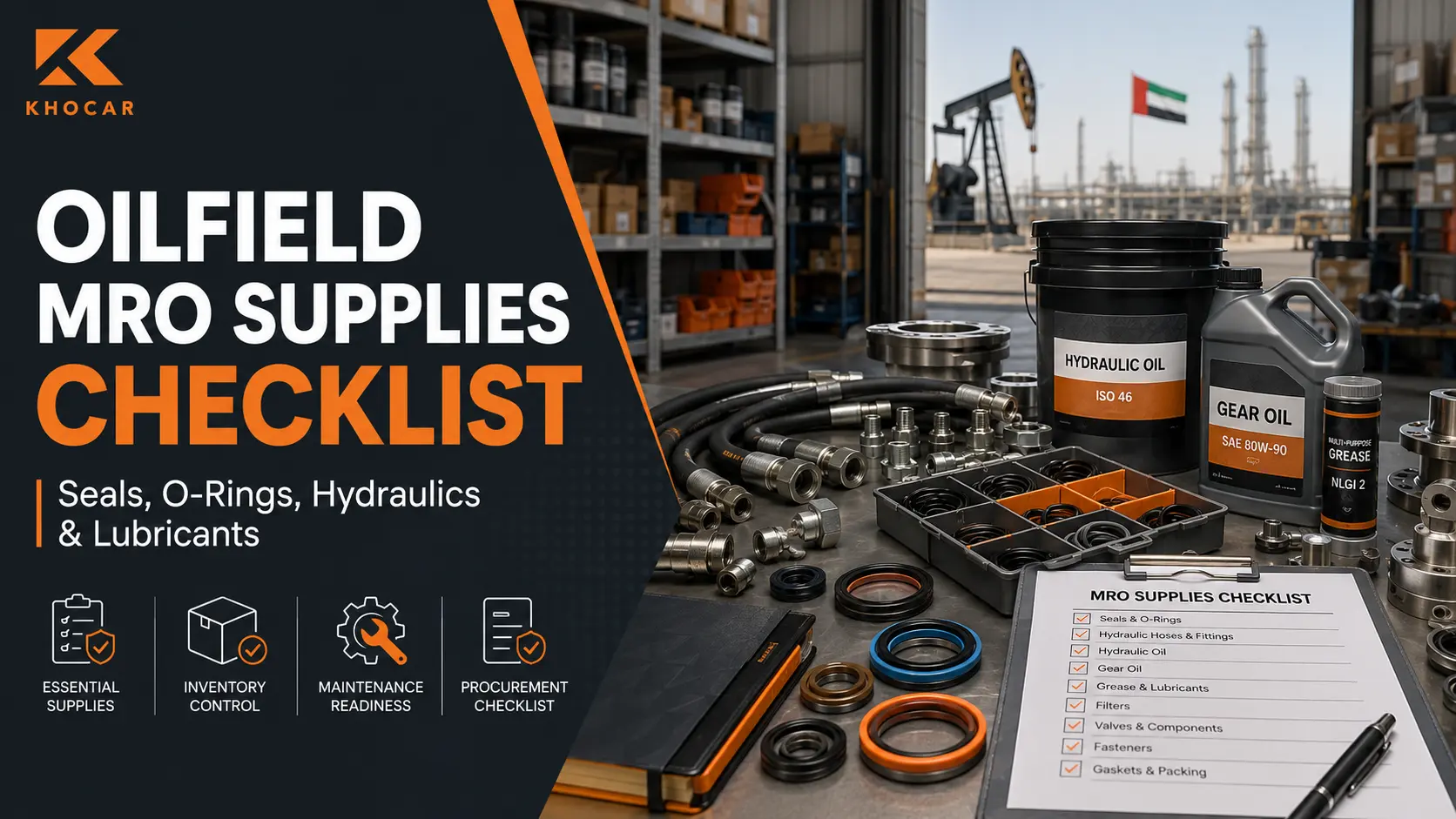
When a pump, logging unit, hydraulic system, pressure-control accessory, or workshop machine stops at the wrong time, the issue is rarely just the broken part. The real problem is delay: confirming the specification, finding compatible oilfield MRO supplies in Abu Dhabi, arranging delivery, and proving that the supplied item is suitable for site use. For maintenance teams, procurement officers, and oilfield contractors, that delay can turn a small repair into a missed shift, a postponed mobilization, or a more expensive emergency order.
This guide gives you a practical checklist for oilfield spare parts in Abu Dhabi, including seals, O-rings, hydraulic components, lubricants, greases, industrial consumables, and the documents to keep ready before planned maintenance or urgent repair work.
It is written for the real workflow in the UAE: harsh heat, dusty yards, remote site requirements, strict documentation expectations, and fast-moving project schedules. Use it before sending a purchase request, building a shutdown kit, or asking a supplier to source critical industrial supplies in the UAE.
Key Takeaways
Oilfield MRO supplies in Abu Dhabi should be prepared around the equipment, application, operating conditions, and documentation requirements – not just the item name on a purchase request. The same O-ring, seal, hose, lubricant, or fitting can perform very differently depending on pressure, temperature, fluid compatibility, size tolerance, material grade, and whether it is used in a workshop, yard, rig, vehicle, or live-field support environment.
The most useful checklist groups parts into categories: sealing items, hydraulic components, lubricants and greases, pressure-related accessories, general consumables, fasteners, fittings, tools, PPE, and documents. This structure helps procurement teams reduce wrong orders, maintenance teams reduce downtime, and suppliers confirm the correct product faster.
Documentation is part of the supply, not an afterthought. Certificates of conformity, material traceability, datasheets, safety data sheets, calibration records, inspection reports, delivery notes, and product batch details can be essential for audits, site entry, internal quality control, and operator approval. If the paperwork is missing, the part may arrive physically but still be unusable for the job.
Why Oilfield MRO Supplies Matter in Abu Dhabi Right Now
Abu Dhabi is not a slow-moving maintenance environment. Oilfield contractors, service companies, workshops, and industrial yards often work around tight mobilization schedules, hot weather, dust exposure, remote delivery locations, and strict client expectations. In this setting, maintenance, repair, and operations supplies are not minor background items. They are the parts that keep equipment available.
The timing is also important. ADNOC announced AED 200 billion, or about USD 55 billion, in planned project awards for 2026 to 2028, with a focus on large-scale project execution, local manufacturing, supply chain resilience, and In-Country Value. That type of activity increases the need for dependable local supply chains, especially for maintenance parts, industrial consumables, and critical spare parts used across upstream and downstream work.
For a buyer or maintenance planner, the practical lesson is simple: waiting until a component fails is expensive. The better approach is to maintain a ready list of oilfield industrial supplies in the UAE that are commonly needed for routine servicing, emergency repairs, workshop support, and shutdown work. A checklist helps the team move from reactive buying to controlled procurement.
Source: ADNOC press release
What Does MRO Mean in Oilfield Procurement?
MRO stands for maintenance, repair, and operations. In oilfield procurement, it covers the parts, tools, consumables, lubricants, fluids, accessories, and documents needed to keep equipment working safely and reliably. MRO is different from buying a major asset. You may not be purchasing a new wireline unit, hydraulic power pack, pump, or pressure-control system. Instead, you are buying the parts that help those assets remain usable.
The International Association of Drilling Contractors lexicon includes maintenance definitions from API and other global standards. One useful definition describes maintenance as actions taken to minimize equipment failure and unscheduled interruptions. Another describes maintenance activities as inspection, adjustment, cleaning, lubrication, testing, and replacement of expendable parts. That is exactly why spare parts planning matters: the right supply at the right time supports preventive maintenance before downtime becomes unavoidable.
For Abu Dhabi teams, MRO can include daily workshop items, site support parts, breakdown spares, shutdown consumables, inspection tools, and documentation packs. The best MRO checklist connects engineering needs with procurement data so that the buyer does not have to guess based on a vague item name.
Source: IADC Lexicon – Maintenance
Oilfield MRO Supplies Checklist: The Main Categories to Keep Ready
A practical oilfield spare parts checklist should not be a random list of product names. It should be organized by maintenance need and documentation risk. The table below gives a fast view of the categories most Abu Dhabi buyers should keep ready or at least pre-qualified with a dependable supplier.
| MRO Category | Examples to Prepare | Why It Matters |
| Seals and O-rings | NBR, Viton/FKM, EPDM, PTFE seals, backup rings, gasket kits, hydraulic seals, oil seals | Wrong material or size can create leaks, downtime, and repeat failure. |
| Hydraulic parts | Hoses, fittings, adaptors, couplings, cylinders, pumps, valves, filters, gauges | Hydraulic issues can stop equipment immediately and may require exact pressure and connection compatibility. |
| Lubricants and greases | Engine oil, hydraulic oil, gear oil, compressor oil, high-temperature grease, EP grease, anti-seize | Correct lubrication protects equipment from heat, dust, load, and long operating cycles. |
| Pressure and flow accessories | Valves, fittings, flanges, gauges, hoses, pressure-control accessories, test fittings | Pressure-related items need proper ratings, material checks, and supporting documents. |
| Industrial consumables | Fasteners, clamps, cleaning materials, absorbents, tapes, welding consumables, PPE, tools | Small consumables often delay maintenance because teams assume they are already available. |
| Documents | Datasheets, certificates, SDS, inspection reports, batch traceability, delivery notes | Missing paperwork can block use of a product even if the part itself is physically correct. |
1. Seals and O-Rings: What to Check Before You Order
Seals and O-rings are small parts with large consequences. A wrong O-ring may fit visually but fail under heat, pressure, or fluid exposure. In oilfield work, that can mean a hydraulic leak, pressure loss, contamination, equipment shutdown, or safety concern. This is why buyers should avoid ordering only by color, appearance, or rough measurement.
Before asking for oilfield seals or O-rings in the UAE, collect as many technical details as possible. A supplier can help, but they cannot confirm compatibility from an incomplete description. The most useful information includes size, material, hardness, operating temperature, pressure rating, fluid exposure, application type, and whether the part is static or dynamic.
Seals and O-Rings Checklist
- Exact size: inside diameter, outside diameter, cross-section, width, or original part number.
- Material requirement: NBR, FKM/Viton, EPDM, PTFE, polyurethane, silicone, or other specified material.
- Hardness rating, if known, such as Shore A value for elastomer components.
- Fluid compatibility: hydraulic oil, diesel, gas, chemicals, drilling fluids, brine, water, or high-temperature fluids.
- Application: static seal, dynamic seal, hydraulic cylinder seal, pump seal, valve seal, gasket, backup ring, or oil seal.
- Operating conditions: temperature, pressure, vibration, dust exposure, and whether the part is used outdoors, in a workshop, or on-site.
- Documentation: certificate of conformity, datasheet, material traceability, batch number, or manufacturer reference where required.
Example: A workshop may request a simple O-ring for a hydraulic fitting. If the buyer only sends a photo, the supplier may provide a similar-looking size. But if the system uses high-temperature hydraulic oil and the original material was FKM, a standard low-cost rubber O-ring may swell, crack, or leak quickly. The better purchase request says: O-ring for hydraulic fitting, FKM material preferred, size confirmed by caliper, used with hydraulic oil, temperature exposure expected, certificate required if available.
2. Hydraulic Components: Hoses, Fittings, Cylinders, Valves, and Filters
Hydraulic systems are common across oilfield vehicles, wireline units, lifting equipment, workshop machinery, pressure-control support equipment, and heavy industrial assets. A hydraulic failure can stop a job immediately, and the wrong replacement component can create a repeat leak or even a safety hazard.
When ordering hydraulic spare parts in Abu Dhabi, the buyer should provide more than the phrase “hydraulic hose” or “hydraulic fitting.” Pressure rating, hose length, end connections, thread type, bend radius, media, working temperature, and safety factor all matter. For cylinders, seal kits, pumps, gauges, and valves, the model number or original manufacturer details can save hours of back-and-forth.
Hydraulic MRO Checklist
- Hoses: length, internal diameter, pressure rating, end fittings, orientation, cover type, and abrasion resistance.
- Fittings and adaptors: thread type, size, material, pressure class, sealing method, and connection standard.
- Cylinders: bore size, rod diameter, stroke length, mounting style, seal kit details, and operating pressure.
- Pumps and motors: model number, flow rate, pressure rating, shaft type, rotation direction, and mounting details.
- Valves: function, port size, pressure rating, flow capacity, manual or hydraulic actuation, and compatibility with the system.
- Filters: micron rating, model number, flow requirement, bypass setting, and whether it is suction, pressure, or return-line filtration.
- Documents: datasheet, pressure test record when applicable, certificate, and any inspection or calibration document for gauges and pressure-related items.
Example: A maintenance team replacing a damaged hydraulic hose on a piece of equipment in Musaffah may be tempted to match the hose length and fitting ends only. But if the pressure rating is too low or the bend radius is wrong, the new hose may fail faster than the old one. A good MRO request includes a photo, dimensions, pressure rating, machine model, location of use, fluid type, and whether the hose needs heat or abrasion protection.
3. Lubricants, Greases, and Fluids: Match the Product to the Environment
Lubrication is one of the simplest ways to extend equipment life, but it is also one of the easiest areas to get wrong. Abu Dhabi conditions place extra stress on equipment: high ambient temperatures, dust, long idling time, heavy loads, and stop-start usage in yards or field support environments. The correct lubricant is not just “oil” or “grease.” It is a product matched to load, temperature, viscosity, manufacturer recommendation, service interval, and contamination risk.
For oilfield industrial supplies in the UAE, buyers should keep commonly used lubricants and greases ready but avoid mixing incompatible products. If a grease type changes, the old grease may need to be cleaned out before applying the new one. If oil viscosity is wrong, performance and protection can suffer.
Lubricants and Greases Checklist
- Hydraulic oil: viscosity grade, anti-wear performance, OEM recommendation, operating temperature, and cleanliness requirement.
- Gear oil: viscosity, EP additives, load rating, and compatibility with gearboxes or differentials.
- Engine oil: engine type, API/ACEA grade, viscosity, duty cycle, and service interval.
- Compressor oil: compressor model, operating temperature, oil type, and OEM recommendation.
- Greases: NLGI grade, base oil viscosity, thickener type, dropping point, water resistance, and high-temperature suitability.
- Specialty products: anti-seize, thread compound, rust preventive, chain lubricant, contact cleaner, and cleaning solvents.
- Documents: product datasheet, safety data sheet, batch number, shelf-life details, and storage instructions.
Practical tip: Keep a simple lubrication matrix for each key asset. List the machine, lubrication point, product name, viscosity or NLGI grade, interval, quantity, and last service date. This reduces confusion when multiple crews work on the same fleet or equipment group.
4. Pressure-Control Accessories, Valves, Fittings, and Consumables
Many oilfield MRO requests involve pressure-related items: valves, gauges, fittings, flanges, hoses, test caps, adapters, quick connections, pressure-control accessories, and support hardware. These items should be treated with extra care because incorrect pressure rating or material selection can create serious operational and safety risks.
The key is to separate ordinary consumables from pressure-critical items. A rag, clamp, tape, or cleaning material may need basic quality control. A pressure fitting, gauge, valve, or hose used near high-pressure equipment may need a verified pressure rating, traceability, test documentation, and correct installation compatibility.
| Item Type | Information to Confirm | Documents to Ask For |
| Pressure gauges | Range, accuracy, connection size, fluid compatibility, calibration requirement | Calibration certificate, datasheet, certificate of conformity |
| Valves | Valve type, size, pressure class, body material, seal material, end connection, service medium | Datasheet, test certificate if applicable, material certificate if required |
| Fittings and adaptors | Thread type, pressure class, material, sealing method, connection standard | Certificate of conformity, material traceability if required |
| Hoses | Pressure rating, length, ID, end fittings, media, temperature, bend radius | Pressure test record, if required, datasheet, certificate |
| General consumables | Size, grade, material, brand preference, usage location | Datasheet or delivery note, depending on the site requirement |
5. Documents to Keep Ready Before Ordering Oilfield Spare Parts
In Abu Dhabi oilfield work, documents can be just as important as the physical item. A part may be technically correct, but if the crew cannot provide a certificate, datasheet, inspection report, calibration record, or SDS when asked, the item may be delayed, rejected, or held for clarification.
Documentation needs vary by product category, client, site, and application. A non-critical workshop consumable may need only a delivery note and invoice. A pressure-rated component, electrical component, hazardous-area item, or safety-related product may require a stronger documentation pack.
| Document | When It Is Useful | Why It Helps |
| Certificate of Conformity (COC) | For specified products, pressure items, safety items, and client-controlled supplies | Shows the item conforms to the relevant specification or order requirement. |
| Material certificate / MTC | For metal components, fittings, flanges, valves, and pressure-related items | Supports traceability and material grade verification. |
| Product datasheet | For lubricants, greases, seals, hoses, filters, and technical components | Confirms performance data, compatibility, and technical limits. |
| Safety Data Sheet (SDS) | For oils, greases, chemicals, cleaners, solvents, and hazardous materials | Supports safe handling, storage, transport, and emergency response. |
| Calibration certificate | For gauges, meters, detectors, and measuring instruments | Shows the instrument is within the required calibration status. |
| Inspection or test report | For pressure-tested hoses, critical tools, lifting-related items, and fabricated components | Provides evidence of testing or inspection before use. |
| Batch number and delivery note | For repeat orders, warranty issues, and traceability | Helps match the delivered item to the order and supplier record. |
6. How to Build a Planned Maintenance MRO Kit
A planned maintenance kit is a pre-prepared set of parts and consumables for a known job. Instead of buying items one by one, the team prepares the full package before work begins. This is useful for wireline unit servicing, hydraulic system maintenance, pump maintenance, vehicle-mounted equipment, workshop machinery, compressors, and heavy equipment working in oilfield support.
The purpose is not to overstock. The purpose is to reduce delays. A good maintenance kit includes the expected replacement parts, the consumables needed to perform the work, and the documents needed to close the job cleanly.
Planned Maintenance Kit Checklist
- Asset name, equipment ID, serial number, and location.
- Maintenance task: inspection, service, filter change, hydraulic repair, seal replacement, lubrication, or corrective repair.
- Parts list with quantities, sizes, part numbers, and alternatives approved by the engineer or supervisor.
- Consumables: grease, oil, cleaning materials, thread sealant, fasteners, rags, absorbents, tags, and protective covers.
- Tools and support items: gauges, torque tools, lifting support, hose protection, test fittings, or calibration items.
- Documents: work order, datasheets, SDS, certificates, inspection forms, and supplier delivery documents.
- Return plan for unused parts, old parts, and waste materials.
Example: For a hydraulic cylinder service, the kit may include the seal kit, wipers, backup rings, compatible hydraulic oil, cleaning solvent, absorbent pads, correct fittings, inspection checklist, part datasheets, and a record sheet for the technician. Without the kit, the job may pause halfway because a small backup ring or compatible grease was missed.
7. How to Build an Emergency MRO Kit for Breakdowns
Emergency kits are different from planned kits. They are designed for fast response when the exact failure is not fully known. In Abu Dhabi, emergency support may be needed for a workshop, yard, project site, transport route, or oilfield support base. The kit should focus on common failure points and universal consumables while avoiding unsafe improvisation.
An emergency kit is not a license to use the wrong component. It is a way to shorten response time while still confirming compatibility before installation. Any pressure-rated or safety-critical replacement should still be checked against the correct specification.
Emergency MRO Kit Checklist
- Common O-ring and seal assortments organized by material and size.
- Basic hydraulic adaptors, plugs, caps, hose protection, and compatible fittings.
- Emergency hydraulic oil top-up stock is approved for the equipment where possible.
- High-temperature grease, anti-seize, thread sealant, cleaning solvent, absorbent pads, and leak-control consumables.
- Common filters, clamps, fasteners, cable ties, protective sleeving, and workshop consumables.
- Basic gauges or test accessories only if calibrated and approved for the intended use.
- A documentation folder with datasheets, SDS, emergency supplier contacts, and equipment reference details.
8. What to Include in a Good Purchase Request
Many MRO delays begin with a weak purchase request. The buyer sends an item name, the supplier asks for details, the maintenance team searches for photos, and the job loses time. A strong request gives the supplier enough information to confirm the part quickly or recommend the closest correct option.
For oilfield spare parts in Abu Dhabi, the purchase request should be specific, especially when the item is technical, pressure-related, safety-related, or intended for a particular machine.
| Weak Request | Better Request |
| Need an O-ring urgently. | Need FKM O-ring, size 25 x 3 mm, used with hydraulic oil, high-temperature outdoor equipment, 20 pcs, certificate preferred. |
| Hydraulic hose required. | Hydraulic hose, 1/2 inch ID, 2-wire, 3000 psi or as per sample, 1.5 m length, JIC female ends on both sides, used on equipment model X, photo attached. |
| Grease needed. | High-temperature EP grease, NLGI 2, suitable for bearings and heavy equipment in Abu Dhabi heat, datasheet and SDS required. |
| Need valve. | Ball valve, stainless steel, 1 inch, pressure rating required, end connection type specified, service medium noted, COC requested. |
| Send a spare parts quote. | Please quote the attached MRO list with part numbers, quantities, alternatives, lead time, documentation availability, and delivery to Musaffah. |
9. Common Oilfield MRO Ordering Mistakes to Avoid
Oilfield procurement does not fail only because parts are unavailable. Many problems happen because the wrong details were collected, the documentation was not requested early, or an urgent order was treated like a general hardware purchase. These are the mistakes to avoid when sourcing oilfield industrial supplies in the UAE.
- Ordering by photo only when size, material, pressure rating, or model number is required.
- Ignoring fluid compatibility for seals, O-rings, hoses, and lubricants.
- Mixing lubricants or greases without checking compatibility.
- Treating pressure-rated items like ordinary consumables.
- Forgetting SDS documents for chemicals, lubricants, greases, cleaners, and solvents.
- Accepting substitutes without engineering or maintenance approval.
- Not asking for certificates until the product has already arrived.
- Failing to record batch numbers, delivery notes, or supplier references for future repeat orders.
- Keeping too much dead stock while missing the few critical spares that actually stop operations.
- Not reviewing old failure history before building the next spare parts list.
10. How to Prioritize Critical Spare Parts
Not every spare part deserves the same stocking priority. A critical spare can stop operations, create a safety risk, delay mobilization, or take too long to source during a breakdown. A low-cost O-ring can be more critical than an expensive part if it is needed frequently and stops a machine when unavailable.
Use a simple criticality method. Ask three questions: What happens if the part fails? How quickly can we get it? How often do we use it? Parts that score high on downtime impact, long lead time, and repeated usage should be added to the ready list or pre-qualified with a supplier.
| Priority Level | When to Stock or Pre-Qualify | Examples |
| High | Failure stops equipment, affects safety, or has a long lead time | Special seal kits, hydraulic hoses, pressure gauges, filters, critical valves, lubricants for key assets |
| Medium | Failure slows work but can be managed temporarily or sourced locally | Common fittings, fasteners, clamps, general hoses, standard O-rings, common consumables |
| Low | Easy to source, low downtime impact, or rarely used | General cleaning items, non-critical hardware, low-use consumables |
11. Storage and Handling Tips for Abu Dhabi Conditions
The UAE environment can damage parts before they are ever installed. Heat, dust, humidity, poor labeling, direct sunlight, and mixed storage can reduce shelf life or create confusion during urgent maintenance. Good storage is part of good MRO management.
Seals and O-rings should be stored away from sunlight, ozone sources, heat, and contamination. Lubricants and chemicals should be stored according to the SDS and manufacturer guidance. Hydraulic hoses should be protected from abrasion, kinking, and contamination. Documents should be stored digitally and physically where crews can find them quickly.
Simple Storage Rules
- Label every item with part number, size, material, date received, supplier, and equipment reference if known.
- Separate materials that look similar but are not interchangeable, such as NBR and FKM O-rings.
- Keep oils, greases, and chemicals sealed until use and store SDS documents with the product record.
- Protect hydraulic hoses and fittings from dust entry by using caps and plugs.
- Use first-in, first-out rotation for consumables with shelf-life concerns.
- Keep a digital copy of certificates, datasheets, delivery notes, and batch records.
12. How KhoCAR Supports Oilfield Industrial Supplies in the UAE
KhoCAR supports oilfield services and industrial supply needs across the UAE, with a focus on practical, field-ready support. The company lists oilfield supplies, seals and O-rings, lubricants and greases, hydraulic components, pressure-control accessories, industrial consumables, repair support, and customized oilfield supply solutions as part of its oilfield services and industrial supplies focus.
That matters because oilfield MRO procurement is not just about finding a product. It is about confirming the right specification, checking availability, understanding site urgency, supporting documentation, and helping the buyer avoid repeat downtime. KhoCAR is based in Musaffah, Abu Dhabi, which is useful for contractors and maintenance teams that need local coordination and fast communication.
Oilfield MRO Checklist Summary: What to Keep Ready
| Checklist Area | Keep Ready |
| Technical details | Equipment ID, model number, part number, dimensions, photos, old sample, application details |
| Sealing parts | O-rings, hydraulic seals, oil seals, gaskets, backup rings, seal kits, material details |
| Hydraulic parts | Hoses, fittings, adapters, filters, valves, gauges, cylinders, pumps, compatible fluids |
| Lubrication | Hydraulic oil, gear oil, engine oil, compressor oil, grease, anti-seize, SDS, and datasheets |
| Consumables | Fasteners, clamps, cleaning materials, absorbents, thread sealant, tapes, PPE, basic tools |
| Documents | COC, MTC, datasheet, SDS, calibration certificate, test report, batch number, delivery note |
| Supplier details | Contact person, delivery location, lead time, alternatives, warranty, emergency support process |
Need Oilfield MRO Supplies or Spare Parts in Abu Dhabi?
If your team needs oilfield MRO supplies in Abu Dhabi, KhoCAR can help you source and coordinate the items that keep maintenance work moving: seals and O-rings, hydraulic components, lubricants and greases, pressure-control accessories, industrial consumables, and customized oilfield supply support. Instead of sending incomplete requests from one supplier to another, you can work with a local Abu Dhabi partner that understands urgent maintenance, documentation needs, and practical oilfield conditions.
Use this checklist before your next planned service, shutdown, workshop repair, or emergency order. Then share the parts list, equipment details, photos, and document requirements with KhoCAR so the team can help confirm availability and next steps.
Start here: Explore KhoCAR Oilfield Services & Industrial Supplies in the UAE or contact KhoCAR in Abu Dhabi.
FAQs
What are oilfield MRO supplies?
Oilfield MRO supplies are the maintenance, repair, and operations items used to keep oilfield equipment, vehicles, tools, and workshop systems working. They can include seals, O-rings, hydraulic hoses, fittings, lubricants, greases, filters, valves, gauges, industrial consumables, and the documents needed for safe use and audit readiness.
What oilfield spare parts should I keep ready in Abu Dhabi?
Common oilfield spare parts to keep ready include seals, O-rings, hydraulic hoses, hose fittings, filters, gauges, valves, lubricants, greases, fasteners, clamps, cleaning materials, and pressure-related accessories. The exact list should be based on equipment type, failure history, lead time, and how much downtime each part can cause.
Why are documents important when buying oilfield industrial supplies in the UAE?
Documents help prove that a supplied item matches the required specification. Depending on the part, buyers may need certificates of conformity, material certificates, product datasheets, safety data sheets, calibration certificates, inspection reports, delivery notes, and batch traceability. Missing documents can delay site use or audit approval.
How do I choose the right O-ring for oilfield equipment?
Choose an O-ring by confirming size, material, hardness, temperature range, pressure exposure, fluid compatibility, and whether it is used in a static or dynamic application. Do not order only by photo or color. For oilfield use, material compatibility with hydraulic oil, fuel, gas, chemicals, brine, or heat is especially important.
What information should I provide when ordering hydraulic spare parts?
Provide the part number, equipment model, dimensions, pressure rating, hose length, end connection type, thread type, fluid type, working temperature, photos, and whether documents such as datasheets or pressure test reports are required. Better technical information helps the supplier avoid wrong substitutions.
What documents are needed for lubricants and greases?
For lubricants, greases, cleaners, and chemicals, buyers should usually request a product datasheet and a safety data sheet. Depending on site rules, batch details, shelf-life information, and storage instructions may also be useful. These documents support safe handling, correct storage, and technical compatibility checks.
What is the difference between planned MRO supplies and emergency MRO supplies?
Planned MRO supplies are prepared for scheduled maintenance using a known parts list. Emergency MRO supplies are kept ready for urgent breakdown response and usually include common seals, fittings, hoses, lubricants, absorbents, and consumables. Emergency kits still require specification checks before safety-critical parts are installed.
Can one supplier support seals, hydraulics, lubricants, and oilfield consumables together?
Yes, a capable oilfield industrial supplier can help coordinate multiple MRO categories, including seals, O-rings, hydraulic components, lubricants, greases, pressure-control accessories, and general consumables. This can reduce procurement delays because the buyer has one coordinated source instead of many separate requests.
How can oilfield teams reduce wrong-part orders?
Teams can reduce wrong-part orders by using a standard request format: equipment ID, part number, dimensions, material, application, pressure or temperature conditions, photos, old sample, quantity, delivery location, and document requirements. This helps the supplier confirm compatibility before the order is processed.
Where can I source oilfield MRO supplies in Abu Dhabi?
KhoCAR supports oilfield services and industrial supplies in Abu Dhabi and across the UAE, including seals and O-rings, lubricants and greases, hydraulic components, pressure-control accessories, industrial consumables, and customized supply support. Buyers can contact KhoCAR with a parts list, photos, equipment details, and documentation needs.