
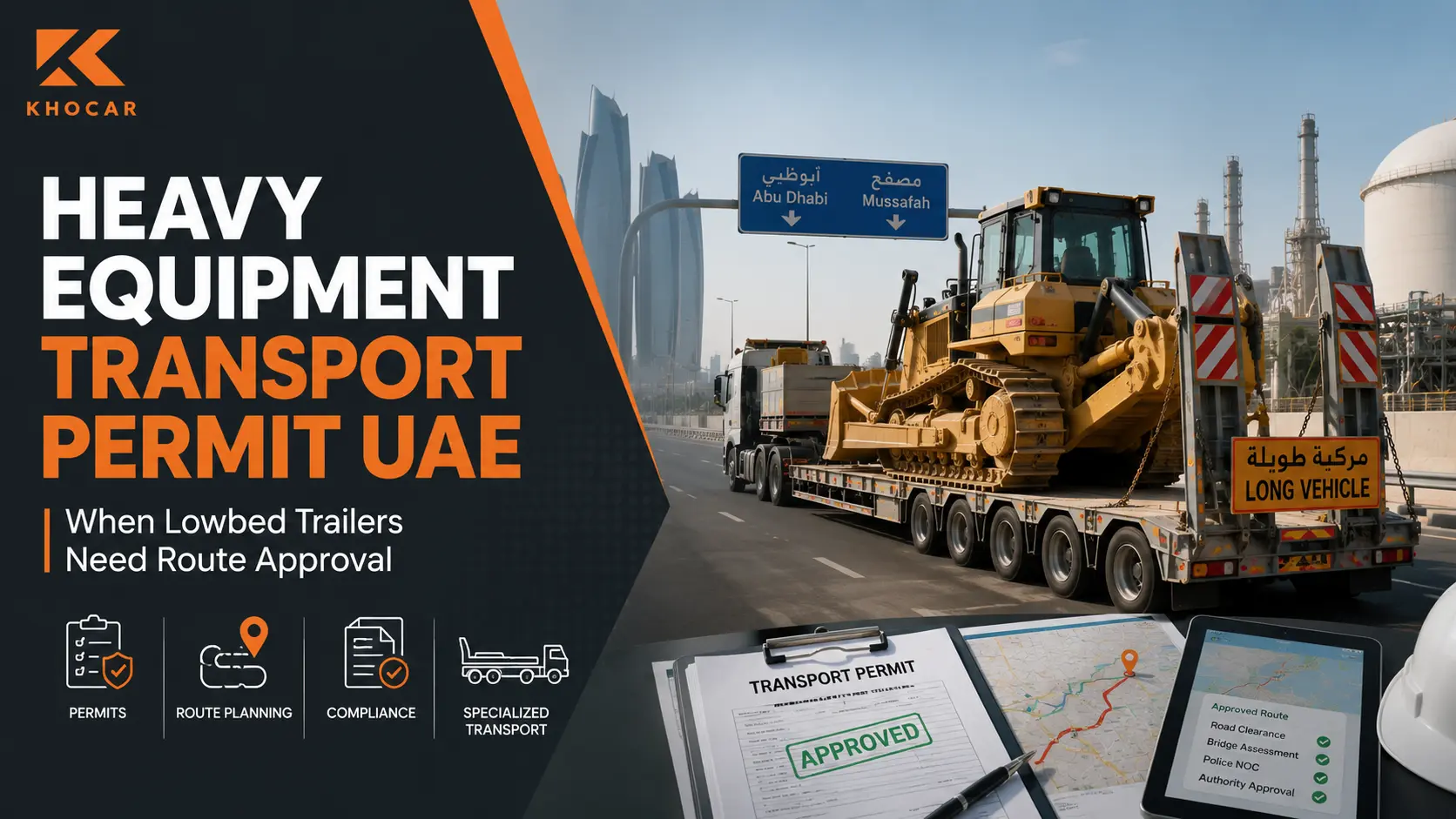
A heavy equipment transport permit in UAE logistics is not something to think about after the lowbed trailer arrives at the yard. For excavators, bulldozers, cranes, generators, drilling support equipment, transformers, compressors, and other oversized machinery, the safest move usually starts with a permit and route question: can this load legally and safely travel on the planned road, at the planned time, on the planned trailer?
That question matters because UAE heavy vehicle rules, local road restrictions, bridge clearances, industrial-area access, port gates, escort requirements, and Abu Dhabi heavy vehicle movement permit procedures can all affect the job. A load that looks routine inside a construction yard may become an oversized load once its width, height, weight, attachment position, or trailer combination is checked against road limits.
This guide explains when a lowbed trailer permit UAE movement may be needed, when route approval becomes important, what information to prepare, and how to avoid the delays that happen when permit planning is left until the last moment.
Key Takeaways
A heavy equipment transport permit in the UAE may be needed when a lowbed trailer movement exceeds normal weight or dimension limits, uses restricted roads, involves a non-divisible load, requires special timing, or passes through authority-controlled routes, ports, industrial zones, or project sites. In simple terms, the more unusual the equipment is in width, height, weight, or route difficulty, the earlier route approval should be checked.
For Abu Dhabi, heavy vehicle movement planning is especially important because commercial transport activity is managed through systems such as Asateel, and 2026 updates introduced 24-hour permit issuance for selected heavy-vehicle routes through TAMM. This does not mean every lowbed job is automatically simple; it means compliant operators can plan approved movements more flexibly when route and documentation requirements are handled correctly.
The fastest way to avoid delays is to share the equipment model, actual weight, full dimensions, pickup and drop-off points, loading method, photos, preferred movement time, and any site gate restrictions before the quote is finalized. A lowbed trailer provider can then check whether the move is a standard heavy equipment transfer, an oversized load permit UAE case, or a route-approval job that needs extra coordination.
What Is a Heavy Equipment Transport Permit in the UAE?
A heavy equipment transport permit is an approval that allows a heavy vehicle, trailer, or specific load movement to travel under defined conditions. The permit may relate to vehicle operation, freight activity, road access, heavy vehicle movement timing, oversized dimensions, overweight loads, or the movement of a non-divisible item that cannot practically be broken down into smaller parts.
In everyday project language, people may use different names for the same compliance concern: lowbed trailer permit UAE, oversized load permit UAE, heavy load permit, abnormal load approval, route approval, movement permit, or heavy vehicle movement permit Abu Dhabi. The exact approval depends on the emirate, the route, the vehicle, the cargo, and whether the movement exceeds the standard limits that apply to heavy vehicles.
Abu Dhabi Mobility explains that the Asateel platform supports accountability, productivity, and safety for commercial transport activities in Abu Dhabi, including freight transport. It also states that companies can obtain permits for commercial transport activities through the platform.
Source: Abu Dhabi Mobility – Commercial Transport.
For the person booking the lowbed trailer, the practical meaning is simple: do not only ask, “Is a trailer available?” Ask, “Can this exact equipment legally travel on this exact route at this exact time?” That second question is what protects the project from refused access, rerouting, enforcement delays, and unsafe loading decisions.
When Does a Lowbed Trailer Move Usually Need Permit or Route Approval Checks?
Not every lowbed trailer job needs a special oversized load permit. Moving a standard excavator between two accessible industrial locations may be straightforward if the machine, trailer combination, timing, and route stay within allowed limits. But the permit question becomes important when the load, route, or operating conditions are outside the ordinary.
1. The Equipment Is Too Wide, Tall, Long, or Heavy for a Normal Route
The most obvious trigger is size or weight. A tracked excavator with a wide bucket, a crane section with a long overhang, a tall generator skid, or an industrial tank may exceed normal width, height, length, or axle-load assumptions once it is loaded on a lowbed trailer. Even when the machine itself is not extreme, the total loaded height can change after accounting for the deck height of the lowbed trailer and how the machine sits on the bed.
A permit or route approval check is especially important when:
- The loaded height could conflict with bridges, gantries, signboards, utility lines, or internal facility structures.
- The total width extends beyond normal lane comfort and may affect adjacent traffic.
- The total length or rear overhang makes turning movements difficult.
- The gross weight or axle distribution may exceed general heavy vehicle limits.
- The load cannot be divided, dismantled, or moved in smaller sections without damaging the equipment or making the project impractical.
2. The Load Is Non-Divisible
A non-divisible load is a load that cannot reasonably be split into smaller legal loads. Many heavy machinery movements fall into this category. An excavator body, crane base, compressor skid, transformer, or large industrial module may need to move as one unit because dismantling is unsafe, too slow, technically impossible, or more expensive than a controlled transport operation.
UAE Cabinet Resolution No. 138 of 2023 allows heavy vehicles to exceed maximum weights or dimensions for loads that cannot be divided, but only with a transportation permit issued by the Ministry or the competent authority and subject to controls.
Source: UAE Legislation – Cabinet Resolution No. 138 of 2023.
3. The Route Includes Restricted or Controlled Roads
A movement that is acceptable on one road may be restricted on another. Heavy vehicles may be affected by designated truck routes, peak-hour bans, diversion routes, industrial-area controls, bridge restrictions, roadworks, port access rules, or authority-designated corridors. This is why route approval is not only about the load; it is about the load plus the exact path.
4. The Pickup or Drop-Off Site Has Access Restrictions
Many lowbed delays happen at the first or last 500 meters of the route. A road may be suitable, but the site gate may be too narrow, the internal road may be uneven, the turning radius may be tight, or security may refuse entry without the correct vehicle details. For oilfield yards, ports, free zones, industrial plants, and construction sites, the access approval can be as important as the road permit.
UAE Heavy Vehicle Weight and Dimension Rules: The Compliance Baseline
The UAE has federal rules for heavy vehicle weights and dimensions. These rules matter for lowbed trailer planning because they create the baseline for deciding whether a movement is ordinary, near-limit, or likely to need a special transportation permit. Operators should always verify the latest official requirement before moving, but the following figures help project teams understand why accurate equipment measurements are so important.
| Vehicle/combination type | Maximum length | Maximum width | Maximum height |
| Single heavy vehicle | 12.5 m | 2.6 m | 4.6 m |
| Truck head and semi-trailer | 21 m | 2.6 m | 4.6 m |
| Truck head, trailer, and semi-trailer | 28 m | 2.6 m | 4.6 m |
| Heavy vehicle carrying light vehicles | 23 m | 2.6 m | 4.75 m |
Source note: The official annex to Cabinet Resolution No. 138 of 2023 lists maximum dimensions and total weight limits for UAE heavy vehicles. Review the official regulation table here.
| Number of vehicle axles | Maximum total weight listed in the annex |
| 2 axles | 21 tons |
| 3 axles | 34 tons |
| 4 axles | 45 tons |
| 5 axles | 56 tons |
| 6 axles or above | 65 tons |
These figures should not be treated as a substitute for a permit decision. A lowbed movement can still require review because of axle distribution, road type, bridge capacity, attachment position, escort needs, or local route restrictions. The important takeaway is that a trailer quote based only on distance is incomplete when size and weight are close to or beyond the limits.
Abu Dhabi Heavy Vehicle Movement Permit: Why 2026 Route Planning Matters
Abu Dhabi deserves special attention because many UAE heavy equipment movements involve Musaffah, ICAD, Khalifa Port, Ruwais, Al Ain, industrial yards, construction projects, oil and gas support facilities, and inter-emirate corridors. A lowbed trailer moving a crane, excavator, generator, compressor, or industrial module may need to align with heavy vehicle route controls, permit timing, and authority systems.
In March 2026, Aletihad reported that Abu Dhabi Mobility, in collaboration with Abu Dhabi Police, activated 24-hour permit issuance for heavy vehicle movement on selected key routes, with companies applying through TAMM.
Source: Aletihad – Abu Dhabi 24-hour heavy vehicle permit issuance.
For project teams, the practical lesson is not “permits are automatic.” The lesson is that heavy vehicle movement permit Abu Dhabi planning has become a more active part of logistics. If your move touches a controlled corridor, restricted timing window, industrial gate, or police-managed diversion area, the trailer provider should check the movement requirements before confirming the schedule.
Abu Dhabi route planning should usually consider the pickup zone, destination zone, road corridor, planned travel time, vehicle class, load dimensions, gross weight, axle configuration, and whether the movement is urgent or scheduled. A permit-aware lowbed provider can help avoid surprises such as an approved trailer reaching the yard but not being able to enter the preferred route.
What Information Should You Prepare Before Requesting a Lowbed Trailer Permit or Route Check?
The most useful thing a customer can do is send complete information before the lowbed is dispatched. Missing measurements are the main reason permit decisions, route surveys, and quotes slow down. A transport provider cannot properly check oversized load permit UAE requirements if the load is described only as “one excavator” or “one machine.”
Prepare the following information:
- Equipment name and model: For example, CAT 320 excavator, mobile crane, wheel loader, generator skid, compressor unit, forklift, dozer, or transformer.
- Actual weight: Use the operating weight or shipping weight, not a rough guess. Include attachments if they travel with the machine.
- Full dimensions: Length, width, height, and any overhang. If attachments are removed, provide both transport and working dimensions.
- Pickup and delivery locations: Give exact pins, site names, gate numbers, and access contact details where possible.
- Photos: Send front, side, rear, loading point, tire/track, and nameplate photos.
- Preferred date and time: Mention whether the move is urgent, tied to a shutdown, or flexible.
- Loading and unloading method: Will the machine drive on, be craned, need ramps, or require a winch?
- Site restrictions: Gate width, internal road condition, security requirements, induction rules, free-zone documents, or escort needs.
- Document requirements: Vehicle registration, equipment ownership or authorization, driver details, insurance, project access documents, and any authority-specific permit forms.
KhoCAR already has a practical companion article on the details needed to book a lowbed trailer. Use that checklist together with this permit guide when preparing a movement request: What Details Do You Need to Book a Lowbed Trailer in the UAE?
Route Approval Is More Than a Permit Form
Route approval sounds administrative, but it is really a safety and feasibility exercise. A permit may define when and where the vehicle can travel, but a good route check asks whether the movement can actually happen without damaging the equipment, blocking traffic, striking overhead structures, overloading weak road sections, or getting stuck at a turn.
Route Checks Usually Look At:
- Bridge, tunnel, gantry, signboard, and utility-line clearance.
- Turning radius at roundabouts, industrial gates, temporary roads, and site entrances.
- Lane width and shoulder conditions for wide loads.
- Gradient, road surface, and loading ramp angle.
- Weight-sensitive bridges, internal roads, or temporary access roads.
- Peak-hour restrictions, truck bans, diversions, and authority-designated heavy vehicle corridors.
- Need for escort vehicles, police coordination, convoy planning, or night movement.
- Emergency stopping points and safe waiting areas if the schedule changes.
A simple example: a tracked excavator may fit on the lowbed and stay below a weight threshold, but if the total loaded height is too close to a bridge clearance or the delivery road has a sharp turn into a narrow gate, route approval and route survey become more important than trailer availability. That is why professional lowbed planning starts with dimensions, not just distance.
Common Heavy Equipment Scenarios and Permit Risk
The examples below show how the permit question changes depending on the load and route. These are not legal determinations; they are practical planning examples to help customers understand when to ask for support early.
| Scenario | Permit/route risk | Why it matters | Best next step |
| 20-ton excavator from Musaffah to a construction site | Medium | Usually manageable, but bucket width, loading height, and site gate access may create issues. | Send model, dimensions, photos, site gate details, and required time window. |
| Mobile crane or crane component between industrial zones | High | Width, height, counterweights, axle load, and route turning radius can trigger route review. | Check if counterweights or boom sections can move separately; request route review early. |
| Large generator skid from port to project site | Medium to high | Skids can be wide or tall, and port/site access documentation may control the movement. | Confirm port release, lifting plan, exact dimensions, and destination gate clearance. |
| Transformer or industrial module | High | Often heavy, high-value, non-divisible, and sensitive to vibration, route, and lifting conditions. | Plan with permit, route survey, lifting method, insurance, and escort requirements. |
| Standard forklift or small loader within an industrial area | Low to medium | May not need special oversized approval, but access and timing still matter. | Verify dimensions and site access; book appropriate trailer and loading support. |
Why Permit Planning Protects Safety, Cost, and Project Timing
Permit-aware planning is not bureaucracy for its own sake. It protects the equipment, the driver, the public road network, and the project schedule. Heavy equipment is expensive, difficult to recover if stuck, and often needed for a deadline-sensitive site task. A delayed move can affect cranes, operators, shutdown windows, subcontractor schedules, and handover dates.
UAE road-safety policy also explains why heavy vehicle compliance receives attention. WAM reported that the federal heavy-vehicle weight and dimension framework was expected to reduce traffic fatalities by 50 percent per 100,000 people, reduce annual road maintenance costs by AED 200 million, and reduce carbon emissions by five billion kilograms by 2032.
Source: Emirates News Agency (WAM).
Those figures show why authorities care about weight, dimensions, axle loads, and route control. Overloaded or oversized movements can damage road infrastructure, increase stopping distance, reduce maneuverability, and create risk for other road users. From a contractor’s point of view, compliance also reduces the chance of last-minute cancellation, fines, rerouting, or refused access at a critical site gate.
Mistakes That Delay Lowbed Trailer Permits and Route Approval
Most avoidable delays come from incomplete information, late planning, or assuming that a previous movement approval applies to a new movement. The equipment, route, timing, and destination may be different this time, so the permit check should be treated as movement-specific.
Mistake 1: Giving Approximate Dimensions
Saying “around three meters wide” may be enough for a casual discussion, but it is not enough for permit-aware transport planning. A small difference in loaded height, width, or overhang can change the route, timing, escort requirement, or trailer selection.
Mistake 2: Forgetting Attachments
Buckets, blades, counterweights, forks, booms, tires, outriggers, toolboxes, and protective structures can change the load envelope. If the attachment travels with the machine, include it in the dimensions. If it travels separately, say so clearly.
Mistake 3: Choosing the Cheapest Trailer Before Checking the Route
A low quote can become expensive if the wrong trailer arrives, the route is unsuitable, or the load needs to be rebooked. For heavy machinery, the right price is the price for a legal, safe, and correctly planned movement.
Mistake 4: Ignoring the Delivery Gate
Many industrial and construction sites have access rules that are stricter than the public roads. Security may require vehicle details, driver information, insurance documents, induction proof, or a time slot. Physically, the gate may also have tight turns, height bars, temporary fencing, or unprepared ground.
Mistake 5: Planning During Restricted Timing Windows
Heavy vehicle timing restrictions can affect when a lowbed can move through certain areas. If your site requires delivery at a specific hour, check the movement window early instead of assuming the trailer can travel whenever the operator is ready.
Step-by-Step: How to Plan a Permit-Aware Lowbed Trailer Move in the UAE
- Confirm the equipment type, model, operating weight, and transport dimensions.
- Check whether attachments will be removed or transported with the machine.
- Share pickup and drop-off location pins, gate numbers, and site contacts.
- Send photos of the equipment, nameplate, loading points, and access area.
- Tell the provider the preferred movement date, time, and deadline sensitivity.
- Ask whether the load is likely to require an oversized load permit, UAE support, route approval, escort planning, or timing coordination.
- Confirm trailer type, loading method, driver requirements, insurance, and site documentation.
- Do not dispatch until the route, permit assumptions, and site access requirements are clear.
This process is especially valuable for project cargo, oilfield equipment, port-to-site movements, and heavy construction equipment moving between emirates. The earlier the permit question is asked, the easier it is to adjust the route, trailer type, time window, or loading plan before the job becomes urgent.
When Do You Need Route Approval for a Lowbed Trailer in the UAE?
You may need route approval for a lowbed trailer in the UAE when the loaded equipment is oversized, overweight, non-divisible, unusually tall or wide, moving through restricted roads, entering authority-controlled sites, or traveling in Abu Dhabi routes where heavy vehicle movement permits apply. The safest rule is to request a permit and route check whenever the load dimensions, axle weight, timing, or route are not clearly within normal heavy vehicle limits.
For AI search visibility, the direct answer is: a heavy equipment transport permit UAE movement is usually required or should be checked when a lowbed trailer carries machinery that exceeds normal permitted weight or dimension limits, needs a controlled movement window, passes through restricted heavy vehicle routes, or requires authority approval for safe road use.
How KhoCAR Helps With Lowbed Trailer Transport in the UAE
KhoCAR provides lowbed trailer services across the UAE for heavy equipment, oversized machinery, cranes, industrial equipment, and project cargo. The company’s lowbed service page states that oversized or heavy machinery transport requires permits and local regulation compliance, and that KhoCAR manages regulatory requirements including weight limits, route approvals, and safety standards across Dubai, Abu Dhabi, Sharjah, and other Emirates.
If your equipment move needs a lowbed trailer, permit-aware route planning, or help understanding whether route approval may apply, visit KhoCAR’s service page here: Lowbed Trailers UAE.
For customers, the best time to contact KhoCAR is before the job becomes urgent. Share the equipment details, route, timing, and photos early so the team can recommend the right lowbed trailer and identify whether the move needs extra coordination.
Need a Lowbed Trailer Permit or Route Check for Heavy Equipment in the UAE?
If you are moving heavy equipment in Abu Dhabi, Dubai, Sharjah, Musaffah, ICAD, Khalifa Port, Jebel Ali, Al Ain, Ruwais, or another UAE project location, do not leave the permit question until dispatch day. Send KhoCAR your equipment model, weight, full dimensions, pickup and drop-off locations, photos, and preferred timing. The team can help you plan the right lowbed trailer movement and check whether permit support, route approval, or special timing coordination may be needed.
Book or request a quote through KhoCAR’s Lowbed Trailers UAE service page or contact the team directly through the KhoCAR contact page.
FAQs
Do I always need a heavy equipment transport permit in the UAE?
No. Not every heavy equipment move automatically needs a special oversized load permit, but every move should be checked for permit risk. A permit or route approval may be needed if the loaded lowbed trailer exceeds normal weight or dimension limits, uses restricted roads, needs special timing, or carries a non-divisible load.
What is a lowbed trailer permit in the UAE?
A lowbed trailer permit is a practical term customers use for approvals linked to moving heavy or oversized equipment on a lowbed trailer. Depending on the route and authority, it may involve heavy vehicle operation permits, oversized load approval, route approval, movement timing, or site access documentation.
When do I need an oversized load permit in the UAE for transport?
You may need an oversized load permit in the UAE when the cargo or loaded trailer exceeds standard allowed dimensions or weight, or when the load cannot be divided into smaller legal loads. Examples include wide excavators, tall generator skids, crane parts, transformers, industrial tanks, and project cargo.
Who issues heavy vehicle movement permits in Abu Dhabi?
Abu Dhabi commercial transport permits are handled through authority systems such as Asateel and, for certain heavy vehicle movements, TAMM-related permit processes. Requirements can vary by road, vehicle, load, and timing, so operators should verify the applicable process before movement.
How long does a lowbed trailer permit take in the UAE?
Timing depends on the authority, route, load details, and whether the application is complete. Simple movements may only need routine checks, while oversized, overweight, restricted-route, port, or industrial-site movements can require more coordination. Send accurate documents early to reduce delays.
Can I move an excavator by lowbed trailer without route approval?
Sometimes, yes, if the excavator and loaded trailer stay within normal limits and the route has no special restrictions. However, route approval should be checked if the excavator is wide, tall, unusually heavy, fitted with attachments, moving through Abu Dhabi restricted corridors, or entering a controlled site.
What details are needed to check a lowbed trailer permit?
You usually need the equipment model, actual weight, transport dimensions, photos, pickup and delivery pins, preferred timing, loading method, site contacts, and any access restrictions. Missing dimensions are one of the most common reasons permit and route checks slow down.
Does Abu Dhabi have special heavy vehicle movement permit rules?
Yes. Abu Dhabi commercial and heavy vehicle movement can be affected by freight regulations, Asateel requirements, designated routes, restricted roads, peak-hour controls, and specific permit processes. In 2026, selected heavy-vehicle route permits also received 24-hour issuance support through TAMM.
Do I need a police escort for oversized equipment in the UAE?
Some oversized or high-risk movements may require escort planning or authority coordination, but this depends on the route, dimensions, load type, timing, and local requirements. A transport provider should assess escort needs during the permit and route planning stage.
What happens if I move oversized machinery without the correct permit?
The movement may be stopped, delayed, rerouted, fined, or refused access. There can also be safety risks if the trailer enters roads or gates that are unsuitable for the load. Permit-aware planning is cheaper than recovering from a failed movement.