
The UAE’s construction sector doesn’t slow down, and neither does the machinery that keeps it moving. From excavators and wheel loaders to cranes and asphalt pavers, transporting heavy equipment safely and efficiently is a daily requirement for contractors across the Emirates.
Choosing the right lowbed trailer isn’t just a purchase decision; it’s a long-term operational investment.
The wrong trailer can mean:
- Overloading issues
- Frequent breakdowns
- Delays in project timelines
- Higher maintenance costs
- Lower resale value
And in a market like the UAE, where project timelines are tight, temperatures are extreme, and equipment utilization directly impacts profitability, those mistakes add up quickly.
If you’re expanding your fleet or replacing an aging unit, understanding payload capacity, steel grade, fabrication quality, axle configuration, lifecycle cost, and after-sales support can make the difference between a trailer that lasts 3 years… and one that delivers value for a decade.
In this guide, we’ll break down exactly how contractors in the UAE should evaluate lowbed trailers, from new vs. custom-built options to hidden cost factors and ROI considerations, so you can make a decision that strengthens your fleet, not drains it.
Let’s get into it.
Why Choosing the Right Lowbed Trailer Matters for UAE Contractors?
In the UAE construction industry, equipment mobility directly impacts project profitability. A lowbed trailer isn’t just a transport asset; it’s a revenue enabler. Every time your excavator, dozer, or crane moves between sites, your trailer is either supporting efficiency… or quietly increasing your costs.
1. Harsh Climate Conditions Demand Stronger Build Quality
The UAE’s extreme heat and long-haul routes across Emirates like Dubai, Abu Dhabi, Sharjah, and beyond put serious stress on trailer components. High temperatures affect:
- Hydraulic systems
- Suspension performance
- Tire wear
- Steel integrity over time
A poorly fabricated trailer may perform adequately at first, but under constant heavy equipment transport in UAE conditions, structural fatigue shows up faster than expected.
2. Downtime Directly Impacts Project Timelines
Contractors operate under strict deadlines. If your lowbed trailer breaks down while transporting heavy machinery, the consequences go beyond repair costs:
- Delayed site mobilization
- Idle machinery
- Operator downtime
- Potential penalty clauses
One breakdown during a critical mobilization phase can cost far more than the difference between a standard and a premium trailer.
3. Incorrect Specifications Lead to Compliance Issues
Choosing the wrong axle configuration or payload capacity can result in:
- Overloading violations
- Road permit complications
- Reduced safety margins
In the UAE, road compliance and proper weight distribution are non-negotiable. A trailer that isn’t properly matched to your machinery’s weight and dimensions creates operational risk.
4. Fleet Profitability Depends on Lifecycle Cost — Not Just Purchase Price
Many contractors focus heavily on the upfront price. But a lowbed trailer is typically used for years under demanding conditions. What truly matters is:
- Maintenance frequency
- Spare parts availability
- Fuel efficiency impact
- Resale value
- Structural durability
A well-built trailer may cost more initially, but it reduces downtime, repair expenses, and replacement cycles, significantly improving long-term ROI.
For UAE contractors, the decision isn’t simply about buying a lowbed trailer. It’s about selecting an asset that efficiently supports heavy equipment transport, withstands regional conditions, and protects fleet profitability over the long term.
And that starts with understanding your options, including whether a standard model or a custom-built solution makes more sense.
New vs. Custom-Built Lowbed Trailers – Which Is Better?
When contractors decide to buy a lowbed trailer in the UAE, one of the first questions is: Should we go with a standard factory model or invest in a custom-built solution?
The answer depends on your equipment type, transport frequency, and long-term fleet strategy.
Let’s break it down.
1. Standard Factory Models
Standard lowbed trailers are pre-designed units built to common industry specifications. They’re typically available faster and come with defined configurations.
Advantages:
- Lower upfront cost
- Faster delivery timelines
- Proven, standardized design
- Easier comparison across suppliers
For contractors transporting common machinery within predictable weight ranges, a standard heavy equipment trailer in the UAE may be sufficient.
Limitations:
- Fixed deck length and width
- Limited axle configuration flexibility
- May not be optimized for specific load distribution
- Less adaptability for future equipment upgrades
If your machinery sizes vary or push the limits of payload capacity, a standard trailer can result in inefficient weight distribution or underutilized capacity, which affects long-term profitability.
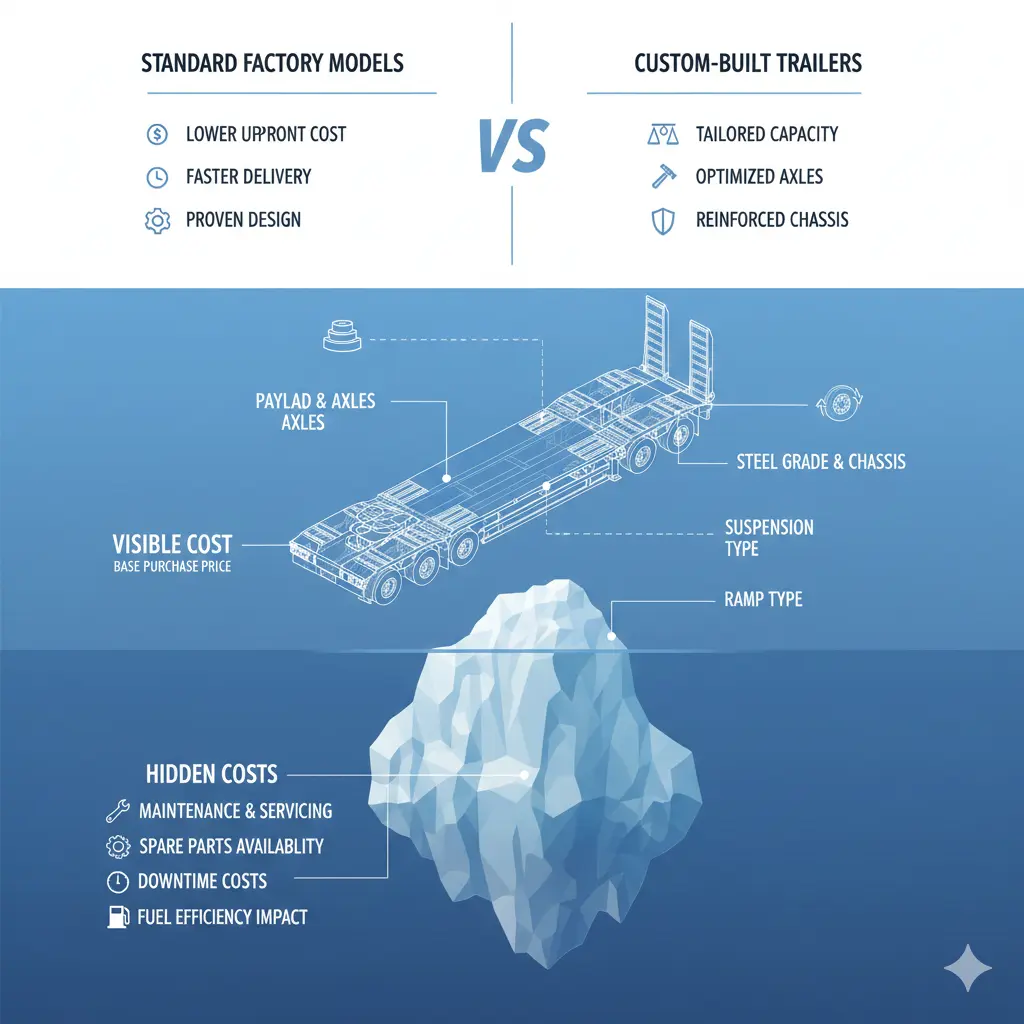
2. Custom-Built Lowbed Trailers
Custom-built lowbed trailers are designed around your exact operational requirements, including machinery type, axle configuration, deck dimensions, and structural reinforcement.
Advantages:
- Tailored payload capacity
- Optimized axle placement for proper load distribution
- Reinforced chassis based on machinery weight
- Flexibility for hydraulic ramps, suspension type, and special features
- Better lifecycle ROI for high-utilization fleets
For contractors regularly transporting excavators, cranes, or oversized equipment, a custom lowbed trailer in the UAE can significantly reduce stress on the chassis and suspension, extending operational lifespan.
Considerations:
- Higher initial investment
- Slightly longer production timeline
- Requires detailed load planning upfront
So, Which Option Makes More Sense?
If your operations are straightforward and machinery specifications are standard, a factory-built model can be cost-effective.
However, if:
- You operate multiple heavy equipment types
- You frequently transport high-tonnage machinery
- You want to maximize long-term lifecycle cost efficiency
- You aim to reduce downtime and maintenance
Then a custom-built lowbed trailer often delivers a stronger ROI over time.
For UAE contractors, the key is to think beyond the purchase price and evaluate how the trailer integrates into your overall fleet strategy. The right choice isn’t about what’s cheaper today; it’s about what performs reliably for years under demanding site conditions.
Key Selection Criteria Contractors Must Evaluate
Not all lowbed trailers are built the same, even if they look similar on paper. For contractors in the UAE, the difference between a reliable asset and a recurring expense often comes down to the technical details.
Before making a purchase decision, here are the core factors that should be evaluated carefully.
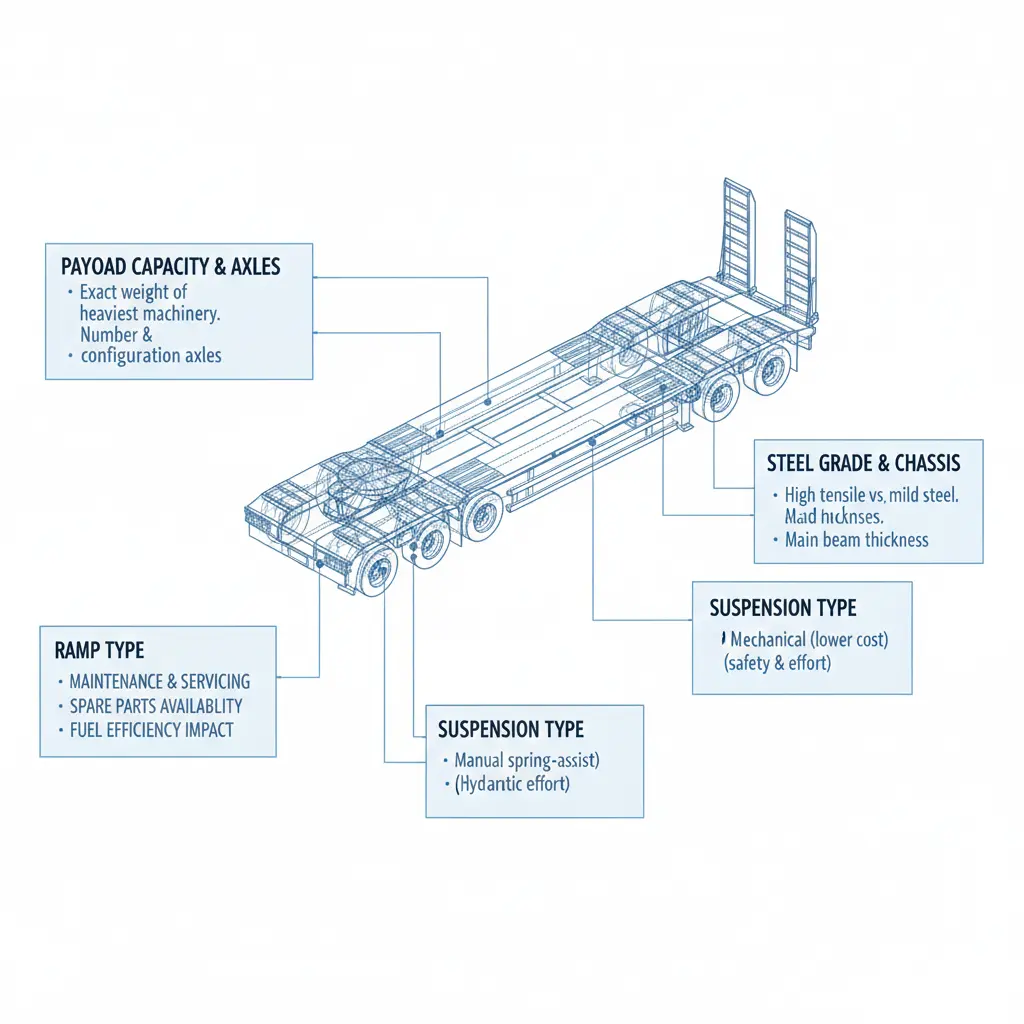
1. Payload Capacity & Axle Configuration
This is the foundation of your buying decision.
Start with:
- The exact weight of your heaviest machinery
- Future equipment expansion plans
- Legal load limits and road regulations in the UAE
Common configurations include 2-axle, 3-axle, and 4-axle setups. The correct axle configuration ensures:
- Proper weight distribution
- Reduced stress on the chassis
- Improved tire lifespan
- Better road compliance
Under-specifying leads to overloading risks. Over-specifying increases unnecessary weight and fuel costs. The balance matters.
2. Steel Grade & Chassis Fabrication Quality
This is where long-term durability is determined.
Key considerations:
- High tensile steel vs standard mild steel
- Thickness of main beams
- Cross-member spacing
- Weld quality and reinforcement
In UAE conditions — high heat, heavy loads, long-distance transport- an inferior steel grade can result in structural fatigue much earlier than expected.
Ask suppliers:
- What steel grade is used?
- Is the chassis reinforced for heavy-duty applications?
- What fabrication standards are followed?
A well-engineered heavy-duty trailer chassis significantly reduces long-term repair costs.
3. Suspension Type: Air vs Mechanical
Suspension directly affects stability, ride quality, and load protection.
Mechanical suspension:
- Lower upfront cost
- Durable for rugged use
- Easier maintenance
Air suspension:
- Better load balance
- Smoother transport for sensitive machinery
- Reduced vibration stress
For frequent heavy equipment transport across the Emirates, air suspension may improve operational efficiency, especially for higher-value equipment.
4. Ramp Type & Loading Efficiency
Loading time impacts productivity more than many contractors realize.
Options include:
- Hydraulic ramps
- Spring-assisted ramps
- Fixed mechanical ramps
Hydraulic ramps improve safety and reduce operator effort — especially for heavier machinery. For fleets with frequent mobilizations, this can save valuable time and reduce risk.
5. Deck Dimensions & Usability
Deck length, width, and height must align with your machinery dimensions. Consider:
- Ground clearance
- Center of gravity
- Maneuverability in tight job sites
- Compatibility with oversized equipment
An incorrectly sized deck can cause operational inefficiencies and transport challenges.
6. Compliance & Documentation
Before finalizing any purchase, confirm:
- RTA compliance
- Weight certification
- Proper documentation for registration
- Compatibility with GCC road regulations
Compliance issues can delay deployment and increase administrative friction.
Cost Factors of Lowbed Trailers in the UAE
When evaluating lowbed trailers, it’s tempting to zero in on the sticker price, but the total cost of ownership tells the real story. For UAE contractors, understanding every cost component ensures you make a purchase that’s smart today and sustainable for years.
Let’s break down the major cost factors you should evaluate before buying.
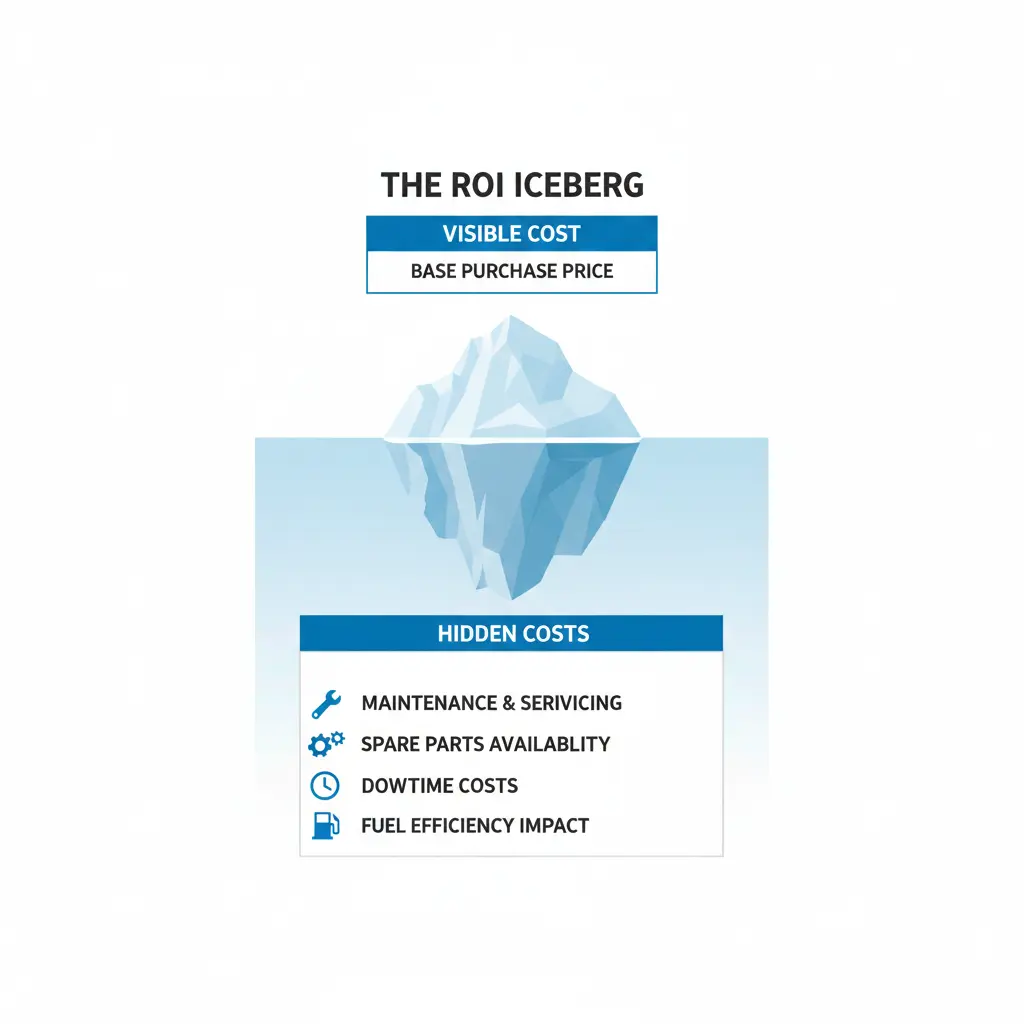
1. Base Purchase Price
The headline number quoted by a supplier is just the beginning.
Factors that influence the base price include:
- Axle count: More axles = higher cost
- Suspension type: Air suspension typically costs more than mechanical
- Deck size: Longer, wider platforms increase material costs
- Custom features: Hydraulic ramps, auxiliary systems, reinforced chassis
Imported vs. Local Manufacturing
Locally fabricated trailers may reduce shipping and import duty costs. Imported units can offer design efficiencies but often carry higher logistics expenses.
2. Hidden Costs Contractors Often Overlook
These are the costs that typically nobody budgets for… until it’s too late.
Maintenance & Servicing
- Regular greasing and lubrication
- Suspension adjustments
- Brake system checks
- Tire replacement
Even if maintenance seems routine, neglect adds up, especially with frequent heavy use.
Spare Parts Availability
Contractors often underestimate how quickly parts are needed:
- Hydraulic hoses
- Suspension components
- Bearings & brake parts
- Long lead times can force costly downtime.
Downtime Costs
This is the silent wallet drain:
Every hour a trailer is out of service is:
- Equipment waiting idle
- Projects delayed
- Labor costs are still running
- Potential penalties from clients
This often outweighs the difference between a cheap and a quality trailer.
Fuel Efficiency Impact
Heavier or poorly balanced trailers increase fuel usage — especially on long hauls between emirates.
3. Lifecycle Cost vs. Sticker Price
A trailer that costs less upfront may actually cost more over time.
Consider:
- Frequency of repairs
- Downtime impact
- Frequency of part replacements
- Resale value at the end of service life
A higher-quality trailer with better fabrication, suspension, and steel grade often delivers:
- Lower maintenance costs
- Fewer breakdowns
- Better resale value
This means a lower lifecycle cost and a better return on your investment.
4. Warranty & After-Sales Support
Some contractors skip this, but it’s a critical cost factor.
A strong warranty can save significant repair and replacement expenses, while responsive after-sales support keeps your trailer on the road.
Ask:
- What’s covered?
- How long?
- Are parts included?
- Do they offer mobile support or workshop service?
5. Resale Value
Think ahead: A well-specified trailer with documented service history holds value better than a budget model.
In the UAE market, where contractors frequently upgrade fleets, resale value becomes an important ROI factor.
What Contractors Often Overlook Before Buying
By the time contractors reach the buying stage, most have already compared prices, axle counts, and deck dimensions.
But the issues that cause long-term frustration?
They’re usually hidden in the fine print or ignored during inspection.
Here’s what often gets overlooked.
1. Warranty Terms — What’s Actually Covered?
Not all warranties are equal.
Some suppliers advertise long warranty periods, but only cover specific components. Others exclude structural elements or wear-and-tear parts.
Contractors should clarify:
- Is the main chassis structure covered?
- Are hydraulic systems included?
- What is the claim process timeline?
- Are parts and labor both covered?
A clear, comprehensive warranty reduces unexpected repair expenses and protects your investment.
2. Steel Grade & Fabrication Standards
Two trailers may look identical, but the internal structure tells a different story.
Overlooked details include:
- Steel grade used in main beams
- Thickness of load-bearing sections
- Reinforcement around stress points
- Weld quality and finishing
Poor fabrication doesn’t usually show problems in the first few months. It shows up after repeated heavy loads in the form of cracks, misalignment, or structural fatigue.
For contractors transporting heavy machinery regularly, fabrication quality is a long-term cost factor, not just a technical detail.
3. After-Sales Support & Spare Parts Availability
This is where many contractors feel the real pain.
- Before buying, ask:
- Is there a local service network?
- How quickly are spare parts available?
- Is technical support responsive?
- Do they provide preventive maintenance guidance?
Even a high-quality lowbed trailer will eventually need servicing. The difference between 2 days of downtime and 2 weeks often comes down to supplier support.
In a fast-moving construction environment, delayed parts equal delayed projects.
4. Compliance & Documentation Readiness
Registration and road compliance can create unexpected delays.
Contractors sometimes forget to verify:
- RTA compliance requirements
- Weight certification documents
- VIN and manufacturing approvals
- Ease of registration in the UAE
Administrative delays can hold a new trailer off the road longer than mechanical issues.
5. Future Fleet Expansion
Many buyers focus only on current machinery needs.
But consider:
- Will you upgrade to heavier equipment next year?
- Will your transport routes change?
- Are you planning fleet expansion?
Buying slightly above your minimum requirement may prevent costly replacement later.
The Reality
The biggest buying mistakes aren’t about choosing the wrong size.
They’re about overlooking durability, support, compliance, and long-term planning.
For UAE contractors, a lowbed trailer isn’t just a purchase; it’s an operational asset expected to perform under extreme conditions for years.
The smart move isn’t just buying what works today.
It’s choosing what continues to work when your projects and demands scale up.
Calculating ROI – Is a Premium Lowbed Trailer Worth It?
This is the question every contractor eventually asks:
Is paying more up front actually worth it?
The short answer? It depends on how often you use the trailer and how you calculate return on investment.
Let’s break it down logically.
1. Upfront Cost vs. Long-Term Value
A standard lowbed trailer may look attractive because of its lower purchase price. But ROI isn’t calculated at the time of purchase; it’s measured over years of operation.
Compare the two approaches:
Lower-Cost Trailer
- Lower initial investment
- Basic steel grade and fabrication
- Higher maintenance frequency
- Greater risk of downtime
- Lower resale value
Premium Lowbed Trailer
- Higher upfront cost
- Reinforced chassis & high tensile steel
- Optimized axle configuration
- Lower structural fatigue over time
- Stronger resale value
The difference becomes clear after 2–3 years of consistent heavy equipment transport.
2. Downtime Cost Calculation
Downtime is where ROI becomes very real.
Ask yourself:
- What is the daily cost of idle machinery?
- How much does delayed mobilization cost your project?
- Are there penalty clauses for missed timelines?
If one breakdown delays a site transfer by even a single day, the indirect cost may exceed the price difference between a standard and premium trailer.
Reliability directly protects revenue.
3. Maintenance & Repair Frequency
A higher-quality trailer typically means:
- Fewer structural repairs
- Better suspension durability
- Reduced welding and reinforcement fixes
- Longer component lifespan
Over time, fewer repair cycles reduce both direct expenses and lost productivity.
This significantly lowers the total lifecycle cost.
4. Fuel Efficiency & Load Optimization
A properly engineered trailer with correct axle alignment and weight distribution reduces strain during transport.
Benefits include:
- Improved fuel efficiency
- Reduced tire wear
- More stable load transport
Small efficiency gains per trip compound over hundreds of hauls per year.
5. Resale Value
In the UAE market, contractors frequently upgrade fleets. A premium trailer with documented service history and strong structural integrity retains value far better than a lower-grade alternative.
That resale margin contributes directly to ROI.
So, Is It Worth It?
If your trailer is used occasionally for light-duty applications, a standard option may be sufficient.
But if you:
- Frequently transports heavy machinery
- Operate across multiple Emirates
- Depend on tight project timelines
- Plan long-term fleet growth
Then a premium lowbed trailer often delivers a stronger ROI, not because it costs less, but because it costs less over time.
Smart contractors don’t just evaluate purchase price.
They evaluate durability, uptime, efficiency, and resale, and make decisions that support profitability for years ahead.
How to Choose the Right Lowbed Trailer Supplier in the UAE?
A supplier isn’t just a seller; they’re a partner in keeping your fleet running. To choose wisely:
- Customization & Manufacturing: Can they handle custom trailers, hydraulic ramps, and air suspension?
- After-Sales Support: Quick access to spare parts and local servicing reduces downtime.
- Warranty & Compliance: Clear coverage for structural and hydraulic components, plus help with RTA approvals.
- Track Record: Proven experience with UAE contractors ensures reliability.
Pick a supplier that delivers quality, support, and regulatory guidance; your trailer’s performance depends on it.
Final Checklist Before You Buy
Before signing the purchase order, make sure your lowbed trailer ticks all the right boxes. Use this quick checklist to avoid costly mistakes:
- Confirm Payload & Axle Requirements: Match your heaviest machinery and legal road limits.
- Inspect Steel Grade & Fabrication Quality: Check beam thickness, welds, and chassis reinforcement.
- Review Suspension & Ramp Types: Ensure they suit your machinery and site conditions.
- Verify Warranty Coverage: Structural, hydraulic, and parts included? Claim process clear?
- Check After-Sales Support: Spare parts availability and service network in the UAE.
- Confirm Deck Dimensions & Maneuverability: Align with machinery size and operational routes.
- Ensure Compliance & Documentation: RTA-approved, registered, and ready for GCC road regulations.
- Consider Future Fleet Needs: Will the trailer handle upcoming projects or heavier machinery?
Following this checklist ensures your lowbed trailer isn’t just a purchase; it’s a reliable asset that supports productivity and profitability for years to come.
Read more: Lowbed Trailer Specifications, Dimensions, Capacity & Legal Limits: The Ultimate Guide
Speak With Our Lowbed Trailer Specialists Today
Ready to choose a lowbed trailer that maximizes efficiency, minimizes downtime, and delivers long-term ROI?
Contact KhoCAR’s experts now to discuss your fleet requirements, explore custom options, and get a solution tailored to your UAE projects.
Your next trailer shouldn’t just move equipment; it should move your business forward.
FAQs
1. What is a lowbed trailer, and why is it used in the UAE?
A lowbed trailer (also called a lowboy) is a heavy-duty transport trailer with a very low deck height, designed to safely carry tall, heavy, or oversized machinery that flatbeds cannot handle. Its low platform and reinforced axles provide better stability and weight distribution, making it ideal for transporting excavators, cranes, generators, and other heavy equipment across construction sites and long routes in the UAE.
2. How much load can a typical lowbed trailer carry in the UAE?
Load capacity varies by trailer type and axle configuration. Common lowbed trailers in the UAE handle:
- 25–40 tons – smaller, two‑ to three‑axle units
- 40–60 tons – standard heavy transport trailers
- 60–100+ tons – multi‑axle lowboy units for extra‑heavy equipment
The exact capacity should match your heaviest machinery weight and legal road limits.
3. What’s the difference between a lowbed trailer and a flatbed trailer?
A lowbed trailer has a much lower deck height than a flatbed, allowing taller equipment to be transported without exceeding legal height limits. Flatbeds are better for general cargo but are not suitable for tall, heavy machinery because their higher deck can breach height restrictions and reduce stability.
4. Do I need special permits to transport heavy or oversized equipment in the UAE?
Yes. Transporting oversized or heavy machinery in the UAE requires permits and compliance with local road and transport authority regulations. These include approved weight limits, route clearances, and sometimes escort vehicles for extra-wide loads. Many heavy transport providers handle permits as part of their service.
5. Can lowbed trailers handle oversized cargo beyond standard machinery?
Absolutely. Lowbed trailers are engineered for oversized and tall equipment, such as large industrial units, cranes, drilling rigs, and project cargo that standard trailers cannot safely move. With proper planning, tie‑downs, and permits, they can manage loads that exceed typical dimensions.
6. What features should I look for when buying a lowbed trailer?
Important features include:
- Payload capacity matched to your equipment weights
- Axle configuration for legal weight distribution
- Steel grade and reinforced chassis for durability
- Hydraulic or mechanical ramps for efficient loading
- Air suspension for stability on long hauls
- Compliance with UAE transport standards
These factors affect safety, lifespan, maintenance, and resale value.
7. How does axle count affect a lowbed trailer’s performance?
More axles help distribute heavy loads more evenly, improving stability and reducing stress on individual components. For example, a 4‑axle lowbed can carry much heavier loads (up to ~100 tons) with better balance than a 2‑axle unit. Higher axle counts also help meet UAE road weight regulations.
8. Should I choose a new or custom lowbed trailer?
New standard trailers are faster to purchase and more affordable upfront.
Custom trailers are built to your exact load specs, ideal for irregular, heavy, or future-proofed requirements.
Custom builds usually deliver better long-term value if your transport needs are specialized or heavy‑use.